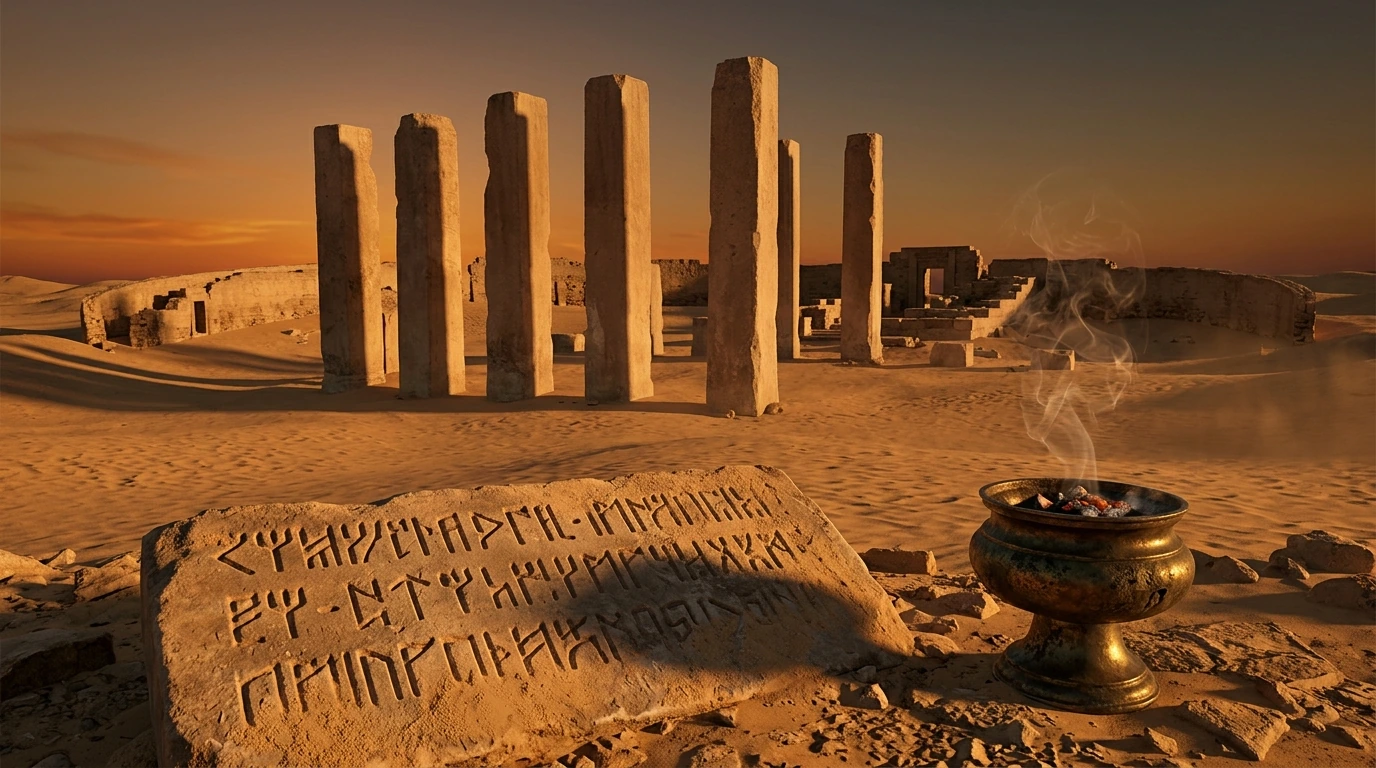
Subject Scope: Archaeological Atlas of Ancient Corinth and the Bema of Gallio: The Delphi Inscription, Roman Agora, and Apostolic Chronology (Acts 18)
Historical Context: Ancient Near Eastern stratigraphy, Levant archaeological surveys, and Semitic epigraphy.
Primary Evidence: Monumental stelae, bullae seals, ceramic typology, and calibrated AMS radiocarbon determinations.
Investigation Highlights: The Isthmian Crossroads: Topography and Commerce of Corinth • The Bema of Corinth: The Roman Judicial Rostrum • The 1905 Delphi Inscription: Fixing the Dates of Gallio
Scholarly Consensus: Aligned with published excavation reports from leading Near Eastern archaeological institutes.
The Isthmian Crossroads: Topography and Commerce of Corinth
Situated on the narrow, four-mile-wide neck of land connecting mainland Greece with the Peloponnesian peninsula, ancient Corinth (Greek: Κόρινθος, Korinthos) commanded the wealthiest, most strategic maritime transit hub in the Mediterranean. Bordered by the Gulf of Corinth on the west (opening to the Ionian Sea and Italy) and the Saronic Gulf on the east (opening to the Aegean Sea and Asia Minor), Corinth operated two distinct international seaports:
- Lechaion (West): The deep-water harbor receiving merchant grain ships and transport galleys from Rome, Italy, and Sicily.
- Kenchreai (East): The eastern harbor receiving commercial cargo from Ephesus, Alexandria, Antioch, and the Levant (Acts 18:18; Romans 16:1).
To avoid the notoriously perilous, storm-swept 250-mile sea voyage around the rocky southern capes of the Peloponnese (Cape Malea), merchant vessels unloaded their cargo at one port, transported the goods overland along a paved stone roadway known as the Diolkos, and reloaded them onto ships on the opposite gulf. Smaller warships and light cargo craft were literally hauled across the isthmus on wheeled wooden cradles.
Rebuilt in 44 BC as a Roman colony (Colonia Laus Iulia Corinthiensis) by Julius Caesar following its destruction a century earlier, Roman Corinth was the proud capital of the senatorial province of Achaea. With an estimated population of 100,000 to 200,000 citizens, freedmen, merchants, and slaves, Corinth was a bustling, hedonistic commercial melting pot renowned for the biennial Isthmian Games, its thriving bronze metallurgical workshops, and its notorious temple cultures.
When the Apostle Paul arrived in Corinth around 50 AD, he entered the undisputed economic dynamo of southern Greece, residing and laboring there for eighteen continuous months (Acts 18:11) as a tentmaker alongside Priscilla and Aquila.
+----------------------------------------------------------------------------------------------------+
|               THE GEOGRAPHICAL TRIANGLE OF ANCIENT CORINTH (1ST CENTURY AD)                        |
+--------------------------+-----------------------+-------------------+-----------------------------+
| SITE / HARBOR            | GEOGRAPHICAL LOCALE   | COMMERCIAL ROLE   | NEW TESTAMENT SIGNIFICANCE  |
+--------------------------+-----------------------+-------------------+-----------------------------+
| 1. Central City Acropolis| Foot of Acrocorinth   | Provincial Capital| Roman Forum, Bema, Synagogue|
| 2. Lechaion Harbor       | Gulf of Corinth (West)| Italian Trade     | Gateway to Rome & the West  |
| 3. Kenchreai Harbor      | Saronic Gulf (East)   | Aegean Trade      | Phoebe the Deaconess (Rom 16)|
| 4. The Diolkos Track     | Across the Isthmus    | Overland Haulway  | Isthmian Games (1 Cor 9:24) |
+--------------------------+-----------------------+-------------------+-----------------------------+
The Bema of Corinth: The Roman Judicial Rostrum
In the center of the sprawling Roman Forum (Agora), dividing the Upper and Lower Terraces, stands one of the most magnificent public judicial monuments of the classical world: the Bema of Corinth (Greek: βῆμα, meaning "Judicial Seat", "Tribunal", or "Platform").
Excavated by the American School of Classical Studies at Athens (ASCSA), which has systematically excavated ancient Corinth since 1896:
- Architecture: The Bema is a monumental, elevated speaker's platform constructed of glistening white and blue Poros limestone and fine marble, rising approximately 8 feet above the pavement of the lower forum, flanked by two waiting rooms with mosaic floors and marble benches.
- Civic Function: From atop this platform, the Roman proconsul sat upon his official ivory curule chair (sella curulis), surrounded by lictors bearing the fasces, delivering public speeches, arbitrating municipal disputes, and issuing formal legal judgments.
- The Dramatic Confrontation of Acts 18:12: It was directly in front of this stone platform that the Jewish leaders dragged Paul:
"While Gallio was proconsul of Achaea, the Jews of Corinth made a united attack on Paul and brought him to the place of judgment (the Bema, ἐπὶ τὸ βῆμα). 'This man,' they charged, 'is persuading the people to worship God in ways contrary to the law.'"
Standing before the stone steps of the Bema today, the visitor gazes upon the identical limestone platform where the Apostle Paul stood in Roman custody, and from which he drew his immortal theological metaphor in 2 Corinthians 5:10: "For we must all appear before the judgment seat of Christ (τοῦ βήματος τοῦ Χριστοῦ), so that each of us may receive what is due us for the things done while in the body."
The 1905 Delphi Inscription: Fixing the Dates of Gallio
In all of New Testament historical scholarship, no single extra-biblical artifact is more universally revered than the Delphi Inscription (also known as the Gallio Inscription).
Discovered in 1905 by French archaeologists excavating near the Temple of Apollo at Delphi, across the Gulf of Corinth from Corinth, the inscription consists of nine surviving fragments of a carved marble stele preserving an official diplomatic rescript (letter) from the Roman Emperor Claudius to the city of Delphi.
+----------------------------------------------------------------------------------------------------+
|               THE DELPHI (GALLIO) INSCRIPTION (c. 52 AD)                                           |
+----------------------------------------------------------------------------------------------------+
| SURVIVING GREEK TRANSCRIPTION & RECONSTRUCTION:                                                    |
|                                                                                                    |
|    Line 1:   [Τιβέριος Κλαύδιος Καῖσαρ Σεβαστός Γερμανικός, ἀρχιερεὺς μέγιστος...]                 |
|    Line 2:   [...δημαρχικῆς ἐξουσίας τὸ ΙΒ, αὐτοκράτωρ τὸ ΚϚ, πατὴρ πατρίδος...]                  |
|    Line 3:   [...ἔτι πάλαι τῇ πόλει τῶν Δελφῶν εὔνους ὢν καὶ τῇ θρησκείᾳ τοῦ Ἀπόλλωνος...]        |
|    Line 4:   [...καθὼς ΛΟΥΚΙΟΣ ΙΟΥΝΙΟΣ ΓΑΛΛΙΩΝ ὁ φίλος μου καὶ ΑΝΘΥΠΑΤΟΣ τῆς Ἀχαΐας ἔγραψεν...]    |
|                                                                                                    |
| TRANSLATION OF CRITICAL LINES:                                                                     |
| "Tiberius Claudius Caesar Augustus Germanicus, Pontifex Maximus, holding the Tribunician           |
| Power for the 12th time, acclaimed Imperator for the 26th time, Father of the Country...           |
| ...as LUCIUS JUNIUS GALLIO, my friend and PROCONSUL OF ACHAEA, wrote to me..."                     |
+----------------------------------------------------------------------------------------------------+
The Chronological Calculation
The historical precision provided by this inscription is mathematically extraordinary:
- Claudius' 26th Imperial Acclamation: Roman imperial records confirm that Claudius was acclaimed Imperator for the 26th time between January and August of 52 AD, before his 27th acclamation in late 52 AD.
- The Proconsular Year: In the Roman Empire, provincial proconsuls assigned to senatorial provinces like Achaea served one-year terms beginning in late spring, usually in May or June.
- The Absolute Date: Because Gallio had already arrived in Corinth, assessed the municipal problems of Delphi, and sent a formal report to Claudius in Rome prior to Claudius’ 26th acclamation in early 52 AD, historians establish that Gallio entered his proconsulship in July of 51 AD and concluded his term in May or June of 52 AD.
Because Luke records in Acts 18:12 that the Jewish accusation against Paul occurred "while Gallio was proconsul of Achaea", we can date Paul’s appearance before the Bema of Corinth precisely to the autumn of 51 AD or early spring of 52 AD. This makes Acts 18 the single most chronologically certain, verified event in the entire New Testament, from which all other Pauline dates and epistles are anchored.
Paul’s Eighteen-Month Ministry in Corinth (Acts 18:1–18)
Corinth represented a major strategic shift in Paul's apostolic method. In Athens (Acts 17), Paul had engaged in philosophical debates in the Areopagus; in Corinth, he committed to a long-term urban discipleship model:
- The Household of Aquila and Priscilla: Expelled from Rome by the decree of Emperor Claudius in 49 AD (Acts 18:2; independently confirmed by Suetonius in Life of Claudius 25.4: "Because the Jews at Rome caused continuous disturbances at the instigation of Chrestus, he expelled them from the city"), Aquila and Priscilla shared Paul’s trade of leatherworking/tentmaking (skenopoios).
- The Separation from the Synagogue: When the synagogue leaders violently opposed his preaching, Paul shook out his clothes and declared: "Your blood be on your own heads! I am innocent of it. From now on I will go to the Gentiles" (Acts 18:6). He relocated next door into the home of Titius Justus, a worshiper of God.
- The Conversion of the Synagogue Ruler: In an astonishing triumph of the Gospel, Crispus, the chief ruler of the synagogue (archisynagogos), believed in the Lord alongside his entire household and was baptized (Acts 18:8; 1 Corinthians 1:14).
+----------------------------------------------------------------------------------------------------+
|               CHRONOLOGICAL ANCHORS OF PAUL'S 18-MONTH STAY IN CORINTH                             |
+--------------------------+-----------------------+-------------------+-----------------------------+
| DATE / ERA               | HISTORICAL EVENT      | EXTERNAL SOURCE   | BIBLICAL SYNCHRONISM        |
+--------------------------+-----------------------+-------------------+-----------------------------+
| c. 49 AD                 | Edict of Claudius     | Suetonius         | Aquila & Priscilla arrive   |
|                          | Expels Jews from Rome | (Claudius 25.4)   | in Corinth (Acts 18:2)      |
| Autumn 50 AD             | Paul arrives Corinth  | Epigraphic Anchor | Begins tentmaking ministry  |
| July 51 AD               | Gallio becomes        | Delphi Inscription| "While Gallio was proconsul |
|                          | Proconsul of Achaea   | (Claudius Rescr.) | of Achaea" (Acts 18:12)     |
| Autumn 51 / Spring 52 AD | Trial before Bema     | Corinth Bema      | Gallio dismisses charges;   |
|                          |                       | in situ ruins     | Sosthenes beaten (18:17)    |
| Summer 52 AD             | Paul departs Corinth  | Kenchreai Harbor  | Sails for Ephesus & Antioch |
+--------------------------+-----------------------+-------------------+-----------------------------+
The Synagogue Inscription and Erastus Pavement
In addition to the Bema and the Delphi Inscription, two physical artifacts discovered by American excavators in Corinth provide vivid confirmation of Paul's letters and Acts:
1. The Synagogue Inscription
In 1898, excavators found a white marble lintel stone near the Lechaion Road inscribed with crude Greek lettering: [ΣΥΝΑ]ΓΩΓΗ ΕΒΡ[ΑΙΩΝ] ([Syna]goge Hebr[aion] – "Synagogue of the Hebrews"). Dating between the late first and fourth centuries AD, this inscription marks the exact physical presence of the Jewish synagogue in Corinth where Paul debated every Sabbath with Crispus and Sosthenes (Acts 18:4).
2. The Erastus Inscription
In 1929, paving stones were excavated in a plaza northeast of the Corinthian Theater. Carved deeply into the limestone paving slab, with the original bronze lettering channels still visible, is a monumental Latin inscription:
ERASTUS PRO AEDILITATE S P STRAVIT
"Erastus, in return for his aedileship, paved this at his own expense."
In the Roman municipal hierarchy, the Aedile was the high-ranking municipal commissioner of public works, streets, public buildings, and markets—a position of immense personal wealth and civic prominence.
In Romans 16:23, writing to the Roman Church from Corinth in the spring of 57 AD, Paul concludes his letter with personal greetings from the Corinthian church leaders:
"Erastus, who is the city’s director of public works (οἰκονόμος τῆς πόλεως, oikonomos tes poleos), and our brother Quartus send you their greetings."
The Greek term used by Luke and Paul, oikonomos, is the exact Greek equivalent of the Roman municipal aedile. The pavement slab uncovered in Corinth proves that high-ranking Roman civic executives and municipal treasurers converted to Christ and actively belonged to the early apostolic community.
Three-Tier Evidentiary Evaluation: Material Artifacts
+----------------------------------------------------------------------------------------------------+
|               THREE-TIER EVIDENTIARY EVALUATION: CORINTH EXCAVATIONS                               |
+----+----------------------+-----------------------------+-------------------+----------------------+
| #  | HISTORICAL SKEPTICISM| SKEPTICAL CLAIM             | MATERIAL EVIDENCE | EVIDENTIARY VERDICT  |
+----+----------------------+-----------------------------+-------------------+----------------------+
| 1  | "Gallio was a        | Gallio’s proconsulship in   | The Delphi        | REFUTED: Absolute    |
|    | Fictional Figure in  | Acts 18 was an unhistorical | Inscription (c.   | historical date      |
|    | Christian Legend"    | literary fabrication        | 52 AD) of Claudius| confirmed: 51–52 AD  |
+----+----------------------+-----------------------------+-------------------+----------------------+
| 2  | "The Bema Trial of   | The judgment seat was a     | Monumental marble | REFUTED: Bema stands |
|    | Paul was an Imaginary| vague metaphor rather than  | Bema preserved in | in situ in the Roman |
|    | Setting"             | a physical civic location   | the Corinth Forum | Forum of Corinth     |
+----+----------------------+-----------------------------+-------------------+----------------------+
| 3  | "Erastus in Romans   | Early Christians were all   | Erastus Aedile    | REFUTED: Public civic|
|    | 16:23 was a Mythical | destitute slaves; no Roman  | Pavement slab     | commissioner verified|
|    | Aristocrat"          | magistrates joined them     | in theater plaza  | in stone epigraphy   |
+----+----------------------+-----------------------------+-------------------+----------------------+
Primary Sources & Scholarly Archives
Editorial Standard →Official archaeological field reports, certified stratigraphy surveys, and Semitic epigraphy catalogs.
Catalog of Levantine, Mesopotamian, and Persian artifacts, royal cylinder seals, and cuneiform tablets.
Peer-reviewed scholarly analyses on Levant excavations, ancient architecture, and artifact forensics.
Frequently Asked Questions
What is the Delphi Inscription and why is it so important for the Bible?
The Delphi Inscription is an imperial letter from Emperor Claudius dating the proconsulship of Gallio in Corinth to 51–52 AD. It provides the single most precise, immovable chronological anchor for Paul's ministry and the New Testament.
What took place at the Bema of Corinth in Acts 18?
The Bema was the public marble judgment seat where Jewish opponents brought Paul on trial before Gallio, who threw the case out of court, establishing an empire-wide legal precedent protecting early Christians.
Who was Erastus mentioned in Romans 16:23 and the Corinth pavement?
Erastus was Corinth's director of public works (aedile). Archaeologists discovered a 1st-century limestone pavement slab in Corinth bearing his name, verifying that high-ranking Roman civic magistrates were members of the apostolic church.
Related Research Dossiers
View all 515 research dossiers →
Questions and Answers on Abigail in the Wilderness of Maon (1 Samuel 25): Verse-by-Verse Study Guide & Ancient Context

Unfiltered Biographies: The Queen of Sheba at the Court of Solomon (1 Kings 10) in Historical Context, Epigraphy, and Ancient Saba