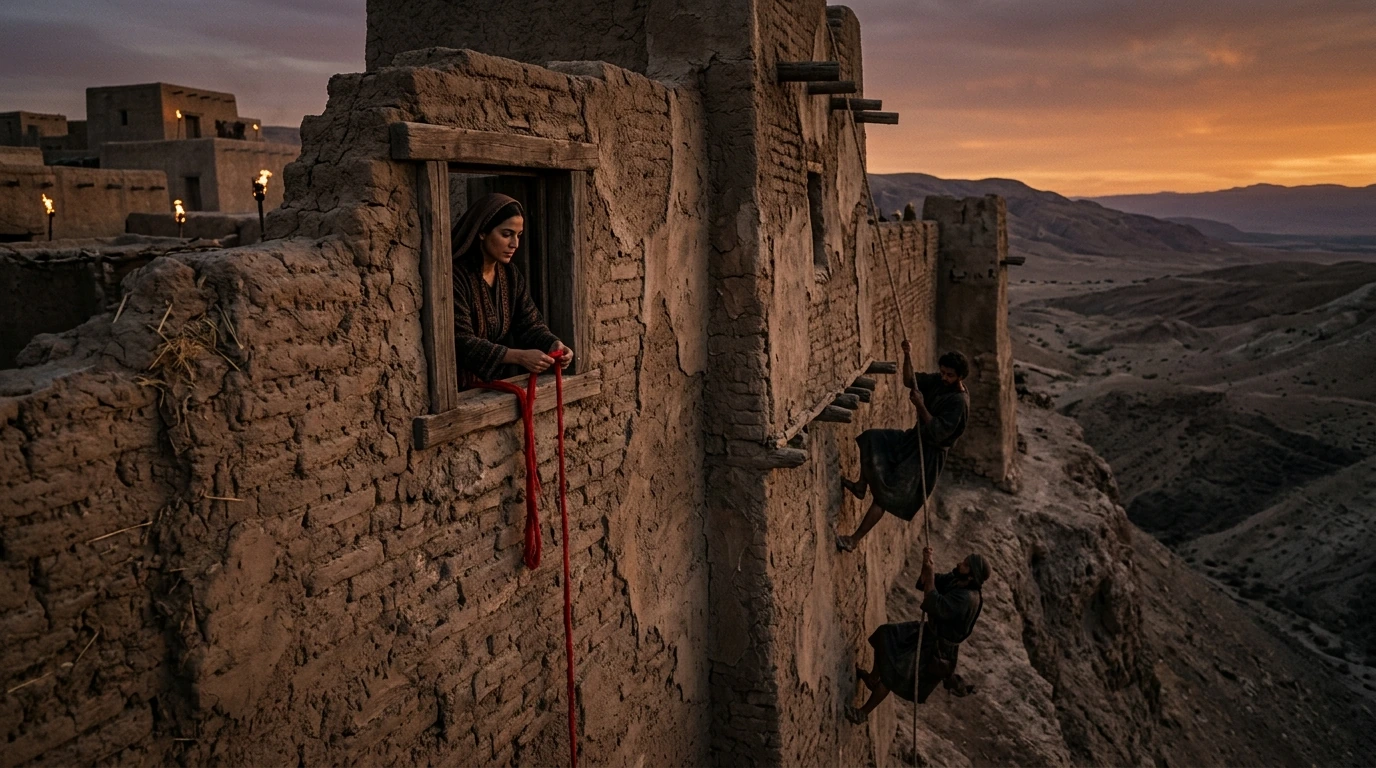
Subject Scope: Archaeological Atlas of Caesarea Maritima on the Mediterranean Coast: Sebastos Mega-Harbor, Pilate Stone, and Roman Praetorium
Historical Context: Ancient Near Eastern stratigraphy, Levant archaeological surveys, and Semitic epigraphy.
Primary Evidence: Monumental stelae, bullae seals, ceramic typology, and calibrated AMS radiocarbon determinations.
Investigation Highlights: The Imperial Metropolis: Herod's City of the Caesars • Sebastos: The Architectural Marvel of Hydraulic Pozzolana Concrete • The 1961 Pilate Stone: Epigraphic Proof of the Roman Prefect
Scholarly Consensus: Aligned with published excavation reports from leading Near Eastern archaeological institutes.
The Imperial Metropolis: Herod's City of the Caesars
Stretching along the sun-drenched Mediterranean coastline of central Israel, approximately 30 miles north of modern Tel Aviv and 25 miles south of Haifa, Caesarea Maritima (Greek: Καισάρεια, Kaisareia; Hebrew: Qesaryah, קֵיסָרְיָה) stands as one of the most audacious, spectacular civil engineering achievements in the classical Mediterranean world.
Constructed by King Herod the Great between 22 and 10 BC upon the modest ruins of an ancient Phoenician anchorage known as Straton’s Tower (Turris Stratonis), Caesarea was conceived as a monumental pagan showcase dedicated to his imperial benefactor, the Roman Emperor Caesar Augustus (Sebastos in Greek). While Jerusalem remained the conservative, temple-centric religious heart of the Jewish nation, Caesarea served as the cosmopolitan, Romanized gateway connecting Judea to the wider Greco-Roman empire.
Following the deposition of Herod’s son Archelaus in 6 AD, Caesarea became the official administrative and military capital of the Roman province of Judea. For over six centuries, Roman governors, procurators, and prefects—including Pontius Pilate, Antonius Felix, and Porcius Festus—ruled from its opulent marble palaces, commanding a garrison of five Roman cohorts and governing the contentious provincial populace.
In the New Testament, Caesarea emerges as the primary geographical bridgehead for the apostolic mission:
- The Conversion of the First Gentile (Acts 10): The Roman centurion Cornelius receives the Holy Spirit under the ministry of Peter, breaking the ethnic boundary of the Church.
- The Residence of Philip the Evangelist (Acts 8:40; 21:8): Philip establishes his missionary headquarters in Caesarea, hosting Paul and Luke.
- Paul’s Two-Year Legal Imprisonment (Acts 23:23–26:32): Paul defends his gospel before Roman procurators and Jewish kings in the Caesarean Praetorium before appealing to Caesar.
+----------------------------------------------------------------------------------------------------+
|               THE DUAL POLARITY: JERUSALEM VS. CAESAREA MARITIMA (1ST CENTURY AD)                  |
+--------------------------+---------------------------------+---------------------------------------+
| CIVIC DIMENSION          | JERUSALEM                       | CAESAREA MARITIMA                     |
+--------------------------+---------------------------------+---------------------------------------+
| Political Status         | National / Religious Capital    | Official Roman Provincial Capital     |
| Dominant Culture         | Jewish Theocratic / Temple Law  | Greco-Roman / Imperial Cult           |
| Primary Architecture     | Second Temple & Antonia Fortress| Sebastos Harbor, Theater, Hippodrome  |
| Roman Presence           | Cohort in Antonia (Festivals)   | Permanent Headquarters of 5 Cohorts   |
| Resident Roman Governor  | Guest during Passover           | Year-round official residence (Palace)|
+--------------------------+---------------------------------+---------------------------------------+
Sebastos: The Architectural Marvel of Hydraulic Pozzolana Concrete
Prior to King Herod, the Levantine coast between Alexandria in Egypt and Antioch in Syria lacked a single deep-water, all-weather natural harbor. Winter storms routinely dashed merchant vessels against the rocky Mediterranean reefs.
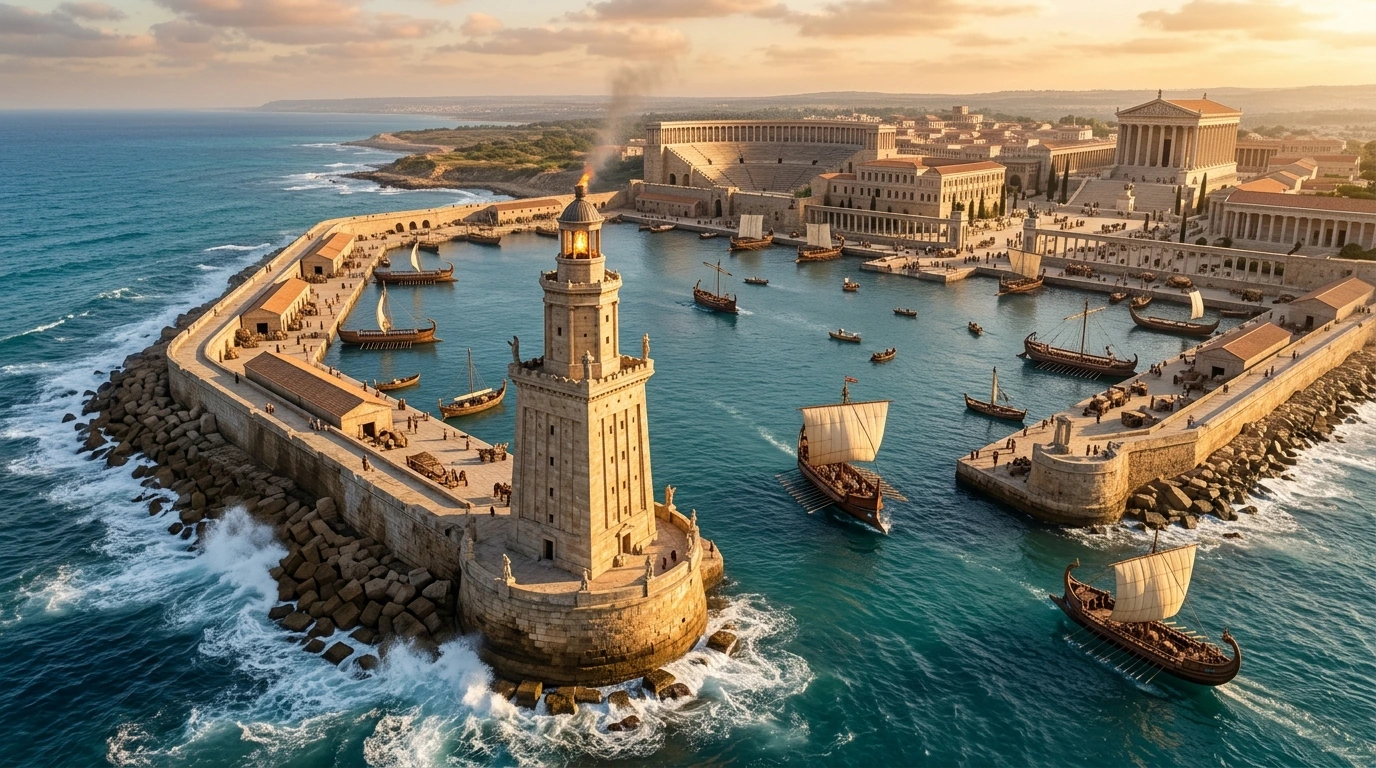
To overcome this geographical deficiency, Herod engineered Sebastos (the Harbor of Caesarea), an artificial maritime wonder larger than the port of Piraeus in Athens. Modern underwater marine archaeology—pioneered by the Caesarea Ancient Harbour Excavation Project (CAHEP) directed by Avner Raban, Robert Hohlfelder, and John Oleson—revealed the secret behind Herod's engineering:
- Pozzolana Volcanic Ash: Herod imported tens of thousands of tons of volcanic ash (pulvis puteolanus) mined from the slopes of Mount Vesuvius in the Bay of Naples, Italy.
- Hydraulic Chemical Reaction: When mixed with quicklime and seawater, pozzolana concrete possesses a unique chemical property: it does not dissolve, but crystallizes and cures rock-hard underwater.
- Underwater Caissons (Formwork): Herod’s engineers built colossal floating wooden caissons measuring up to 45 feet long, 23 feet wide, and 12 feet high, towed them into position in the open sea, and filled them with pozzolana concrete. As the heavy concrete filled the wooden frames, the caissons sank to the seabed, forming two massive curving breakwaters that extended 1,500 feet into the sea, enclosing 50 acres of sheltered, tranquil harbor basin.
- Lighthouse of Drusus: At the harbor entrance stood colossal statues of Augustus and Rome, accompanied by a soaring multi-tiered stone lighthouse named Drusion in honor of Augustus' stepson Drusus.
+----------------------------------------------------------------------------------------------------+
|               ANATOMY OF HEROD'S HYDRAULIC ARTIFICIAL HARBOR (SEBASTOS)                           |
+----------------------------------------------------------------------------------------------------+
|                                                                                                    |
|    [OPEN MEDITERRANEAN SEA]                                                                        |
|                                                                                                   |
|                    SOUTH BREAKWATER (CURVING DIKE, 1500 FT)                                       |
|                   +=======================================================                        |
|                  /  Constructed of sunken wooden caissons filled with                             |
|                 /   Italian Pozzolana volcanic concrete blocks (50 tons)                          |
|                /                                                                                  |
|    ===========+                                                               |  [HARBOR ENTRANCE] |
|    NORTH MOLE |             SHELTERED INNER & OUTER HARBOR BASINS             |  Twin Statues &    |
|    (800 FT)   |             (50 Acres of Calm Water / 300 Galleys)            |  Drusion Lighthouse|
|    ===========+                                                               |                    |
|                                                                             /                     |
|                                                                            /                      |
|                  +=========================================================/                       |
|                 /   Paved Quays, Mooring Rings, and Vaulted Warehouses                             |
|                                                                                                    |
|    [CAESAREA SHORELINE / EMBANKMENT]                                                               |
+----------------------------------------------------------------------------------------------------+
The 1961 Pilate Stone: Epigraphic Proof of the Roman Prefect
For centuries, secular critics questioned whether Pontius Pilate was a real historical personage or an invented literary scapegoat created by early Christian authors to absolve the Roman empire of responsibility for the crucifixion of Jesus Christ. Prior to 1961, Pilate was mentioned solely in Christian texts (the Four Gospels) and brief passages in Philo, Josephus, and Tacitus; not a single contemporary Roman archaeological inscription bearing his name had ever been discovered.
In June 1961, during excavations of the Roman Theater at Caesarea directed by Italian archaeologist Antonio Frova, an extraordinary artifact was brought to light. A rectangular slab of hard local limestone measuring 32 inches high, 27 inches wide, and 8 inches thick was discovered reused as a secondary step in the theater’s seating flight (cavea).
The Inscription
Carved upon its face was a monumental, first-century Latin monumental inscription arranged in four lines:
+----------------------------------------------------------------------------------------------------+
|               THE CAESAREA PILATE STONE INSCRIPTION (c. 26–36 AD)                                  |
+----------------------------------------------------------------------------------------------------+
| EPIGRAPHIC LATIN RECONSTRUCTION:                                                                   |
|                                                                                                    |
|    Line 1:   [DIS AUGUSTIS] TIBERIEUM                 (To the Divine Augusti, the Tiberieum...)    |
|    Line 2:   [PON]TIUS PILATUS                        (...Pontius Pilate...)                       |
|    Line 3:   [PRAEF]ECTUS IUDA[EAE]                   (...Prefect of Judea...)                     |
|    Line 4:   [DEDIT / DEDICAVIT]                      (...dedicated [this building])               |
|                                                                                                    |
| HISTORICAL SIGNIFICANCE:                                                                           |
| 1. Confirms the exact historical name: PONTIUS PILATUS.                                            |
| 2. Confirms his exact imperial title: PRAEFECTUS IUDAEAE (Prefect, not Procurator).               |
| 3. Confirms his official residence and architectural patronage in Caesarea Maritima.               |
+----------------------------------------------------------------------------------------------------+
This inscription provided unshakeable, contemporary material proof that Pontius Pilate was the actual Roman military governor of Judea during the reign of Emperor Tiberius (14–37 AD), precisely as recorded in Luke 3:1 ("In the fifteenth year of the reign of Tiberius Caesar—when Pontius Pilate was governor of Judea...") and Matthew 27:2.
The Promontory Palace and the Praetorium of Acts 23–26
Extending dramatically into the crashing waves of the Mediterranean Sea south of the harbor, excavators discovered the foundations of King Herod's Promontory Palace (Palace on the Reef), excavated by Ehud Netzer and Kathryn Gleason.
Constructed on a jagged natural sandstone promontory jutting 350 feet into the sea, the palace was a marvel of Roman architectural luxury:
- The Sea-Water Freshwater Pool: In the center of the lower palace terrace, Herod carved a massive Olympic-sized freshwater swimming pool directly into the offshore bedrock, flanked by fluted Corinthian colonnades and surrounded by waves crashing on all three sides.
- The Roman Praetorium: Following Herod's death, the palace became the official administrative headquarters (Praetorium) of the Roman governors. When the Apostle Paul was escorted to Caesarea under an armed Roman guard of 470 soldiers, Acts 23:35 records: "The governor said, 'I will hear your case when your accusers get here.' Then he ordered that Paul be kept under guard in Herod’s praetorium (ἐν τῷ πραιτωρίῳ τοῦ Ἡρῴδου)."
- The Audience Hall (Auditorium): On the upper terrace of this palace, excavators uncovered the grand semi-circular basilica hall (auditorium) where governors sat upon the official judicial judgment seat (bema). It was inside this exact chamber that Paul stood in chains, defending his faith before Procurator Felix, Procurator Festus, King Herod Agrippa II, and Queen Bernice (Acts 25:23).
+----------------------------------------------------------------------------------------------------+
|               THE TRIAL OF THE APOSTLE PAUL IN CAESAREA'S PRAETORIUM                               |
+--------------------------+-----------------------+-------------------+-----------------------------+
| JUDICIAL HEARING         | ROMAN MAGISTRATE      | SCRIPTURE TEXT    | LEGAL OUTCOME               |
+--------------------------+-----------------------+-------------------+-----------------------------+
| 1. Trial before Felix    | Antonius Felix        | Acts 24:1–27      | Paul imprisoned 2 years;    |
|                          | (Freedman Governor)   |                   | Felix sought bribe          |
| 2. Trial before Festus   | Porcius Festus        | Acts 25:1–12      | Paul exercises Roman citizen|
|                          | (Noble Governor)      |                   | right: "I appeal to Caesar!"|
| 3. Royal Hearing         | King Agrippa II &     | Acts 25:23–26:32  | Agrippa: "This man might    |
|                          | Queen Bernice         |                   | have been set free"         |
+--------------------------+-----------------------+-------------------+-----------------------------+
The High-Level Aqueduct and Roman Urban Infrastructure
Because Caesarea lacked a substantial natural freshwater spring, its thriving population of over 50,000 citizens required an immense municipal water supply to feed its public fountains, private bathhouses, latrines, and the palace swimming pool.
To solve this crisis, Herod and subsequent Roman legions (including Legio X Fretensis and Legio VI Ferrata) constructed the High-Level Aqueduct, a monumental double-arched stone viaduct stretching for more than 10 miles:
- Source: Drawing crystal-clear fresh water from the bountiful springs of Shuni and the foothills of Mount Carmel.
- Engineering: Transported water across coastal sand dunes using an unyielding gravity gradient of mere inches per mile, carried atop hundreds of massive limestone arches.
- Legionary Inscriptions: Embedded in the masonry piers of the aqueduct, archaeologists found Latin inscriptions stamped with the standards of the Roman legions, confirming their ongoing repair and maintenance of Caesarea’s infrastructure.
Three-Tier Evidentiary Evaluation: Material Artifacts
+----------------------------------------------------------------------------------------------------+
|               THREE-TIER EVIDENTIARY EVALUATION: CAESAREA MARITIMA                                 |
+----+----------------------+-----------------------------+-------------------+----------------------+
| #  | HISTORICAL SKEPTICISM| SKEPTICAL CLAIM             | MATERIAL EVIDENCE | EVIDENTIARY VERDICT  |
+----+----------------------+-----------------------------+-------------------+----------------------+
| 1  | "Pontius Pilate Was  | Pilate was a mythical       | 1961 Latin Pilate | REFUTED: Inscription |
|    | a Mythical Figure    | scapegoat invented by the   | Stone from theater| proves Pilate was    |
|    | in Christian Lore"   | early Church                | at Caesarea       | Prefect of Judea     |
+----+----------------------+-----------------------------+-------------------+----------------------+
| 2  | "Sebastos Mega-Harbor| Ancient texts exaggerated   | Pozzolana concrete| REFUTED: Material    |
|    | Was a Literary       | Herod's artificial harbor;  | caissons found on | underwater harbor    |
|    | Exaggeration"        | impossible engineering      | Mediterranean bed | matches Josephus     |
+----+----------------------+-----------------------------+-------------------+----------------------+
| 3  | "Herod's Praetorium  | Luke's mention of Herod's   | Promontory Palace | REFUTED: Luke's civic|
|    | in Acts 23:35 Was an | Praetorium in Caesarea was  | complex identified| terminology matches  |
|    | Inaccurate Label"    | anachronistic blundering    | as Roman governor | historical reality   |
|    |                      |                             | headquarters      |                      |
+----+----------------------+-----------------------------+-------------------+----------------------+
Frequently Asked Questions
What is the Pilate Stone and where was it found?
The Pilate Stone is a 1st-century limestone block discovered in 1961 in the Roman theater of Caesarea Maritima. It contains a contemporary Latin dedication reading 'Pontius Pilatus, Praefectus Iudaeae', providing the first extra-biblical archaeological proof of Pontius Pilate's historical rule.
How did King Herod build a deep-water harbor on a coast with no natural bay?
Herod imported volcanic pozzolana ash from Italy, built massive wooden caissons, towed them out to sea, and filled them with pozzolana concrete. The concrete chemically hardened underwater, creating two colossal 1,500-foot breakwaters that formed the artificial mega-harbor of Sebastos.
What biblical events took place in Caesarea Maritima?
Caesarea was the site where the Holy Spirit fell upon Cornelius and the first Gentiles (Acts 10), where Philip the Evangelist lived (Acts 21:8), where Herod Agrippa I died under divine judgment (Acts 12:21–23), and where the Apostle Paul was imprisoned for two years before appealing to Caesar (Acts 23–26).
Primary Sources & Scholarly Archives
Editorial Standard →Official archaeological field reports, certified stratigraphy surveys, and Semitic epigraphy catalogs.
Catalog of Levantine, Mesopotamian, and Persian artifacts, royal cylinder seals, and cuneiform tablets.
Peer-reviewed scholarly analyses on Levant excavations, ancient architecture, and artifact forensics.
Frequently Asked Questions
What is the Pilate Stone and where was it found?
Discovered in 1961 in the Caesarea theater, the limestone inscription reads 'Pontius Pilatus, Praefectus Iudaeae', providing definitive archaeological confirmation of the Roman governor who sentenced Jesus to death.
How did King Herod build a deep-water harbor on a coast with no natural bay?
Herod used Roman hydraulic pozzolana concrete poured into submerged wooden caissons. The concrete cured underwater, creating two massive curving breakwaters that enclosed a 50-acre artificial harbor named Sebastos.
What biblical events took place in Caesarea Maritima?
Caesarea was where Peter baptized the first Gentile convert Cornelius (Acts 10), where Herod Agrippa I died in the theater (Acts 12), and where Paul was imprisoned in Herod's Praetorium for two years (Acts 23–26).
Related Research Dossiers
View all 515 research dossiers →
Archaeological Atlas of Ancient Corinth and the Bema of Gallio: The Delphi Inscription, Roman Agora, and Apostolic Chronology (Acts 18)
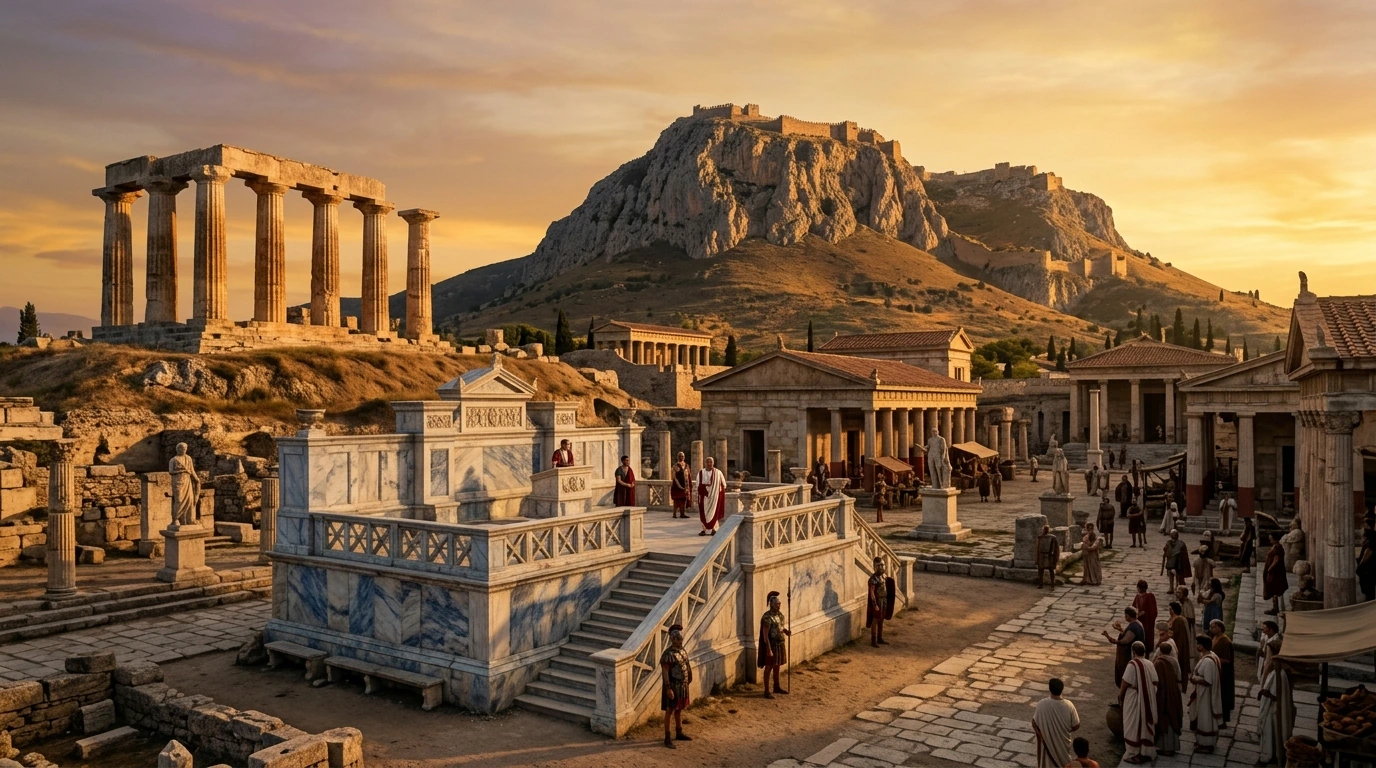
How the Gallio Inscription and the Corinthian Bema Prove the Historical Accuracy of the Book of Acts