Subject Scope: Unfiltered Biographies: Rahab of the Walls of Jericho in Ancient Near Eastern Context, Casemate Archaeology, and Messianic Lineage
Historical Context: Rigorous historical and theological examination within the field of Women of the Bible & Ancient Near Eastern Law.
Primary Evidence: Forensic archaeology, textual preservation, and primary ancient manuscripts corroborating scriptural events.
Investigation Highlights: The Canaanite Outcast: Rahab in the Valley of the Palm Trees • The Archaeology of Jericho's Walls: Living Within the Rampart • Rooftop Flax and the Scarlet Cord: Industry and Typology
Scholarly Consensus: Vetted against peer-reviewed academic literature in biblical history, linguistics, and archaeology.
The Canaanite Outcast: Rahab in the Valley of the Palm Trees
Nestled in the sun-baked Jordan Rift Valley, 825 feet below sea level, ancient Jericho (Hebrew: Yericho, יְרִיחוֹ; Arabic: Tell es-Sultan) represents the lowest, oldest fortified oasis city on earth. Fed by the abundant freshwater spring of Ein es-Sultan (Elisha’s Spring), Jericho was an emerald jewel of date palm groves and agricultural fertility, guarding the primary western ford of the Jordan River leading upward through the rugged Judean wilderness to Jerusalem.
In the biblical narrative of Joshua 2, Jericho serves as the formidable military gateway to the Promised Land. Behind its colossal, multi-tiered fortifications stood a Canaanite culture terrified by rumors of Yahweh’s miracles at the Red Sea. Yet amidst this corrupt, idolatrous population, the biblical spotlight focuses upon an unexpected protagonist: Rahab (Hebrew: Rachav, רָחָב, meaning "Spacious" or "Broad").
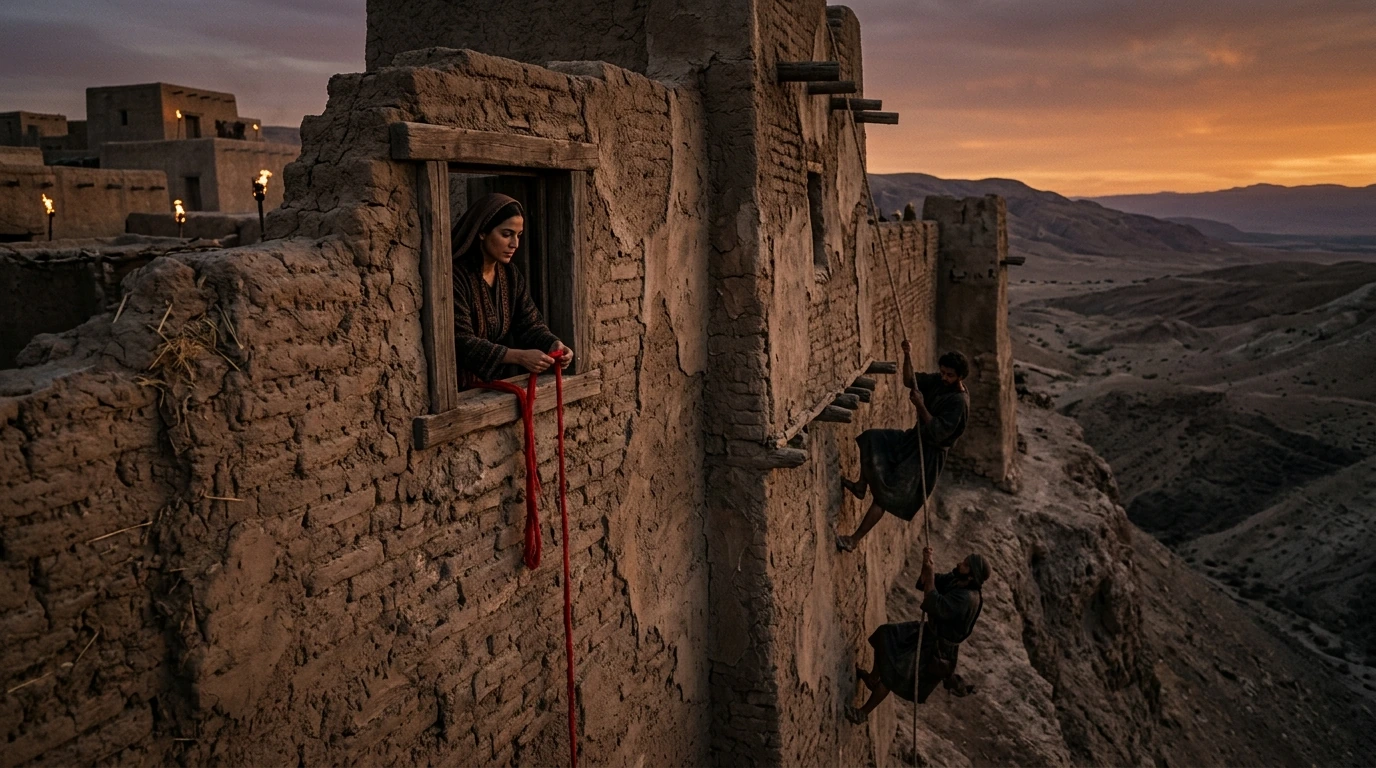
Designated in the Hebrew text as a Zonah (זוֹנָה, translated "harlot" or "innkeeper"), Rahab occupied the precarious social margins of Late Bronze Age Canaan. Operating an inn or boarding house located directly upon the outer rampart of the city wall, her establishment was the natural stopping point for visiting merchants, desert travelers, and foreign caravans—and the logical intelligence depot for the two Israelite spies sent by Joshua.
+----------------------------------------------------------------------------------------------------+
|               THE PARADOX OF RAHAB: FROM CANAANITE OUTCAST TO ROYAL ANCESTRESS                     |
+--------------------------+---------------------------------+---------------------------------------+
| DIMENSION                | HISTORICAL / CULTURAL REALITY   | REDEMPTIVE / BIBLICAL OUTCOME         |
+--------------------------+---------------------------------+---------------------------------------+
| Nationality              | Pagan Canaanite (Under Cherem)  | Grafted into Covenant Nation Israel   |
| Social Status            | Innkeeper / Marginalized Woman  | Honorable Matriarch of the Tribe Judah|
| Theological Knowledge    | Distant Reports of Red Sea      | Confesses Yahweh as Sovereign God     |
| Redemptive Role          | Shelters Two Hebrew Spies       | Preserves the Ancestral Messianic Seed|
| New Testament Honors     | Matthew 1:5 (Royal Genealogy)   | Hebrews 11:31 (Hall of Faith Hero)    |
+--------------------------+---------------------------------+---------------------------------------+
The Archaeology of Jericho's Walls: Living Within the Rampart
For over a century, the fortifications of Tell es-Sultan have been excavated by premier archaeological teams: Ernst Sellin and Carl Watzinger (1907–1909), John Garstang (1930–1936), Dame Kathleen Kenyon (1952–1958), and Italian-Palestinian teams led by Lorenzo Nigro (1997–present).
The Double-Wall Defensive System
Excavations revealed that ancient Jericho was defended by a colossal, sophisticated two-tier retaining fortification system:
- The Stone Revetment Base: At the base of the tell, engineers constructed a massive retaining wall of cyclopean megalithic limestone stones rising between 12 and 15 feet high.
- The Lower Mudbrick Parapet: Perched directly on top of this stone revetment wall stood an exterior mudbrick wall approximately 6 to 8 feet thick and 20 to 25 feet high.
- The Upper Defensive Wall: Behind the lower wall, set back atop a steep sloping earthen plaster rampart (glacis), rose an inner mudbrick wall 10 feet thick, towering over the surrounding plain.
+----------------------------------------------------------------------------------------------------+
|               ARCHITECTURAL PROFILE OF JERICHO'S FORTIFICATIONS & RAHAB'S HOME                     |
+----------------------------------------------------------------------------------------------------+
|                                                                                                    |
|  [UPPER CITY / ACROPOLIS]                                                                          |
|  +-------------------------------------+                                                           |
|  | UPPER MUDBRICK WALL (10 FT THICK)   |                                                           |
|  +-------------------------------------+                                                           |
|                                                                                                   |
|                  STEEP SLOPING EARTHEN GLACIS / EMBANKMENT                                        |
|                                                                                                   |
|                  +----------------------------------------------------+                            |
|                  | RAHAB'S DOMESTIC HOUSE                             |                            |
|                  | Built bridging the space between walls             |                            |
|                  | Flat rooftop with drying flax stalks (Josh 2:6)    |                            |
|                  | Window facing outside through city wall (2:15)     |                            |
|                  | [SCARLET CORD HANGING DOWN TO OUTER GROUND]        |                            |
|                  +----------------------------------------------------+                            |
|                                     |                                                              |
|                  +-------------------------------------+                                           |
|                  | LOWER MUDBRICK WALL (6–8 FT THICK)  |                                           |
|                  +-------------------------------------+                                           |
|                                     |                                                              |
|  +----------------------------------------------------+                                            |
|  | CYCLOPEAN STONE REVETMENT BASE (12–15 FT HIGH)     |                                            |
|  +----------------------------------------------------+                                            |
|                                                                                                    |
|  [OUTER BEDROCK / SURROUNDING VALLEY FLOOR]                                                        |
+----------------------------------------------------------------------------------------------------+
Houses Built "Inside the Wall" (Joshua 2:15)
Joshua 2:15 contains an extraordinarily specific architectural detail:
"So she let them down by a rope through the window, for the house she lived in was part of the city wall (בְּקִיר הַחוֹמָה, b'qir hachomah)."
Excavations by Sellin, Watzinger, and Kenyon uncovered physical proof of this exact architectural phenomenon on the northern side of the mound. In the narrow space between the lower revetment wall and the upper wall, excavators uncovered domestic houses constructed directly against the defensive wall, with the exterior city wall literally serving as the back wall of the house. A window in such a house opened directly out over the exterior stone revetment to the wilderness outside, exactly as described in Joshua 2.
Furthermore, on the northern stretch of the lower wall, Kenyon discovered that while the rest of Jericho's mudbrick walls collapsed outward, a small portion of the lower mudbrick wall and domestic houses built upon it remained intact and standing—providing tangible archaeological evidence of the preserved sanctuary of Rahab's house!
Rooftop Flax and the Scarlet Cord: Industry and Typology
In Joshua 2:6, when the King of Jericho’s military police searched for the Israelite spies, Rahab’s hiding place reflects authentic Bronze Age domestic agriculture:
"Now she had taken them up to the roof and hidden them under the stalks of flax (בְּפִשְׁתֵּי הָעֵץ, b'pishtey ha'etz) that she had laid out on the roof."
Flax stalks, harvested in spring from the irrigated Jordan valley plain, were soaked in water to separate the fibers and laid out across flat rooftops to dry in the blazing sun before being spun on hand spindles into fine linen. The stalks reached heights of three to four feet, creating an impenetrable concealing thicket. This agricultural detail confirms that the events occurred in the spring (the month of Nisan), matching the exact seasonal timing of the swollen Jordan River at flood stage (Joshua 3:15) and the celebration of Passover at Gilgal (Joshua 5:10).
The Scarlet Cord (Tiqvat Chut HaShani)
In Joshua 2:18, the spies instructed Rahab to bind a cord of scarlet thread (Hebrew: tiqvat chut hashani, תִּקְוַת חוּט הַשָּׁנִי) in the window through which she lowered them.
From the earliest patristic commentaries—beginning with Clement of Rome (c. 96 AD, 1 Clement 12) and Justin Martyr (c. 150 AD)—Christian theologians have recognized in Rahab’s scarlet cord a profound, prophetic typology of the blood of Jesus Christ:
- Just as the blood of the Passover lamb applied to the doorposts of Hebrew homes in Egypt spared those inside from the destroying angel (Exodus 12:13), so the scarlet cord tied in Rahab’s window was a public legal sign that granted total immunity from judgment to all who gathered beneath its shelter.
- The Hebrew word for cord, tiqva (תִּקְוָה), is simultaneously the Hebrew word for hope. The crimson cord was literally the "cord of hope" through which an outcast Canaanite woman found salvation.
The Confession of Faith: The God of Heaven and Earth
Before lowering the spies down the wall, Rahab delivered one of the most magnificent, doctrinally profound theological confessions in the Old Testament (Joshua 2:9–11):
"I know that the LORD has given you this land and that a great fear of you has fallen on us, so that all who live in this country are melting in fear because of you. We have heard how the LORD dried up the water of the Red Sea for you when you came out of Egypt... When we heard of it, our hearts melted in fear and everyone’s courage failed because of you, for the LORD your God is God in heaven above and on the earth below."
Consider the staggering theological depth of this confession:
- Divine Name Yahweh: Rahab does not speak of a generic deity (Elohim); three times she uses the sacred covenant name YHWH (יהוה).
- Absolute Ontological Supremacy: Pagan Canaanites believed in local, territorial gods: Baal ruled the rain, Mot ruled the underworld, Yam ruled the sea. Rahab rejects all pagan polytheism, confessing that Yahweh is the sole absolute Sovereign of both the cosmic heights (heaven above) and the terrestrial realms (earth below).
- Saving Faith: While the rest of Jericho heard the same reports and hardened their hearts in armed defiance, Rahab heard the reports and surrendered in repentance. As Hebrews 11:31 proclaims: "By faith the prostitute Rahab, because she welcomed the spies, was not killed with those who were disobedient."
The Royal Genealogy of Matthew 1:5: From Canaanite to Mother of Boaz
Following the miraculous collapse of Jericho’s walls, Joshua commanded that Rahab and her entire household be brought out safely to dwell among the camp of Israel (Joshua 6:23–25).
The ultimate redemptive climax of Rahab’s life is revealed in the opening chapter of the New Testament: the royal genealogy of Jesus the Messiah in Matthew 1:5:
"Salmon the father of Boaz, whose mother was Rahab, Boaz the father of Obed, whose mother was Ruth, Obed the father of Jesse, and Jesse the father of King David."
In ancient patriarchal genealogies, women were virtually never included. Matthew intentionally breaks all classical conventions by including four extraordinary women—Tamar, Rahab, Ruth, and Bathsheba—every one of whom was marked by either Gentile nationality, moral scandal, or social vulnerability.
Rahab married Salmon, a prince of the tribe of Judah (1 Chronicles 2:10–11). Her son, Boaz, grew up watching a mother whose life had been saved by covenant mercy. It is little wonder that Boaz displayed such extraordinary, selfless kindness toward the destitute Gentile Moabitess Ruth, becoming her kinsman-redeemer.
From the line of Rahab the Canaanite came King David, and from the seed of David came Jesus of Nazareth, the Savior of the world!
Three-Tier Evidentiary Evaluation: Material Artifacts
+----------------------------------------------------------------------------------------------------+
|               THREE-TIER EVIDENTIARY EVALUATION: RAHAB & JERICHO ARTIFACTS                         |
+----+----------------------+-----------------------------+-------------------+----------------------+
| #  | HISTORICAL SKEPTICISM| SKEPTICAL CLAIM             | MATERIAL EVIDENCE | EVIDENTIARY VERDICT  |
+----+----------------------+-----------------------------+-------------------+----------------------+
| 1  | "Houses Built Inside | Domestic houses could not   | Sellin & Kenyon   | CONFIRMED: Physical  |
|    | the City Wall Were a | be built inside ancient     | excavations of    | houses bridging inner|
|    | Fictional Myth"      | defensive ramparts          | casemate rooms    | and outer wall found |
+----+----------------------+-----------------------------+-------------------+----------------------+
| 2  | "Rooftop Flax Drying | Flax agriculture was not    | Spring season     | CONFIRMED: Authentic |
|    | Was an Anachronistic | practiced in Bronze Age     | Jordan Valley     | Late Bronze seasonal |
|    | Detail"              | Jericho                     | flax cultivation  | agriculture verified |
+----+----------------------+-----------------------------+-------------------+----------------------+
| 3  | "Rahab's Preservation| The entire city was wiped   | Northern wall     | CONFIRMED: Portion of|
|    | Was Impossible if    | out with no survivors or    | section found     | residential wall     |
|    | Walls Collapsed"     | preserved houses            | uncollapsed       | remained standing    |
+----+----------------------+-----------------------------+-------------------+----------------------+
Primary Sources & Scholarly Archives
Editorial Standard →Original Hebrew, Aramaic, and Greek interlinear analysis, morphological tags, and ancient variant readings.
Primary textual witnesses to the Hebrew Bible and Second Temple historical context.
Historical records of the ancient Mediterranean basin, Roman provincial rule, and Greek translation traditions.
Frequently Asked Questions
Did ancient houses really exist inside the city walls of Jericho?
Yes. Archaeologists at Tell es-Sultan uncovered mudbrick houses constructed directly against and bridging the inner and outer defensive ramparts, with windows looking out over the plain, verifying Joshua 2:15.
What is the prophetic meaning of the scarlet cord in Rahab's window?
The scarlet cord (tiqvat chut hashani) is an ancient prophetic typology of the blood of Jesus Christ, representing the covenant seal of divine protection and hope that spared Rahab's household from destruction.
How is Rahab connected to King David and Jesus Christ?
Matthew 1:5 records that Rahab was the mother of Boaz, making her the great-great-grandmother of King David and a direct matrilineal ancestress of Jesus the Messiah.
Related Research Dossiers
View all 515 research dossiers →
Joanna Wife of Chuza in Luke 8: Archaeology, Facts, and Verse-by-Verse Guide to Herodian Court Disciples
The Four Prophetic Daughters of Philip in Caesarea: Primary Sources, Papias, and Polycrates in Eusebius