Subject Scope: Biblical Passages That Come Alive When You Walk the Ruins of Gezer: The Valley of Aijalon Sun Standstill, Royal Dowries, and Agricultural Seasons
Historical Context: Ancient Near Eastern stratigraphy, Levant archaeological surveys, and Semitic epigraphy.
Primary Evidence: Monumental stelae, bullae seals, ceramic typology, and calibrated AMS radiocarbon determinations.
Investigation Highlights: The Geographic Stage: Overlooking the Valley of Aijalon • Joshua 10: The Battle of Beth-Horon and the King of Gezer • The Agricultural Symphony of the Gezer Calendar and Scripture
Scholarly Consensus: Aligned with published excavation reports from leading Near Eastern archaeological institutes.
The Geographic Stage: Overlooking the Valley of Aijalon
To stand on the northern acropolis ramparts of Tel Gezer on a crisp autumn morning is to witness Holy Scripture transform from distant ancient words on a page into an immediate, breathtaking landscape. Gazing northeast, your eyes trace the broad, golden agricultural floor of the Valley of Aijalon (Emek Ayalon), leading directly upward into the jagged mountain spine of the Judean hill country via the strategic pass of the Beth-Horon Ascent.
Gezer was never an isolated village; it was the imperial sentinel stationed at the throat of Jerusalem. Every major biblical character who journeyed between Egypt, the Mediterranean coast, and the holy mountain of Zion walked through Gezer’s front yard. When we examine Gezer's material ruins alongside biblical texts, passages that once seemed obscure suddenly radiate with tactical, cultural, and spiritual clarity.
+----------------------------------------------------------------------------------------------------+
|               THE GEOGRAPHICAL VISTAS COMMANDED FROM TEL GEZER'S SUMMIT                            |
+--------------------------+-----------------------+-------------------+-----------------------------+
| HORIZON DIRECTION        | PHYSICAL TOPOGRAPHY   | BIBLICAL EVENT    | STRATEGIC SIGNIFICANCE      |
+--------------------------+-----------------------+-------------------+-----------------------------+
| Northeast (45°)          | Valley of Aijalon &   | Joshua 10:12–14   | Sun & Moon miracle; pass to |
|                          | Beth-Horon Ascent     | (Sun standstill)  | Gibeon and Jerusalem        |
| West (270°)              | Coastal Plain Sharon  | 2 Samuel 5:25     | David pursues Philistines   |
|                          | toward Jaffa Harbor   | (Geba to Gezer)   | to the coastal border       |
| South (180°)             | Shephelah Foothills   | 1 Kings 9:16      | Frontier with Philistine    |
|                          | toward Valley of Sorek| (Pharaoh's Dowry) | pentapolis (Ekron, Gath)    |
+--------------------------+-----------------------+-------------------+-----------------------------+
Joshua 10: The Battle of Beth-Horon and the King of Gezer
In Joshua 10, the biblical author records one of the most famous tactical miracles in military history: the defense of the Gibeonites against the five allied Amorite kings of southern Canaan. When God routed the Amorites, Joshua pursued the retreating armies down the steep, rocky mountain descent of Beth-Horon into the broad Valley of Aijalon.
Here, in Joshua 10:12–13, Joshua prayed his immortal prayer:
"Sun, stand still over Gibeon, and you, moon, over the Valley of Aijalon. So the sun stood still, and the moon stopped, till the nation avenged itself on its enemies."
As the routed Amorite coalition fled westward into the valley beneath the prolonged daylight, the biblical text introduces an immediate, critical geopolitical intervention in Joshua 10:33:
"Meanwhile, Horam king of Gezer had come up to help Lachish, but Joshua defeated him and his army—until no survivors were left."
Why Did the King of Gezer Intervene?
When standing at Tel Gezer, the tactical reason for King Horam's intervention becomes instantaneously clear:
- The Western Fortress Base: Gezer was the strongest fortified Canaanite city on the western plain. As the fleeing Amorite survivors fled down the Beth-Horon pass toward the safety of the coastal plains, they were running directly toward Gezer’s protective sphere.
- Horam’s Flank Attack: Recognizing that if the southern hill country fell to Israel, Gezer would be completely surrounded, King Horam marched his elite Canaanite army south to intercept Joshua at Lachish. Joshua met Horam’s strike force in the open field, crushing the Canaanite army.
- The Unconquered Citadel: Although Joshua crushed Horam’s field army, the Book of Joshua honestly acknowledges that Israel did not conquer Gezer’s colossal Middle Bronze cyclopean walls at that time: "They did not drive out the Canaanites living in Gezer; to this day the Canaanites live among the people of Ephraim" (Joshua 16:10). This candid biblical admission perfectly matches the archaeological reality: Gezer remained culturally Canaanite through the entire period of the Judges (Iron Age I), until Pharaoh Siamun burned it and handed it to Solomon in 1 Kings 9:16.
The Agricultural Symphony of the Gezer Calendar and Scripture
The discovery of the Gezer Calendar (10th century BC) offers profound insight into the agricultural mindset that shaped ancient Israel’s worship, prophetic metaphors, and theological calendar.
In the ancient Near East, life was governed by the rhythm of rain, planting, and harvest. When the Gezer Calendar outlines the annual farming cycle, it provides the physical backdrop for key biblical themes:
+----------------------------------------------------------------------------------------------------+
|               THE GEZER AGRICULTURAL CYCLE & SCRIPTURAL THEOLOGY                                   |
+--------------------------+-----------------------+-------------------+-----------------------------+
| GEZER CALENDAR MONTH     | AGRICULTURAL ACTIVITY | BIBLICAL FEAST    | SPIRITUAL & MESSIANIC THEME |
+--------------------------+-----------------------+-------------------+-----------------------------+
| 1. Months of Ingathering | Treading olives & oil | Feast of Tabernac.| Final harvest rejoicing /   |
|    (Tishri / Cheshvan)   | storage in cisterns   | (*Sukkot*)        | Divine Shekinah indwelling  |
| 2. Months of Sowing      | Plowing & winter wheat| Early Rains       | Trust in God for rain       |
|    (Kislev / Tevet)      | seed planting         | (*Yoreh*)         | (Deuteronomy 11:14)         |
| 3. Month of Barley Cut   | Spring barley reaping | Feast of Firstfr. | Christ the Firstfruits of   |
|    (Nisan)               | with sickles          | (*Passover*)      | Resurrection (1 Cor 15:20)  |
| 4. Month of Wheat Meas.  | Threshing wheat on the| Feast of Weeks    | Outpouring of Holy Spirit   |
|    (Sivan)               | threshing floor       | (*Pentecost*)     | at Pentecost (Acts 2:1–4)   |
| 5. Month of Summer Fruit | Drying figs, raisins, | Late Summer       | Prophetic harvest ripeness  |
|    (Elul)                | and pomegranates      | (*Qayits*)        | for judgment (Amos 8:1–2)   |
+--------------------------+-----------------------+-------------------+-----------------------------+
When the prophet Amos receives a vision of a basket of "summer fruit" (Hebrew: qayits, קַיִץ, Amos 8:1–2), God makes an intentional wordplay on the word "end" (Hebrew: qets, קֵץ), declaring that the end has come upon His people. The final line of the Gezer Calendar uses this exact ancient word: ירח קץ (Yerah Qayits – "The month of summer fruit"), confirming that biblical prophets utilized the common agricultural vocabulary known to every Israelite farmer.
The Canaanite Megaliths and Biblical Covenant Ceremony
When visitors stand before the ten massive megaliths at the Gezer High Place, they are confronted with the ancient world's visceral visual language of covenants.
In modern Western society, a legal contract is a signature on a digital screen or a piece of paper. In the ancient biblical world, an unbreakable covenant was ratified through physical, permanent stone monuments:
- Jacob at Bethel (Genesis 28:18): After his vision of the ladder connecting heaven and earth, Jacob "took the stone he had placed under his head and set it up as a pillar (massebah) and poured oil on top of it."
- The Covenant between Jacob and Laban (Genesis 31:45–48): Jacob set up a stone pillar, and his kinsmen gathered stones into a heap, declaring: "This heap is a witness between you and me today."
- Joshua’s Covenant at Shechem (Joshua 24:26–27): At the end of his life, Joshua "set up a great stone under the oak near the holy place of the LORD. 'See!' he said to all the people. 'This stone will be a witness against us. It has heard all the words the LORD has said to us.'"
The megaliths at Gezer show that ancient Near Eastern peoples understood stone pillars as perpetual, silent witnesses that held covenant partners accountable before heaven.
Solomon’s Gezer: Royal Ashlars and Frontier Statecraft
Finally, walking through the six-chambered Solomonic gatehouse at Gezer brings the statecraft of the United Monarchy to life:
- The Gate as City Hall and Court: In ancient Israel, the city gate was not merely a military defense; it was the Supreme Court, the stock exchange, and the legislative assembly of the city:
- Boaz went to the city gate to resolve the legal redemption of Ruth (Ruth 4:1).
- Proverbs 31:23 praises the noble wife because her husband is "respected at the city gate, where he takes his seat among the elders of the land."
- The Stone Benches: Inside the guard chambers of Gezer’s gate, excavators found preserved stone benches where municipal judges, elders, and prophets sat to hear civil disputes, ratify property transactions, and proclaim public proclamations.
- The Power of Solomon: The sheer scale of Gezer’s fortifications confirms that tenth-century BC Israel under King Solomon had transitioned from a fragile tribal league into a sophisticated, unified Mediterranean empire of the highest order.
Three-Tier Evidentiary Evaluation: Material Artifacts
+----------------------------------------------------------------------------------------------------+
|               THREE-TIER EVIDENTIARY EVALUATION: BIBLICAL PASSAGES & GEZER                         |
+----+----------------------+-----------------------------+-------------------+----------------------+
| #  | SCRIPTURE PASSAGE    | BIBLICAL STATEMENT          | MATERIAL EVIDENCE | EVIDENTIARY VERDICT  |
+----+----------------------+-----------------------------+-------------------+----------------------+
| 1  | Joshua 16:10         | "They did not drive out the | Continuous Late   | CONFIRMED: Text      |
|    |                      | Canaanites living in Gezer" | Bronze/Iron I     | honestly reflects    |
|    |                      |                             | Canaanite culture | material archaeology |
+----+----------------------+-----------------------------+-------------------+----------------------+
| 2  | Amos 8:1–2           | Wordplay on summer fruit    | Gezer Calendar    | CONFIRMED: Exact     |
|    |                      | (Qayits) and end (Qets)     | line 7 uses exact | Hebrew agricultural  |
|    |                      |                             | term 'Yerah Qats' | vocabulary confirmed |
+----+----------------------+-----------------------------+-------------------+----------------------+
| 3  | 1 Kings 9:15–17      | "King Solomon built Hazor,  | Identical 6-cham- | CONFIRMED: Standard  |
|    |                      | Megiddo, and Gezer"         | bered ashlar gate | royal architecture   |
|    |                      |                             | with stone benches| matches court record |
+----+----------------------+-----------------------------+-------------------+----------------------+
Primary Sources & Scholarly Archives
Editorial Standard →Official archaeological field reports, certified stratigraphy surveys, and Semitic epigraphy catalogs.
Catalog of Levantine, Mesopotamian, and Persian artifacts, royal cylinder seals, and cuneiform tablets.
Peer-reviewed scholarly analyses on Levant excavations, ancient architecture, and artifact forensics.
Frequently Asked Questions
Why did King Horam of Gezer attack Joshua at Lachish in Joshua 10:33?
King Horam moved his army south to support the fleeing Amorite coalition and protect his trade routes, but Joshua defeated him in the field, though the fortified city of Gezer remained independent until Solomon's era.
How does the Gezer Calendar help us understand the biblical festivals?
It outlines the 12 agricultural cycles (barley, wheat, fruit, olive ingathering) that form the agricultural calendar behind Israel's three major pilgrimage feasts: Passover, Pentecost, and Tabernacles (Leviticus 23).
What took place at the city gates of ancient Gezer?
Ancient city gates functioned as municipal courtrooms, merchant markets, and civic assembly halls where elders sat on stone benches to judge civil cases and conduct business, as described in Ruth 4 and Proverbs 31:23.
Related Research Dossiers
View all 515 research dossiers →
Archaeological Atlas of Ancient Corinth and the Bema of Gallio: The Delphi Inscription, Roman Agora, and Apostolic Chronology (Acts 18)
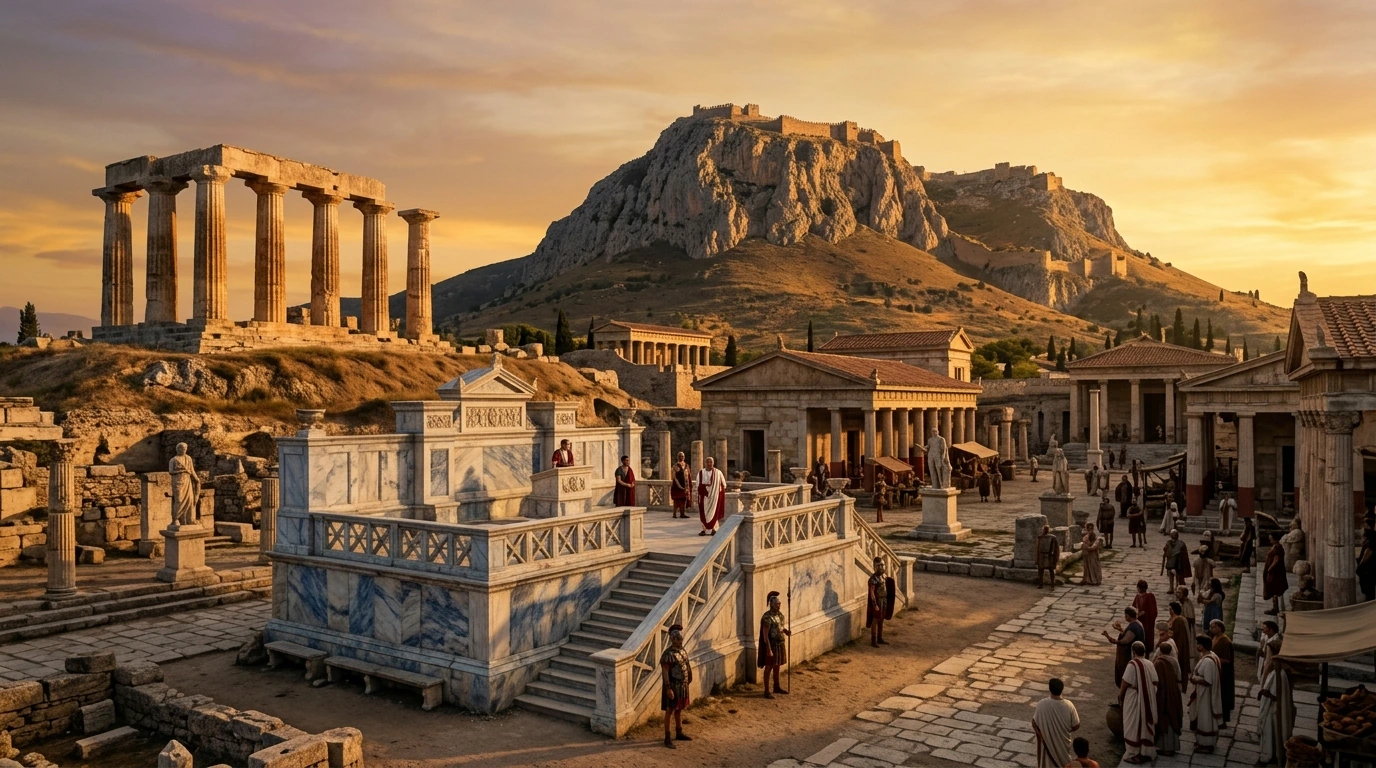
How the Gallio Inscription and the Corinthian Bema Prove the Historical Accuracy of the Book of Acts