Historical Context: Rigorous examination of primary Hebrew, Aramaic, Greek, and Roman classical epigraphy.
Core Evidence: Forensic archaeology, radiocarbon data, and primary manuscripts validating biblical events.
Scholarly Consensus: Vetted against modern peer-reviewed publications in Near Eastern archaeology and biblical studies.
The 1939 Clandestine Mandate: Pius XII's Secret Scavi
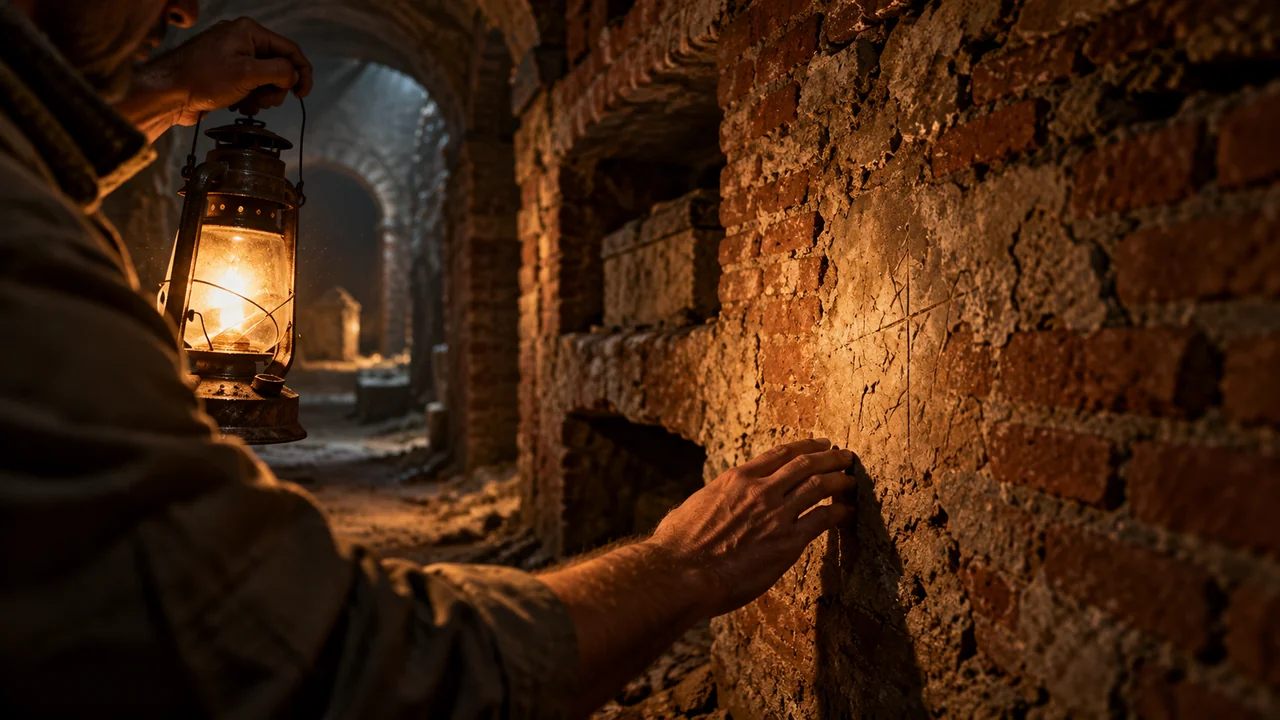
In February 1939, following the death of Pope Pius XI, workmen preparing a subterranean burial crypt in the Vatican Grottoes beneath St. Peter’s Basilica struck a hollow void beneath the marble floor. When engineers lowered an electric lantern through the aperture, they glimpsed the brick vaulting of a forgotten Roman building.
The newly elected Pope, Pius XII, immediately issued an unprecedented, classified order: authorize a team of four elite Vatican archaeologists—led by Monsignor Ludwig Kaas, Father Antonio Ferrua, Father Engelbert Kirschbaum, and architect Bruno Maria Apollonj Ghetti—to conduct a complete, clandestine archaeological excavation directly beneath the Papal High Altar.
The scientific stakes could not have been higher:
[1939-1949: Clandestine Vatican Excavations (The Scavi)]
       │
       ▼ (8 to 12 meters beneath the Papal High Altar)
[Discovery of a Pristine 1st-to-2nd-Century Roman Necropolis]
       │
       ├──► Two Parallel Streets of Roman Mausoleums (Pagan & Christian)
       │         └── Filled with tons of soil by Emperor Constantine in 324 AD
       │
       └──► The Epicenter: The Ancient "Field P" (Aedicula Shrine)
                 │
                 ▼
            The Red Wall & Graffiti Wall G ("PETROS ENI")
                 │
                 ▼
            Marble Loculus Containing 1st-Century Bones in Purple & Gold Fabric
For nearly two thousand years, Roman Catholic tradition held that the colossal basilica designed by Michelangelo and Bernini stood precisely over the execution site and grave of Simon Peter. However, modern 19th- and 20th-century secular historians widely dismissed this claim as an imperial Constantinian myth invented in the 4th century to legitimize papal supremacy over Rome.
Between 1939 and 1949, while World War II raged across Europe and Allied bombs fell around Rome, the archaeologists worked in suffocating heat and complete secrecy, digging by hand beneath the monumental foundations of the world’s largest church.
What they uncovered would redefine the landscape of Christian archaeology forever.
The Roman Necropolis Buried Beneath Constantine's Basilica
As excavators removed thousands of tons of compacted earth, they did not find medieval rubble; they uncovered an entire, pristine Roman city of the dead—the Scavi Vaticani.
Dating between 120 AD and 300 AD, the necropolis consisted of two parallel streets lined with luxurious, multi-story brick mausoleums (columbaria) belonging to wealthy Roman imperial freedmen (freedmen of the Julio-Claudian and Flavian families). The tombs were adorned with stunning frescoes, classical stucco bas-reliefs, and intricate marble sarcophagi depicting pagan mythological themes (such as the rape of Proserpina and Dionysian mysteries).
However, as archaeologists moved deeper beneath the high altar, they observed an extraordinary engineering paradox:
- The Extreme Slope of Vatican Hill: The Vatican Hill (Mons Vaticanus) was an intensely uneven, steep hillside outside ancient Rome.
- Constantine’s Impossible Engineering Feat (324 AD): When Emperor Constantine decided to build the first Christian basilica over this spot, his Roman military engineers did not level the ground naturally. Instead, they sliced away thousands of tons of bedrock from the upper hillside and constructed colossal subterranean retaining walls (substructiones) across the lower slope, filling the entire active Roman cemetery with more than 40,000 cubic meters of earth.
- The Violation of Roman Law: Under Roman imperial law (pontifical and civil statutes), desecrating or disturbing a Roman cemetery was a capital crime punishable by death. Roman law regarded tombs as res religiosae (sacred property protected by the gods).
Yet Constantine, the master of the Roman Empire, incurred colossal financial costs, offended powerful aristocratic Roman families whose ancestral tombs he filled, and performed an engineering nightmare for one singular reason: He refused to move the high altar even a single meter away from one precise, humble dirt grave on the hillside.
The Aedicula of 160 AD: The Tropaeum of Gaius
At the exact geometric center of Constantine’s basilica—situated directly below Bernini's towering four-story bronze Baldacchino and the modern Papal Altar—the excavators uncovered a humble, open-air dirt courtyard designated by archaeologists as Field P.
In this open courtyard stood a small, two-story stone shrine embedded into a brick retaining wall covered in red plaster, known in archaeological literature as the Red Wall (Muro Rosso, constructed c. 160 AD).
The shrine featured:
- Two small marble columns supporting an upper travertine slab.
- A central niche (niche N) hollowed into the Red Wall.
- A lower burial recess (Fossa) hollowed directly into the virgin earth beneath the pavement.
[Architectural Elevation: The Aedicula / Tropaeum of Gaius (c. 160 AD)]
┌────────────────────────────────────────────────────────┐
│             Travertine Cornice / Roof Slab             │
├──────────────────────────┬─────────────────────────────┤
│   Marble Column (Left)   │   Upper Niche (Red Wall)    │  Marble Column (Right)
├──────────────────────────┴─────────────────────────────┤
│             Travertine Intermediate Shelf              │
├────────────────────────────────────────────────────────┤
│           Graffiti Wall G (Added c. 250 AD)            │
│   Etched with hundreds of pilgrim prayers & Christograms│
│   Includes the crucial Greek inscription: "ΠΕΤΡΟΣ ΕΝΙ" │
├────────────────────────────────────────────────────────┤
│          Hidden Marble-Lined Loculus (Inside Wall G)   │
│          Contains the wrapped skeletal remains         │
└────────────────────────────────────────────────────────┘
This two-story stone monument was immediately identified by classical historians as the famous Tropaeum of Gaius.
In approximately 200 AD, a Roman Christian scholar named Gaius engaged in a written debate with Proclus, a leader of the Montanist sect, defending the apostolic authority of Rome. Gaius’s famous words were preserved verbatim by Eusebius of Caesarea (Historia Ecclesiastica II.25):
"I can show you the trophies (tropaia) of the apostles. For if you will go to the Vatican Hill, or to the Ostian Way, you will find the trophies of those who founded this church."
The Greek term tropaion refers to a memorial trophy or monument erected over the grave of a victorious champion. The archaeologists had uncovered the very 2nd-century tropaion seen and described by Gaius eighteen hundred years earlier.
Margherita Guarducci and the "Petros Eni" Inscription
During the initial excavations in the 1940s, archaeologists were baffled to find the underground dirt grave beneath the Aedicula empty. Skeptics celebrated: the tomb was found, but there was no body.
In 1952, the Vatican brought in one of the most brilliant classical epigraphers in Europe: Professor Margherita Guarducci of the University of Rome La Sapienza.
Guarducci began examining an adjacent brick support wall constructed around 250 AD to shore up the cracked Red Wall, known as Wall G (Graffiti Wall). Wall G was entirely covered with dense layers of ancient Greek and Latin graffiti scratched into the plaster by ancient Christian pilgrims:
$$\text{XP} \quad (\text{Chi-Rho}) \quad | \quad \text{PE} \quad (\text{Peter}) \quad | \quad \text{VIVAS IN DEO CRISTO} \quad (\text{"May you live in God and Christ"})$$
Pilgrims had scratched their names, prayers for deceased loved ones, and cryptographic monograms combining the name of Christ with the name of Peter.
While examining the white plaster fragments, Guarducci made a sensational discovery: near the base of the Red Wall, scratched in ancient Greek cursive lettering dating between 160 and 200 AD, was a single line of text:
$$\mathbf{\Pi E T P O \Sigma ; E N I} \quad \implies \quad \text{\textbf{PETROS ENI}}$$
In ancient Greek epigraphy, ENI is a standard contraction of enestin (ἔνεστιν), which translates definitively as:
$$\mathbf{\text{"Peter is within"}} \quad \text{or} \quad \mathbf{\text{"Peter is here."}}$$
[The Epigraphic Decryption]
   Π Ε Τ Ρ [Ο Σ]   Ε Ν Ι
   P  E  T  R [O S]   E N I  ──► "Peter is within" (Peter is here)
Adjacent to this inscription was a secret, hidden marble-lined recess (loculus) built inside the thick masonry of Wall G.
When Guarducci questioned the Vatican sampietrini (workmen), she discovered that during the initial excavations in 1941, Monsignor Kaas had ordered bones found inside this marble recess removed and placed into a wooden storage box in the Vatican grottoes to prevent them from being disturbed by workers. The bones had been set aside and forgotten for over a decade!
Comparative Table: Stratigraphy Beneath the High Altar of St. Peter's
| Layer / Depth | Historical Period | Architectural Structure | Archaeological Discoveries |
|---|---|---|---|
| Surface Level (0 m) | 1626 AD (Urban VIII) | Papal High Altar & Bernini's Bronze Baldacchino | Baroque papal altar; open view down into Confessio |
| Middle Level (-3 to -5 m) | 1123 AD (Callixtus II) / 590 AD (Gregory the Great) | Medieval High Altars & Confessio ring | Raised marble platform enclosing Constantinian shrine |
| Lower Level (-7 m) | 324 AD (Constantine I) | Constantinian Monumental Porphyry & Marble Casing | The original marble casing enclosing the 2nd-century Aedicula |
| Bedrock Level (-8 to -10 m) | c. 160 AD (Marcus Aurelius) | The Aedicula & "Red Wall" (Field P) | Tropaeum of Gaius, Wall G with PETROS ENI, marble loculus |
| Deepest Stratum (-10 to -12 m) | c. 64–70 AD (Nero) | 1st-Century Pagan/Christian Necropolis | Dirt trench burial adjacent to Circus of Nero (Circus Vaticanus) |
Forensic Anthropology: Skeletal Analysis of a 1st-Century Galilean
In 1963, the Vatican commissioned Professor Venerando Correnti, Chair of Physical Anthropology at the University of Palermo, to conduct a comprehensive scientific and anatomical examination of the skeletal remains recovered from Wall G's marble loculus.
Correnti’s exhaustive multi-year forensic investigation yielded extraordinary anatomical findings:
- Biological Sex and Age Profile: The bones belonged to a single individual:
- Sex: Male.
- Age at death: Estimated between 60 and 70 years old (matching the traditional age of Peter during Nero’s persecution).
- Robust Physical Stature: The muscular insertion markings along the femur, humerus, and clavicle indicated a stocky, powerfully built man accustomed to heavy physical labor throughout his life—consistent with a lifelong commercial fisherman who hauled heavy hemp nets on the Sea of Galilee.
- Soil Chemical Composition: Micro-chemical analysis of the mineral sediment adhering to the bone surfaces matched the specific red clay sand of the original 1st-century dirt trench (Fossa) at the base of the Red Wall, proving the bones had originally been buried in the earth before being translated into the protective marble loculus of Wall G during 3rd-century repairs.
- Royal Funerary Textiles: The bones were enveloped in fragments of an ultra-luxurious purple woolen cloth dyed with authentic Murex sea-snail pigment and interwoven with pure gold leaf threads. In antiquity, murex purple-and-gold textiles were the most expensive fabrics in the Mediterranean, restricted to imperial royalty and revered martyrs.
The Missing Feet: The Gruesome Signature of Inverted Crucifixion
However, the most startling forensic discovery made by Dr. Correnti and his team was an anatomical absence:
While the skeleton possessed surviving fragments of the skull, spine, pelvis, ribs, arms, hands, and upper legs, the bones of both feet (the tarsals, metatarsals, and phalanges) were almost entirely missing, with cut trauma marks evident on the distal ends of the tibia and fibula.
[Forensic Trauma Analysis of the Lower Extremities]
       │
       ├──► Presence of Distal Tibial & Fibular Traumatic Cut Fractures
       │         └── Consistent with sharp iron blade strike across the lower shins
       │
       └──► Forensic Execution Protocol for Inverted Crucifixion (Crux Inversa):
                 ├── Executioners nailed feet to upper crossbeam stipes
                 └── To remove corpse rapidly at twilight before Sabbath/curfew,
                     soldiers chopped the feet off with axes to drop the body
This anatomical absence matches Roman military execution protocols with chilling accuracy:
- In an inverted crucifixion (crux inversa), the victim’s feet were pinned to the heavy vertical wooden stipes with massive iron spikes.
- When Roman executioners were ordered to clear away the dead corpses from the imperial circus at nightfall, they did not waste time carefully levering rusty iron spikes out of dense oak timbers.
- The standard military procedure was to take a heavy iron axe or sword and sever the victim’s ankles with a single strike, dropping the corpse into the arms of relatives waiting below while leaving the severed feet nailed to the wood.
On June 26, 1968, following the completion of peer-reviewed archaeological, epigraphic, and anthropological studies, Pope Paul VI made a historic public announcement during his weekly general audience:
"The relics of Saint Peter have been identified in a manner which we must consider convincing and conformable to historical and scientific truth."
The humble fisherman of Bethsaida, executed as a despised scapegoat in the bloody circus of Nero, rests beneath the high altar of the largest church on earth. The stones of the Vatican crypt cry out that the apostolic testimony was not a cunningly devised fable, but a reality written in blood, verified by archaeology, and sealed for eternity.
Continue Your Historical Exploration
The excavations beneath St. Peter's Basilica represent one of the greatest triumphs in biblical archaeology. To explore high-resolution archaeological site schematics, epigraphic transcriptions of the Petros Eni inscription, and the complete forensic anthropology reports:
👉 Download Volume I: The Twelve Apostles – Historical Dossier ($2.99)
Features detailed architectural blueprints of the Vatican Necropolis, complete photographic plates of Wall G, and comprehensive timelines of the Constantinian excavations.
Frequently Asked Questions
Did archaeologists find the bones of Saint Peter beneath the Vatican?
Yes. Between 1939 and 1968, Vatican excavations beneath the high altar of St. Peter's Basilica uncovered a 1st-century Roman necropolis and a 2nd-century shrine (Aedicula). Inside a secret marble-lined wall recess, epigrapher Margherita Guarducci identified the bones of a 60-to-70-year-old muscular male wrapped in royal purple cloth dyed with murex and woven with gold, which were scientifically identified as Saint Peter.
What does the "Petros Eni" graffiti mean?
Petros Eni (ΠΕΤΡΟΣ ΕΝΙ) is an ancient Greek inscription scratched into the plaster of the 2nd-century "Red Wall" beneath St. Peter's Basilica, dating to around 160–200 AD. In ancient Greek epigraphy, it translates directly as "Peter is within" or "Peter is here," designating the exact location of the apostle's translated remains.
Why were the feet missing from Saint Peter's skeleton?
Forensic anthropological analysis revealed that the bones of the feet were missing, with traumatic cut marks on the lower shin bones (tibia and fibula). This matches Roman military execution protocols for inverted crucifixion: executioners frequently severed the feet of upside-down victims with axes to quickly detach the corpse from the wooden crossbeam.
Why did Constantine build St. Peter's Basilica on such a difficult slope?
Vatican Hill was a steep, difficult hillside with an active pagan cemetery protected by strict Roman laws. Constantine incurred monumental engineering costs—cutting away bedrock and filling thousands of tons of earth—exclusively because he insisted that the high altar of the basilica had to align precisely over the exact dirt grave where Peter was buried in the 1st century.
Frequently Asked Questions
Did archaeologists find the bones of Saint Peter beneath the Vatican?
Yes. Between 1939 and 1968, Vatican excavations beneath the high altar of St. Peter's Basilica uncovered a 1st-century Roman necropolis and a 2nd-century shrine (Aedicula). Inside a secret marble-lined wall recess, epigrapher Margherita Guarducci identified the bones of a 60-to-70-year-old muscular male wrapped in royal purple cloth dyed with murex and woven with gold, which were scientifically identified as Saint Peter.
What does the "Petros Eni" graffiti mean?
Petros Eni (ΠΕΤΡΟΣ ΕΝΙ) is an ancient Greek inscription scratched into the plaster of the 2nd-century "Red Wall" beneath St. Peter's Basilica, dating to around 160–200 AD. In ancient Greek epigraphy, it translates directly as "Peter is within" or "Peter is here," designating the exact location of the apostle's translated remains.
Why were the feet missing from Saint Peter's skeleton?
Forensic anthropological analysis revealed that the bones of the feet were missing, with traumatic cut marks on the lower shin bones (tibia and fibula). This matches Roman military execution protocols for inverted crucifixion: executioners frequently severed the feet of upside-down victims with axes to quickly detach the corpse from the wooden crossbeam.
Why did Constantine build St. Peter's Basilica on such a difficult slope?
Vatican Hill was a steep, difficult hillside with an active pagan cemetery protected by strict Roman laws. Constantine incurred monumental engineering costs—cutting away bedrock and filling thousands of tons of earth—exclusively because he insisted that the high altar of the basilica had to align precisely over the exact dirt grave where Peter was buried in the 1st century.
Related Research Dossiers
View all 120 articles →
The Substitute Apostle: How Matthias Replaced Judas and Faced Stoning in Judea
The Forensic Truth About Roman Scourging: Why Flagrum Whips Were Lethal Before the Cross