Historical Context: Rigorous examination of primary Hebrew, Aramaic, Greek, and Roman classical epigraphy.
Core Evidence: Forensic archaeology, radiocarbon data, and primary manuscripts validating biblical events.
Scholarly Consensus: Vetted against modern peer-reviewed publications in Near Eastern archaeology and biblical studies.
The Clash in Patras: Proconsul Aegeas and Maximilla's Conversion
In the late autumn of approximately 60 AD, along the windy Peloponnesian coast of Achaea (southern Greece), the Apostle Andrew—the first disciple called by Jesus of Nazareth (John 1:40)—entered the flourishing Greco-Roman seaport of Patras. A commercial gateway overlooking the Gulf of Corinth, Patras was administered by the Roman imperial proconsul Aegeas (often rendered in Latin texts as Aegeates).
Andrew's public preaching and healing ministries disrupted the social fabric of the city. He challenged the civic worship of the pagan Olympian pantheon, healed the critically ill nobleman Stratocles (the proconsul's brother), and converted Maximilla, the high-born wife of Aegeas himself. Maximilla's subsequent vow of Christian chastity and refusal to participate in Roman sacrificial banquets enraged the proconsul, who viewed Christian theology not merely as philosophical eccentricity, but as an existential threat to Roman marital authority, domestic stability, and civic obedience.
The Latin and Greek versions of the Passio Sancti Andreae Apostoli (The Passion of Saint Andrew) preserve the fiery legal dialogue between the Roman magistrate and the Galilean apostle:
"Aegeas said: 'Are you that Andrew who destroys the temples of the gods and persuades men to adopt that superstitious sect which the emperors of Rome have commanded to be extirpated?' Andrew answered: 'The emperors of Rome have not yet learned what truth the Son of God has taught... The earthly judges who sit in high places must themselves be judged by the Judge of all creation.'"
Aegeas ordered Andrew cast into the deepest dungeon of the praetorium. However, public unrest among the Greek citizenry escalated rapidly. Fearing that executing Andrew immediately by the sword would transform him into an instant martyr and trigger a provincial rebellion, Aegeas devised a calculated, slow-burning sentence intended to break the apostle’s dignity while intimidating the restless populace.
The Tactical Sadism of Rope Suspension (Ligatio vs. Clavatio)
When modern readers picture crucifixion, they universally envision large iron nails (clavi) driven through the wrists and heel bones (calcanei), as confirmed by the famous 1968 archaeological discovery of the crucified man Jehohanan in Giv'at ha-Mivtar, Jerusalem.
However, Roman penal law recognized two distinct methods of cross attachment:
- Crucifixio per Clavationem: Nailing the extremities. While intensely excruciating, iron nails produce rapid, massive vascular trauma, traumatic hemorrhage, and local tissue necrosis, which typically accelerates circulatory shock and death within 12 to 24 hours.
- Crucifixio per Ligationem: Fastening the victim exclusively with heavy hemp or rawhide cords (funes).
[Roman Sentence: Crucifixio per Ligationem]
       │
       ▼
[Tight Hemp Ropes Bound Around Limbs]
       │
       ├──► Prevention of Rapid Exsanguination (No Major Vessel Puncture)
       │         └── Victim's life is deliberately prolonged for days
       │
       ├──► Peripheral Neurovascular Strangulation
       │         └── Compartment syndrome, ischemia, agonizing limb cramping
       │
       └──► Progressive Multi-System Breakdown
                 └── Exposure, hypothermia, dehydration, exhaustion asphyxia
Aegeas explicitly mandated that the executioners use no nails whatsoever, commanding them to bind Andrew’s arms and legs tightly to the wooden beams with coarse ropes. The tactical military motivation was sinister: without arterial or venous puncture, the victim would not bleed out. The heart would continue beating, forcing the condemned man to endure prolonged exposure to the freezing Aegean sea winds, blistering daytime sun, swarming insects, and unrelenting thirst.
From a physiological perspective, suspension by ropes creates progressive peripheral neurovascular strangulation. As the victim's body sags under gravitational pull, the tightly knotted cords act as tourniquets, cutting off superficial venous return while arterial inflow persists. This triggers acute compartment syndrome in the forearms and lower legs, severe peripheral edema, excruciating ischemic muscular spasms, and progressive hyperkalemia as damaged muscle tissue breaks down (rhabdomyolysis).
Forty-Eight Hours of Open-Air Preaching: The Incipient Revolt
The execution of Andrew did not silence his voice; it provided him with an elevated pulpit.
According to the early patristic account preserved in the Acts of Andrew (dating to the mid-2nd century, reconstructed by scholars from Greek and Coptic fragments) and echoed by Saint Gregory of Tours in Liber de Miraculis Beati Andreae Apostoli:
"For two full days he hung alive upon the timber, his voice never failing, nor did his mind grow dark. A crowd of more than twenty thousand citizens surrounded the place of execution, weeping aloud and crying out: 'This is a righteous man! This is a holy teacher! He has done no wrong; why is he made to suffer so cruel a torment?'"
While suspended between earth and sky, overlooking the Gulf of Patras, Andrew preached continuously to the gathered crowds. He expounded upon the mystery of the cross, encouraged the believers to remain steadfast during impending imperial persecutions, and urged the citizens not to avenge his blood with civil violence.
By the second afternoon, the crowd’s grief transformed into fury. An armed mob of twenty thousand citizens surrounded the governor's palace, threatening to drag Aegeas through the streets and burn his villa to the ground unless the apostle was cut down immediately.
Terrified by the prospect of an imperial inquiry from Rome over a preventable provincial riot, Aegeas personally hurried to the execution hill with his praetorian detachment to release Andrew.
When the proconsul approached the cross, Andrew looked down upon him and refused clemency, declaring:
"Why have you come, Aegeas? If you come to believe in Christ, the gates of mercy are open even to you. But if you come merely to loose me, know that I shall not descend alive from this wood. I already see my King waiting to receive me."
As Roman soldiers attempted to cut the ropes, their hands became mysteriously paralyzed with muscular spasms. Witnesses reported that an unearthly, blinding flash of divine light enveloped the cross, rendering the apostle invisible to human eyes for nearly half an hour. When the celestial brilliance finally faded, Andrew had breathed his last.
The Crux Decussata: Ancient History vs. Medieval Heraldry
No discussion of St. Andrew is complete without addressing the famous X-shaped cross, historically known as the Crux Decussata (from the Roman numeral $X$, decussis). Today, this symbol is universally recognized across the globe on the national flag of Scotland (the Saltire), the naval ensigns of the Russian Empire, and countless municipal coats of arms.
However, historical and textual criticism demands honest distinction between ancient documentary evidence and medieval artistic development:
[1st Century AD: Historical Event]
       │ St. Andrew crucified in Patras (Historical reality: Bound with ropes)
       │ Early patristic texts describe an ordinary upright Latin / T-shaped cross
       ▼
[10th to 14th Century: Devotional Evolution]
       │ Medieval iconography in Burgundy, France & Scotland adopts the "Saltire" (X)
       │ Tradition: Andrew chose an X-shape out of reverence to Christ (Greek letter Chi: "X")
       ▼
[Modern Era: Universal Heraldic Identity]
       │ The Scottish Saltire (Flag of St. Andrew) & Saint Andrew's Cross worldwide
- The Patristic Consensus: The earliest 2nd- and 3rd-century manuscripts of the Acts of Andrew do not mention an X-shaped cross; they simply use the standard Greek term stauros (stake or cross) and describe Andrew being bound to two intersecting wooden beams.
- The Medieval Emergence: The first clear artistic depictions of Andrew on an X-shaped diagonal timber emerge in the 10th century in monastic manuscripts from Burgundy and Anglo-Saxon England. By the 14th century, the tradition was formalized across Western Europe: it was asserted that Andrew requested an oblique cross shaped like the Greek letter Chi ($mathrm{X}$), the first letter of Christ’s name in Greek ($mathrm{X} hoiotasigma auacute{o} arsigma$), signifying both adoration and holy unworthiness.
- The Relic Evidence: The physical relic of Andrew's cross preserved in Patras today is indeed an oblique, diagonal wooden structure composed of ancient olive wood, matching the medieval decussata tradition.
Comparative Table: Roman Crucifixion Typologies
| Cross Typology | Latin Designation | Physical Geometry | Notable Historical Execution | Typical Physiological Mechanism |
|---|---|---|---|---|
| Crux Simplex | Single upright stake | Single vertical pole without crossbeam | Mass executions in military sieges; impalement | Piercing through abdominal/thoracic cavity; rapid internal hemorrhage |
| Crux Immissa | Latin Cross | Vertical stipes with horizontal patibulum crossing below top | Jesus of Nazareth, Christian martyrs in Rome | Combined positional asphyxia, dehydration, and nail shock |
| Crux Commissa | Tau Cross ($T$-shape) | Crossbeam placed directly atop vertical beam | Common Roman military executions recorded by Josephus | Rapid gravitational pulling on the thoracic cage; positional suffocation |
| Crux Decussata | Saint Andrew's Cross ($X$-shape) | Two diagonal intersecting beams forming an $X$ | Apostle Andrew in Patras, Greece | Multi-day exposure, neurovascular compartment syndrome, exhaustion |
| Crux Inversa | Inverted Cross | Upright cross turned upside down | Apostle Peter on Vatican Hill, Rome | Acute cerebral venous congestion, intracranial pressure, lung crush |
Archaeological Custody: The Relics of Patras and St. Peter’s Vatican Exchange
The physical relics of Saint Andrew possess one of the most meticulously documented chains of custody in late antique and medieval ecclesiastical archaeology.
In 357 AD, Emperor Constantius II (son of Constantine the Great) ordered Andrew’s body exhumed from Patras and solemnly transferred to the newly consecrated Church of the Holy Apostles in Constantinople, where it rested alongside the relics of Saint Luke and Saint Timothy.
However, the apostle's head and the surviving fragments of his cross remained in Patras. During the Fourth Crusade in 1204, French and Italian crusaders looted Byzantine treasures; cardinal Peter of Capua transferred major relics to Amalfi Cathedral in southern Italy.
[Martyrdom at Patras (c. 60 AD)]
       ├──► Body transferred to Constantinople (357 AD) ──► Amalfi Cathedral (1208 AD)
       │
       └──► Holy Head & Wooden Cross kept in Patras
                 │
                 ▼ (1462 AD: Turkish Ottoman Invasion)
            Entrusted to Pope Pius II in Rome (Housed inside St. Peter's Basilica pillar)
                 │
                 ▼ (September 26, 1964: Historic Ecumenical Restitution)
            Pope Paul VI returns Holy Head to Patras as gesture of Orthodox-Catholic unity
In 1462, as Ottoman Turkish armies swept through southern Greece, Thomas Palaeologus, the Byzantine Despot of the Morea, fled Patras carrying the holy skull of St. Andrew to prevent its desecration. He presented it to Pope Pius II in Rome. The relic was enshrined with imperial honors inside one of the four monumental pier niches surrounding the high altar of St. Peter's Basilica, directly opposite the tomb of his brother Peter.
In an unprecedented historic gesture on September 26, 1964, Pope Paul VI officially returned the skull of Saint Andrew to the Greek Orthodox Church in Patras. Today, pilgrims and historical researchers can examine the apostle’s skull, enclosed in a gilded silver reliquary, alongside the preserved diagonal olive-wood cross timbers at the magnificent Cathedral of Saint Andrew in Patras, standing on the exact traditional shore of his ancient martyrdom.
The Theological Testament: Welcoming the Timber of Glory
In classical Roman culture, crucifixion was regarded with unspeakable dread. The Roman orator Cicero declared in his Pro Rabirio Postumo: "The very word 'cross' should be far removed not only from the person of a Roman citizen, but from his thoughts, his eyes, and his ears."
Yet when Andrew first caught sight of his cross standing on the rocky bluffs of Patras, ancient witnesses record that he did not scream, flee, or curse his captors. Instead, he uttered a hymn of sacred greeting that has resonated through liturgical history:
"O cross most welcome, long desired, deeply loved, and now made ready for my longing soul! Confident and rejoicing do I come to you; receive me with gladness as a disciple of Him who hung upon you, that through you He may receive me, who through you redeemed me."
To the Roman Empire, the cross was the ultimate instrument of terror—a weapon designed to enforce imperial subjugation through public humiliation. To the Apostle Andrew, it was the gate of eternal life. His two days of heroic endurance on the wind-swept cross of Patras demonstrated that the message of the Galilean rabbi was a revolutionary conviction that no legion, emperor, or magistrate could ever extinguish.
Continue Your Historical Exploration
Andrew's resolute courage in Patras reveals the unbreakable psychological conviction of the 1st-century apostolic eyewitnesses. Discover the complete primary sources, forensic medical analyses, and archaeological documentation:
👉 Download Volume I: The Twelve Apostles – Historical Dossier ($2.99)
Includes translated Greek manuscripts of the Acts of Andrew, forensic diagrams of ancient cross mechanics, and complete relic inventories.
Frequently Asked Questions
Why was Saint Andrew crucified on an X-shaped cross?
According to medieval church tradition, Andrew requested an X-shaped cross (Crux Decussata) out of deep humility, deeming himself unworthy to suffer on a cross shaped like that of Jesus Christ, while also honoring the Greek letter Chi (X), the first letter of Christ’s name in Greek. Early 2nd-century accounts describe him simply bound to wooden timbers.
Why did the Romans use ropes instead of nails for Andrew?
Roman Proconsul Aegeas explicitly ordered executioners to bind Andrew with ropes (ligatio) rather than driving iron nails into his limbs (clavatio). The cruel objective was to avoid rapid blood loss, thereby deliberately prolonging his agony over multiple days under exposure to cold winds, thirst, and sun.
How long did Saint Andrew survive on the cross?
Ancient patristic sources, including the Acts of Andrew and Gregory of Tours, record that Andrew hung alive upon the cross for two full days (approximately 48 hours), continuously preaching to crowds of over 20,000 Greek citizens until his death.
Where are Saint Andrew’s relics today?
The holy skull of Saint Andrew and the preserved wooden cross timbers are venerated at the Cathedral of Saint Andrew in Patras, Greece, after being returned by Pope Paul VI from St. Peter’s Basilica in 1964 as a monumental gesture of reconciliation between the Roman Catholic and Eastern Orthodox churches.
Frequently Asked Questions
Why was Saint Andrew crucified on an X-shaped cross?
According to medieval church tradition, Andrew requested an X-shaped cross (Crux Decussata) out of deep humility, deeming himself unworthy to suffer on a cross shaped like that of Jesus Christ, while also honoring the Greek letter Chi (X), the first letter of Christ’s name in Greek. Early 2nd-century accounts describe him simply bound to wooden timbers.
Why did the Romans use ropes instead of nails for Andrew?
Roman Proconsul Aegeas explicitly ordered executioners to bind Andrew with ropes (ligatio) rather than driving iron nails into his limbs (clavatio). The cruel objective was to avoid rapid blood loss, thereby deliberately prolonging his agony over multiple days under exposure to cold winds, thirst, and sun.
How long did Saint Andrew survive on the cross?
Ancient patristic sources, including the Acts of Andrew and Gregory of Tours, record that Andrew hung alive upon the cross for two full days (approximately 48 hours), continuously preaching to crowds of over 20,000 Greek citizens until his death.
Where are Saint Andrew’s relics today?
The holy skull of Saint Andrew and the preserved wooden cross timbers are venerated at the Cathedral of Saint Andrew in Patras, Greece, after being returned by Pope Paul VI from St. Peter’s Basilica in 1964 as a monumental gesture of reconciliation between the Roman Catholic and Eastern Orthodox churches.
Related Research Dossiers
View all 120 articles →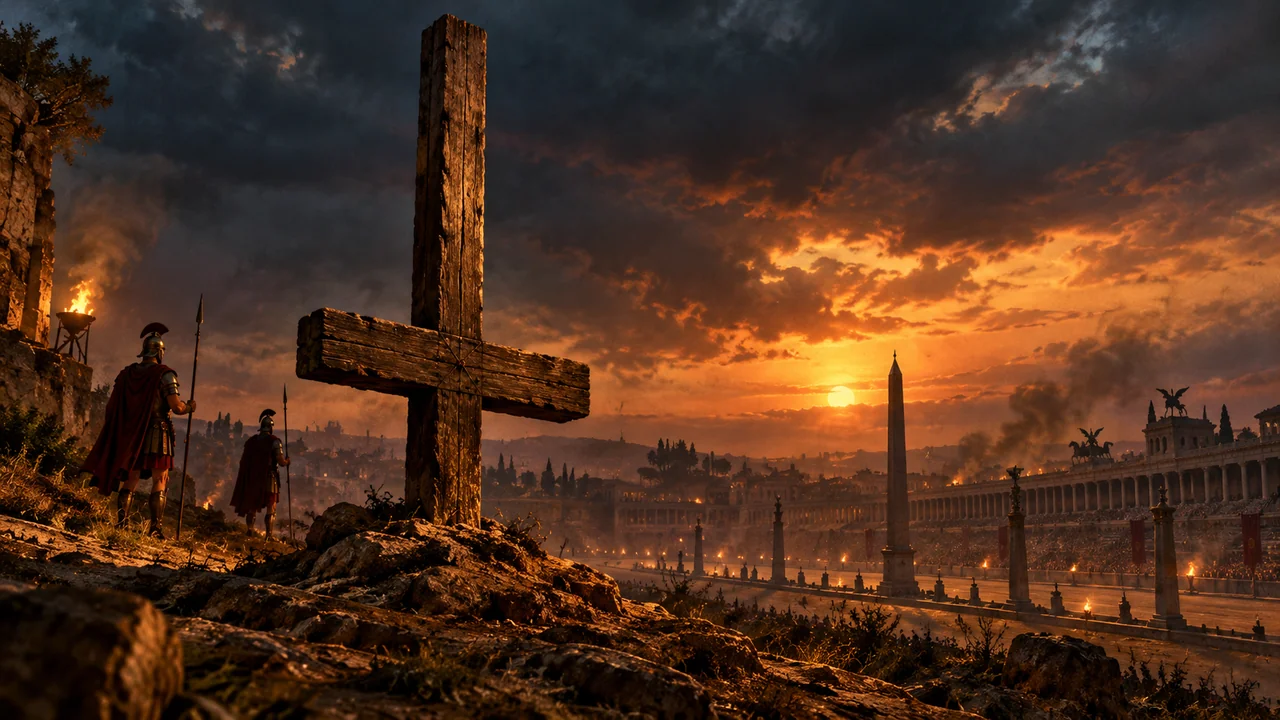
Why St. Peter Demanded an Inverted Cross: The Forensic and Historical Reality of Nero's Circus
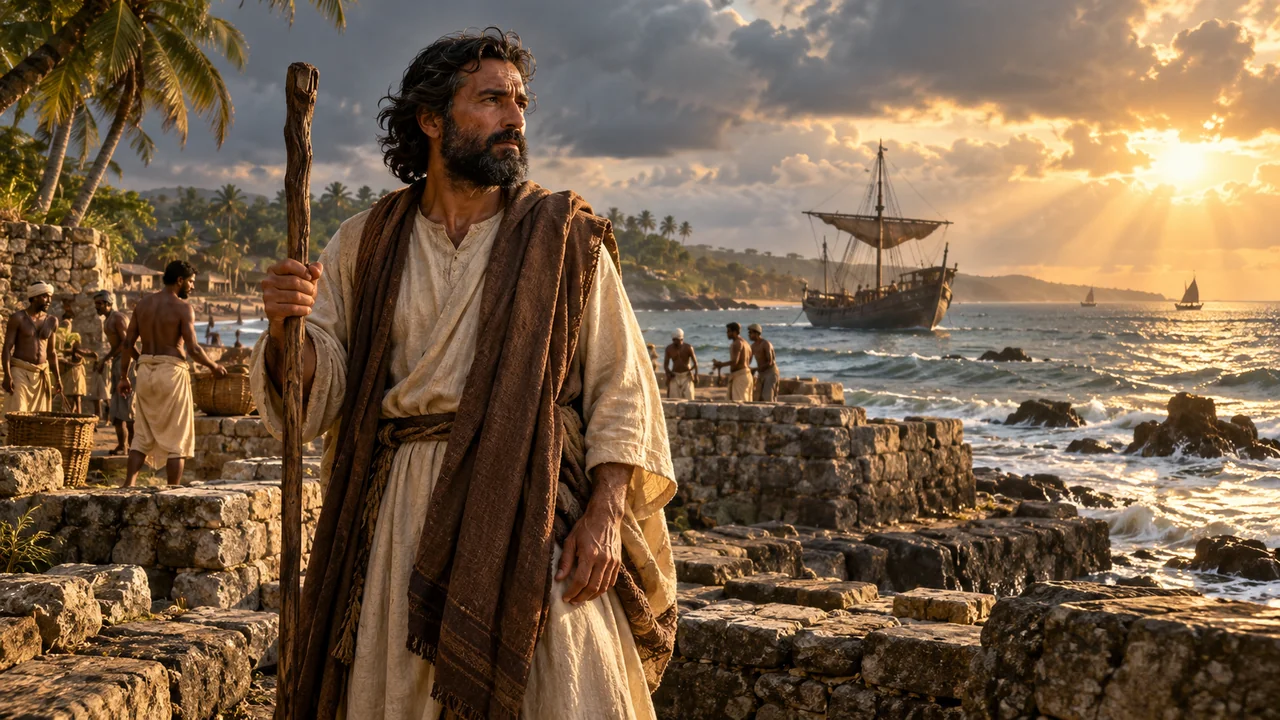
The Spear at Mylapore: Did the Apostle Thomas Really Build Churches in Ancient India?