Historical Context: Rigorous examination of primary Hebrew, Aramaic, Greek, and Roman classical epigraphy.
Core Evidence: Forensic archaeology, radiocarbon data, and primary manuscripts validating biblical events.
Scholarly Consensus: Vetted against modern peer-reviewed publications in Near Eastern archaeology and biblical studies.
The Terror of Domitian: "Dominus et Deus" and the Ephesian Arrest
Toward the twilight of the 1st century, approximately 92 to 95 AD, the Roman Empire fell under the paranoid, tyrannical rule of Titus Flavius Domitianus (Emperor Domitian), the last ruler of the Flavian dynasty. Unlike his father Vespasian or his brother Titus, Domitian demanded absolute divine homage from all Roman subjects, officially mandating that he be addressed in all legal petitions and imperial courts as Dominus et Deus—"Lord and God" (Suetonius, De Vita Caesarum, Domitian XIII.2).
In the Roman province of Asia (modern Turkey), the city of Ephesus was the bustling commercial and cultural metropolis of the Aegean. It was also the home of the last surviving member of Jesus’s original twelve disciples: John the Apostle, the son of Zebedee, revered across Asia Minor as the "Beloved Disciple" and author of the Fourth Gospel.
John’s ministry openly rebuked the imperial cult. While civic statues of Domitian were erected throughout Ephesus and daily incense was burned on municipal altars proclaiming Caesar’s divinity, John and the churches of Asia proclaimed that Jesus Christ alone was Lord of heaven and earth.
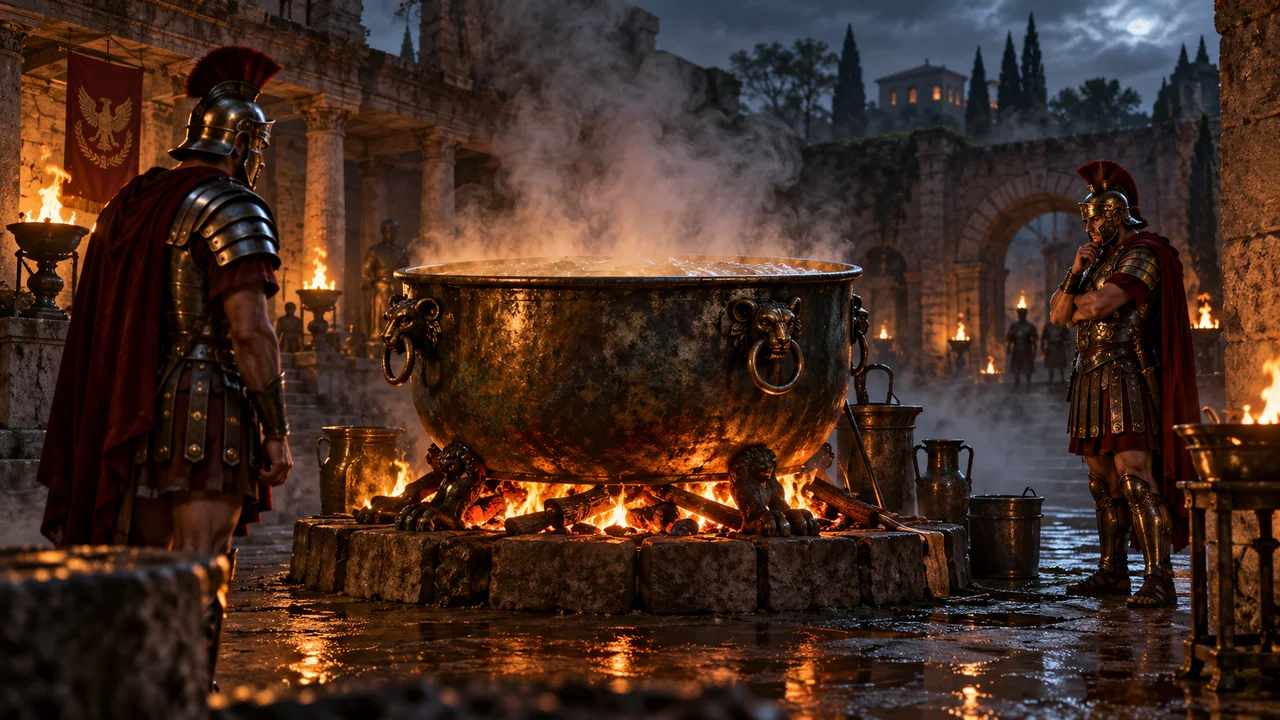
According to ancient patristic chronicles, the Roman proconsul of Asia arrested John and, recognizing his high stature throughout the East, had the elderly apostle chained and dispatched by imperial galley directly to Rome for formal trial before Emperor Domitian himself.
Tertullian's Testimony at the Porta Latina (Latin Gate)
The most famous and authoritative historical witness to John’s Roman ordeal comes from the North African Christian apologist Tertullian of Carthage (c. 155–220 AD). Writing barely a century after the event in his celebrated legal defense De Praescriptione Haereticorum (The Prescription of Heretics, Chapter 36), Tertullian compares the glory of Rome's apostolic witnesses:
"How happy is that church, where the apostles poured forth all their doctrine along with their blood! Where Peter endures a passion like his Lord's; where Paul wins his crown in a death like John the Baptist's; where the Apostle John, after having been plunged into boiling oil, suffered nothing, and was thence banished to an island!"
[Imperial Arrest in Ephesus (c. 92-95 AD)]
       │ (Escorted under Praetorian guard)
       ▼
[Arraignment before Domitian at Rome's Latin Gate (Porta Latina)]
       │
       ▼
[Public Execution Order: Immersion into Cauldron of Boiling Oil]
       │
       ├──► Physical Phenomenon: Total Thermal Immunity (No Cellular Burn)
       │         └── Amazement of Praetorians and Pagan Spectators
       │
       └──► Imperial Sentence Commuted: "Relegatio in Insulam"
                 └── Hard Labor Banishment to the Granite Mines of Patmos
The designated location for this macabre public execution was near the Porta Latina (the Latin Gate), an ancient gate in the Aurelian Walls where criminals and treasonous rebels were condemned before entering Rome along the Via Latina.
Saint Jerome (c. 347–420 AD), the master translator of the Latin Vulgate, confirmed this ancient event in his Commentary on Matthew (20:23) and in Adversus Jovinianum (I.26), writing:
"John was a martyr, because he was put into a vat of boiling oil, and although he came out clean and refreshed rather than harmed, nevertheless the intention of martyrdom was fully accomplished."
The memory was so indelible in the collective consciousness of the early Roman church that an ancient oratory was constructed on the site—known today as the 5th-century chapel of San Giovanni in Oleo (Saint John in Oil)—standing adjacent to the basilica of San Giovanni a Porta Latina.
The Thermal Physics of Boiling Oil vs. Human Tissue
To understand the sheer magnitude of the historical event recorded by Tertullian and Jerome, one must analyze the physical and forensic thermal dynamics of boiling oil (oleum fervens).
In ancient Roman penal cruelty, plunging an agitator into a vat of boiling oil or liquefied pitch was among the most terrifying forms of execution, reserved for political traitors and runaway slaves.
- Boiling Point Disparity: While water boils at $100^circmathrm{C}$ ($212^circmathrm{F}$), the boiling point of extra virgin olive oil (oleum olivarum) ranges between $190^circmathrm{C}$ and $215^circmathrm{C}$ ($374^circmathrm{F}$ to $419^circmathrm{F}$)—more than double the thermal intensity of boiling water.
- Thermal Conductivity and Viscosity: Unlike boiling water, which quickly evaporates and sheds heat, heated oil has high viscosity and hydrophobic adherence. It clings to human skin, sealing in radiant heat and transferring thermal kinetic energy directly into biological tissues with catastrophic speed.
- Forensic Pathology of Full Immersion:
- Within 0.5 seconds of immersion, full-thickness (third-degree) burns occur. The stratum corneum, epidermis, and dermis undergo instantaneous coagulative necrosis.
- Within 3 to 5 seconds, subcutaneous fat liquefies and muscle proteins denature, triggering explosive fluid vaporization within cellular membranes.
- Within 15 seconds, massive systemic shock, acute neurogenic shock from widespread peripheral nerve destruction, and respiratory failure from inhaling vaporized toxic hydrocarbons result in instantaneous fatality.
For an elderly man in his eighties or nineties to be submerged into a bronze cauldron of boiling oil and emerge completely unscathed—retaining intact skin, undamaged hair, and clear respiratory function—was perceived by the Roman praetorians, magistrates, and gathered citizens as an undeniable suspension of natural physical laws.
Roman Jurisprudence: The Penalty of "Relegatio in Insulam"
Why didn't Emperor Domitian simply order his praetorian executioners to decapitate John with a gladius, as Nero had done to Paul?
The answer lies in the intricate complexities of Roman criminal law and ancient religious superstition:
[Ancient Roman Legal Dilemma]
       │
       ├──► Superstition: Visible divine protection was feared as "Maligna Magia" (Sorcery)
       │         └── Imperial executions could not be repeated if the gods explicitly forbade it
       │
       └──► Solution: "Relegatio in Insulam" (Civil Banishment)
                 ├── Stripping of civic status and legal voice
                 └── Banishment to isolated penal quarries (Patmos) to die of natural exposure
- Fear of Divine Retribution (Nefas): Roman polytheism was deeply superstitious. When an execution failed through extraordinary or inexplicable circumstances, pagan magistrates feared that an unknown, powerful deity (numen) was actively protecting the accused. To strike the victim again with iron after such an omen was considered nefas (a sacrilege against the cosmos) that could bring imperial catastrophe upon the city of Rome.
- The Legal Framework of Relegatio: Rather than declaring him innocent, Domitian utilized the Roman legal sentence of Relegatio in Insulam (penal deportation to an island). Unlike deportatio, which involved total confiscation of property and immediate civil death, relegatio removed the individual from public society and isolated them on a remote penal island without officially executing them, silencing their influence while avoiding public martyrdom.
Eusebius of Caesarea confirms this legal transition in his Historia Ecclesiastica (Book III, Chapter 18):
"In this persecution, it is reported that the Apostle and Evangelist John, who was yet alive, was condemned to dwell on the island of Patmos on account of his testimony to the divine word."
Comparative Table: Apostolic Martyrdoms vs. John's Natural Longevity
| Apostle | Method of Death | Historical Location | Preserved Primary Sources | Theological Distinction |
|---|---|---|---|---|
| Peter | Inverted Crucifixion | Rome (Vatican Hill) | Tacitus, Eusebius (Hist. Eccl. III.1), Origen | Surrendered life in humble imitation of Christ |
| Paul | Decapitation by Sword | Rome (Via Ostiensis) | 1 Clement, Tertullian, Acts of Paul | Roman citizen’s honorable capital sentence |
| Andrew | 2-Day Rope Crucifixion | Patras, Greece | Acts of Andrew, Gregory of Tours | Patient endurance and open-air witness |
| James the Greater | Executed by Gladius | Jerusalem | Acts 12:1–2, Eusebius / Clement | First apostle to seal his witness with blood |
| Bartholomew | Flaying & Decapitation | Albanopolis, Armenia | Armenian Chronicles, Isidore of Seville | Endured ultimate anatomical excoriation |
| John the Beloved | Natural Death in Old Age (survived boiling oil) | Ephesus / Patmos | Tertullian, Irenaeus, Polycarp, Jerome | "Martyr in Will, Confessor in Flesh" |
The Aegean Penal Colony: The Volcanic Mines of Patmos
Banished to Patmos, a crescent-shaped volcanic island in the Icarian Sea measuring barely 13 square miles, John entered a desolate imperial penal quarry.
Under Roman administration, exiled prisoners on Aegean penal islands were subjected to grueling labor in limestone and granite quarries (damnatio ad metalla). Clothed in rags, chained with iron fetters, and subsisting on meager rations of barley bread and brackish water, the elderly apostle climbed the jagged volcanic ridges of Patmos.
It was in this stark, rugged sanctuary—inside a volcanic fissure known today as the Cave of the Apocalypse—that John received the grandest prophetic revelation in human history:
"I, John, your brother and companion in the suffering and kingdom and patient endurance that are ours in Jesus, was on the island of Patmos because of the word of God and the testimony of Jesus. On the Lord’s Day I was in the Spirit, and I heard behind me a loud voice like a trumpet..." — Revelation 1:9–10
Following the assassination of Emperor Domitian in his imperial palace in September of 96 AD, the Roman Senate issued a decree of damnatio memoriae, canceling the cruel dictator’s unjust decrees. The new benevolent Emperor Nerva released all political and religious exiles.
John was permitted to return across the Aegean to Ephesus, where his close disciple Saint Polycarp of Smyrna and later Saint Irenaeus of Lyons recorded that he lived to an extreme old age, writing his Gospel and pastoral epistles before falling asleep peacefully in Christ around 100 AD during the reign of Emperor Trajan.
Theology of the Cup: "Martyr in Will, Confessor in Flesh"
John’s supernatural preservation at the Latin Gate resolved a profound scriptural mystery found in the Gospels.
In Matthew 20:20–23, the mother of James and John approached Jesus, asking that her two sons might sit on his right and left in his kingdom. Jesus answered directly:
"You do not know what you are asking. Can you drink the cup that I am to drink?" They answered: "We can." Jesus replied: "You will indeed drink my cup..."
James drank the cup of martyrdom first, falling by the sword of Herod Agrippa I in 44 AD (Acts 12:2). But how could Jesus's prophetic promise apply to John if he died of natural old age in Ephesus?
The early Church Fathers recognized that John drank the cup to its very dregs:
- He was hunted, chained, and dragged across the Mediterranean.
- He surrendered his physical body to the flames of the boiling cauldron at the Porta Latina.
- He bore the exhaustion, hunger, and cold of the imperial quarries of Patmos.
As early Christian theologians formulated: John was Martyr non morte sed voluntate—a martyr not by the termination of physical breath, but by the absolute willingness of his soul. He proved that whether Christ calls his servants to seal their testimony in the arena through a violent death, or to endure decades of patient fidelity through the solitude of old age, the crown of apostolic faithfulness shines with identical eternal brilliance.
Unearth the Entire Historical Record of the Twelve
The survival of Apostle John and the martyrdoms of his companions form the unshakeable foundation of historical Christianity. Discover the complete academic dossiers, Greek transcripts, and forensic insights:
👉 Download Volume I: The Twelve Apostles – Historical Dossier ($2.99)
Features the complete texts of early patristic testimonies, historical timelines of the Flavian emperors, and high-resolution maps of 1st-century Aegean trade and exile routes.
Frequently Asked Questions
Did the Apostle John really survive a cauldron of boiling oil?
Yes, according to the ancient historical tradition preserved by early church father Tertullian of Carthage in De Praescriptione Haereticorum (c. 200 AD) and reaffirmed by Saint Jerome. The event occurred near Rome's Latin Gate (Porta Latina) under Emperor Domitian, where John emerged unharmed through divine preservation.
Why was John banished to Patmos instead of executed?
Roman criminal law and pagan superstition held that when a capital execution failed due to an apparent supernatural intervention, repeating the execution was considered an affront to the gods (nefas). Consequently, Emperor Domitian commuted the sentence to Relegatio in Insulam—penal banishment to the volcanic quarries of Patmos.
What is the difference between a "Martyr" and a "Confessor"?
In early Christian theology, a martyr (witness) was someone who sealed their faith with physical death, whereas a confessor was someone who endured severe persecution, torture, imprisonment, or exile for Christ but survived to die a natural death. John is uniquely revered as both: a "martyr in will, confessor in flesh."
Did any of the original twelve apostles die of natural causes?
Yes. John the Apostle is the only member of the original twelve disciples historically recorded to have died of natural causes in old age. According to Irenaeus, Polycarp, and Eusebius, John returned from exile on Patmos and lived in Ephesus until approximately 100 AD during the reign of Emperor Trajan.
Frequently Asked Questions
Did the Apostle John really survive a cauldron of boiling oil?
Yes, according to the ancient historical tradition preserved by early church father Tertullian of Carthage in De Praescriptione Haereticorum (c. 200 AD) and reaffirmed by Saint Jerome. The event occurred near Rome's Latin Gate (Porta Latina) under Emperor Domitian, where John emerged unharmed through divine preservation.
Why was John banished to Patmos instead of executed?
Roman criminal law and pagan superstition held that when a capital execution failed due to an apparent supernatural intervention, repeating the execution was considered an affront to the gods (nefas). Consequently, Emperor Domitian commuted the sentence to Relegatio in Insulam—penal banishment to the volcanic quarries of Patmos.
What is the difference between a "Martyr" and a "Confessor"?
In early Christian theology, a martyr (witness) was someone who sealed their faith with physical death, whereas a confessor was someone who endured severe persecution, torture, imprisonment, or exile for Christ but survived to die a natural death. John is uniquely revered as both: a "martyr in will, confessor in flesh."
Did any of the original twelve apostles die of natural causes?
Yes. John the Apostle is the only member of the original twelve disciples historically recorded to have died of natural causes in old age. According to Irenaeus, Polycarp, and Eusebius, John returned from exile on Patmos and lived in Ephesus until approximately 100 AD during the reign of Emperor Trajan.
Related Research Dossiers
View all 120 articles →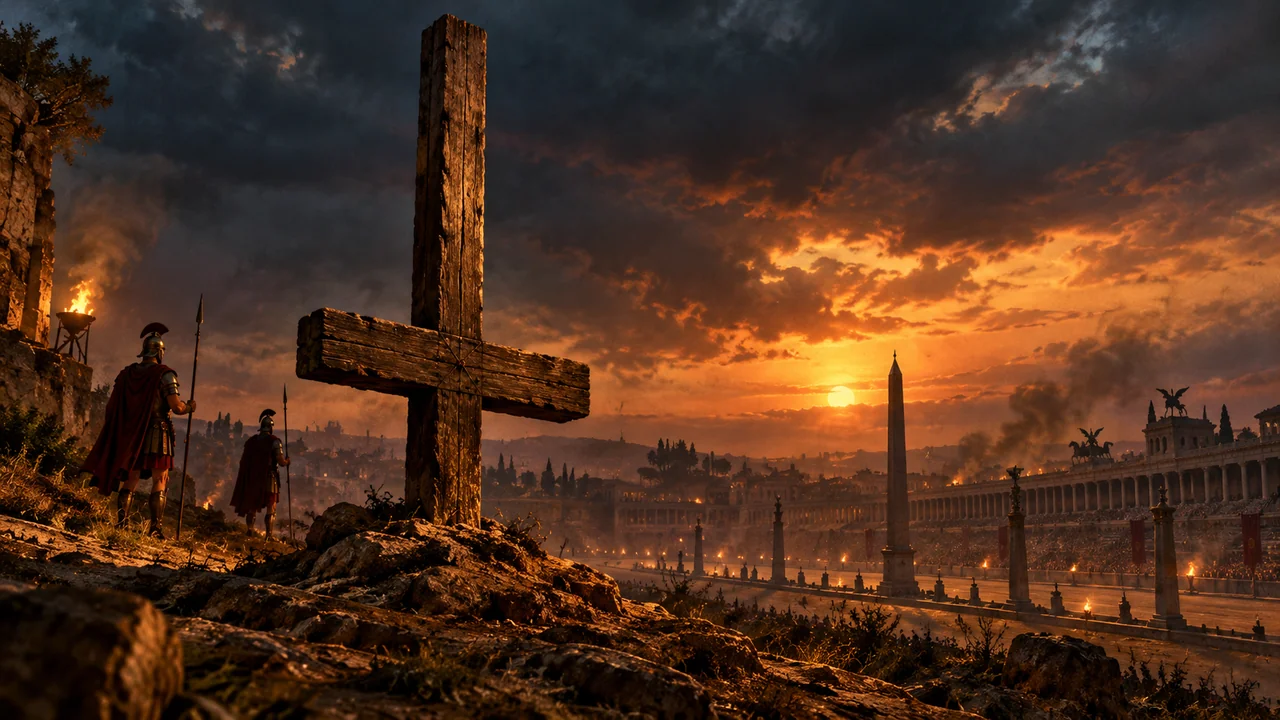
Why St. Peter Demanded an Inverted Cross: The Forensic and Historical Reality of Nero's Circus
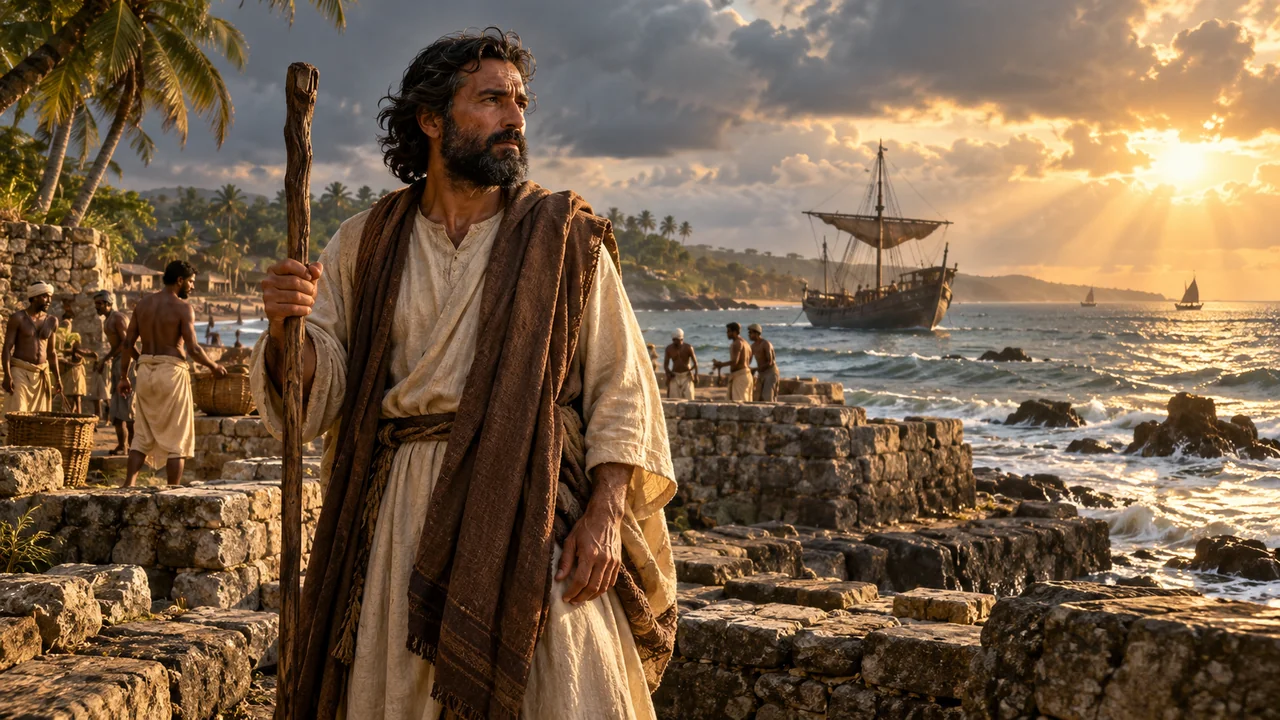
The Spear at Mylapore: Did the Apostle Thomas Really Build Churches in Ancient India?