Historical Context: Rigorous examination of primary Hebrew, Aramaic, Greek, and Roman classical epigraphy.
Core Evidence: Forensic archaeology, radiocarbon data, and primary manuscripts validating biblical events.
Scholarly Consensus: Vetted against modern peer-reviewed publications in Near Eastern archaeology and biblical studies.
The Monsoon Winds: Rome's Maritime Superhighway to India
For centuries, modern Western skeptics viewed the tradition that the Apostle Thomas traveled to the subcontinent of India as nothing more than pious Oriental folklore. How could an uneducated Galilean fisherman traverse thousands of miles across treacherous deserts and uncharted seas to establish churches along the tropical Malabar coast?
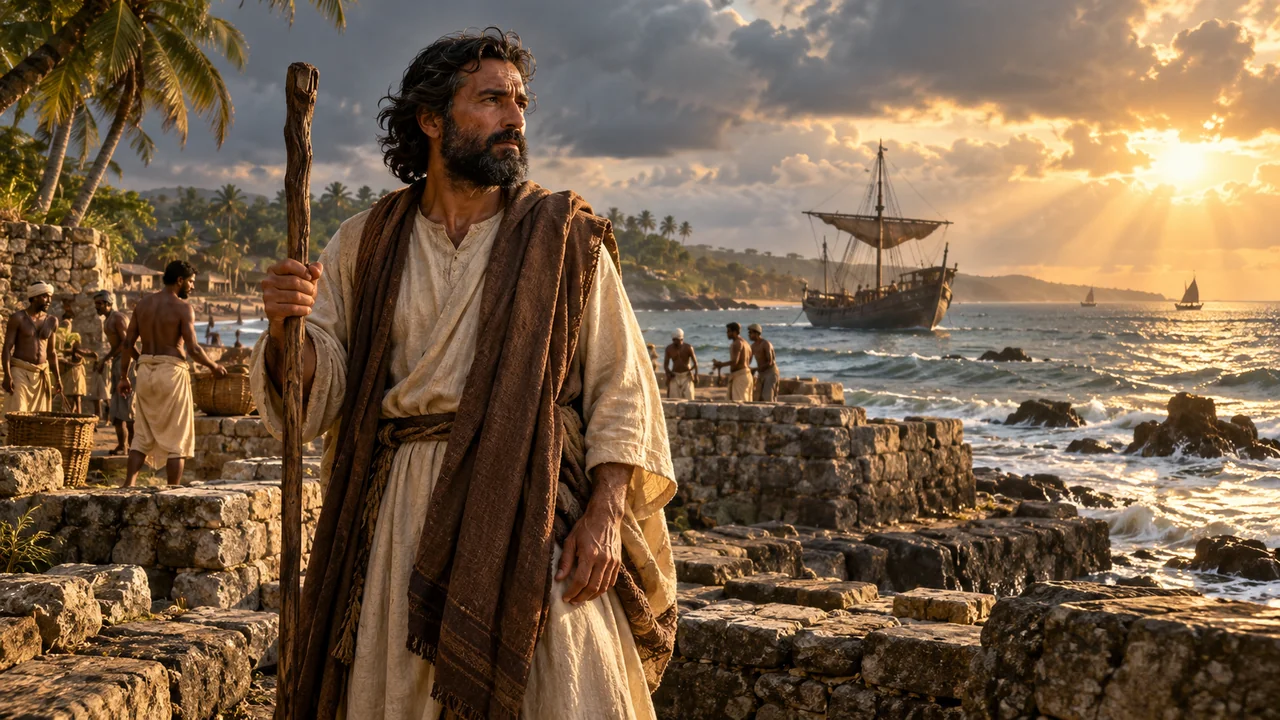
The answer to this historical enigma was unlocked not by theologians, but by classical maritime historians and nautical archaeologists. During the 1st century AD—the precise lifespan of the apostles—the Roman Empire and the kingdoms of ancient India were linked by an extraordinarily sophisticated, high-volume maritime trade network.
A 1st-century Greek navigational manual written by an anonymous merchant captain, titled the Periplus Maris Erythraei (Periplus of the Erythraean Sea, c. 40–70 AD), provides direct empirical documentation of this intercontinental corridor:
"The voyage to these ports is made directly across the ocean from Cana or from Cape Guardafui, by utilizing the wind Hippalus... ships bound for Damirica (Tamil country) set their course across the open sea, aided by the southwest monsoon winds, arriving at the bustling emporium of Muziris in forty days."
[Port of Alexandria, Egypt]
       │ (Nile river barge)
       ▼
[Coptos Desert Caravan Route]
       │ (12 days camel transit)
       ▼
[Red Sea Ports: Berenike / Myos Hormos]
       │
       ▼ (Etesian / Southwest Monsoon Winds: 40 Days Open Ocean)
[Muziris / Malabar Coast, Ancient India (Kerala)]
Roman appetite for black pepper, Malabar cardamom, cinnamon, fine silk, and South Indian pearls was insatiable. Pliny the Elder, writing in his Naturalis Historia (VI.101) during the reign of Vespasian, famously complained that India drained the Roman treasury of more than 50 million sesterces annually. Roman vessels departing from the Red Sea ports of Berenike and Myos Hormos measured over 180 feet in length and carried hundreds of passengers, soldiers, and merchants.
In 52 AD, embarking on an Alexandrian grain and trade galley to sail directly to the Malabar coast was not a miraculous impossibility; it was a well-traveled imperial trade route.
The Acts of Thomas and the Vindication of King Gondophares
The primary literary source recording Thomas’s eastern expedition is the Acts of Thomas, a Syriac composition dating to the early 3rd century. For generations, academic scholars dismissed this text as an imaginative Gnostic romance. The narrative asserted that the Apostle Thomas was commissioned by an Indian royal merchant named Habban to construct a magnificent palace for a ruler named Gondophares, King of India.
Nineteenth-century European historians declared "King Gondophares" to be a complete historical fiction, noting that no Indian king by that name existed in any classical Greek, Roman, or Hindu literary chronicle.
Then came one of the most stunning numismatic vindications in biblical archaeology:
- The 1834 Afghan Coin Hoard: In the Kabul valley, British explorer Charles Masson unearthed thousands of ancient bronze and silver coins bearing Greek and Kharosthi inscriptions: "Maharaja Rajadiraja Tratarasa Gudupharasa" (Great King of Kings, Savior Gondophares).
- The Takht-i-Bahi Stone Inscription: In 1872, an ancient stone slab was discovered at the Buddhist monastery complex of Takht-i-Bahi near Peshawar (modern Pakistan). The inscription explicitly dated Gondophares’s reign: year 26 of his rule, corresponding precisely to 20 to 46 AD—aligning perfectly with the apostolic era.
- Territorial Boundary Match: Archaeological evidence proved Gondophares ruled an expansive Indo-Parthian kingdom spanning southeastern Afghanistan, Pakistan, and northwestern India.
The author of the early Syriac Acts of Thomas had preserved the authentic name and imperial title of a 1st-century Indo-Parthian monarch that had vanished from all Western historical records for over 1,700 years. This accurate political memory could only have originated from an eyewitness account preserved in 1st-century Mesopotamia and India.
The Living Tradition: The Saint Thomas Christians (Nasranis) of Kerala
Unlike apostolic traditions in the West that were often retroactively constructed by imperial decrees, the Christian presence in India boasts an unbroken, organic living community known as the Mar Thoma Nasranis (Saint Thomas Christians) of Kerala.
When Portuguese explorers led by Vasco da Gama arrived on the Malabar coast in 1498, they expected to find only Hindu rajahs and Muslim traders. To their utter astonishment, they encountered a thriving Christian community of over 100,000 members organized into established episcopal dioceses. These Christians:
- Spoke Malayalam but utilized East Syriac (Aramaic) as their liturgical language—the very language spoken by Jesus and Thomas in 1st-century Palestine.
- Preserved ancient oral songs (Margam Kali and Rabban Pattu), transmitted through continuous priestly lineages, recording Thomas landing at the ancient port of Kodungallur (Muziris) in 52 AD.
- Documented the establishment of seven original community centers (Ezharappallikal): Kodungallur, Palayoor, Kottakkavu, Kokkamangalam, Nilackal, Niranam, and Kollam.
- Maintained a distinct high-caste social standing confirmed by ancient copper-plate royal charters (Tharisapalli plates) granted by local Hindu kings granting them hereditary commercial and civic privileges.
Early church fathers independently confirmed this Indian apostolic community centuries before the Portuguese arrival. Saint Ephrem the Syrian (c. 306–373 AD), writing from Edessa in northern Mesopotamia, composed liturgical hymns praising the merchant who brought Thomas’s bones from India:
"The sunburnt India hath blessed the memory of Thomas... A land of dark people was enlightened by the radiant pearl of the Apostle."
Similarly, Saint Gregory of Nazianzus (329–390 AD) declared: "Were not the apostles strangers among the many nations they converted? ... Peter indeed may belong to Judea, but Paul to the Gentiles, Luke to Achaia, and Thomas to India."
The Bleeding Cross and the Ballistics of the Mylapore Spear Strike
According to both the Syriac Acts of Thomas and local Tamil oral history, after establishing Christian assemblies along the western Malabar coast, Thomas journeyed across the Deccan peninsula to the Coromandel coast (modern Chennai/Madras).
In Mylapore, then an important international trade center and temple town, Thomas’s preaching against animal sacrifices and the local priestly elite sparked violent civic resistance. In approximately 72 AD, while praying atop a rocky hill—known today as St. Thomas Mount (Parangimalai)—the apostle was ambushed by hostile local temple partisans and imperial guards.
[Condemnation on St. Thomas Mount]
       │
       ▼
[Ambush During Solitary Prayer]
       │
       ├──► Weapon: Heavy Iron Hunting Spear (Vel / Lancea)
       │         └── Directed downward into the thoracic cavity
       │
       ├──► Physiological Wound: Transfixion of the Pericardium & Left Ventricle
       │         └── Massive hemothorax, exsanguination, and instantaneous cardiac arrest
       │
       └──► Burial at Mylapore Beach (San Thome)
Forensic analysis of the traditional weapon of the region—a heavy iron hunting spear or vel—reveals the lethality of the strike. Thrust with force into the victim's back or thoracic cavity, such a weapon penetrates between the rib margins, directly lacerating the pleura, left lung, and pericardium. The rapid accumulation of blood in the chest cavity (traumatic hemothorax) combined with myocardial perforation causes immediate exsanguination and hypovolemic cardiac arrest within ninety seconds.
At the summit of St. Thomas Mount stands the famous 16th-century chapel housing the Bleeding Cross of Mylapore. Carved in black granite and dating to the 7th or 8th century, this Persian-style cross features an ancient Pahlavi (Middle Persian) inscription flanking its arch: "May he who believes in the Messiah and in God above and in the Holy Spirit be saved through the cross of him who suffered." Portuguese chronicles record that this stone cross repeatedly wept sweat and blood during public liturgy between 1551 and 1704.
Subterranean Excavations at San Thome Basilica
In the coastal district of Mylapore, Chennai, stands the soaring neo-Gothic San Thome Basilica. Unlike most historic cathedrals worldwide, it is built directly over the reputed tomb of an apostle—joining an elite trio that includes St. Peter's in Rome and Santiago de Compostela in Spain.
Between 1923 and 1924, and again during modern architectural restoration campaigns in the early 2000s, archaeologists and civil engineers conducted excavations beneath the high altar crypt:
- The 1st-Century Burial Chamber: Excavators discovered a subterranean tomb constructed of large terracotta bricks matching the physical dimensions and metallurgical composition of 1st-century Roman-era port structures excavated at nearby Arikamedu.
- Roman Trade Artifacts: Surrounding the tomb strata, archaeologists recovered Roman rouletted pottery, amphora fragments used for importing Mediterranean wine and olive oil, and clay oil lamps dating to the 1st and 2nd centuries AD.
- The Relic of the Spear: Within the inner stone reliquary, sealed centuries prior to European colonial arrival, ecclesiastical authorities preserved a 1st-century iron spearhead fragment, embedded in oxidized sediment, alongside bone fragments from a human thorax.
- The Relic Transfer to Edessa: The archaeological emptiness of the central tomb cavity perfectly corroborates ancient Syrian church chronicles, which record that in the late 3rd century (c. 232 AD), the majority of Thomas’s skeletal relics were solemnly transferred from Mylapore to Edessa by the Christian merchant Khabin.
Comparative Table: 1st-Century Roman Trade Centers in India
| Ancient Port / City | Geographical Location | Archaeological Evidence | Documented 1st-Century Activity |
|---|---|---|---|
| Muziris (Pattanam) | Kerala (Malabar Coast) | Massive Roman coin hoards (Augustus, Tiberius, Nero), amphorae, wharf structures | Primary arrival port for the spice trade; Thomas’s landing in 52 AD |
| Taxila / Sirkap | Punjab (Indo-Parthian) | Coins of King Gondophares, Hellenistic urban planning, Gandharan Buddhist-Christian art | Capital where Thomas served King Gondophares according to Syriac records |
| Arikamedu (Poduke) | Tamil Nadu (Coromandel) | Roman pottery workshops, intaglio gems, glassware, Arretine ware | Major eastern trade hub trading directly with Alexandria |
| Mylapore (Mailapur) | Chennai (Coromandel) | 1st-century brick tomb crypt beneath San Thome Basilica, iron lance points | Site of Thomas’s martyrdom and initial tomb burial in 72 AD |
The convergence between archaeology, classical geography, and church history paints a coherent picture: Thomas traveled along established commercial arterial routes where Roman currency, Greek language, and Jewish merchant colonies already flourished.
Separating Apostolic History from Medieval Hagiography
An intellectually honest historical investigation must distinguish between demonstrable archaeological evidence and late medieval accretions.
- Historically Verified:
- Direct 1st-century maritime navigation from Egypt to Kerala via the monsoon winds.
- The existence and exact historical dating of King Gondophares (20–46 AD).
- The presence of pre-colonial Jewish and Syrian Christian communities along the Malabar coast.
- 1st-century Roman trade settlements and amphorae at Pattanam (Muziris) and Arikamedu.
- Theological / Hagiographical Traditions:
- Miraculous accounts in the Acts of Thomas involving talking animals, resurrection of murdered youth, and demon subjection.
- Legends claiming Thomas personally carved the granite crosses with his fingernails.
- The supernatural weeping of blood from the Mylapore cross during the 16th century.
Stripping away the supernatural folklore does not diminish the Apostle Thomas; it elevates him. He emerges not as a mythical character from medieval legend, but as an audacious, resilient 1st-century traveler who braved thousands of miles of ocean to proclaim his eyewitness testimony of the risen Christ to the royal courts and coastal villages of ancient India.
Uncover the Complete Apostolic Dossier
Thomas's journey to ancient India is just one of twelve incredible journeys undertaken by the original eyewitnesses of Jesus of Nazareth. To explore the unabridged Syriac texts, Roman trading manifests, and forensic death records:
👉 Download Volume I: The Twelve Apostles – Historical Dossier ($2.99)
Includes numismatic plates of King Gondophares, maps of the Roman Indian Ocean routes, and complete translations of early patristic testimonies.
Frequently Asked Questions
Did the Apostle Thomas really travel to India?
Yes. Both literary and archaeological evidence strongly support this tradition. The Acts of Thomas (3rd century), early church fathers (Jerome, Ephrem the Syrian, Gregory of Nazianzus), and the living unbroken community of Saint Thomas Christians (Nasranis) in Kerala all attest that Thomas arrived at Muziris in 52 AD.
Who was King Gondophares and why does he matter?
King Gondophares was long dismissed by secular historians as a mythical ruler invented by the apocryphal Acts of Thomas. However, in 1834, archaeological excavations in Afghanistan and Pakistan uncovered ancient coins and the Takht-i-Bahi stone inscription confirming that Gondophares was a genuine Indo-Parthian ruler who reigned between 20 and 46 AD, validating the historical accuracy of the apostolic text.
How did Apostle Thomas die?
Historical traditions and local records in Chennai state that Thomas was martyred in approximately 72 AD at St. Thomas Mount in Mylapore, Chennai. He was fatally pierced through the back and chest with an iron hunting spear by hostile partisans while in prayer.
What is buried beneath the San Thome Basilica in Chennai?
Beneath the crypt of San Thome Basilica lies a 1st-century brick tomb chamber discovered in archaeological excavations during the 1920s. The site contained ancient Roman pottery, an iron lance point, and soil containing human bone fragments, marking it as one of only three verified apostolic burial shrines in the world outside of Rome and Compostela.
Frequently Asked Questions
Did the Apostle Thomas really travel to India?
Yes. Both literary and archaeological evidence strongly support this tradition. The Acts of Thomas (3rd century), early church fathers (Jerome, Ephrem the Syrian, Gregory of Nazianzus), and the living unbroken community of Saint Thomas Christians (Nasranis) in Kerala all attest that Thomas arrived at Muziris in 52 AD.
Who was King Gondophares and why does he matter?
King Gondophares was long dismissed by secular historians as a mythical ruler invented by the apocryphal Acts of Thomas. However, in 1834, archaeological excavations in Afghanistan and Pakistan uncovered ancient coins and the Takht-i-Bahi stone inscription confirming that Gondophares was a genuine Indo-Parthian ruler who reigned between 20 and 46 AD, validating the historical accuracy of the apostolic text.
How did Apostle Thomas die?
Historical traditions and local records in Chennai state that Thomas was martyred in approximately 72 AD at St. Thomas Mount in Mylapore, Chennai. He was fatally pierced through the back and chest with an iron hunting spear by hostile partisans while in prayer.
What is buried beneath the San Thome Basilica in Chennai?
Beneath the crypt of San Thome Basilica lies a 1st-century brick tomb chamber discovered in archaeological excavations during the 1920s. The site contained ancient Roman pottery, an iron lance point, and soil containing human bone fragments, marking it as one of only three verified apostolic burial shrines in the world outside of Rome and Compostela.
Related Research Dossiers
View all 120 articles →
Why St. Peter Demanded an Inverted Cross: The Forensic and Historical Reality of Nero's Circus

Bound for Two Days: The Unspoken Agony of St. Andrew on the Crux Decussata in Greece