Historical Context: Rigorous examination of primary Hebrew, Aramaic, Greek, and Roman classical epigraphy.
Core Evidence: Forensic archaeology, radiocarbon data, and primary manuscripts validating biblical events.
Scholarly Consensus: Vetted against modern peer-reviewed publications in Near Eastern archaeology and biblical studies.
The Gaza Spectacle: A Blinded Champion in Chains
In the late Bronze to early Iron Age transition (c. 1100–1050 BC), the southwestern coastal plain of Canaan was dominated by the Philistine Pentapolis—a formidable confederation of five fortified city-states: Gaza, Ashdod, Ashkelon, Gath, and Ekron. Masters of advanced metallurgy, naval warfare, and fortified urban planning, the Sea Peoples (Philistines) held an iron grip over the fragmented Israelite tribes of the interior hill country.
For two decades, one man had single-handedly disrupted this military hegemony: Samson of the tribe of Dan. Endowed with supernatural physical strength, Samson had waged a solitary guerilla war of attrition against Philistine garrisons. However, following his betrayal by Delilah in the Valley of Sorek, the Philistines finally captured their arch-nemesis.
In a display of sadistic ritual vengeance, the Philistine lords gouged out Samson's eyes, bound him in heavy bronze shackles, and forced him into hard labor turning a massive grain-mill inside the prison-house of Gaza—a degrading chore typically reserved for female slaves or draft animals (Judges 16:21).
Weeks later, the five Philistine lords (seranim) convened a massive victory celebration in Gaza to honor their patron deity, Dagon—the ancient Levantine-Aegean god of fertility and grain. The narrative reaches its boiling point as drunken revelers demanded that the blinded Hebrew warrior be brought forth to entertain the crowd:
"And it came to pass, when their hearts were merry, that they said, 'Call for Samson, that he may make us sport.' And they called for Samson out of the prison house; and he made them sport: and they set him between the pillars." (Judges 16:25)
Thousands of spectators—including the supreme military commanders, priests, civic aristocracy, and an estimated three thousand men and women crowding the elevated roof pavilion—cheered as the broken, blinded giant was mocked in the central courtyard.
The Biblical Architecture of Judges 16: Two Central Pillars
For generations, biblical critics dismissed the narrative of Samson's final act as an exaggerated folk legend. Skeptics argued that no monumental temple in the ancient Near East could possibly be supported by only two wooden columns, and that no human being—regardless of physical prowess—could cause an entire multi-story stone temple to collapse merely by pushing two pillars apart with their bare hands.
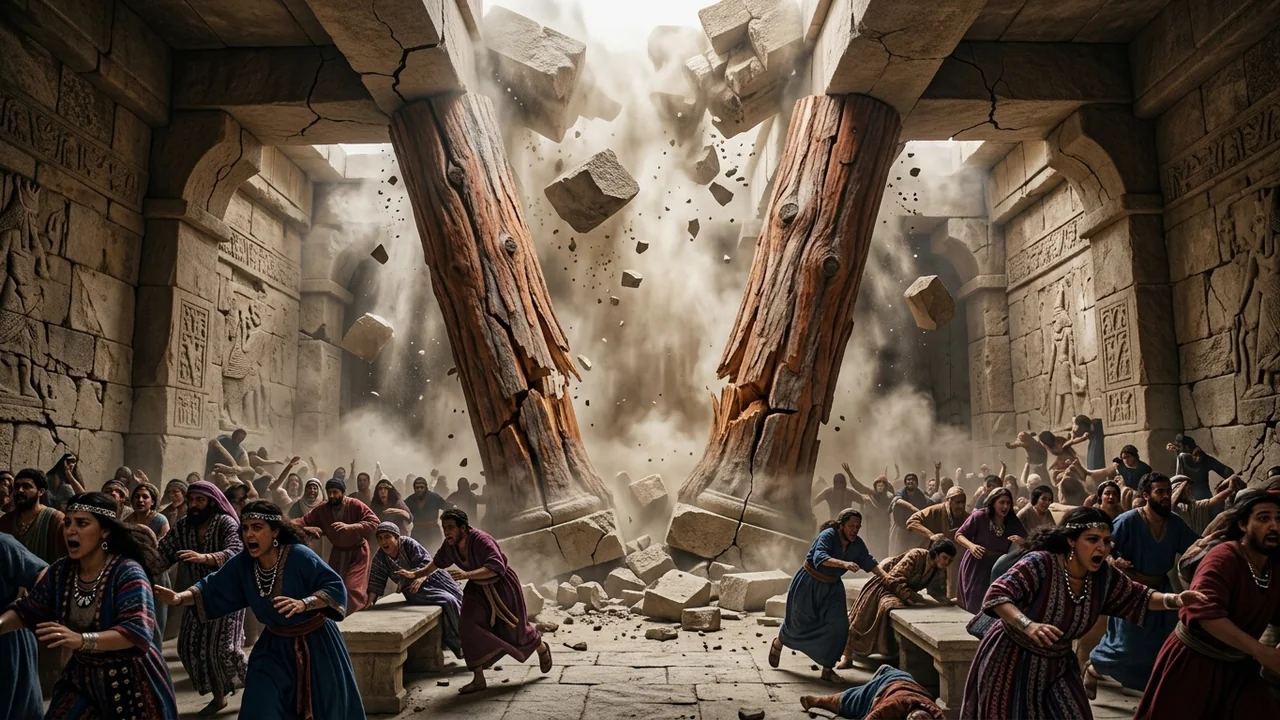
Yet, a close linguistic and architectural reading of Judges 16:26–30 reveals astonishingly specific technical details:
"And Samson said unto the lad that held him by the hand, 'Suffer me that I may feel the pillars whereupon the house standeth, that I may lean upon them.' Now the house was full of men and women; and all the lords of the Philistines were there; and there were upon the roof about three thousand men and women, that beheld while Samson made sport. And Samson called unto the Lord, and said, 'O Lord God, remember me, I pray thee, and strengthen me, I pray thee, only this once, O God, that I may be at once avenged of the Philistines for my two eyes.' And Samson took hold of the two middle pillars upon which the house stood, and on which it was borne up, of the one with his right hand, and of the other with his left. And Samson said, 'Let me die with the Philistines.' And he bowed himself with all his might; and the house fell upon the lords, and upon all the people that were therein."
Notice the precise structural assertions made by the ancient Hebrew author:
- The entire weight of the main roof structure was borne by "the two middle pillars" (shne amudei hatavek).
- The two pillars were positioned close enough together that a single adult man could touch the right pillar with his right hand and the left pillar with his left hand simultaneously (an arm span of roughly 1.8 to 2.1 meters).
- An enormous live load—estimated at approximately 3,000 spectators—was concentrated directly on the flat wooden-and-plaster roof above.
Archaeological Discovery: Tel Qasile and Ekron Temples Unearthed
The architectural skepticism surrounding Judges 16 was shattered in 1971–1974 through groundbreaking archaeological excavations conducted by renowned Israeli archaeologist Prof. Amihai Mazar at Tel Qasile, situated within modern Tel Aviv.
Excavating Stratum X (dating to the late 11th century BC, the exact historical period of Samson and the Judges), Prof. Mazar uncovered the first Philistine sanctuary ever discovered in modern archaeology:
- Circular Stone Plinths: At the center of the main temple hall, Mazar uncovered two circular limestone pillar bases (plinths) resting directly on the compacted earthen floor.
- The Exact Arm-Span Spacing: The distance between the center points of the two stone bases was measured precisely: 1.95 meters (approximately 6.4 feet)! An adult male standing between them could easily extend both arms and rest his hands directly on the shafts of both columns.
- Cedar Trunk Superstructure: Carbonized botanical remains confirmed that the monumental columns were not carved stone monoliths; they were massive trunks of cedar of Lebanon (Cedrus libani) resting unanchored upon the flat limestone plinths, held in place purely by vertical gravitational compressive load!
- Second Confirmation at Tel Miqne (Ekron): In the 1980s and 1990s, excavations at Tel Miqne (ancient Philistine Ekron), directed by Prof. Trude Dothan and Dr. Seymour Gitin, uncovered another monumental Iron Age Philistine sanctuary with an identical structural layout: two primary load-bearing central wooden pillars resting on raised stone pedestals!
Archaeology proved beyond doubt that Philistine temples were built on an architectural blueprint unique to their Aegean Sea Peoples heritage—completely different from traditional Egyptian, Canaanite, or Mesopotamian hypostyle halls!
[Tel Qasile Philistine Temple Architecture (c. 11th Cent. BC)]
                        Roof Pavilion (3,000 Spectators)
                  ══════════════════════════════════════════
                         │                      │
                   [Cedar Pillar 1]        [Cedar Pillar 2]
                         │                      │
                         ├──◄── 1.95 meters ──►─┤
                         │                      │
                   (Stone Plinth)         (Stone Plinth)
                  ──────────────────────────────────────────
                                Temple Floor
Structural Physics: Shear Failure and Progressive Collapse Mechanics
How could pushing or dislodging two wooden pillars bring down a multi-story monumental structure? Modern civil and structural engineers who have analyzed the Tel Qasile and Ekron architectural plans have reconstructed the exact structural physics of the collapse:
1. Unanchored Friction Joints on Stone Pedestals
In ancient Near Eastern timber framing, central wooden columns were rarely bolted or mortised into stone foundations. Instead, the cedar logs were squared or smoothed at the base and rested directly upon the raised limestone plinths. The connection relied entirely on frictional resistance governed by the formula:
$$F_{ ext{friction}} = mu cdot N$$
Where $mu$ is the friction coefficient between cedar wood and smoothed limestone (roughly 0.35 to 0.45), and $N$ is the normal compressive force exerted by the roof dead load and the crowd above.
2. The Overload of 3,000 Spectators (Live Load vs. Dead Load)
In civil engineering, structures are designed to carry both dead load (the weight of the roof beams, clay packing, and stone parapets) and live load (the weight of people and furniture).
A crowd of 3,000 adult human beings represents a staggering live load of approximately 180,000 to 220,000 kilograms (nearly 200 metric tons) concentrated entirely upon a timber-and-earth roof. This catastrophic mass placed the two central cedar columns under near-maximum critical axial compressive stress, creating an unstable state of severe structural tension.
3. Lateral Shear Displacement and Column Buckling
When Samson bowed himself forward with all his strength, he did not need to snap the thick cedar logs in half. He only needed to generate sufficient lateral shear force to shift the bases of the unanchored wooden columns off the smooth limestone plinths:
- By pushing the left pillar outward with his left hand and pulling or thrusting the right pillar with his right, Samson created an eccentric moment of rotational shear.
- As soon as the base of a column shifted even 10 to 15 centimeters off the flat pedestal edge, the colossal downward compressive force became eccentric. The law of structural leverage took over: the 200-ton roof load itself generated a massive bending moment that kicked the columns completely free from their footings!
4. Progressive "Pancake" Collapse
Once the two central load-bearing cedar columns slipped, the primary horizontal tie-beams snapped. The entire central roof bay experienced immediate structural failure. The dynamic shockwave propagated outward across the surrounding perimeter walls in a classic progressive pancake collapse. The thousands of tons of roof timber, clay, limestone coping stones, and human bodies dropped instantly into the enclosed hall below.
Comparative Analysis: Ancient Aegean vs. Semitic Temple Architecture
| Architectural Feature | Philistine Temple (Tel Qasile / Gaza) | Traditional Canaanite / Israelite Temple | Egyptian Hypostyle Temple |
|---|---|---|---|
| Pillar Construction | Two central cedar trunks resting on circular stone plinths | Multiple rows of square stone pillars or solid walls | Massive forests of closely spaced carved stone columns |
| Pillar Spacing | Exactly 1.8 to 2.2 meters apart (single human arm span) | 4 to 8 meters apart across broad courtyards | 2 to 3 meters apart in dense grid arrays |
| Foundation Anchoring | Unanchored friction joint (gravity held) | Deep mortise-and-tenon stone sockets or bedrock footings | Monolithic stone foundations embedded in bedrock |
| Roof Utilization | Flat, mud-plastered timber roof designed for spectator gatherings | Pitched or flat roof with strict restricted priestly access | Solid stone slab roofing with no public roof access |
| Vulnerability to Collapse | Extremely High: Single-point failure of two central columns triggers total collapse | Low: Distributed load across multiple perimeter load paths | Virtually Zero: Highly redundant multi-column load distribution |
The Forensic Trauma of Samson and 3,000 Spectators
The aftermath in the ruins of Gaza was catastrophic. Forensic trauma analysis of high-impact progressive structural collapses (such as the 1981 Kansas City Hyatt Regency walkway collapse or earthquake structural failures) reveals the devastating mechanics of death in ancient masonry collapses:
- Massive Crush Asphyxiation: Over 70% of victims in progressive roof collapses die from immediate crush asphyxiation, where heavy beams and rubble pin the chest and abdomen, preventing diaphragmatic expansion and causing cardiac arrest within minutes.
- Catastrophic Blunt Force Trauma: Impact by falling limestone coping blocks weighing hundreds of kilograms caused instantaneous traumatic brain injury, cervical spine transection, and severe pelvic disruption among the Philistine lords gathered below.
- Samson's Self-Sacrificial Demise: Standing directly at the epicenter of the falling load-bearing beams, Samson experienced instantaneous multi-system blunt force trauma. In the words of the ancient Hebrew chronicler: "So the dead which he slew at his death were more than they which he slew in his life" (Judges 16:30).
His brothers and family descended to Gaza, recovered his broken body from the ruins without resistance from the shattered Philistine survivors, and buried him in the ancestral tomb of Manoah between Zorah and Eshtaol.
Explore the Untamed Chronicles of the Old Testament
Samson’s final stand in Gaza is only one of many dramatic events where ancient military engineering, structural physics, and divine power intersect in the biblical text. If you want to explore the complete historical, forensic, and archaeological dossiers of the Judges, Kings, and Warriors of Israel:
👉 Discover Volume II: Kings & Prophets – Tragic Ends & Medical Mysteries ($2.99)
Includes architectural blueprints of Philistine temples, ballistic analyses of ancient weaponry, and forensic trauma autopsies of biblical martyrs and monarchs.
Frequently Asked Questions
Did archaeologists find the Temple of Dagon in Gaza?
Modern Gaza City is heavily built over ancient strata, making systematic excavation difficult. However, at Tel Qasile (in Tel Aviv) and Tel Miqne (ancient Ekron), archaeologists excavated identical Philistine temples from the 11th century BC, revealing the exact architectural design described in Judges: two load-bearing cedar pillars spaced precisely 1.95 meters apart on stone plinths!
Could one man really push down a stone temple?
From an engineering perspective, Samson did not have to break the stone walls or snap the thick cedar columns. He only needed to apply enough lateral shear force to slide the unanchored wooden pillar bases off their smooth stone pedestals. Once the bases shifted even slightly, the immense downward weight of 3,000 spectators on the roof caused the columns to kick out, triggering an inevitable progressive pancake collapse.
What kind of god was Dagon?
Dagon was an ancient Semitic deity worshiped by the Philistines as their chief national god of agriculture, grain, and maritime fertility. In 1 Samuel 5, the Philistines also brought the captured Ark of the Covenant into the Temple of Dagon in Ashdod, where their stone idol miraculously fell face-down twice before the Ark.
How did Samson get his strength back?
Judges 16:22 notes that after his head had been shaved in the Valley of Sorek, "the hair of his head began to grow again." Samson’s long hair was the external sign of his lifelong Nazirite vow with God. When Samson repented, cried out to God in humble prayer, and surrendered his life in Gaza, God restored his supernatural strength for one final act of judgment against Philistine oppression.
Frequently Asked Questions
Did archaeologists find the Temple of Dagon in Gaza?
Modern Gaza City is heavily built over ancient strata, making systematic excavation difficult. However, at Tel Qasile (in Tel Aviv) and Tel Miqne (ancient Ekron), archaeologists excavated identical Philistine temples from the 11th century BC, revealing the exact architectural design described in Judges: two load-bearing cedar pillars spaced precisely 1.95 meters apart on stone plinths!
Could one man really push down a stone temple?
From an engineering perspective, Samson did not have to break the stone walls or snap the thick cedar columns. He only needed to apply enough lateral shear force to slide the unanchored wooden pillar bases off their smooth stone pedestals. Once the bases shifted even slightly, the immense downward weight of 3,000 spectators on the roof caused the columns to kick out, triggering an inevitable progressive pancake collapse.
What kind of god was Dagon?
Dagon was an ancient Semitic deity worshiped by the Philistines as their chief national god of agriculture, grain, and maritime fertility. In 1 Samuel 5, the Philistines also brought the captured Ark of the Covenant into the Temple of Dagon in Ashdod, where their stone idol miraculously fell face-down twice before the Ark.
How did Samson get his strength back?
Judges 16:22 notes that after his head had been shaved in the Valley of Sorek, "the hair of his head began to grow again." Samson’s long hair was the external sign of his lifelong Nazirite vow with God. When Samson repented, cried out to God in humble prayer, and surrendered his life in Gaza, God restored his supernatural strength for one final act of judgment against Philistine oppression.
Related Research Dossiers
View all 120 articles →
Eaten Alive by Worms: The Gruesome Clinical Pathology Behind Herod Agrippa’s Sudden Collapse
Sawn in Half Inside a Cedar Tree: The Ancient Jewish Record of Isaiah’s Execution