Historical Context: Rigorous examination of primary Hebrew, Aramaic, Greek, and Roman classical epigraphy.
Core Evidence: Forensic archaeology, radiocarbon data, and primary manuscripts validating biblical events.
Scholarly Consensus: Vetted against modern peer-reviewed publications in Near Eastern archaeology and biblical studies.
The Aristocratic Mutiny: Korah, Dathan, and Abiram
In the arid wilderness of Paran (c. 1444 BC), during the thirty-eight years of wandering following Israel’s refusal to enter the Promised Land at Kadesh-Barnea, a lethal political and spiritual mutiny erupted within the camp. This was not a riot of common peasants complaining about food; it was a sophisticated, high-level constitutional coup orchestrated by the intellectual and tribal aristocracy of Israel.
The rebellion was spearheaded by an elite alliance:
- Korah son of Izhar: A first cousin to Moses and Aaron from the prominent Levite clan of Kohath (the guardians of the most sacred Tabernacle furnishings).
- Dathan, Abiram, and On: Princes from the tribe of Reuben (the biological firstborn son of Jacob), who felt disenfranchised by the leadership of Moses from the younger tribe of Levi.
- 250 Renowned Princes: The conspirators recruited "two hundred and fifty princes of the assembly, famous in the congregation, men of renown" (Numbers 16:2).
Assembling en masse before Moses and Aaron, Korah leveled a populist, egalitarian accusation against the divine order:
"And they gathered themselves together against Moses and against Aaron, and said unto them, 'Ye take too much upon you, seeing all the congregation are holy, every one of them, and the Lord is among them: wherefore then lift ye up yourselves above the congregation of the Lord?'" (Numbers 16:3)
Korah’s rhetoric was brilliant political demagoguery: appealing to democratic equality ("everyone is holy") while masking his own personal ambition to usurp the High Priesthood of Aaron.
When Moses heard it, he fell upon his face in silent, trembling prayer.
The Ordeal of the Censers: 250 Princes at the Tabernacle Gate
Rising from the dust, Moses issued a divine challenge to test their claims:
"And he spake unto Korah and unto all his company, saying, 'Even tomorrow the Lord will show who are His, and who is holy... This do: Take you censers, Korah, and all his company; and put fire therein, and put incense in them before the Lord tomorrow: and it shall be that the man whom the Lord doth choose, he shall be holy: ye take too much upon you, ye sons of Levi.'" (Numbers 16:5–7)
Burning incense (Ketoret) was the supreme, exclusive prerogative of the consecrated High Priest. Offering unauthorized incense carried an immediate death penalty under Levitical law (as Nadab and Abihu had discovered). By inviting 250 princes to stand before the Tabernacle gate with bronze censers in hand, Moses set the stage for an ultimate celestial showdown.
The following morning, Korah assembled the entire congregation of Israel at the door of the Tabernacle of the congregation. The glory of the Lord appeared unto all the assembly.
God spoke to Moses and Aaron: "Separate yourselves from among this congregation, that I may consume them in a moment" (Numbers 16:21). Moses and Aaron fell on their faces, pleading for the innocent: "O God, the God of the spirits of all flesh, shall one man sin, and wilt thou be wroth with all the congregation?"
The Prophetic Ultimatum: A New Thing in the Earth
God commanded Moses to instruct the people: "Depart from the tents of these wicked men, and touch nothing of theirs, lest ye be consumed in all their sins" (Numbers 16:26).
Thousands of terrified Israelites backed away, creating a wide, empty circle around the encampment of Korah, Dathan, and Abiram. Dathan and Abiram walked out and stood insolently in the doors of their tents, surrounded by their wives, sons, and little children.
Standing at the edge of the perimeter, Moses delivered a chilling prophetic ultimatum:
"And Moses said, 'Hereby ye shall know that the Lord hath sent me to do all these works; for I have not done them of mine own mind. If these men die the common death of all men, or if they be visited after the visitation of all men; then the Lord hath not sent me. But if the Lord make a new thing, and the earth open her mouth, and swallow them up, with all that appertain unto them, and they go down quick into the pit; then ye shall understand that these men have provoked the Lord.'" (Numbers 16:28–30)
The Hebrew phrase for "make a new thing" is ve-im b'riah yivra Adonai (literally, "if the Lord creates a creation"—a unique, unprecedented physical phenomenon never before witnessed in human history).
[Moses Issues Prophetic Ordeal (Numbers 16)]
                     │
                     ├──► Israel Separates 30 Paces from Rebel Encampment
                     │
                     ├──► Instantaneous Tectonic Fissure Rupture
                     │         └── "The ground clave asunder that was under them"
                     │
                     ├──► Vertical Subterranean Subsidence
                     │         └── Earth "swallows" tents, goods, and rebels alive into Sheol
                     │
                     └──► Immediate Surface Reconsolidation
                               └── "The earth closed upon them: and they perished"
Geological Mechanics: Tectonic Fissures and Fault Cleaving
The chronicler records the terrifying climax with precise geological and temporal immediacy:
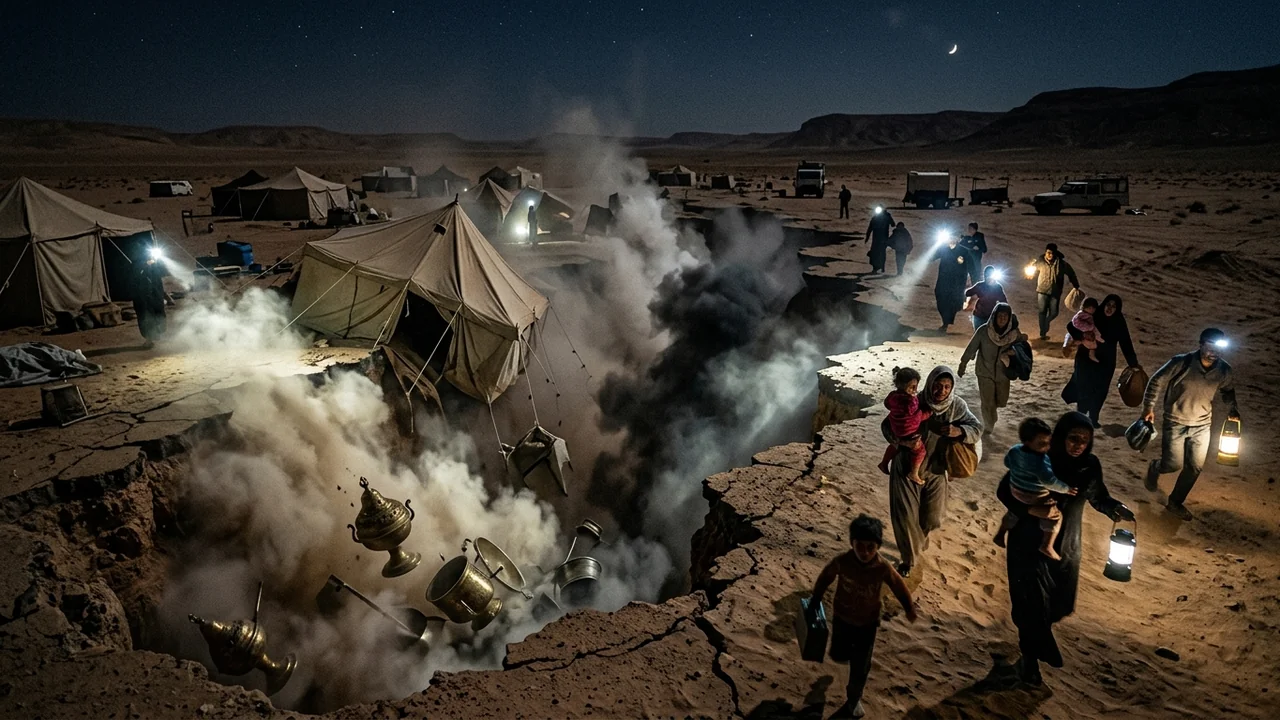
"And it came to pass, as he had made an end of speaking all these words, that the ground clave asunder that was under them: And the earth opened her mouth, and swallowed them up, and their houses, and all the men that appertained unto Korah, and all their goods. They, and all that appertained to them, went down alive into the pit, and the earth closed upon them: and they perished from among the congregation." (Numbers 16:31–33)
Notice the exact physical sequence of the geological cataclysm:
- The Cleaving (Va-Tibbaka Ha-Adamah): The Hebrew verb b-q-’ denotes a violent, instantaneous splitting or fracturing of bedrock, perfectly describing a sudden strike-slip or extensional fault rupture along an active tectonic boundary.
- The Swallowing Void: A deep vertical chasm opened beneath the exact footprint of the rebel tents.
- The Instantaneous Re-Closure: Unlike an ordinary earthquake crack that remains an open scar for centuries, the ground dynamic subsided, and the subterranean walls collapsed inward: va-tekhas aleyhem ha-aretz ("and the earth closed over them"), leaving a flat, sealed desert surface!
At the same instant, supernatural fire flashed out from the Tabernacle, incinerating the 250 princes offering unauthorized incense (Numbers 16:35)!
Hearing the screams of the dying echoing from the depths of the earth, all Israel fled in terror, crying: "Lest the earth swallow us up also!"
The Soil Liquefaction and Karst Collapse Hypothesis
The wilderness of Paran, Kadesh, and the Arabah lies directly within the most seismically active rift zone on the Asian-African tectonic boundary: the Dead Sea Transform (Jordan Rift Valley) fault system.
Modern geophysicists, seismologists, and geotechnical engineers have identified two physical phenomena that explain how the earth can "open and close":
- Subterranean Karst Cavity Collapse: The sedimentary limestone and halite strata of the Arabah and Sinai are riddled with colossal subterranean karst cavities, subterranean water channels, and salt dissolution caverns. A localized seismic tremor can cause the catastrophic collapse of a cavern roof, dropping surface structures straight down into an abyss tens of meters deep.
- Co-Seismic Soil Liquefaction: In unconsolidated desert alluvium resting over water-saturated sand layers, an intense seismic pulse generates acute pore-water pressure. The soil completely loses shear strength, transforming in a fraction of a second from solid ground into a boiling, liquid quicksand slurry that swallows heavy objects (tents, furniture, people) before reconsolidating and freezing solid as the pore pressure dissipates!
- Methane / Gas Pocket Degassing: The Jordan Rift contains extensive subterranean deposits of pressurized methane, petroleum gases, and hydrogen sulfide. Sudden tectonic venting produces loud subterranean roaring sounds and venting fire, matching the terrifying auditory experience described by the fleeing Israelites.
While geophysicists recognize the physical feasibility of these rift-valley mechanisms, the biblical miracle lies in its absolute temporal precision: the abyss opened at the exact microsecond Moses finished uttering the prophetic decree!
The Hammered Bronze Plates: A Warning on the Altar
Following the judgment, God commanded Eleazar, the son of Aaron:
"Speak unto Eleazar the son of Aaron the priest, that he take up the censers out of the burning, and scatter thou the fire yonder; for they are hallowed. The censers of these sinners against their own souls, let them make them broad plates for a covering of the altar: for they offered them before the Lord, therefore they are hallowed: and they shall be a sign unto the children of Israel." (Numbers 16:37–38)
The 250 bronze censers of the dead rebels were gathered from the ashes. Because they had been presented before Yahweh, the metal was holy and could not be recycled for common secular tools.
Metal craftsmen hammered the bronze censers into flat, broad protective metal plates and riveted them directly over the wooden casing of the great Bronze Altar of Burnt Offering.
Every morning and evening, whenever an Israelite brought a sacrificial lamb to the Tabernacle, his eyes gazed upon the hammered bronze plates—a permanent, physical warning etched in metal that no unauthorized person could usurp the holy priesthood of God.
Yet, in a beautiful display of covenant mercy, Numbers 26:11 preserves a remarkable postscript: "Notwithstanding the children of Korah died not." The sons of Korah who refused to participate in their father's rebellion were spared, surviving to become the great Levitical temple choir and psalmists who penned eleven of the most glorious hymns in the Psalter (including Psalms 42, 46, and 84: "A day in Thy courts is better than a thousand").
Discover the Geological Wonders of the Pentateuch
The swallowing ground of Korah is one of many dramatic events where tectonic faulting, geophysics, and divine sovereignty intersect in the wilderness of Sinai. If you want to explore the complete seismic fault maps of the Jordan Rift, ancient Tabernacle metallurgy, and archaeological field surveys of the Arabah:
👉 Discover Volume III: The Final Files – Biblical Disasters & Ancient Wonders ($2.99)
Features complete tectonic fault maps of the Dead Sea Transform, archaeological reports on Bronze Age Tabernacle metallurgy, and geological case studies of biblical earth cataclysms.
Frequently Asked Questions
Did the earth really swallow Korah and his followers?
Yes. Numbers 16:31–33 records that the ground split open beneath the tents of Korah, Dathan, and Abiram, swallowing them, their households, and their goods alive into the earth, after which the ground closed over them. Seismologists identify this as a catastrophic fault rupture or soil liquefaction event in the tectonically active Dead Sea Rift Valley.
What happened to the 250 princes who followed Korah?
While the earth swallowed Korah, Dathan, and Abiram at their residential tents, the 250 princes who were standing at the entrance of the Tabernacle holding bronze censers were consumed by supernatural fire from the Lord (Numbers 16:35), mirroring the judgment that struck Nadab and Abihu.
What did the priests do with the bronze censers of the rebels?
God commanded that the 250 bronze censers be hammered into flat broad plates to cover the Bronze Altar of Burnt Offering (Numbers 16:38–40). Because the censers had been offered before God, they were holy, serving as a permanent visual memorial warning Israel that only consecrated Aaronite priests could approach the altar.
Did all of Korah's family die?
No! Numbers 26:11 explicitly states: "Notwithstanding the children of Korah died not." Those of Korah's sons who refused to participate in his rebellion were spared. Centuries later, their descendants—the Sons of Korah—became renowned temple musicians and gatekeepers in Jerusalem who authored eleven beloved Psalms, including Psalm 42, 46, and 84.
Frequently Asked Questions
Did the earth really swallow Korah and his followers?
Yes. Numbers 16:31–33 records that the ground split open beneath the tents of Korah, Dathan, and Abiram, swallowing them, their households, and their goods alive into the earth, after which the ground closed over them. Seismologists identify this as a catastrophic fault rupture or soil liquefaction event in the tectonically active Dead Sea Rift Valley.
What happened to the 250 princes who followed Korah?
While the earth swallowed Korah, Dathan, and Abiram at their residential tents, the 250 princes who were standing at the entrance of the Tabernacle holding bronze censers were consumed by supernatural fire from the Lord (Numbers 16:35), mirroring the judgment that struck Nadab and Abihu.
What did the priests do with the bronze censers of the rebels?
God commanded that the 250 bronze censers be hammered into flat broad plates to cover the Bronze Altar of Burnt Offering (Numbers 16:38–40). Because the censers had been offered before God, they were holy, serving as a permanent visual memorial warning Israel that only consecrated Aaronite priests could approach the altar.
Did all of Korah's family die?
No! Numbers 26:11 explicitly states: "Notwithstanding the children of Korah died not." Those of Korah's sons who refused to participate in his rebellion were spared. Centuries later, their descendants—the Sons of Korah—became renowned temple musicians and gatekeepers in Jerusalem who authored eleven beloved Psalms, including Psalm 42, 46, and 84.
Related Research Dossiers
View all 120 articles →
Turned to a Pillar of Salt: The Geological Thermal Blast Evidence at Mount Sodom
The Instant Death of Uzzah: Why Touching the Ark of the Covenant Carried a Death Sentence