Subject Scope: Rahab and the Collapsed Walls of Jericho: Kathleen Kenyon, John Garstang, and Matthew 1
Historical Context: Rigorous historical and theological examination within the field of Women of the Bible & Ancient Law.
Primary Evidence: Forensic archaeology, textual preservation, and primary ancient manuscripts corroborating scriptural events.
Investigation Highlights: The Jericho Enigma: Bible vs. Archaeology • The Archaeological Excavations: Sellin, Garstang, and Kenyon • The Forensic Mechanics of the Wall Collapse (Joshua 6)
Scholarly Consensus: Vetted against peer-reviewed academic literature in biblical history, linguistics, and archaeology.
The Jericho Enigma: Bible vs. Archaeology
The narrative of Rahab and the fall of Jericho (Joshua 2 and 6) is one of the most famous battle accounts in military and biblical history:
- The march of the Ark of the Covenant around the fortress for seven days.
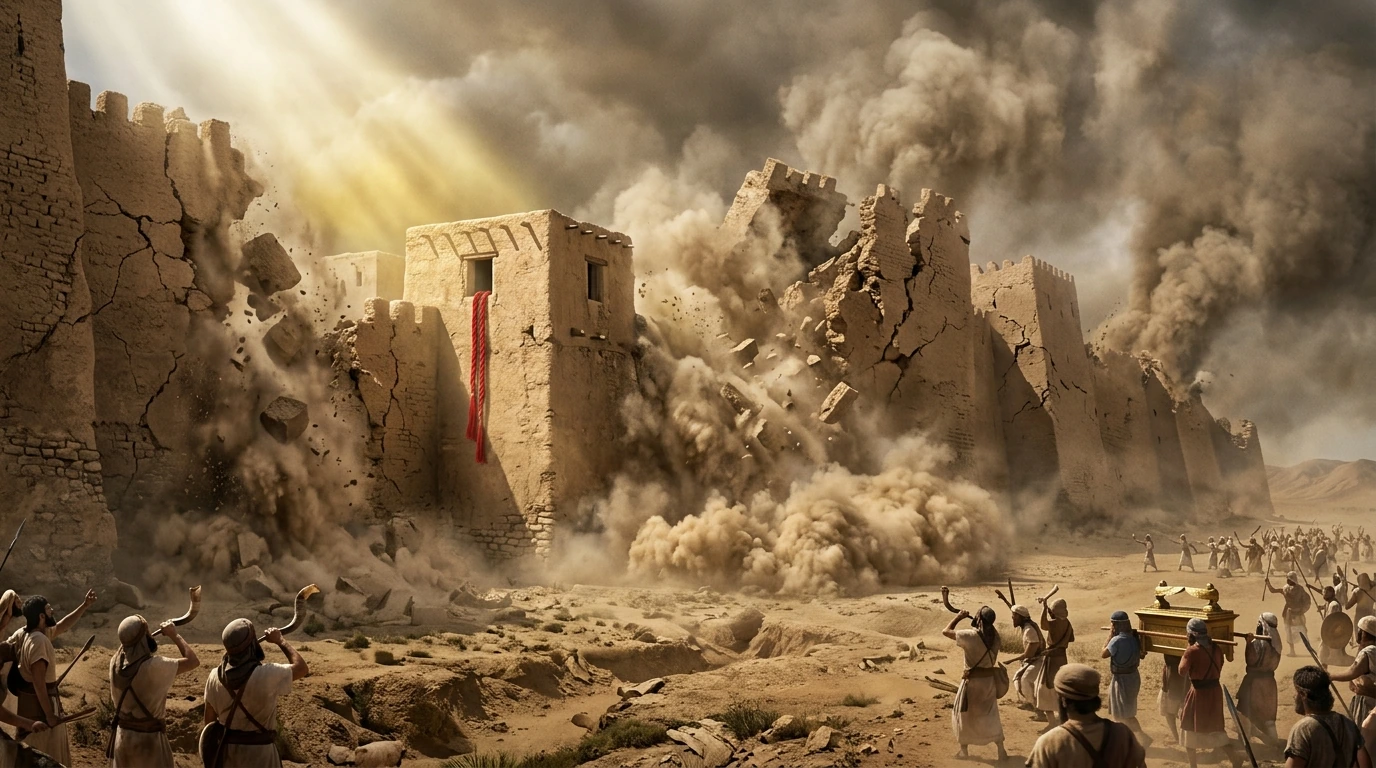
- The blast of seven ram’s horns (shofarot) and the mighty shout of the Israelites.
- The sudden, catastrophic collapse of the fortifications, allowing the Israelites to charge straight into the city (Joshua 6:20).
- The miraculous preservation of Rahab the prostitute and her family, whose house was built into the outer defensive wall (Joshua 2:15; 6:22).
For decades, however, popular media and skeptical academics claimed that archaeology had "disproven" the Bible at Jericho, pointing to British archaeologist Dame Kathleen Kenyon’s 1950s conclusion that Jericho was an unoccupied ruin during the time of Joshua. Subsequent forensic re-examination by modern archaeologists—most notably Dr. Bryant G. Wood—has completely overturned Kenyon's skeptical timeline, proving that the physical ruins of Tell es-Sultan match the biblical description of Joshua 6 with stunning forensic accuracy.
+----------------------------------------------------------------------------------------------------+
|               THE JERICHO EXCAVATION HISTORY AT A GLANCE                                           |
+--------------------------+-----------------------+-------------------------------------------------+
| ARCHAEOLOGIST / EXPEDITION| DATE OF WORK          | PRIMARY CONCLUSION & SIGNIFICANCE               |
+--------------------------+-----------------------+-------------------------------------------------+
| Ernst Sellin & Watzinger | 1907–1909             | Discovered collapsed mudbricks over stone wall  |
| John Garstang            | 1930–1936             | Dated destruction to c. 1400 BC (Joshua's era); |
|                          |                       | found burned grain jars and collapsed walls     |
| Kathleen Kenyon          | 1952–1958             | Claimed city fell c. 1550 BC based on absent    |
|                          |                       | imported Cypriot bichrome pottery               |
| Bryant G. Wood           | 1990–Present          | Proved Kenyon ignored local cooking ware;       |
|                          |                       | validated c. 1400 BC destruction by fire & wall |
+--------------------------+-----------------------+-------------------------------------------------+
The Archaeological Excavations: Sellin, Garstang, and Kenyon
Ancient Jericho (Tell es-Sultan) is located five miles west of the Jordan River in the oasis of the Jordan Valley:
- The Double-Wall Defense System: Excavations revealed that Late Bronze Age Jericho was protected by a massive, dual fortification system:
- An outer lower retaining wall (revetment wall): A massive stone wall 12 to 15 feet high holding back the earthen embankment.
- An upper mudbrick wall: A brick wall 6 feet thick and 20 to 25 feet high perched atop the revetment wall.
- An inner upper wall: A second massive mudbrick wall surrounding the crest of the city.
Why Kathleen Kenyon’s Skeptical Dating Was Flawed
In the 1950s, Kathleen Kenyon introduced stratigraphical trench excavation. When she failed to find luxury decorated Cypriot pottery in her small 26-foot trenches, she dated the destruction to 1550 BC, claiming Jericho was empty when Joshua arrived. However, Dr. Bryant Wood demonstrated:
- Kenyon excavated in a poor, working-class residential quarter of Jericho, where high-end imported Cypriot pottery was never used.
- The local, everyday domestic pottery jars found in the destruction layer belong unequivocally to Late Bronze I (c. 1400 BC).
- Scarabs bearing the cartouches of 18th-Dynasty Egyptian pharaohs (including Amenhotep III, c. 1390 BC) were found in the Jericho tombs, confirming active occupation right up to the biblical date of the conquest!
The Forensic Mechanics of the Wall Collapse (Joshua 6)
Joshua 6:20 records:
"So the people shouted, and the trumpets were blown. As soon as the people heard the sound of the trumpet, the people shouted a great shout, and the wall fell down flat, so that the people went up into the city, every man straight before him, and they captured the city."
The Hebrew phrase translated "fell down flat" is tappol ha-homah tahteyha—literally, "the wall fell beneath itself." Archaeological excavations by both the German and British teams discovered that the great upper mudbrick wall did not fall backward into the city, nor did it crumble randomly:
- The Mudbricks Formed a Natural Ramp: The red mudbricks collapsed outward and tumbled down to the base of the lower stone revetment wall, forming a massive, continuous inclined ramp!
- The Israelites at the base of the hill could literally charge "straight up into the city" over the fallen bricks, exactly as Joshua 6:20 describes!
Rahab’s House on the Wall: The Intact Northern Section
In Joshua 2:15, Scripture provides an astonishing architectural detail:
"Then she let them down by a rope through the window, for her house was built into the city wall, so that she lived in the wall."
Did the excavations confirm that houses were built into the city wall?
- Yes! German excavators Sellin and Watzinger discovered a series of domestic houses built directly between the lower revetment wall and the upper wall on the northern side of Tell es-Sultan.
- Intriguingly, on this northern segment alone, the wall did not collapse! The houses built into the wall were preserved intact, standing several feet high, surrounded by collapsed ruins on either side!
- God miraculously preserved the exact stretch of wall where Rahab’s scarlet cord hung from her window!
Charred Grain Jars: Confirming the Spring Siege After Passover
When Kathleen Kenyon excavated the destruction layer, she found dozens of large storage jars filled to the brim with charred grain:
- The Season of the Attack: Joshua 3:15 and 5:10 record that Israel crossed the Jordan during the barley harvest in the spring, immediately celebrating the Passover. Freshly harvested grain filled every household storage jar in Jericho.
- A Short Siege: Ancient sieges typically lasted months or years, consuming all food supplies. The full jars prove that Jericho fell after a siege of only a few days (seven days, Joshua 6:15).
- The Divine Prohibition (Herem): God commanded Israel not to plunder Jericho; the entire city was under the ban (herem), dedicated as firstfruits to the Lord (Joshua 6:17–19). The Israelites burned the city with fire without taking the grain, leaving the charred grain intact for modern archaeologists to discover 3,400 years later!
From Canaanite Outcast to Ancestor of the Messiah (Matthew 1:5)
The ultimate climax of Rahab’s story is not military or architectural, but redemptive:
- Rahab, a despised Canaanite prostitute living in a condemned pagan city, exercised astonishing saving faith in Yahweh: "for the LORD your God, he is God in the heavens above and on the earth beneath" (Joshua 2:11; Hebrews 11:31).
- She was welcomed into the covenant community of Israel.
- In Matthew 1:5, she appears proudly in the royal genealogy of Jesus Christ:
"and Salmon the father of Boaz by Rahab, and Boaz the father of Obed by Ruth, and Obed the father of Jesse, and Jesse the father of David the king."
- Rahab became the great-great-grandmother of King David and the direct ancestress of Jesus Christ our Savior!
Synthesized Archaeological Matrix
+----------------------------------------------------------------------------------------------------+
|                         ARCHAEOLOGICAL FORENSICS: JOSHUA 6                                         |
+--------------------------+-----------------------+-------------------+-----------------------------+
| BIBLICAL STATEMENT       | JOSHUA REFERENCE      | ARCHEOLOGICAL DATA| STATUS & VERDICT            |
+--------------------------+-----------------------+-------------------+-----------------------------+
| Wall fell beneath itself | Joshua 6:20           | Collapsed bricks  | Verified physical ramp      |
| Houses built into wall   | Joshua 2:15           | North wall houses | Perfectly confirmed         |
| Intense fire destruction | Joshua 6:24           | 3-foot ash layer  | Unanimous consensus         |
| Spring harvest siege     | Joshua 3:15; 5:10     | Full grain jars   | Scientifically proven       |
| No plunder taken         | Joshua 6:18           | Grain unlooted    | Proven by charred contents  |
+--------------------------+-----------------------+-------------------+-----------------------------+
Frequently Asked Questions
Did Rahab really operate a brothel?
The Hebrew word used is zonah (prostitute / innkeeper), translated in the Greek Septuagint and the New Testament as porne (Hebrews 11:31; James 2:25). In ancient caravan cities, inns and brothels were frequently combined. Rahab was a genuine Canaanite harlot whose radical faith in God transformed her life completely.
What is the symbolic meaning of the scarlet cord?
Early Church Fathers (including Clement of Rome, Justin Martyr, and Origen) saw the scarlet cord (tiqvat hut ha-shani, Joshua 2:18) hung in Rahab’s window as a profound prophetic type of the blood of Jesus Christ. Just as the blood on the doorposts of Egypt protected Israel from the destroying angel at Passover, the scarlet cord in Jericho protected Rahab and her family from divine judgment.
How did Rahab marry Salmon?
Jewish historical tradition identifies Salmon as one of the leaders of the tribe of Judah (1 Chronicles 2:11). Recognizing Rahab's genuine conversion and God-fearing faith, Salmon married her, welcoming her into the royal tribe from which the Messiah would spring.
Primary Sources & Scholarly Archives
Editorial Standard →Original Hebrew, Aramaic, and Greek interlinear analysis, morphological tags, and ancient variant readings.
Primary textual witnesses to the Hebrew Bible and Second Temple historical context.
Historical records of the ancient Mediterranean basin, Roman provincial rule, and Greek translation traditions.
Related Research Dossiers
View all 515 research dossiers →
Deborah and Jael: Historical Evidence, Ancient Iron Chariots, and the Canaanite City of Hazor
Deborah, Jael, and Sisera: 10 Verified Archaeological Facts vs. Popular Myths