Historical Context: Rigorous examination of primary Hebrew, Aramaic, Greek, and Roman classical epigraphy.
Core Evidence: Forensic archaeology, radiocarbon data, and primary manuscripts validating biblical events.
Scholarly Consensus: Vetted against modern peer-reviewed publications in Near Eastern archaeology and biblical studies.
The Royal House of Omri and the Phoenician Alliance
In the 9th century BC, the Northern Kingdom of Israel emerged as one of the preeminent military and economic superpowers of the ancient Levant. Under the reign of King Omri and his son King Ahab, Israel possessed formidable standing armies, thousands of iron-fitted war chariots, and monumental ashlar-masonry palaces that rivaled any contemporary Near Eastern dynasty.
To cement Israel's northern trade dominance over maritime shipping routes, Omri negotiated a dynastic marriage alliance with Ethbaal, the priest-king of Tyre and Sidon. The bride was Ethbaal’s formidable daughter, Princess Jezebel.
Jezebel was not merely a foreign queen consort; she was a zealous high priestess and militant evangelist of the Phoenician storm god Baal-Melqart and the fertility goddess Asherah. Arriving at the royal capitals of Samaria and Jezreel, she fundamentally altered the religious landscape of Israel. She financed a court of 450 prophets of Baal and 400 prophets of Asherah, established state-sponsored pagan shrines, and instituted a ruthless state pogrom aimed at the systematic eradication of Yahwism.
Her confrontation with Prophet Elijah on Mount Carmel (1 Kings 18) and her judicial murder of Naboth to seize his family vineyard (1 Kings 21) established Jezebel in biblical memory as the archetype of tyrannical corruption and ruthless royal entitlement.
The Bloody Day at Tel Jezreel: 2 Kings 9 Decoded
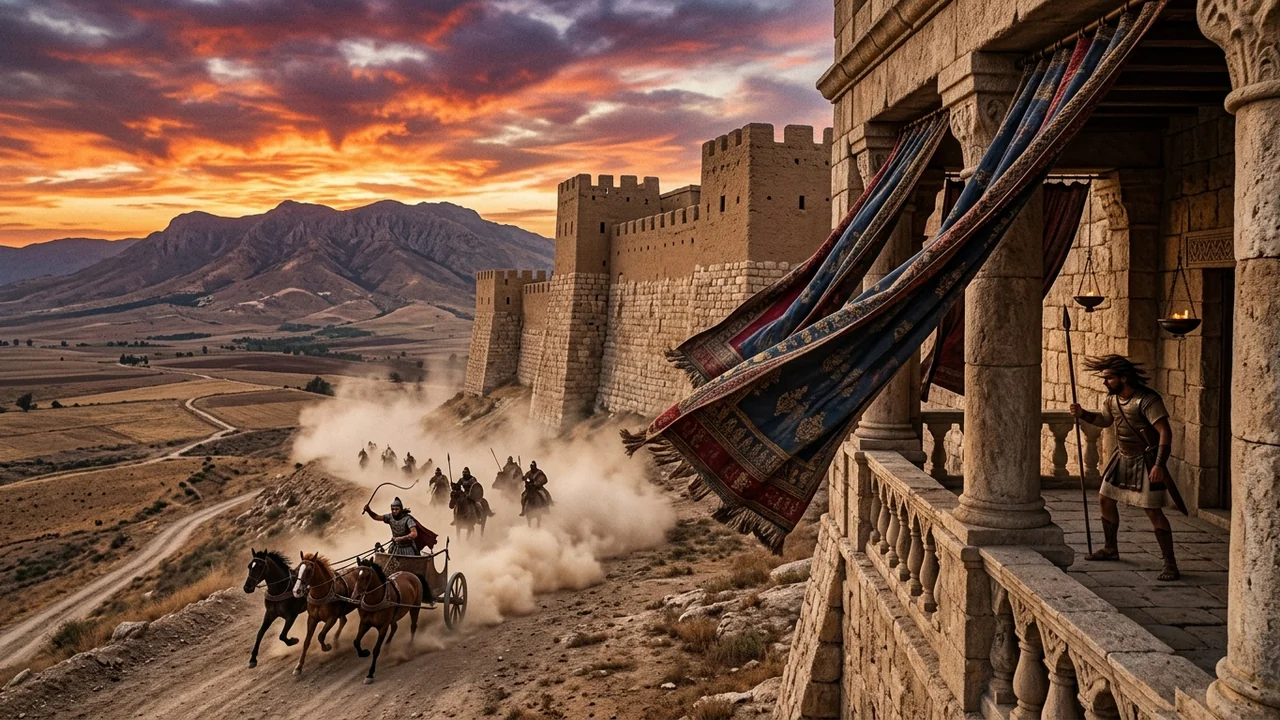
The divine retribution foretold by Elijah—that the dogs would eat Jezebel by the rampart of Jezreel—reached its climax in 841 BC. General Jehu, an aggressive military commander anointed by Elisha’s disciple, launched a furious chariot blitz toward the winter palace of Jezreel. Having already executed King Joram of Israel and King Ahaziah of Judah in the field of Naboth, Jehu rode his thundering chariot through the monumental fortress gates.
Aware of her imminent doom, the aging Queen Mother Jezebel refused to flee or cower. In a final display of regal defiance, she prepared for her confrontation:
"And when Jehu was come to Jezreel, Jezebel heard of it; and she painted her eyes, and attired her head, and looked out at a window. And as Jehu entered in at the gate, she said, 'Had Zimri peace, who slew his master?'" (2 Kings 9:30–31)
By painting her eyes with galena kohl and styling her royal coiffure, Jezebel presented herself as a Phoenician queen in complete command, comparing Jehu to Zimri—an assassin whose coup had lasted only seven days.
Looking up at the palace tower, Jehu shouted: "Who is on my side? Who?"
Two or three royal court eunuchs, weary of her oppressive reign, looked out from the high balcony. Jehu commanded them coldly: "Throw her down!" (Shimtuhah!).
Without hesitation, the eunuchs hurled the Queen Mother over the stone balustrade. She plummeted to the stone-paved courtyard below. Her blood splattered against the palace wall and on the warhorses, and Jehu deliberately drove his heavy war chariot directly over her broken body. Leaving her crushed corpse in the dirt, the usurper entered the palace to dine.
Forensic Mechanics of Defenestration and Trampling
From a modern forensic pathology perspective, the death of Queen Jezebel involved two successive, catastrophic blunt force trauma events:
[1. High-Velocity Free Fall Defenestration]
       │  └── Severe deceleration impact against stone courtyard pavers
       │  └── Multiple skull base fractures, flail chest, aortic transection
       │
[2. Secondary Equine and Chariot Trampling]
       │  └── Massive crush injury by iron-rimmed wooden chariot wheels
       │  └── Extensive abdominal evisceration and pelvic disruption
       │
[3. Post-Mortem Feral Scavenger Predation]
       └── Pack consumption of soft visceral tissue within 2 to 3 hours
-
High-Velocity Deceleration Impact: Archaeological excavations of Iron Age palaces in the Levant reveal that royal towers reached heights of 10 to 15 meters (33 to 50 feet). A free fall from this height onto polished limestone bedrock produces terminal impact velocities exceeding 50 km/h (31 mph). Upon impact, the body experiences catastrophic blunt force deceleration:
- Basilar skull fractures and severe brainstem laceration.
- Bilateral flail chest with multiple fractured ribs penetrating lung parenchyma.
- Rupture or traumatic transection of the thoracic aorta, producing immediate internal exsanguination.
- The biblical note that "some of her blood was sprinkled on the wall" indicates high-pressure arterial spraying resulting from open compound fractures or severe vascular rupture upon stone impact.
-
Crush Trauma by Equine Trampling and Chariot Wheels: Ancient Near Eastern war chariots weighed approximately 300 to 450 kilograms, pulled by two heavy warhorses fitted with bronze hooves and iron-studded harnesses. Jehu driving his chariot directly over her body inflicted severe crush injuries:
- Complete pelvic disruption and transection of abdominal viscera.
- Compound crushing of long bones, producing extensive tissue destruction and external hemorrhage.
Death was either instantaneous upon initial stone impact or occurred within seconds from traumatic hemorrhagic shock.
Canine Scavenger Taphonomy: Why Only Skull, Feet, and Palms Remained
After concluding his banquet inside the palace, Jehu remembered the dead queen: "Go, see now this cursed woman, and bury her: for she is a king's daughter" (2 Kings 9:34). But when his guards went out into the courtyard, they were met with a gruesome scene:
"And they went to bury her: but they found no more of her than the skull, and the feet, and the palms of her hands. Wherefore they came again, and told him. And he said, 'This is the word of the Lord, which He spake by His servant Elijah the Tishbite, saying: In the portion of Jezreel shall dogs eat the flesh of Jezebel... so that they shall not say: This is Jezebel.'" (2 Kings 9:35–37)
For centuries, readers wondered whether this detail was an exaggerated literary device. However, modern forensic taphonomists and forensic anthropologists who study the scavenging patterns of feral canines (Canis lupus familiaris) have confirmed that this narrative represents flawless forensic accuracy.
In ancient Near Eastern fortified cities, packs of semi-feral pariah dogs roamed the municipal refuse dumps and street alleys outside the citadel. When large quantities of fresh mammalian tissue become available, canine feeding behavior follows a documented, invariant anatomical sequence:
- Abdominal Viscera and Thighs First: Canines invariably attack the soft, exposed tissues of the abdomen, pelvis, and upper thighs. The high nutritional value of liver, kidneys, and intestinal adipose tissue makes these the primary targets.
- Thoracic Cage and Limbs Second: Once the abdomen is hollowed out, dogs consume the muscular flesh of the chest, back, biceps, and shoulders, stripping the long bones of the arms and legs.
- Refusal of Densely Keratinized and Low-Yield Bone:
- The Cranium (Skull): Canines struggle to breach the thick, rounded adult human neurocranium. Unless the pack consists of large hyenas equipped with bone-crushing jaws, domestic and feral dogs lack the bite force to penetrate the thick parietal and frontal bones of an adult skull, leaving it largely stripped of scalp but intact.
- The Palms of the Hands: Human palms consist of extremely dense palmar aponeurosis, thick keratinized epidermis, and little edible muscle or adipose tissue. Canines routinely reject or discard distal phalanges and metacarpal clusters.
- The Feet: The soles of human feet (plantar fascia) are tough, fibrous, and difficult to chew, surrounded by multiple compact tarsal and metatarsal bones offering negligible caloric value to scavenging animals.
The forensic reality that only the skull, the soles of the feet, and the palms of the hands remained after a pack of feral dogs fed for several hours is a striking confirmation that the biblical narrator was recording an authentic eyewitness forensic observation.
The Archaeological Breakthrough: The Jezebel Seal (Yzb'l)
For over two millennia, no physical artifact directly bearing the name of Queen Jezebel was known to exist outside the biblical text. That changed dramatically through the research of Dr. Marjo Korpel, an Old Testament scholar and epigrapher at Utrecht University in the Netherlands.
In 1964, a remarkably large, exquisite stone seal carved from dark gray steatite (soapstone) was acquired by the Israel Department of Antiquities and placed in the collections of the Israel Museum in Jerusalem. The seal measured an impressive 31 millimeters in height—unusually large for private seals of the era—and featured intricate Phoenician iconography:
- A crowned, winged sphinx (cherub) with a female human face, wearing a Phoenician-style crown.
- The ancient Egyptian ankh symbol representing life, flanked by two uraeus cobras.
- A winged solar disk at the upper register.
- A lotus flower below, symbolizing Phoenician royalty and regeneration.
In 2007, Dr. Korpel published an exhaustive epigraphic study re-evaluating the inscription carved in early West Semitic paleo-Hebrew/Phoenician script:
[Reconstructed Paleo-Hebrew Inscription on the Steatite Seal]
                       (Y) - Z - B - L
                       𐤉  - 𐤆 - 𐤁 - 𐤋
The seal clearly displays the four consonants: Z - B - L (Zebel). Above the damaged upper margin, microscopic traces of the initial letter Yodh (Y) and an initial possessive Lamed (L) were identified, reconstructing the complete formal inscription:
L' Y Z B ' L — "Belonging to Jezebel"
The exceptional size of the seal, its regal Phoenician-Egyptian hybrid symbols, its 9th-century BC epigraphic dating, and the rare female royal name provide overwhelming circumstantial and epigraphic evidence that this stone was the personal royal signet seal of Queen Jezebel of Israel, used to seal official imperial letters, decrees, and perhaps even the forged royal documents that ordered the stoning of Naboth!
Tel Jezreel Excavations: The Omride Compound Unearthed
Between 1990 and 1996, joint archaeological excavations conducted by the Tel Aviv University Institute of Archaeology and the British School of Archaeology in Jerusalem, directed by Prof. David Ussishkin and John Woodhead, systematically excavated Tel Jezreel in the fertile Jezreel Valley.
Their discoveries confirmed the monumental scale of the royal compound:
- Massive Casemate Enclosure Wall: Archaeologists uncovered an enormous fortified military enclosure measuring 270 meters long by 150 meters wide (nearly 10 acres), surrounded by a massive stone casemate wall and a rock-cut dry moat up to 6 meters deep.
- Iron Age II Pottery and Chariot Stabling: The stratum dating to the mid-9th century BC yielded rich deposits of high-grade Samaria-ware pottery and expansive open courtyards designed specifically for chariot maneuvers and royal military gatherings, precisely matching the operational backdrop of Jehu’s chariot assault in 2 Kings 9.
- The Winepresses of Naboth: In 2013, the Jezreel Expedition directed by Dr. Norma Franklin discovered an extensive Iron Age vineyard complex and carved rock winepresses just outside the north wall of the fortress—confirming the exact topographical setting of Naboth’s ancient ancestral vineyard.
The stones, the pottery, the inscriptions, and the canine taphonomy all speak with one voice: the catastrophic end of Queen Jezebel at Tel Jezreel is grounded in authentic, tangible historical reality.
Investigate the Unsolved Dynastic Murders of Scripture
Queen Jezebel’s defenestration is part of a complex tapestry of ancient Near Eastern court intrigues, royal assassinations, and fulfilled prophecies. If you want to explore the full archaeological dossiers of the kings of Israel and Judah:
👉 Discover Volume II: Kings & Prophets – Tragic Ends & Medical Mysteries ($2.99)
Features the complete epigraphic analysis of the Jezebel Seal, the Tel Dan "House of David" Stele, and forensic autopsies of ancient biblical royalty.
Frequently Asked Questions
Was Queen Jezebel a real historical figure?
Yes. Beyond the detailed canonical narratives of 1 and 2 Kings, epigraphers and archaeologists have identified an authentic 9th-century BC stone signet seal housed in the Israel Museum bearing her exact name in paleo-Phoenician script (L'YZB'L - "Belonging to Jezebel"), alongside monumental excavations of her royal palaces at Samaria and Tel Jezreel.
Why did the dogs only leave Jezebel’s skull, feet, and palms?
Modern forensic taphonomy and animal scavenger studies confirm that canine packs systematically consume soft abdominal viscera, muscle, and marrow-rich long bones first. Canines routinely reject or cannot crush the thick, round adult human skull, while the palms and soles of the feet consist of tough, highly keratinized fibrous tissue that provides little nutritional value to scavenging dogs.
Where is Tel Jezreel located today?
Tel Jezreel is an archaeological mound located in northern Israel, situated on a low hill in the Jezreel Valley overlooking Mount Gilboa. Major excavations by Tel Aviv University and the British School of Archaeology have uncovered the massive 9th-century BC Omride fortress walls, gatehouses, and rock-cut moats.
Who killed Jezebel?
Queen Jezebel was executed on the orders of General Jehu, who was leading a military rebellion against the Omride dynasty in 841 BC. Two or three royal court eunuchs threw her out of an upper palace window at Jehu's command, after which Jehu trampled her body beneath his chariot horses.
Frequently Asked Questions
Was Queen Jezebel a real historical figure?
Yes. Beyond the detailed canonical narratives of 1 and 2 Kings, epigraphers and archaeologists have identified an authentic 9th-century BC stone signet seal housed in the Israel Museum bearing her exact name in paleo-Phoenician script (L'YZB'L - "Belonging to Jezebel"), alongside monumental excavations of her royal palaces at Samaria and Tel Jezreel.
Why did the dogs only leave Jezebel’s skull, feet, and palms?
Modern forensic taphonomy and animal scavenger studies confirm that canine packs systematically consume soft abdominal viscera, muscle, and marrow-rich long bones first. Canines routinely reject or cannot crush the thick, round adult human skull, while the palms and soles of the feet consist of tough, highly keratinized fibrous tissue that provides little nutritional value to scavenging dogs.
Where is Tel Jezreel located today?
Tel Jezreel is an archaeological mound located in northern Israel, situated on a low hill in the Jezreel Valley overlooking Mount Gilboa. Major excavations by Tel Aviv University and the British School of Archaeology have uncovered the massive 9th-century BC Omride fortress walls, gatehouses, and rock-cut moats.
Who killed Jezebel?
Queen Jezebel was executed on the orders of General Jehu, who was leading a military rebellion against the Omride dynasty in 841 BC. Two or three royal court eunuchs threw her out of an upper palace window at Jehu's command, after which Jehu trampled her body beneath his chariot horses.
Related Research Dossiers
View all 120 articles →
The Catacombs of Domitilla: How 150,000 Early Christians Hid and Buried Their Dead

The Secret Codices of Nag Hammadi: Why the Early Church Barred the Gnostic Gospels