Historical Context: Rigorous examination of primary Hebrew, Aramaic, Greek, and Roman classical epigraphy.
Core Evidence: Forensic archaeology, radiocarbon data, and primary manuscripts validating biblical events.
Scholarly Consensus: Vetted against modern peer-reviewed publications in Near Eastern archaeology and biblical studies.
The Skeptical Verdict on the Fourth Gospel
Throughout the nineteenth and early twentieth centuries, historical-critical theologians and secular New Testament scholars reached what they believed was an unshakeable scholarly consensus: the Gospel of John was not an eyewitness historical document written by the Apostle John in the first century, but a late, highly allegorical, non-historical theological treatise composed in the late second century AD (c. 150–180 AD) by a Hellenistic Christian living far outside the borders of Roman Palestine.
Leading critics of the German Tübingen School, led by Ferdinand Christian Baur, argued that the author of John possessed no firsthand geographical knowledge of pre-70 AD Jerusalem. They asserted that the Evangelist frequently invented fictional architectural details to serve as spiritual allegories.
At the epicenter of this skeptical critique stood the famous opening verses of John chapter 5:
"Now there is at Jerusalem by the sheep market a pool, which is called in the Hebrew tongue Bethesda, having five porches [porticoes]. In these lay a great multitude of impotent folk, of blind, halt, withered, waiting for the moving of the water." (John 5:2–3)
Skeptics attacked this description with relentless vigor:
- No Five-Sided Pool in Ancient Architecture: Greek, Roman, and Jewish civil architecture built pools in squares, rectangles, or circles. A pool with "five porches" (stoas or covered colonnades) was deemed a structural impossibility. How could a pool have five sides without being a pentagon—an architectural shape completely unknown in ancient reservoirs?
- Allegorical Invention: Critics asserted that the "five porches" were a theological allegory invented by the author to symbolize the Five Books of Moses (the Pentateuch), which were powerless to heal fallen humanity until Christ arrived.
- Zero Extrabiblical Mention: Secular historians noted that neither the Old Testament, the Apocrypha, nor Flavius Josephus ever mentioned a place called Bethesda having five covered porticoes.
The conclusion seemed settled: the Pool of Bethesda was a pious Christian myth.
Then, buried beneath forty feet of Byzantine, Crusader, and Ottoman debris near the Sheep Gate in Jerusalem, archaeologists struck the ancient stone porticoes.
The Enigma of John 5:2: The Five Porticoes
To understand why nineteenth-century critics were bewildered by John's description, one must understand how ancient colonnades were built:
       [THE SKEPTICAL DILEMMA: HOW TO CONSTRUCT FIVE PORCHES?]

       SKEPTICAL ASSUMPTION:                   HISTORICAL REALITY:
       A Pentagonal Pool (Mythical)            A Bi-Partite Twin Pool
             /                                ┌─────────┬─────────┐
            /                                 │ Portico │ Portico │
           /       <- Five Sides?             │    1    │    2    │
          /           (Never built in         ├─────────┼─────────┤
         /________     ancient world!)        │    ◄─── Central ──┤ <- Portico 5!
                                               ├─────────┼─────────┤
                                               │ Portico │ Portico │
                                               │    3    │    4    │
                                               └─────────┴─────────┘
  ═════════════════════════════════════════════════════════════════════════
If a pool was constructed as a single open rectangle, it had four porticoes—one on each outer side: north, south, east, and west.
Where was the fifth portico?
Unless one could find a physical pool with five colonnaded halls, the skepticism regarding John’s eyewitness authenticity remained a major weapon against the reliability of the New Testament.
The Excavations of Conrad Schick and the White Fathers
The breakthrough began in the late nineteenth century. In 1856, the Ottoman Sultan Abdulmejid I gifted the twelfth-century Crusader Church of St. Anne—located near the Lions' Gate (historically the Sheep Gate) in the Muslim Quarter of Jerusalem—to Emperor Napoleon III of France in gratitude for French support during the Crimean War.
The French entrusted the sanctuary to the Missionaries of Africa (known colloquially as the White Fathers). Recognizing the ancient Christian tradition that placed the birthplace of the Virgin Mary and the healing of the paralytic near the site, the White Fathers and legendary German architect and archaeologist Conrad Schick began systematic excavations beneath the courtyard of St. Anne’s.
       [THE DISCOVERY OF THE POOL OF BETHESDA: JERUSALEM]
  ══════════════════════════════════════════════════════════════════
    Location:       St. Anne’s Compound, Muslim Quarter, Jerusalem
    Archaeologists: Conrad Schick (1888), Father Roland de Vaux (1950s)
    Depth:          10 to 13 meters (33 to 43 feet) beneath street level
    Structure:      Two massive rectangular rock-cut reservoirs
    Colonnades:     Exactly five covered porticoes (Four outer, one central)
    Original Date:  Hellenistic to Hasmonean / Herodian (3rd c. BC - 1st c. AD)
  ══════════════════════════════════════════════════════════════════
In 1888, while excavating forty feet beneath the current ground level, Conrad Schick exposed the subterranean bedrock foundations of a massive, ancient water complex.
Over the following decades, further rigorous excavations led by Father Roland de Vaux and Father Pierre Benoit (of the prestigious École Biblique et Archéologique Française) cleared the entire complex. What they uncovered stunned the academic world: John’s five-portico pool was real, sitting precisely where he said it was, down to the millimeter!
Architectural Blueprint: The Trapezoidal Twin Reservoirs
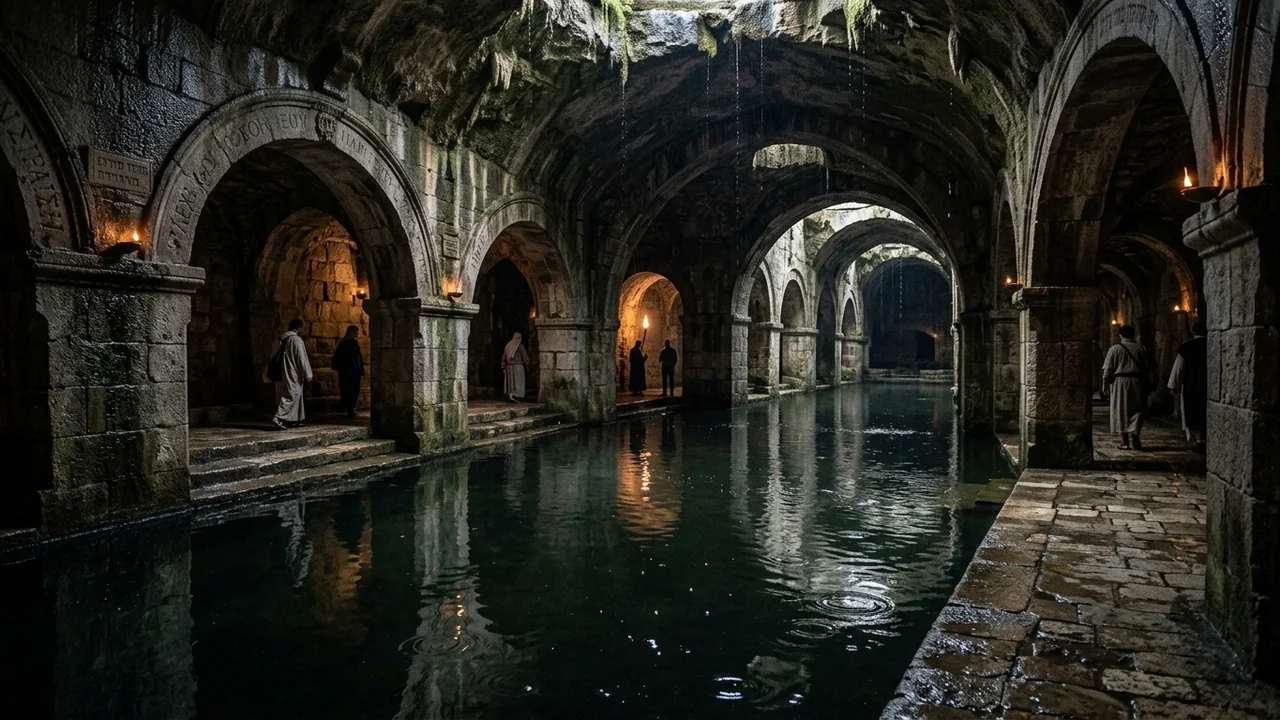
The excavations revealed that Bethesda was not a single pool, but a massive double-pool complex (a bipartite reservoir) cut deep into the natural limestone bedrock of the Beth Zeta valley:
       [ARCHITECTURAL BLUEPRINT: THE POOL OF BETHESDA]

                ◄────── NORTHERN PORTICO (1) ──────►
         ┌──────────────────────────────────────────────┐
         │                                              │ ▲
       ▲ │              NORTHERN RESERVOIR              │ │
       │ │            (Open Water Basin)                │ │
       │ │          Length: 53 m | Width: 40 m          │ │
       P │                                              │ P
       O ├══════════════════════════════════════════════┤ O
       R │ ◄── CENTRAL ROCK-CUT DIKE / PORTICO (5) ──►  │ R
       T │      (Width: 6 meters | Separating Wall)     │ T
       I ├══════════════════════════════════════════════┤ I
       C │                                              │ C
       O │              SOUTHERN RESERVOIR              │ O
       │ │            (Open Water Basin)                │ │
       (4)│          Length: 47 m | Width: 52 m          │ (2)
       ▼ │                                              │ │
         └──────────────────────────────────────────────┘ ▼
                ◄────── SOUTHERN PORTICO (3) ──────►
  ══════════════════════════════════════════════════════════════════
The dimensions of the complex were colossal:
- Total footprint: approximately 100 meters (330 feet) long by 50 to 60 meters (165–200 feet) wide.
- Depth: the pools were carved between 7 and 13 meters (23–43 feet) deep into the bedrock, capable of holding hundreds of thousands of gallons of water.
- The Five Porticoes: Colonnaded, covered porches (stoas) surrounded the perimeter on all four exterior sides (North, South, East, and West). Crucially, a broad central stone dike (6 meters wide) divided the northern pool from the southern pool. Running directly across this central separating wall was the fifth covered portico!
The Apostle John was not writing allegorical poetry about the Pentateuch; he was describing a physical architectural masterpiece that he had walked through with his own feet!
Because the Romans under Titus completely destroyed this complex in 70 AD, and the subsequent pagan emperor Hadrian built a temple to Serapis/Asclepius over the rubble in 135 AD, no late second-century author living in Greece could have known about these five porticoes. The only way an author could have known that Bethesda possessed five covered porches was if he had personally seen it before Jerusalem was leveled in 70 AD.
Hydro-Engineering: Siphons, Springs, and the Stirring of Waters
The Gospel of John mentions a peculiar local phenomenon: the sick and paralyzed gathered in the porticoes waiting for the "moving of the water", believing that an angel descended at certain intervals to trouble the pool, and the first person to enter was healed (John 5:3–4).
Archaeological hydro-engineering studies of the Bethesda complex revealed the scientific and geological mechanism behind this "troubling" of the water:
- Intermittent Karstic Spring: The pools were fed by an underground intermittent siphon spring originating in the Beth Zeta ridge north of the Temple Mount. Karstic springs in the Judean hills function like natural hydraulic siphons: subterranean rock cavities slowly fill with water until a siphon threshold is breached, causing a sudden, rapid discharge of bubbling, surging water into the basin before settling again.
- Sluice Gate Transfer System: Excavators discovered a subterranean conduit and sluice gate connecting the upper northern pool to the lower southern pool. When the priests opened the sluice gate to transfer water for ritual cleansing, a sudden violent rush of water surged into the southern pool, churning the surface into bubbling foam.
To the ancient, suffering sufferers who sat in the dark shadows of the colonnades, this sudden, bubbling hydraulic surge was interpreted as the presence of divine power!
The Healing Sanctuary: From Jewish Mikveh to Roman Asclepeion
Why were hundreds of sick, lame, and paralyzed people gathered at Bethesda in the first place?
Archaeological excavations surrounding the twin pools revealed a vast complex of smaller, plastered ritual baths (mikvaot), stone steps, and subterranean channels:
            [STRATIGRAPHY OF BETHESDA THROUGH THE AGES]
  ┌─────────────────────────┬───────────────────────────┬────────────────────┐
  │ Historical Layer        │ Architectural Function    │ Archaeology Found  │
  ├─────────────────────────┼───────────────────────────┼────────────────────┤
  │ 1. Hasmonean / Herodian │ Dual Water Reservoir &    │ Twin Pools with 5  │
  │    (200 BC – 70 AD)     │ Jewish Ritual Purification│ Porticoes & Dike   │
  ├─────────────────────────┼───────────────────────────┼────────────────────┤
  │ 2. Roman Aelia          │ Pagan Asclepeion          │ Snake figurines,   │
  │    Capitolina (135 AD)  │ (Temple to Healing God)   │ votive foot carved │
  ├─────────────────────────┼───────────────────────────┼────────────────────┤
  │ 3. Byzantine Basilica   │ Basilica of St. Mary of   │ Massive 5th-cent.  │
  │    (c. 450 AD)          │ the Probatica (Sheep Pool)│ Mosaic & Columns   │
  ├─────────────────────────┼───────────────────────────┼────────────────────┤
  │ 4. Crusader Church      │ Church of St. Anne        │ Intact 12th-cent.  │
  │    (c. 1130 AD)         │ Preservation of crypt     │ Romanesque Church  │
  └─────────────────────────┴───────────────────────────┴────────────────────┘
During the first century, the southern pool served as a Jewish ritual bath (mikveh) where pilgrims purified themselves before entering the nearby Temple courts through the Sheep Gate. The poor and disabled, barred from the Temple sanctuaries because of physical defects under strict Sadducean legislation, congregated under the shade of the five porticoes seeking divine mercy.
In 135 AD, when Emperor Hadrian rebuilt Jerusalem as the pagan Roman colony of Aelia Capitolina, he recognized the existing healing reputation of Bethesda and transformed the site into a Roman Asclepeion—a healing sanctuary dedicated to Asclepius, the Greco-Roman god of medicine, and his companion goddess Hygieia.
Archaeologists excavated multiple pagan votive offerings from this layer, including:
- A beautifully carved marble votive human foot, dedicated by a Roman woman named Pompeia Lucilia in gratitude for the healing of her foot!
- Terracotta figurines of snakes entwined around staffs (the universal symbol of Asclepius).
Hadrian built his pagan healing temple directly over the ruins of Bethesda precisely because the site had been famous across the Mediterranean for healing miracles dating back to the ministry of Jesus!
Comparative Topography: Gospel Description vs. Modern Excavations
| Feature in John 5:1–9 | Critical Skeptical Allegation | Modern Archaeological Excavations (St. Anne’s) |
|---|---|---|
| Location: Near Sheep Gate | Claimed John was confused about Jerusalem gates | Discovered right beside the Lions' Gate / Sheep Gate (North of Temple) |
| Hebrew Name: Bethesda | Alleged mythological name meaning "House of Mercy" | The Copper Scroll from Qumran Cave 3 confirms the Hebrew name Bet Eshdatayin |
| Five Porticoes (Stoas) | Declared impossible; dismissed as allegory for 5 books | Discovered a bipartite twin pool with 4 perimeter porticoes + 1 central portico! |
| Water Churning / Moving | Rejected as superstitious myth | Discovered natural karstic siphon spring and subterranean sluice gate surge system |
| Mass of Sick & Lame | Regarded as dramatic exaggeration | Extensive healing installation with multiple healing baths confirmed in Roman strata |
The Copper Scroll (3Q15)—a pure copper scroll discovered in Qumran Cave 3 in 1952—contains an inventory of sixty-four underground hiding places for Temple treasures. In Column XI, lines 12–13, it explicitly mentions:
"In Bet Eshdatayin, in the reservoir where the smaller basin enters..."
Here, in a first-century Hebrew document completely independent of the New Testament, is the exact Hebrew name of the twin pools: Bet Eshdatayin ("House of the Twin Outpourings" or Bethesda)!
Discover the Complete 4-Volume Master Study Dossiers
The excavation of the Pool of Bethesda is one of the most stunning vindications of the historical accuracy of the Gospel of John ever achieved. To explore full architectural blueprints of the five porticoes, high-resolution photographs of Conrad Schick's subterranean excavations, and forensic studies of New Testament archaeology:
👉 Unlock the Complete 4-Volume Master Bundle & Premium AI ($9.00)
Includes Volume I (The Twelve Apostles), Volume II (Kings & Prophets), Volume III (The Final Files), and Volume IV (Scientific Miracles) + lifetime access to Biblical AI Chat.
Frequently Asked Questions
Where was the Pool of Bethesda discovered?
The Pool of Bethesda was excavated beneath the courtyard of the Church of St. Anne, near the Lions' Gate (historically the Sheep Gate) in the Muslim Quarter of the Old City of Jerusalem. Archaeological excavations led by Conrad Schick in 1888 and Father Roland de Vaux in the 1950s cleared the site, exposing the ruins 40 feet below ground.
How did the pool have five porticoes if ancient pools were rectangular?
Bethesda was constructed as a bipartite dual-reservoir complex—two massive rectangular pools separated by a broad central stone dike. Four covered porticoes (colonnades) enclosed the outer perimeter of the complex, while the fifth covered portico ran directly across the central dividing wall, creating exactly five covered colonnades as John 5:2 recorded.
Why did nineteenth-century critics doubt John's description of Bethesda?
Critics of the German Tübingen School argued that the Gospel of John was a late second-century allegorical novel written by someone who had never visited Jerusalem. They claimed a five-portico pool was an architectural impossibility and asserted that the "five porches" were a fictional symbol representing the five books of the Law of Moses.
What caused the "stirring of the water" mentioned in John 5?
Archaeological hydro-engineering studies discovered that the pools were fed by an intermittent karstic siphon spring, along with a subterranean sluice-gate system connecting the northern and southern reservoirs. When subterranean natural pressure released or the sluice gates were opened, water surged violently into the basin, creating bubbling foam that ancient sufferers believed signaled divine healing.
Frequently Asked Questions
Where was the Pool of Bethesda discovered?
The Pool of Bethesda was excavated beneath the courtyard of the Church of St. Anne, near the Lions' Gate (historically the Sheep Gate) in the Muslim Quarter of the Old City of Jerusalem. Archaeological excavations led by Conrad Schick in 1888 and Father Roland de Vaux in the 1950s cleared the site, exposing the ruins 40 feet below ground.
How did the pool have five porticoes if ancient pools were rectangular?
Bethesda was constructed as a bipartite dual-reservoir complex—two massive rectangular pools separated by a broad central stone dike. Four covered porticoes (colonnades) enclosed the outer perimeter of the complex, while the fifth covered portico ran directly across the central dividing wall, creating exactly five covered colonnades as John 5:2 recorded.
Why did nineteenth-century critics doubt John's description of Bethesda?
Critics of the German Tübingen School argued that the Gospel of John was a late second-century allegorical novel written by someone who had never visited Jerusalem. They claimed a five-portico pool was an architectural impossibility and asserted that the "five porches" were a fictional symbol representing the five books of the Law of Moses.
What caused the "stirring of the water" mentioned in John 5?
Archaeological hydro-engineering studies discovered that the pools were fed by an intermittent karstic siphon spring, along with a subterranean sluice-gate system connecting the northern and southern reservoirs. When subterranean natural pressure released or the sluice gates were opened, water surged violently into the basin, creating bubbling foam that ancient sufferers believed signaled divine healing.
Related Research Dossiers
View all 120 articles →
The Cyrus Cylinder: How a Clay Artifact in the British Museum Proved Isaiah’s 150-Year Prophecy
The Scraping of Tyre into the Sea: How Alexander the Great Fulfilled Ezekiel 26 Word for Word