Historical Context: Rigorous examination of primary Hebrew, Aramaic, Greek, and Roman classical epigraphy.
Core Evidence: Forensic archaeology, radiocarbon data, and primary manuscripts validating biblical events.
Scholarly Consensus: Vetted against modern peer-reviewed publications in Near Eastern archaeology and biblical studies.
The Century of Skepticism: Was Pilate a Mythological Invention?
For nearly two millennia, the name of Pontius Pilate was repeated daily across the globe in the historic Christian recitations of the Apostles' Creed: "Suffered under Pontius Pilate, was crucified, dead, and buried." In the biblical Gospels, Pilate occupies a pivotal role as the Roman magistrate who presided over the legal trial of Jesus of Nazareth, found Him innocent of sedition, yet cowardly yielded to the pressure of the Jerusalem crowd to authorize His judicial execution by crucifixion.
However, with the rise of the nineteenth-century "Mythicist School" and radical historical-critical rationalism, secular academics began casting severe doubt upon the historical reliability of the Gospel narratives. Influential critics argued that the Gospel authors had invented fictional characters to personify imperial Roman indifference and Jewish hostility.
Skeptics pointed to the complete absence of any contemporary, first-century archaeological or monumental inscriptions bearing the name of Pontius Pilate in the land of Judea:
- If Pilate had truly governed Judea for a decade (26–36 AD) during the reign of Emperor Tiberius, why had not a single stone, monument, or official imperial building inscription bearing his name ever been unearthed?
- Furthermore, critics highlighted what appeared to be a glaring historical contradiction: the Roman historian Cornelius Tacitus (writing c. 116 AD in Annales XV.44) referred to Pilate as a "procurator", whereas the Greek Gospels referred to him as a "governor" (hegemon).
Skeptics boldly claimed that the New Testament writers were ignorant of first-century Roman administrative titles, having composed their accounts decades or centuries later.
Then, on a hot Mediterranean afternoon in June 1961, the earth of ancient Caesarea Maritima surrendered a physical artifact that silenced the mythicist hypothesis forever.
The 1961 Excavations at Caesarea: Dr. Antonio Frova’s Find
In the summer of 1961, an Italian archaeological expedition sponsored by the Istituto Lombardo di Scienze e Lettere of Milan was excavating the ancient Roman theater of Caesarea Maritima—the Mediterranean deep-water port city constructed by Herod the Great that served as the official administrative capital and military headquarters of Roman Judea.
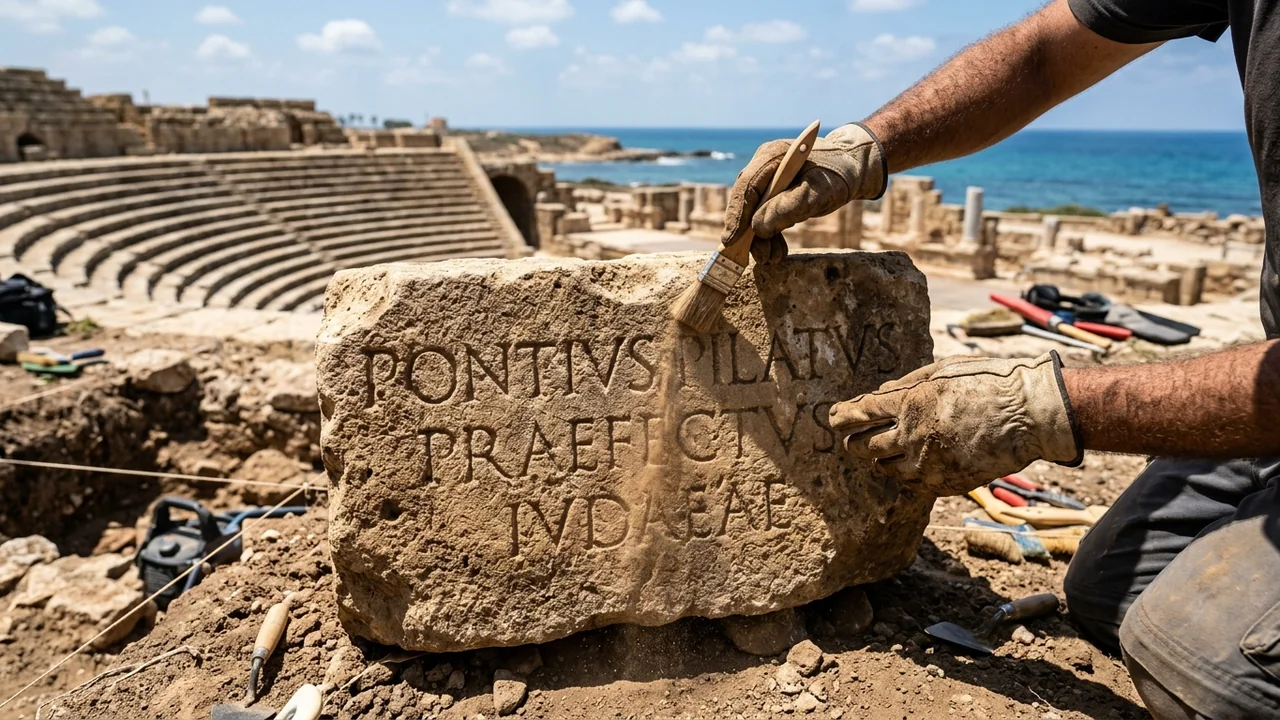
Under the direction of renowned archaeologist Dr. Antonio Frova, workers were clearing the theater’s northern vomitorium (stairway entrance). As the workmen overturned a large, hard limestone slab measuring approximately 82 centimeters (32 inches) high, 68 centimeters (27 inches) wide, and 20 centimeters (8 inches) thick, they noticed that the reverse side was not blank:
       [THE DISCOVERY OF THE PILATE STONE: CAESAREA, 1961]
  ══════════════════════════════════════════════════════════════════
    Location:       Caesarea Maritima (Roman Theater, Northern Exit)
    Director:       Dr. Antonio Frova (Archaeological Mission of Milan)
    Current Home:   Israel Museum, Jerusalem (Artifact ID: AE 1963, 104)
    Material:       Local crystalline nummulitic limestone
    Context:        Reused as a theater step/riser in the 4th century AD
    Original Date:  c. 26–36 AD (Reign of Emperor Tiberius Caesar)
  ══════════════════════════════════════════════════════════════════
The stone had originally been crafted as a monumental dedication block for a public building. Centuries later, during renovations in the fourth century AD, the building had been demolished and the stone reused (spolia) as a stair-step in the theater, with the inscribed face turned downward, preserving the ancient Latin letters from complete erosion!
When the dust of millennia was brushed away, the carved Roman lapidary letters of the first century AD emerged with dramatic clarity.
Epigraphic Anatomy of the Inscription: Deciphering the Latin
The inscription consists of four carved lines in classical Latin capitals. Although the left margin of the limestone slab was partially damaged during its fourth-century recarving for the theater stairs, classical epigraphers and Latinists reconstructed the damaged text with overwhelming consensus:
                     [THE CAESAREA PILATE INSCRIPTION]

      LINE 1:   [DIS AVGVSTI]S TIBERIEVM
      LINE 2:   [...PON]TIVS PILATVS
      LINE 3:   [...PRAEF]ECTVS IVDA[EAE]
      LINE 4:   [...FECIT D]E[DICAVIT]

  ══════════════════════════════════════════════════════════════════
  TRANSLATION:
  "To the divine Augusti [this] Tiberieum,
   Pontius Pilate, Prefect of Judea,
   [has erected and] dedicated."
  ══════════════════════════════════════════════════════════════════
                  [TRANSCRIPTION OF PRESERVED CHARACTERS]
  Line 1:  ...S TIBÉPIÉVM
           (The "Tiberieum" - a temple or civic monument dedicated to Emperor Tiberius)
  Line 2:  ...TIUS PILATUS
           (The distinct personal family name and cognomen of Pontius Pilate)
  Line 3:  ...ECTUS IUDAEA
           (The administrative title "Praefectus" and province name "Iudaea")
The inscription was a public commemorative plaque recording that Pontius Pilate, as governor of the province, had personally funded and dedicated a public monument or temple—termed a Tiberieum—in honor of his imperial benefactor, the Roman Emperor Tiberius Caesar (who ruled from 14 to 37 AD).
This single discovery provided unassailable, contemporary, first-century epigraphic proof that Pontius Pilate was an authentic, living Roman historical figure who ruled over Judea during the precise reign of Tiberius Caesar.
Prefect vs. Procurator: Settling an Ancient Administrative Riddle
Beyond verifying Pilate’s physical existence, the Pilate Stone solved a long-standing historical debate concerning Roman imperial administrative titles:
The Historical Shift from "Prefect" to "Procurator"
In the second century AD, historians like Tacitus referred to Pilate as a procurator. However, Roman legal and administrative studies have since established that prior to the reign of Emperor Claudius (41–54 AD), Roman governors of secondary military provinces (such as Judea) held the military title of Praefectus (Prefect).
Only under Claudius was the provincial administrative system reorganized, transferring governors from military prefects to civilian financial procurators:
- When Tacitus wrote in 116 AD, he used the contemporary title of his own day (procurator) as an anachronism.
- But the New Testament authors, writing in Greek, used the broad, general administrative title hegemon (ἡγεμών, translated "governor"), which was the standard Greek equivalent for the military praefectus.
The Pilate Stone proved that Pilate held the title PRAEFECTUS IUDAEAE—confirming that the stone was cut before the administrative reforms of Claudius, dating it squarely to the reign of Tiberius, exactly where the Gospel accounts place it!
              [THE EVOLUTION OF ROMAN PROVINCIAL TITLES]
  ┌─────────────────────────────┬───────────────────────────┬────────────────┐
  │ Historical Period           │ Official Imperial Title   │ Primary Proof  │
  ├─────────────────────────────┼───────────────────────────┼────────────────┤
  │ Augustus to Caligula        │ PRAEFECTUS (Prefect)      │ Pilate Stone   │
  │ (6 AD – 41 AD)              │ Military Governor         │ (Caesarea)     │
  ├─────────────────────────────┼───────────────────────────┼────────────────┤
  │ Claudius onward             │ PROCURATOR                │ Tacitus,       │
  │ (41 AD – 66 AD)             │ Civil / Financial Manager │ Annales XV.44  │
  └─────────────────────────────┴───────────────────────────┴────────────────┘
Secondary Confirmations: Josephus, Philo, and Tacitus
The discovery of the Pilate Stone at Caesarea corroborated a dense network of ancient non-Christian historical witnesses who described Pilate’s volatile ten-year administration:
1. Flavius Josephus (Jewish Antiquities & Jewish War)
Josephus records multiple confrontations between Pilate and the Jewish population:
- The Imperial Standards Incident: Pilate secretly introduced military standards bearing the effigy of Tiberius into Jerusalem by night, sparking a massive five-day peaceful protest in the Caesarea stadium (Antiquities XVIII.3.1).
- The Aqueduct Crisis: Pilate appropriated sacred Temple funds (the Corban) to construct a 25-mile aqueduct into Jerusalem, brutally suppressing the resulting riot with disguised club-wielding soldiers (Antiquities XVIII.3.2).
- The Samaritan Massacre: In 36 AD, Pilate dispatched heavy cavalry to slaughter a group of Samaritans assembled on Mount Gerizim, leading the Syrian legate Vitellius to depose Pilate and send him to Rome to face trial before Tiberius (Antiquities XVIII.4.1–2).
2. Philo of Alexandria (On the Embassy to Gaius)
Writing around 40 AD, the Jewish philosopher Philo quotes a letter from King Herod Agrippa I characterizing Pilate as a man of:
"inflexible, stubborn, and cruel disposition," known for "corruptibility, violence, robberies, assaults, abusive behavior, frequent executions without trial, and endless and intolerable savagery." (Legatio ad Gaium, 301–302).
3. Cornelius Tacitus (Annales XV.44)
Describing Emperor Nero’s persecution of Christians after the Great Fire of Rome in 64 AD, Tacitus provides one of the most famous pagan references to the crucifixion of Jesus Christ:
"Christus, from whom the name had its origin, suffered the extreme penalty during the reign of Tiberius at the hands of one of our procurators, Pontius Pilatus..."
Comparative Matrix: The Historical Pilate vs. The Gospel Accounts
The portrayal of Pontius Pilate in the four Gospels—a proud, cynical Roman aristocrat who despised Jewish religious scruples, yet found himself trapped in a volatile political corner—aligns seamlessly with the independent historical and archaeological record:
| Biographical Trait / Event | Extrabiblical Archaeological & Historical Record | Gospel Testimony (Matthew, Mark, Luke, John) |
|---|---|---|
| Official Title | Praefectus Iudaeae (Pilate Stone, Caesarea, 1961) | Hegemon / Governor (Matthew 27:2; Luke 3:1) |
| Imperial Patron | Dedicated a public Tiberieum to Emperor Tiberius | Feared being reported: "Thou art not Caesar's friend" (John 19:12) |
| Headquarters & Residence | Caesarea Maritima / Praetorium at Jerusalem | Governed from Caesarea; resided at Praetorium during Passover (John 18:28) |
| Cynicism toward Truth | Known for arrogant disregard of philosophical morality | Famously uttered to Jesus: "What is truth?" (John 18:38) |
| Prone to Cruelty | Slaughtered protesters with clubs; crushed Samaritans | "The Galileans, whose blood Pilate had mingled with their sacrifices" (Luke 13:1) |
| Political Cowardice | Terrified of being denounced to Rome by Jewish elites | Yielded to political blackmail to prevent an insurrection (Matthew 27:24–26) |
In 2018, modern technology provided yet another stunning confirmation of the Roman prefect:
- Archaeologists conducting laboratory cleaning of a copper alloy ring discovered decades earlier at the Herodium fortress near Bethlehem deciphered a Greek inscription: "Of Pilate" (Pilato).
- Because the name Pilate was exceedingly rare in the ancient Roman world, this administrative ring was almost certainly utilized by a high-ranking official belonging to the prefect's personal staff.
Discover the Complete 4-Volume Master Study Dossiers
The Pilate Stone is a dramatic reminder that the New Testament narratives are rooted in physical, verifiable historical reality. To examine full-resolution epigraphic scans of the Caesarea inscription, classical Latin translations of Tacitus and Josephus, and forensic reconstructions of the Roman trial of Jesus:
👉 Unlock the Complete 4-Volume Master Bundle & Premium AI ($9.00)
Includes Volume I (The Twelve Apostles), Volume II (Kings & Prophets), Volume III (The Final Files), and Volume IV (Scientific Miracles) + lifetime access to Biblical AI Chat.
Frequently Asked Questions
What is the Pontius Pilate Stone?
The Pilate Stone is a 32-inch-high limestone dedication block discovered in 1961 in the Roman theater of Caesarea Maritima, Israel, by Italian archaeologist Dr. Antonio Frova. It contains a first-century Latin inscription naming "Pontius Pilate, Prefect of Judea" dedicating a public building ("Tiberieum") to Emperor Tiberius Caesar.
Why is the Pilate Stone so important for biblical archaeology?
Prior to 1961, critics and mythicists claimed that Pontius Pilate was a fictional literary invention because no first-century monumental inscriptions bearing his name had ever been found. The Pilate Stone provided direct, contemporary, physical proof of his historical existence, his exact political jurisdiction over Judea, and his authentic Roman title.
Why does the stone say "Prefect" instead of "Procurator"?
The inscription officially lists Pilate as Praefectus Iudaeae (Prefect of Judea). This solved a major historical riddle: while later historians like Tacitus used the title "procurator" anachronistically, historical Roman records demonstrate that under Emperors Augustus and Tiberius (prior to Claudius), governors of Judea held the military rank of Prefect, proving the inscription dates authentically to the early first century.
Where is the original Pilate Stone kept today?
The original limestone artifact is housed in the Israel Museum in Jerusalem, while a faithful replica is displayed in situ on the windswept ruins of the ancient Roman theater at Caesarea Maritima along the Mediterranean coast.
Frequently Asked Questions
What is the Pontius Pilate Stone?
The Pilate Stone is a 32-inch-high limestone dedication block discovered in 1961 in the Roman theater of Caesarea Maritima, Israel, by Italian archaeologist Dr. Antonio Frova. It contains a first-century Latin inscription naming "Pontius Pilate, Prefect of Judea" dedicating a public building ("Tiberieum") to Emperor Tiberius Caesar.
Why is the Pilate Stone so important for biblical archaeology?
Prior to 1961, critics and mythicists claimed that Pontius Pilate was a fictional literary invention because no first-century monumental inscriptions bearing his name had ever been found. The Pilate Stone provided direct, contemporary, physical proof of his historical existence, his exact political jurisdiction over Judea, and his authentic Roman title.
Why does the stone say "Prefect" instead of "Procurator"?
The inscription officially lists Pilate as Praefectus Iudaeae (Prefect of Judea). This solved a major historical riddle: while later historians like Tacitus used the title "procurator" anachronistically, historical Roman records demonstrate that under Emperors Augustus and Tiberius (prior to Claudius), governors of Judea held the military rank of Prefect, proving the inscription dates authentically to the early first century.
Where is the original Pilate Stone kept today?
The original limestone artifact is housed in the Israel Museum in Jerusalem, while a faithful replica is displayed in situ on the windswept ruins of the ancient Roman theater at Caesarea Maritima along the Mediterranean coast.
Related Research Dossiers
View all 120 articles →
Hallucination Hypothesis Disproven: Why Mass Group Psychology Cannot Explain Post-Crucifixion Sightings
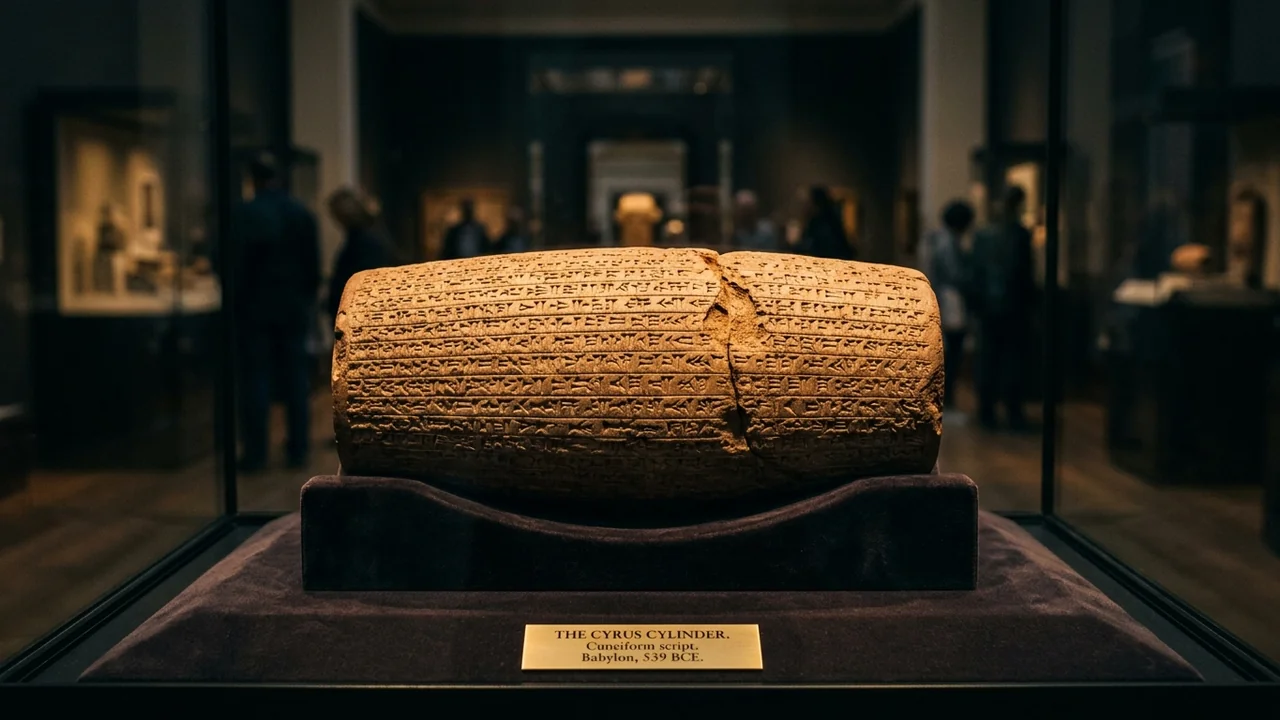
The Cyrus Cylinder: How a Clay Artifact in the British Museum Proved Isaiah’s 150-Year Prophecy