Historical Context: Rigorous examination of primary Hebrew, Aramaic, Greek, and Roman classical epigraphy.
Core Evidence: Forensic archaeology, radiocarbon data, and primary manuscripts validating biblical events.
Scholarly Consensus: Vetted against modern peer-reviewed publications in Near Eastern archaeology and biblical studies.
The High-Stakes Attack on Luke’s Credibility
Throughout the nineteenth century, radical historical-critical scholars launched a concerted academic campaign against the historical reliability of the Book of Acts. Led by the German Tübingen School under theologian Ferdinand Christian Baur, critics claimed that Acts was not an authentic first-century eyewitness history written by Luke the physician, but a second-century historical romance penned around 150–175 AD by an unknown Christian propagandist trying to harmonize conflicting Petrine and Pauline factions.
To prove that the author of Acts was a late, uninformed fabricator writing far from the events, critics scrutinized every legal term, geographical boundary, and civic title in the text.
Their primary rule of engagement was simple: if Luke used a civic title for a Roman city magistrate that did not appear in classical Greek literature (such as the works of Plato, Thucydides, Demosthenes, or Xenophon), critics pounced upon it as proof of gross historical ignorance.
At the center of their indictment stood a single, obscure Greek word in Acts 17:6:
"And when they found them not, they drew Jason and certain brethren unto the RULERS OF THE CITY [POLITARCHAS], crying, These that have turned the world upside down are come hither also; Whom Jason hath received: and these all do contrary to the decrees of Caesar, saying that there is another king, one Jesus." (Acts 17:6–7)
In classical Greek, the standard municipal rulers of a city were known as archontes or demarchoi. But Luke did not use either of these common terms. Instead, Luke coined a seemingly bizarre, unrecorded Greek compound word: politarchas (πολιτάρχας)—the plural accusative form of politarchēs (politarch).
The nineteenth-century critics were triumphant. They boldly asserted that no such office as a "Politarch" had ever existed in the Greco-Roman world. They claimed Luke had invented the word out of thin air, exposing himself as an incompetent second-century novelist.
Then, from the marble arches of ancient Macedonia, the stone monuments began to speak.
The Contested Title in Acts 17:6: Politarchas
To appreciate the linguistic audacity of Luke’s term, one must understand Roman provincial administration:
       [THE SKEPTICAL INDICTMENT AGAINST ACTS 17:6]
  ══════════════════════════════════════════════════════════════════
  • Standard Classical Greek for City Ruler:  ARCHON (ἄρχων)
  • Standard Roman Municipal Magistrate:      DUOVIR / PRAETOR
  • Luke's Peculiar Term in Thessalonica:     POLITARCH (πολιτάρχης)

  SKEPTICAL CLAIM (Tübingen School, 1845):
  "The word 'Politarch' is completely absent from all classical Greek
   literature. Luke invented this title because he was completely
   ignorant of ancient Macedonian municipal institutions!"
  ══════════════════════════════════════════════════════════════════
The author of Acts was either an extraordinary historical scholar who possessed hyper-accurate local knowledge of local municipal terminology, or he was an incompetent fraud. There was no middle ground.
If archaeologists could demonstrate that Thessalonica was ruled not by generic archons, but by a specific, local collegiate magistracy known officially as Politarchs, Luke’s historical reputation would be vindicated at the highest level of epigraphic science.
The 1835 Vardar Gate Discovery in Thessaloniki
The turning point occurred in the modern Greek city of Thessaloniki (ancient Thessalonica).
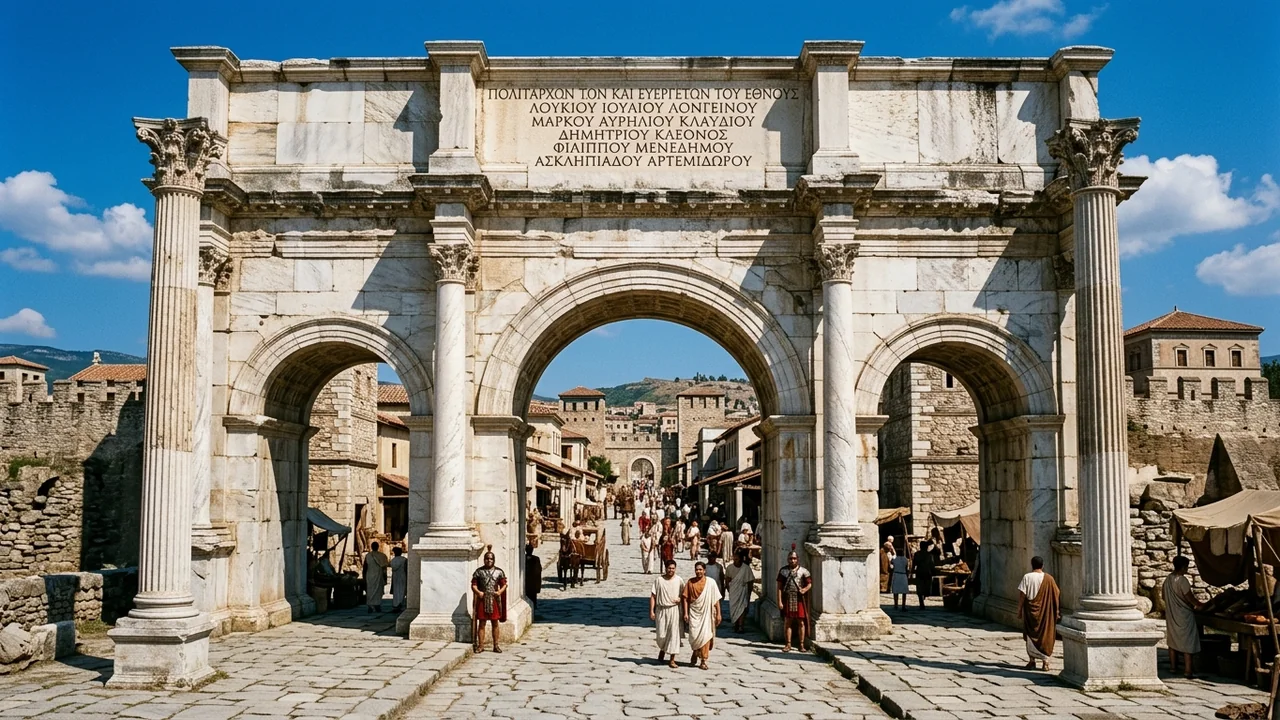
At the western entrance to the ancient city stood the Vardar Gate (the Golden Gate), a monumental Roman triumphal arch originally constructed during the late Roman imperial era along the famous Via Egnatia—the great military highway that connected Rome to Constantinople:
       [THE DISCOVERY OF THE VARDAR GATE ARCH: 1835]
  ══════════════════════════════════════════════════════════════════
    Location:       Vardar Gate (Western Entrance), Thessaloniki, Greece
    Artifact:       Inscribed marble architrave / lintel block
    Dimensions:     Length: 1.95 meters (6.4 feet) | Height: 0.65 m
    Acquisition:    Purchased by British Consul John Blunt (1835)
    Current Home:   British Museum, London (Artifact ID: GR 1876.12-14.1)
    Date of Carving: Mid-1st Century AD (Reign of Emperor Claudius)
  ══════════════════════════════════════════════════════════════════
In 1835, during urban restructuring under the Ottoman Empire, the ancient Roman arch was partially dismantled by Turkish authorities to obtain stone blocks for city wall repairs.
Alert British Consul John Blunt recognized that a massive marble lintel block from the arch was densely inscribed with classical Greek lettering. Blunt purchased the stone to prevent its destruction and arranged for its shipment to London, where it was presented to the British Museum in 1876.
Epigraphic Anatomy: Deciphering the British Museum Block
When classical epigraphers examined the marble block (designated in the British Museum catalog as GR 1876.12-14.1), they discovered that the very first word carved in monumental Greek capitals was the exact term that skeptics had mocked for decades:
                 [THE MONUMENTAL VARDAR GATE INSCRIPTION]

      ΠΟΛΕΙΤΑΡΧΟΥΝΤΩΝ [ΣΩΣΙΠΑΤΡΟΥ ΤΟΥ ΚΛΕΟΠΑΤΡΑΣ...]

  ══════════════════════════════════════════════════════════════════
  TRANSCRIPTION:
  Πολειταρχούντων Σωσιπάτρου τοῦ Κλεοπάτρας...

  TRANSLATION:
  "IN THE TIME OF THE POLITARCHS:
   Sosipater son of Cleopatra,
   Lucius Pontius Secundus,
   Publius Flavius Sabinus,
   Demetrius son of Faustus,
   Demetrius son of Nicopolis..."
  ══════════════════════════════════════════════════════════════════
The inscription was a formal public monument dating to the first century AD (during the reigns of Claudius and Nero), listing the names of the six ruling city magistrates (Politarchs) who governed Thessalonica, alongside the city treasurer (tamias) and gymnastics supervisor (gymnasiarchos).
Astonishingly, several of the personal names listed among the Thessalonian Politarchs on the stone match the very names of Paul’s traveling companions from Thessalonica and Berea recorded in the New Testament:
- Sosipater (Acts 20:4; Romans 16:21)
- Secundus (Acts 20:4: "and of the Thessalonians, Aristarchus and Secundus")
- Gaius (Acts 19:29)
While these individuals on the stone were not necessarily the identical disciples mentioned by Paul, the inscription demonstrated that these specific names were prominent aristocratic family names in first-century Thessalonica!
Sixty-Five Inscriptions: The Unique Macedonian Administrative Magistracy
The Vardar Gate inscription was not an isolated finding. Over the subsequent century, epigraphers, classical historians, and archaeologists uncovered an avalanche of epigraphic evidence:
       [THE EPIGRAPHIC CENSUS OF THE TITLE "POLITARCH"]
  ══════════════════════════════════════════════════════════════════
  Total Inscriptions Cataloged:   Over 65 distinct ancient inscriptions
  Geographic Concentration:       Exclusively confined to MACEDONIA!
  Key Cities Featuring Title:     - Thessalonica (32 inscriptions)
                                  - Berea (Beroea)
                                  - Philippi
                                  - Amphipolis
  Chronological Range:            2nd Century BC to 3rd Century AD
  ══════════════════════════════════════════════════════════════════
Classical studies (such as the definitive monograph by Dr. Carl Schuler, The Macedonian Politarchs, and Dr. Alanna Nobbs) established the following historical realities:
- A Free City Privilege: Thessalonica was granted the privileged status of a "free city" (civitas libera) by the Romans after the Battle of Philippi in 42 BC. As a free city, it was not governed directly by a Roman military prefect, but was permitted to maintain its traditional native Macedonian civic constitution.
- The Collegiate Board: The supreme executive magistracy under this Macedonian constitution was a collegiate board of magistrates known officially as Politarchai (rulers of the citizens).
- Hyper-Localized Terminology: The title was virtually unknown in Athens, Corinth, Rome, or Alexandria. It existed almost exclusively within the municipal borders of Macedonia!
How could an alleged second-century forger living in Syria or Rome have known that Thessalonica had rejected standard Greek titles and was governed by a unique collegiate council called "Politarchs"?
He could not have known—unless he was the historical companion of Paul who personally stood in the agora of Thessalonica in 50 AD and watched Jason being dragged before the living Politarchs!
Sir William Ramsay’s Epiphany: From Skeptic to Defender
The epigraphic vindication of Luke’s vocabulary triggered one of the most famous intellectual conversions in the history of classical scholarship: that of Sir William Mitchell Ramsay (1851–1939).
Educated at Oxford under the influence of German higher criticism, Ramsay began his archaeological career in Asia Minor firmly convinced that the Book of Acts was a second-century historical forgery:
- Ramsay spent thirty years traveling across Greece, Turkey, and Macedonia, conducting topological surveys and deciphering thousands of Roman and Greek inscriptions with a copy of Acts in his hand.
- Everywhere Ramsay excavated, he expected to catch Luke in geographical and administrative blunders.
- Instead, in city after city, Ramsay found that Luke’s titles, border demarcations, Roman legal procedures, and municipal terms were accurate to a microscopic degree.
       [THE HISTORIC VERDICT OF SIR WILLIAM MITCHELL RAMSAY]
  "Luke is a historian of the first rank; not merely are his statements
   of fact trustworthy; he is possessed of the true historic sense...
   In short, this author should be placed along with the very greatest
   of historians!"
  ══════════════════════════════════════════════════════════════════
   Source: Sir William M. Ramsay, St. Paul the Traveller and the Roman Citizen
Ramsay concluded that Luke was incapable of historical carelessness. If Luke called a magistrate a Politarch, an Asiarch, or a Proconsul, it was because that was the exact legal title used in that city on that day.
Comparative Epigraphy Table: Luke’s Impeccable Roman Titles
Luke’s extraordinary precision is visible across every province visited in the Pauline journeys:
| Biblical City | Biblical Title in Acts | Historical / Epigraphic Verification | Archaeological Source |
|---|---|---|---|
| Thessalonica | Politarchas (Acts 17:6) | Unique collegiate magistrates of Macedonian free cities | Vardar Gate Inscription (British Museum GR 1876.12-14.1) |
| Cyprus | Proconsul (Anthypatos, Acts 13:7) | Senatorial province governed by a proconsul, not propraetor | Soloi Inscription naming Proconsul Paulus |
| Philippi | Praetors (Strategoi, Acts 16:20) | Roman colony (colonia) where duoviri arrogantly styled themselves praetors | Confirmed by Cicero (De Lege Agraria II.34) |
| Malta | Chief Man (Protos, Acts 28:7) | Publius officially designated with unique local title Protos | Inscription CIL X, 7495 found on Malta |
| Ephesus | Townclerk (Grammateus, Acts 19:35) | Supreme executive officer of the municipal assembly | Scores of Ephesian epigraphic decrees |
| Ephesus | Chief of Asia (Asiarchs, Acts 19:31) | Provincial religious councilors presiding over imperial cult | Strabo (Geographica XIV.1.42) and inscriptions |
Discover the Complete 4-Volume Master Study Dossiers
The Politarch inscriptions of Thessalonica stand as an unshakeable monument to the historical authority of the Book of Acts. To explore high-resolution photographic plates of the Vardar Gate inscription, complete epigraphic surveys of Sir William Ramsay's Macedonian discoveries, and verse-by-verse analyses of the Book of Acts:
👉 Unlock the Complete 4-Volume Master Bundle & Premium AI ($9.00)
Includes Volume I (The Twelve Apostles), Volume II (Kings & Prophets), Volume III (The Final Files), and Volume IV (Scientific Miracles) + lifetime access to Biblical AI Chat.
Frequently Asked Questions
What is a "Politarch" in the Book of Acts?
In Acts 17:6, the author Luke refers to the civic rulers of Thessalonica as politarchas (Politarchs). For centuries, critics claimed Luke invented this word because it did not appear in classical Greek literature, using it to argue that Acts was a late fictional romance.
How did archaeology verify the title Politarch?
In 1835, an ancient Roman triumphal arch (the Vardar Gate) was dismantled in Thessaloniki, revealing an 8-foot-long classical Greek inscription from the first century AD beginning: "In the time of the Politarchs..." listing six city magistrates. Since then, over 65 ancient inscriptions have been discovered across Macedonia confirming that Politarch was the official, unique municipal title for Macedonian city rulers.
Where is the Vardar Gate inscription kept today?
The original marble architrave block from the Vardar Gate is housed in the British Museum in London (Department of Greece and Rome, catalog number GR 1876.12-14.1).
Who was Sir William Ramsay and why is his testimony significant?
Sir William Mitchell Ramsay was a prominent 19th-century Oxford-trained archaeologist who began his career believing Acts was a second-century forgery. After decades of excavating cities across Asia Minor and Greece, and discovering that Luke's civic titles and geographical borders were accurate to a microscopic degree, Ramsay converted from skepticism and declared Luke to be one of the greatest historians in antiquity.
Frequently Asked Questions
What is a "Politarch" in the Book of Acts?
In Acts 17:6, the author Luke refers to the civic rulers of Thessalonica as politarchas (Politarchs). For centuries, critics claimed Luke invented this word because it did not appear in classical Greek literature, using it to argue that Acts was a late fictional romance.
How did archaeology verify the title Politarch?
In 1835, an ancient Roman triumphal arch (the Vardar Gate) was dismantled in Thessaloniki, revealing an 8-foot-long classical Greek inscription from the first century AD beginning: "In the time of the Politarchs..." listing six city magistrates. Since then, over 65 ancient inscriptions have been discovered across Macedonia confirming that Politarch was the official, unique municipal title for Macedonian city rulers.
Where is the Vardar Gate inscription kept today?
The original marble architrave block from the Vardar Gate is housed in the British Museum in London (Department of Greece and Rome, catalog number GR 1876.12-14.1).
Who was Sir William Ramsay and why is his testimony significant?
Sir William Mitchell Ramsay was a prominent 19th-century Oxford-trained archaeologist who began his career believing Acts was a second-century forgery. After decades of excavating cities across Asia Minor and Greece, and discovering that Luke's civic titles and geographical borders were accurate to a microscopic degree, Ramsay converted from skepticism and declared Luke to be one of the greatest historians in antiquity.
Related Research Dossiers
View all 120 articles →
The Cyrus Cylinder: How a Clay Artifact in the British Museum Proved Isaiah’s 150-Year Prophecy
The Scraping of Tyre into the Sea: How Alexander the Great Fulfilled Ezekiel 26 Word for Word