Historical Context: Rigorous examination of primary Hebrew, Aramaic, Greek, and Roman classical epigraphy.
Core Evidence: Forensic archaeology, radiocarbon data, and primary manuscripts validating biblical events.
Scholarly Consensus: Vetted against modern peer-reviewed publications in Near Eastern archaeology and biblical studies.
The Modern Myth of Nicaea and the Deity of Christ
In modern popular culture, skeptical literature, and bestselling revisionist novels (such as Dan Brown’s The Da Vinci Code), a persistent historical myth has been aggressively circulated: that the original, historical Jesus of Nazareth was viewed by his earliest followers merely as a mortal prophet, philosopher, or moral rabbi, and that his divinity was a late political invention concocted in 325 AD at the Council of Nicaea by Emperor Constantine the Great to consolidate imperial power.
Prominent academic skeptics (such as Bart Ehrman in How Jesus Became God) similarly argue that a high Christology—in which Jesus is explicitly worshiped as Almighty God (Theos)—was the product of gradual, late theological evolution spanning several centuries of Greco-Roman mythologizing.
According to this skeptical theory, Christians prior to the fourth century:
- Did not possess formal public or dedicated church buildings.
- Did not erect monuments calling Jesus "God".
- Maintained a low, purely human portrait of Jesus that was violently suppressed by Constantine's imperial bishops.
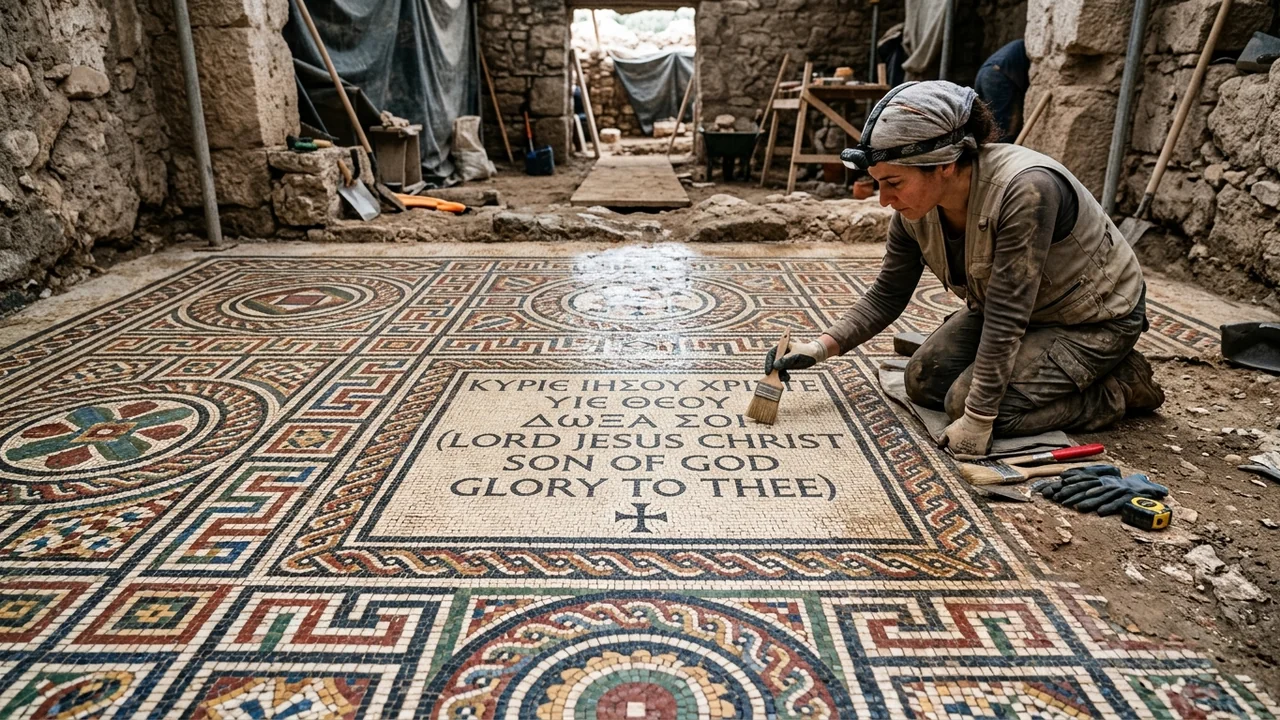
However, in the late autumn of 2005, an extraordinary archaeological excavation conducted inside the razor-wire perimeter of an Israeli maximum-security prison unearthed a physical artifact that obliterated this skeptical narrative: The Megiddo Mosaic.
Dating to approximately 230 AD—nearly a century before the Council of Nicaea—this beautifully preserved mosaic floor in a Christian prayer hall contained an explicit dedication in Greek capitals:
ΠΡΟΣΗΝΕΓΚΕΝ ΑΚΕΠΤΟΥΣ Η ΦΙΛΟΘΕΟΣ ΤΗΝ ΤΡΑΠΕΖΑΝ ΘΕΩ ΙΗΣΟΥ ΧΡΙΣΤΩ ΜΝΗΜΟΣΥΝΟΝ
"The God-loving Akeptous offered this table to GOD JESUS CHRIST as a memorial."
The 2005 Excavations Inside Megiddo Maximum-Security Prison
The discovery took place in one of the most unexpected locations on earth: inside the high-security walls of the Megiddo Prison, located in the Jezreel Valley of northern Israel, near the ancient biblical mound of Tel Megiddo (Armageddon).
In late 2005, the Israel Prison Service planned to construct a new wing for incarcerated security prisoners. Under Israeli antiquities laws, any construction project must be preceded by a salvage excavation. The Israel Antiquities Authority (IAA) dispatched archaeologist Dr. Yotam Tepper to supervise the excavation, utilizing dozens of low-security inmates as field laborers.
       [THE DISCOVERY OF THE MEGIDDO MOSAIC: AUTUMN 2005]
  ══════════════════════════════════════════════════════════════════
    Location:       Megiddo Prison Compound, Jezreel Valley, Israel
    Excavator:      Dr. Yotam Tepper (Israel Antiquities Authority)
    Ancient Site:   Legio / Caparcotna (Base of Roman 6th Legion)
    Structure:      Rectangular Christian Prayer Hall (Domus-Ecclesia)
    Dimensions:     Approximately 54 square meters (580 sq feet)
    Artifact ID:    Megiddo Mosaic Inscriptions 1, 2, and 3
    Date of Origin: c. 230 AD (Reign of Emperor Severus Alexander)
  ══════════════════════════════════════════════════════════════════
As the excavators peeled back layers of Ottoman soil and Roman fill, they uncovered the pristine, vibrant, multicolored mosaic floor of a large rectangular building measuring 9 meters long by 6 meters wide.
The structure was not a typical private Roman residence, nor was it a pagan temple. It was an authentic, early Christian prayer hall (domus-ecclesia)—the oldest Christian house of worship ever excavated in the Holy Land!
Epigraphic Anatomy of the Inscriptions: To God Jesus Christ
The mosaic floor is framed by an ornate black-and-white geometric border and features four beautifully preserved panels with Greek inscriptions set in black tesserae against a cream-white background.
The crowning jewel of the mosaic is the southern medallion inscription, designated by epigraphers as the Akeptous Inscription:
                 [THE AKEPTOUS INSCRIPTION: TEXT & NOMINA SACRA]

      ΠΡΟΣΗΝΕΓΚΕΝ ΑΚΕΠΤΟΥΣ
      Η ΦΙΛΟΘΕΟΣ ΤΗΝ ΤΡΑΠΕΖΑΝ
      ΘΩ ΙΥ ΧΩ ΜΝΗΜΟΣΥΝΟΝ

  ══════════════════════════════════════════════════════════════════
  FULL GREEK RESTORATION:
  Προσήνεγκεν Ἀκεπτοῦς ἡ φιλόθεος τὴν τράπεζαν Θεῷ Ἰησοῦ Χριστῷ μνημόσυνον.

  TRANSLATION:
  "The God-loving Akeptous has offered this table to GOD JESUS CHRIST
   as a memorial."
  ══════════════════════════════════════════════════════════════════
The Paleographic Proof: Nomina Sacra
Notice the vital third line: ΘΩ ΙΥ ΧΩ (Theō Iēsou Christō).
- In early Christian manuscripts and inscriptions, the most sacred divine names were written using a specialized scribal convention known as Nomina Sacra ("Sacred Names").
- Words like God (Theos), Lord (Kyrios), Jesus (Iesous), and Christ (Christos) were contracted to their first and last letters, with a horizontal bar (supralinear stroke) carved above them: ΘΩ (Theō = God), ΙΥ (Iēsou = Jesus), ΧΩ (Christō = Christ).
The Megiddo Mosaic uses the exact Nomina Sacra convention found in early biblical papyri like Papyrus 46 (c. 175–200 AD) and Papyrus 66 (c. 200 AD)!
This epigraphic evidence proves beyond dispute that in 230 AD—nearly an entire century before Constantine and the Council of Nicaea—ordinary Christian believers in Roman Palestine openly and unequivocally worshiped Jesus Christ as THEOS: ALMIGHTY GOD.
The Three Donors: A Roman Centurion, an Artisan, and a Wealthy Woman
The inscriptions across the mosaic floor reveal a fascinating, rich demographic snapshot of the pre-Constantinian Christian community:
       [THE THREE DONOR PANELS OF THE MEGIDDO PRAYER HALL]
  ══════════════════════════════════════════════════════════════════
  1. THE NOBLE WOMAN (Akeptous):
     Offered the sacred communion table ("trapeza") to God Jesus
     Christ as an act of memorial and personal devotion.

  2. THE ROMAN CENTURION (Gaianus):
     "Gaianus, a centurion, our brother, has made this mosaic
      at his own expense. Brutius has carried out the work."

  3. THE FOUR MARTYRS / VIRGINS:
     "Remember Primilla, and Kyriake, and Dorothea, and moreover Chreste."
  ══════════════════════════════════════════════════════════════════
1. The Roman Centurion Gaianus
The northern inscription identifies the primary financial benefactor of the prayer hall: Gaianus, a Roman centurion (hekatontarches).
- Gaianus belonged to the Roman Sixth Ironclad Legion (Legio VI Ferrata), which was garrisoned directly adjacent to the site at Caparcotna.
- He refers to himself as "our brother" (adelphos hēmon), demonstrating that despite his high military rank in the imperial Roman army, he identified fully as a humble brother in the local Christian congregation!
- This provides direct archaeological confirmation of the New Testament pattern in the Book of Acts, where Roman military officers (such as Cornelius in Acts 10 and the centurion at the cross in Mark 15:39) were among the earliest converts to Christ.
2. The Female Patron Akeptous
Akeptous was a wealthy Christian woman who donated the central stone communion table (trapeza). In early Christian worship, the trapeza was the table upon which the bread and wine of the Lord's Supper (the Eucharist) were consecrated. Akeptous's prominent dedication highlights the extraordinary honor, leadership, and financial autonomy enjoyed by women in the early pre-Constantinian Church.
3. The Memorial to Four Women Martyrs
The western inscription honors four Christian women: Primilla, Kyriake, Dorothea, and Chreste. Prominent epigraphers (such as Dr. Leah Di Segni of Hebrew University) suggest that these were local Christian women who had suffered martyrdom during earlier Roman persecutions under Septimius Severus (c. 202 AD) and were remembered by the congregation in their liturgical prayers.
Iconography of the Fish: The Pre-Constantinian Ichthys
In the center of the mosaic floor, directly flanking the inscription, the artist Brutius laid out two exquisitely detailed, tessellated fish.
                 [THE ICHTHYS MOSAIC SYMBOLISM]

                     <°))))><        ><((((°>
                 (Twin Ichthys Fish on Mosaic Floor)

  ══════════════════════════════════════════════════════════════════
  THE ANCIENT GREEK ACRONYM: Ι-Χ-Θ-Υ-Σ (ICHTHYS = FISH)
    Ι - Iēsous     (Jesus)
    Χ - Christos   (Christ)
    Θ - Theou      (Of God)
    Υ - Huios      (Son)
    Σ - Sōtēr      (Savior)
  ══════════════════════════════════════════════════════════════════
In the early centuries of the Church, when Christianity was an illegal, underground movement (religio illicita) subject to intermittent imperial persecution, Christians did not use the Cross as their public symbol (as the cross remained a horrific instrument of active Roman execution).
Instead, they adopted the Ichthys (fish) as their universal theological badge:
- The five Greek letters of the word for fish formed the acrostic: "Jesus Christ, Son of God, Savior".
- The twin fish in the Megiddo mosaic served as a public confession of faith, visible to all who entered the prayer hall to take communion at Akeptous’s table.
Dating and Stratigraphy: Legio VI Ferrata and 230 AD
The dating of the Megiddo Mosaic has been established with remarkable precision through independent stratigraphic, numismatic, and historical markers:
- Numismatic Context: Excavators recovered dozens of bronze Roman coins sealed directly beneath the floor mortar, including coins minted under Emperor Severus Alexander (who reigned from 222 to 235 AD) and Elagabalus (218–222 AD). Not a single coin dated after the mid-third century was found in the foundation levels.
- The Withdrawal of the Sixth Legion: Historical and epigraphic records show that the Roman garrison of Legio VI Ferrata was transferred out of the Galilee to southern Jordan (Adrou) around 280 AD during the administrative reforms of Emperor Diocletian. The presence of Centurion Gaianus proves the mosaic was laid while the Sixth Legion was still permanently headquartered at Caparcotna.
- The Pre-Diocletianic Destruction: Around 303–305 AD, the building was intentionally dismantled and covered with a layer of packed earth and stone rubble, likely during the Great Persecution launched by Diocletian.
Archaeological consensus dates the mosaic to c. 230 AD—a full ninety-five years prior to the Council of Nicaea!
Comparative Epigraphy: Pre-Nicaean Christian Artifacts
The Megiddo Mosaic is not an isolated anomaly. It stands within a vast continuum of third-century material culture and primary written records confirming that the earliest Christians worshiped Christ as divine:
| Archaeological / Historical Artifact | Provenance & Date | Epigraphic / Literary Content | Theological Significance |
|---|---|---|---|
| The Megiddo Mosaic | Megiddo Prison, Israel (c. 230 AD) | "Offered this table to GOD JESUS CHRIST" (Theō Iēsou Christō) | Earliest monumental mosaic calling Jesus "God" |
| Papyrus 66 (P66) | Bodmer Papyri, Egypt (c. 200 AD) | Preserves John 1:1, 18: "and the Word was God" / "the only begotten God" | Textual proof of deity in the earliest Gospel manuscripts |
| Papyrus 46 (P46) | Chester Beatty Papyri (c. 175–200 AD) | Titus 2:13: "our great God and Savior, Jesus Christ" with Nomina Sacra | Earliest surviving collection of Pauline epistles |
| Alexamenos Graffito | Palatine Hill, Rome (c. 200 AD) | "Alexamenos worships his God" (Pagan graffito mocking Christian prayer) | Hostile pagan proof that Christians worshiped Christ as God |
| Pliny the Younger's Letter | Bithynia, Asia Minor (c. 112 AD) | Christians meet before dawn to "sing hymns to Christ as to a God" (quasi deo) | Earliest pagan administrative report on Christian worship |
Discover the Complete 4-Volume Master Study Dossiers
The Megiddo Mosaic is one of the most stunning epigraphic discoveries of the twenty-first century, providing concrete physical proof that the deity of Christ was the bedrock foundation of the early Christian Church. To explore high-resolution photographic plates of the Greek inscriptions, complete plans of the 3rd-century Caparcotna prayer hall, and comprehensive studies of pre-Constantinian archaeology:
👉 Unlock the Complete 4-Volume Master Bundle & Premium AI ($9.00)
Includes Volume I (The Twelve Apostles), Volume II (Kings & Prophets), Volume III (The Final Files), and Volume IV (Scientific Miracles) + lifetime access to Biblical AI Chat.
Frequently Asked Questions
What is the Megiddo Mosaic and where was it found?
The Megiddo Mosaic is an intact 54-square-meter third-century Christian mosaic floor excavated in 2005 inside the compound of the Megiddo maximum-security prison in the Jezreel Valley of northern Israel by archaeologist Dr. Yotam Tepper. It decorated an early Christian prayer hall (domus-ecclesia).
What makes the Megiddo Mosaic so historically significant?
The mosaic contains a Greek donor inscription reading: "Akeptous has offered this table to God Jesus Christ as a memorial." Dating to approximately 230 AD, it is the earliest monumental archaeological inscription ever discovered that explicitly calls Jesus "God" (Theos), completely disproving the modern myth that the deity of Christ was invented at the Council of Nicaea in 325 AD.
Who funded the Megiddo Mosaic?
The mosaic was funded primarily by a Roman centurion named Gaianus, belonging to the Sixth Ironclad Legion (Legio VI Ferrata), who is identified in the mosaic inscription as "our brother." This provides direct archaeological proof of Roman military officers converting to Christianity and funding early churches.
What symbols appear on the Megiddo Mosaic?
The floor features two large mosaic fish, representing the ancient Christian Ichthys symbol (an acronym for "Jesus Christ, Son of God, Savior"). Because the cross was still an active Roman execution tool in 230 AD, early Christians used the fish as their primary theological emblem.
Frequently Asked Questions
What is the Megiddo Mosaic and where was it found?
The Megiddo Mosaic is an intact 54-square-meter third-century Christian mosaic floor excavated in 2005 inside the compound of the Megiddo maximum-security prison in the Jezreel Valley of northern Israel by archaeologist Dr. Yotam Tepper. It decorated an early Christian prayer hall (domus-ecclesia).
What makes the Megiddo Mosaic so historically significant?
The mosaic contains a Greek donor inscription reading: "Akeptous has offered this table to God Jesus Christ as a memorial." Dating to approximately 230 AD, it is the earliest monumental archaeological inscription ever discovered that explicitly calls Jesus "God" (Theos), completely disproving the modern myth that the deity of Christ was invented at the Council of Nicaea in 325 AD.
Who funded the Megiddo Mosaic?
The mosaic was funded primarily by a Roman centurion named Gaianus, belonging to the Sixth Ironclad Legion (Legio VI Ferrata), who is identified in the mosaic inscription as "our brother." This provides direct archaeological proof of Roman military officers converting to Christianity and funding early churches.
What symbols appear on the Megiddo Mosaic?
The floor features two large mosaic fish, representing the ancient Christian Ichthys symbol (an acronym for "Jesus Christ, Son of God, Savior"). Because the cross was still an active Roman execution tool in 230 AD, early Christians used the fish as their primary theological emblem.
Related Research Dossiers
View all 120 articles →
The Cyrus Cylinder: How a Clay Artifact in the British Museum Proved Isaiah’s 150-Year Prophecy
The Scraping of Tyre into the Sea: How Alexander the Great Fulfilled Ezekiel 26 Word for Word