Subject Scope: Archaeological Atlas of Magdala: The 1st-Century Synagogue, the Magdala Stone, and the Galilean World of Mary Magdalene
Historical Context: Ancient Near Eastern stratigraphy, Levant archaeological surveys, and Semitic epigraphy.
Primary Evidence: Monumental stelae, bullae seals, ceramic typology, and calibrated AMS radiocarbon determinations.
Investigation Highlights: The Accidental Discovery of Ancient Magdala in 2009 • The First-Century Synagogue: Frescoes, Mosaics, and Architecture • The Magdala Stone: The Earliest Relief of the Second Temple Menorah
Scholarly Consensus: Aligned with published excavation reports from leading Near Eastern archaeological institutes.
The Accidental Discovery of Ancient Magdala in 2009
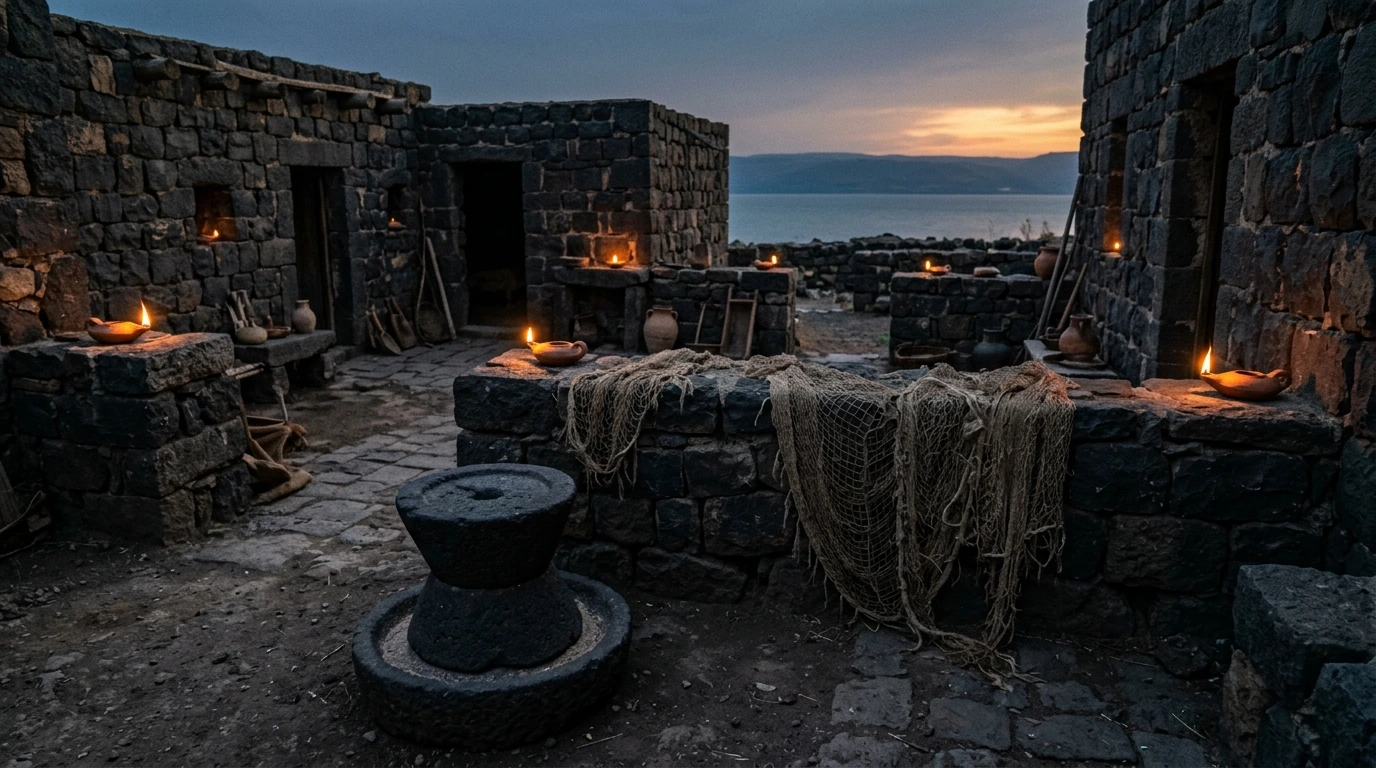
In 2009, on the western shore of the Sea of Galilee between Tiberias and Capernaum, Catholic priest Father Juan Solana initiated construction on a proposed retreat center known as the Magdala Center. In accordance with Israeli antiquities law, the Israel Antiquities Authority (IAA), led by archaeologists Dina Avshalom-Gorni and Arfan Najar, conducted routine exploratory salvage excavations before pouring concrete.
Just fifty centimeters beneath the modern topsoil, the backhoe struck a flat stone. Within weeks, the routine dig became one of the most sensational archaeological discoveries in the history of biblical archaeology:
- The excavators had uncovered an extraordinarily preserved first-century synagogue, in active use between 50 BC and 67 AD.
- This was only the seventh synagogue from the Second Temple period ever discovered in the entire world, and the first 1st-century synagogue ever found in the Galilee region.
- Because the synagogue was constructed while the Second Temple of Jerusalem still stood, it provided uncontested historical proof that rural Galilean Jews gathered in ornate, decorated community synagogues during the lifetime of Jesus Christ!
+----------------------------------------------------------------------------------------------------+
|               THE DISCOVERY CHRONOLOGY OF ANCIENT MAGDALA (MIGDAL)                                |
+--------------------------+-----------------------+-------------------+-----------------------------+
| DATE                     | EXCAVATING BODY       | DISCOVERY ITEM    | HISTORICAL REVELATION       |
+--------------------------+-----------------------+-------------------+-----------------------------+
| 2009 (September)         | IAA (Avshalom-Gorni)  | 1st-cent. Synagogue| Proves synagogues existed   |
|                          |                       | with mosaic floor | in Galilee while Temple stoo|
| 2009 (October)           | IAA                   | The Magdala Stone | Earliest carved Menorah in  |
|                          |                       | in center of hall | a Galilean synagogue        |
| 2010–2014                | Anáhuac University /  | Complex of four   | Living spring water mikvaot |
|                          | IAA (Marcelo Zapata)  | domestic mikvaot  | with pristine plumbing      |
| 2021                     | IAA (Barak Tzin)      | A second 1st-cent.| Proves Magdala was a major  |
|                          |                       | synagogue nearby  | thriving Jewish metropolis  |
+--------------------------+-----------------------+-------------------+-----------------------------+
The First-Century Synagogue: Frescoes, Mosaics, and Architecture
The Magdala synagogue was not a crude stone shed; it was a jewel of first-century Jewish sacred architecture:
- Central Assembly Hall: Measuring approximately 120 square meters, bordered by stepped stone tiers where up to 200 worshippers sat facing the center.
- Vibrant Frescoes: The walls were coated with high-quality Roman-style frescoes (pompeian red, gold, and black geometric patterns), demonstrating that Galilean Jews appreciated sophisticated Mediterranean art while strictly adhering to the Second Commandment by avoiding human or animal likenesses.
- Color Mosaic Floor: In the central hall, a stunning geometric mosaic carpet features meander patterns and an iconic central rosette motif.
- Coins of the Procurators: Excavators found bronze coins sealed beneath the floor mortar, including coins minted in 29 AD under Pontius Pilate, proving the building was actively functioning during the earthly ministry of Jesus Christ.
The Magdala Stone: The Earliest Relief of the Second Temple Menorah
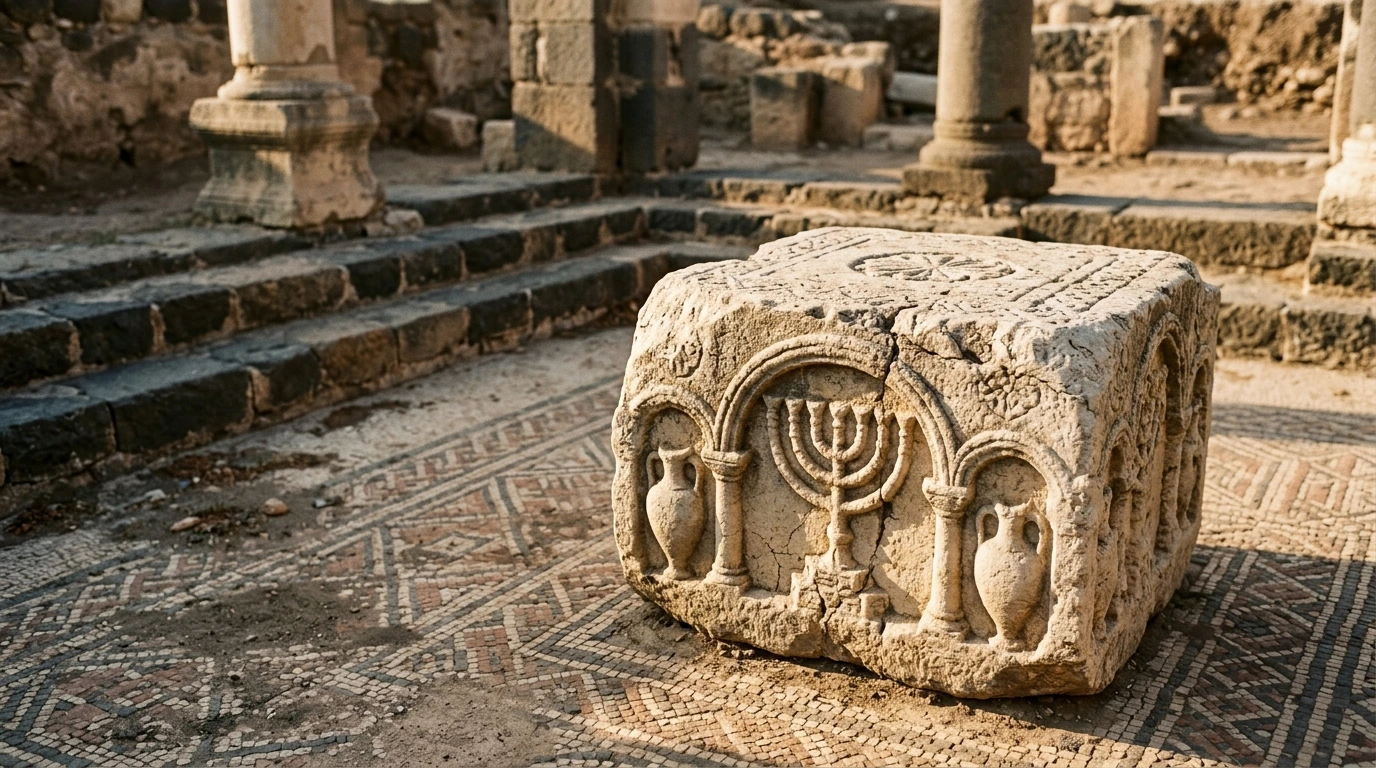
At the exact center of the synagogue hall stood an intricately carved block of natural limestone measuring 24 by 20 inches, standing 18 inches high, known globally as the Magdala Stone:
- The Seven-Branched Menorah: On its front face, facing Jerusalem, is an exquisitely incised seven-branched Menorah resting on a triangular pedestal, flanked by two ceremonial oil amphorae (amphoriskoi). This is the earliest known relief of the Temple Menorah ever discovered inside a Jewish synagogue, carved by an artisan who had observed the actual golden Menorah standing in the Holy Place in Jerusalem!
- The Chariot of Fire (Merkavah): On the bottom of the stone are engraved two rosettes resting above wheels with fiery petals, evoking the divine throne chariot of Ezekiel (Merkavah).
- The Table of Showbread: The top surface features carved rosettes, palm fronds, and cups, matching the furniture of the Temple. Scholars universally conclude that the Magdala Stone served as a reading desk (bima) for the Torah scroll, symbolically translating the sacred holiness of the Jerusalem Temple into a regional Galilean synagogue!
The World of Mary Magdalene: Wealth, Fish Processing, and Healing
In Luke 8:1–3, the Gospel introduces the core group of women who traveled with Jesus and supported His ministry out of their personal financial resources:
"Mary called Magdalene, out of whom had come seven demons, and Joanna the wife of Chuza, Herod’s steward, and Susanna, and many others who provided for Him from their substance."
The title Magdalene (he Magdalene) indicates her origin in Magdala, known in Greek as Taricheae (from taricheuo, meaning "to salt or pickle fish"):
- Magdala was famous across the Roman Empire for its industrial salted and pickled fish, which was exported directly to Rome and across the Mediterranean.
- Excavations revealed massive commercial fish-processing vats along the harbor lined with waterproof hydraulic plaster.
- Mary was not a destitute peasant; coming from this wealthy mercantile export center, she was an independent woman of means who dedicated her wealth to the itinerant ministry of the Messiah who delivered her from demonic torment.
Ritual Purity on the Shore: The Groundwater Mikvaot
Adjacent to the market and residential quarters, archaeologists uncovered four extraordinary ritual immersion baths (Mikvaot):
- Unlike Judean cistern mikvaot filled by seasonal rainwater runoff, the Magdala mikvaot are engineered to tap into living groundwater springs bubbling up beneath the floor.
- Clean, crystal-clear subterranean freshwater enters through channels, fills the basalt immersion basins lined with waterproof plaster, and exits through drainage sluices, maintaining continuous ritual purity according to the strictest Levitical halakha.
Master 20-Question Archaeological Fact Quiz on Magdala
Round 1: Discovery & The 2009 Excavations
- Q: In what year was the first-century synagogue at Magdala accidentally discovered during exploratory salvage excavations?
- Answer: 2009.
- Q: What Catholic priest initiated the construction of the retreat center that led to the discovery of ancient Magdala?
- Answer: Father Juan Solana.
- Q: How deep beneath the modern soil surface was the first-century synagogue uncovered?
- Answer: Just fifty centimeters (approx. 20 inches).
- Q: What was the Greek name of Magdala, meaning "Place of Salted Fish"?
- Answer: Taricheae.
- Q: How many total Second Temple period synagogues were known in the entire world before the 2009 discovery of Magdala?
- Answer: Only six (Magdala was the seventh).
Round 2: The Magdala Stone & Temple Symbols
- Q: What iconic artifact carved from natural limestone was discovered in the center of the Magdala synagogue hall?
- Answer: The Magdala Stone.
- Q: What sacred seven-branched object from the Jerusalem Temple is carved on the front face of the Magdala Stone?
- Answer: The seven-branched Golden Lampstand (Menorah).
- Q: What ancient visual motif carved on the bottom of the Magdala Stone echoes the chariot throne of God in Ezekiel 1?
- Answer: Wheels with fiery rosette petals (the Merkavah chariot).
- Q: What was the functional purpose of the Magdala Stone in the synagogue?
- Answer: A reading desk (bima) for unrolling and reading the Torah scroll.
- Q: What makes the Menorah relief on the Magdala Stone historically unique compared to the Arch of Titus in Rome?
- Answer: It was carved by a Jewish artisan who had actually seen the original Menorah in the Temple before its destruction in 70 AD.
Round 3: Mary Magdalene & The City
- Q: What prominent female disciple of Jesus hailed from this wealthy fishing town?
- Answer: Mary Magdalene (Miriam of Magdala).
- Q: How many demons did Jesus cast out of Mary Magdalene according to Luke 8:2?
- Answer: Seven demons.
- Q: What primary commercial product did Magdala export across the Roman Empire, including to Rome itself?
- Answer: Salted and pickled fish.
- Q: What coins found beneath the synagogue floor proved the building was in use during Jesus’ earthly ministry?
- Answer: Bronze coins minted in 29 AD under Roman Procurator Pontius Pilate.
- Q: In Luke 8:3, how did Mary Magdalene and other faithful women support Jesus and His twelve apostles?
- Answer: Out of their own personal private financial resources ("from their substance").
Round 4: Mikvaot, Art & Scripture
- Q: What type of water filled the four stone ritual baths (mikvaot) discovered in Magdala?
- Answer: Living subterranean groundwater from natural springs beneath the floor.
- Q: What Roman fresco colors decorated the interior walls of the Magdala synagogue?
- Answer: Pompeian red, ochre yellow, and black geometric patterns.
- Q: In Matthew 4:23, what summary of Jesus' ministry confirms that He visited and taught in synagogues throughout Galilee like Magdala?
- Answer: "And Jesus went about all Galilee, teaching in their synagogues, preaching the gospel of the kingdom, and healing all manner of sickness."
- Q: In 2021, what astonishing discovery confirmed that Magdala had multiple independent synagogues?
- Answer: A second 1st-century synagogue was excavated just a short distance from the first.
- Q: What was Mary Magdalene privileged by God to become on the morning of the resurrection in John 20?
- Answer: The first eyewitness to the risen Christ, commissioned as the "Apostle to the Apostles" to proclaim His resurrection.
Comparative Table: Magdala Synagogue vs. Other 1st-Century Synagogues
+----------------------------------------------------------------------------------------------------+
|               SYNTHESIS OF FIRST-CENTURY SECOND TEMPLE SYNAGOGUES                                  |
+--------------------------+-----------------------+-------------------+-----------------------------+
| SYNAGOGUE SITE           | DISCOVERY DATE        | PHYSICAL FEATURES | UNIQUE ARCHAEOLOGICAL VALUE |
+--------------------------+-----------------------+-------------------+-----------------------------+
| Magdala (Galilee)        | 2009                  | Frescoes, mosaic  | Magdala Stone with earliest |
|                          |                       | floors, benches   | Menorah; Pontius Pilate coin|
| Gamla (Golan Heights)    | 1976                  | Basalt benches,   | Destroyed in Roman siege    |
|                          |                       | mikveh at entrance| of 67 AD; arrowheads in situ|
| Masada (Judean Desert)   | 1963 (Yadin)          | Benches, ostraca, | Zealot rebel fortress;      |
|                          |                       | scripture pit     | biblical scroll fragments   |
| Herodium (Judean Hills)  | 1968                  | Converted triclinium| Built inside Herod's palace|
|                          |                       | hall with columns | during First Jewish Revolt  |
+--------------------------+-----------------------+-------------------+-----------------------------+
Frequently Asked Questions
What is the Magdala Stone and why is it world-famous?
The Magdala Stone is a 1st-century limestone Torah-reading block discovered in the center of the Magdala synagogue, bearing the earliest known relief of the seven-branched Temple Menorah carved by a contemporary eyewitness before 70 AD.
Did Jesus teach in the Magdala synagogue?
Yes. Matthew 4:23 and Mark 1:39 explicitly state that Jesus traveled throughout all the towns of Galilee, preaching in their synagogues. As Magdala was a major city on the lake road between Tiberias and Capernaum, Jesus undoubtedly taught there.
What does the archaeology of Magdala reveal about Mary Magdalene?
It proves that Mary came from a wealthy, cosmopolitan fish-exporting center rather than an impoverished village, explaining how she and other women possessed the financial resources to travel with and support Jesus' ministry (Luke 8:1–3).
Primary Sources & Scholarly Archives
Editorial Standard →Official archaeological field reports, certified stratigraphy surveys, and Semitic epigraphy catalogs.
Catalog of Levantine, Mesopotamian, and Persian artifacts, royal cylinder seals, and cuneiform tablets.
Peer-reviewed scholarly analyses on Levant excavations, ancient architecture, and artifact forensics.
Frequently Asked Questions
What is the Magdala Stone and why is it world-famous?
The Magdala Stone is a 1st-century limestone Torah-reading block discovered in the center of the Magdala synagogue, bearing the earliest known relief of the seven-branched Temple Menorah carved by a contemporary eyewitness before 70 AD.
Did Jesus teach in the Magdala synagogue?
Yes. Matthew 4:23 and Mark 1:39 explicitly state that Jesus traveled throughout all the towns of Galilee, preaching in their synagogues. As Magdala was a major city on the lake road between Tiberias and Capernaum, Jesus undoubtedly taught there.
What does the archaeology of Magdala reveal about Mary Magdalene?
It proves that Mary came from a wealthy, cosmopolitan fish-exporting center rather than an impoverished village, explaining how she and other women possessed the financial resources to travel with and support Jesus' ministry (Luke 8:1–3).
Related Research Dossiers
View all 515 research dossiers →
Complete Research Guide to the Great Isaiah Scroll (1QIsa-a): Museum Location, Digital Consultation, and Landmark Passages
The War Scroll (1QM): Apocalyptic Warfare, Sons of Light vs. Sons of Darkness, and Eschatological Realities in the Dead Sea Scrolls