Subject Scope: Visual Pilgrimage and Study Guide to Capernaum (The City of Jesus): Daily Life, Peter’s Insula, and 1st-Century Synagogue Realities
Historical Context: Ancient Near Eastern stratigraphy, Levant archaeological surveys, and Semitic epigraphy.
Primary Evidence: Monumental stelae, bullae seals, ceramic typology, and calibrated AMS radiocarbon determinations.
Investigation Highlights: Capernaum: The Headquarters of Jesus' Galilean Ministry • The Insula Architecture and Daily Domestic Life • The Archaeology of Peter’s House: Domus-Ecclesia to Byzantine Octagon
Scholarly Consensus: Aligned with published excavation reports from leading Near Eastern archaeological institutes.
Capernaum: The Headquarters of Jesus' Galilean Ministry
When Jesus left Nazareth after being rejected in his hometown synagogue, the Gospel of Matthew records a pivotal geographical shift:
"And leaving Nazareth, He came and dwelt in Capernaum, which is by the sea, in the regions of Zebulun and Naphtali, that it might be fulfilled which was spoken by Isaiah the prophet..." (Matthew 4:13–14)
So intimately was Jesus associated with this thriving fishing town on the northwest shore of the Sea of Galilee (Yam Kinneret) that Matthew later refers to it simply as "His own city" (ten idian polin, Matthew 9:1). In Capernaum, Jesus called Peter, Andrew, James, John, and Matthew; here He healed the centurion’s servant, cast out demons in the synagogue, healed Peter’s mother-in-law of a raging fever, delivered the paralyzed man lowered through the roof, and delivered the profound Bread of Life discourse (John 6).
Known in Hebrew as Kfar Nahum (כְּפַר נַחוּם, meaning "Village of Comfort"), the town was never a fortified Roman polis like Tiberias or Sepphoris. It was an industrious, thoroughly Jewish agricultural, fishing, and border transit town inhabited by approximately 1,500 people, strategically situated along the ancient international trade artery known as the Via Maris (Way of the Sea).
+----------------------------------------------------------------------------------------------------+
|               CAPERNAUM: THE ANATOMY OF A FIRST-CENTURY GALILEAN TOWN                              |
+--------------------------+-----------------------+-------------------+-----------------------------+
| GEOGRAPHIC / URBAN UNIT  | ARCHAEOLOGICAL PROOF  | SCRIPTURE LOCUS   | HISTORICAL SIGNIFICANCE     |
+--------------------------+-----------------------+-------------------+-----------------------------+
| 1. Peter's House         | 1st-cent. plaster with| Mark 1:29–34;     | Earliest house-church       |
|    (*Domus-Ecclesia*)    | Christian graffiti    | Matthew 8:14–15   | (*domus-ecclesia*) in world |
| 2. 1st-Cent. Synagogue   | Black basalt foundation| Mark 1:21–28;    | Where Jesus cast out demons |
|    under 4th-cent. White | directly beneath white| Luke 7:1–10       | and taught the Bread of Life|
| 3. Customs Post / Tax    | Roman milestone,      | Matthew 9:9;      | Border post between Herodian|
|    Collector's Booth     | coins, trade harbor   | Mark 2:14         | tetrarchies (Antipas/Philip)|
| 4. Basalt Fishing Harbor | Piers, stone anchors, | Matthew 4:18–22;  | Home port of Peter and the  |
|    and Net Mending Bays  | net-sinkers, hooks    | Luke 5:1–11       | Sons of Zebedee             |
+--------------------------+-----------------------+-------------------+-----------------------------+
The Insula Architecture and Daily Domestic Life
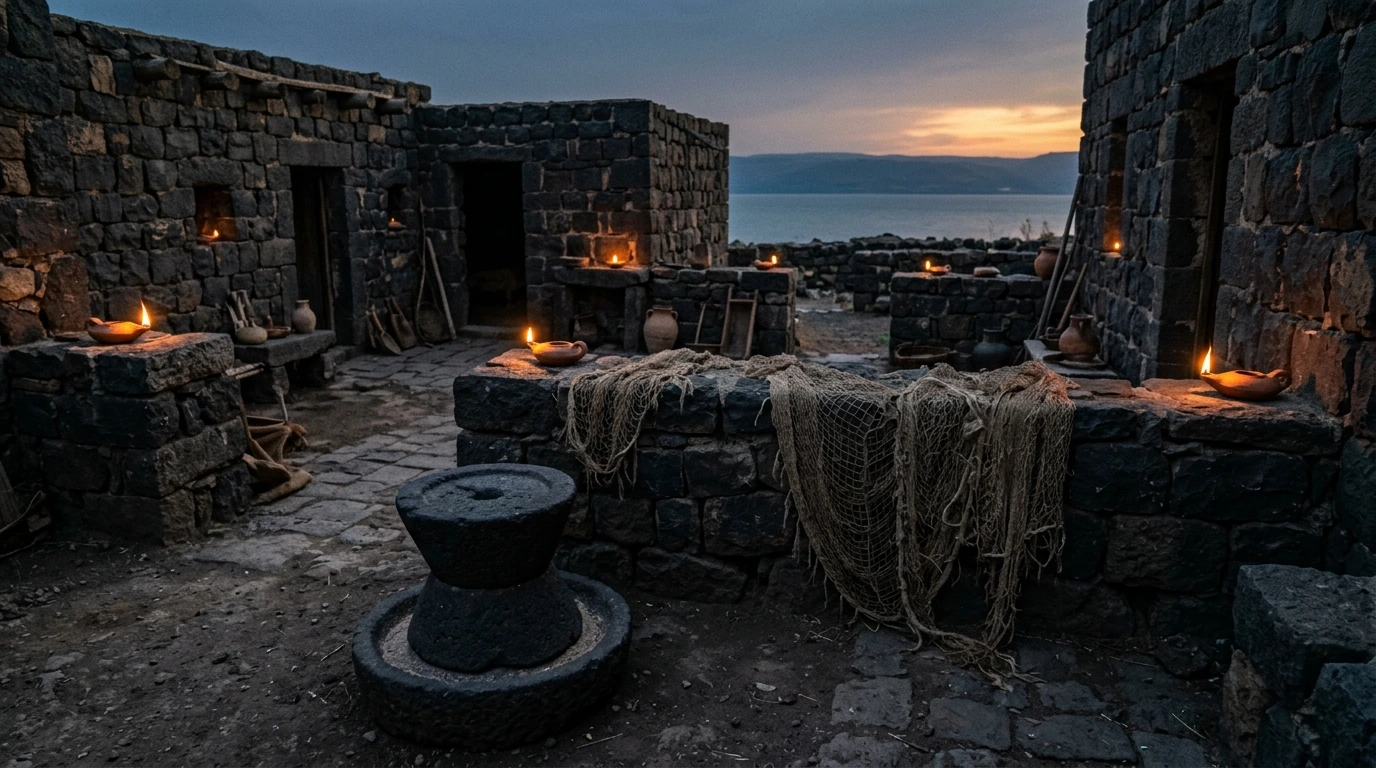
Excavations directed by Franciscan archaeologists Father Virgilio Corbo and Father Stanislao Loffreda revealed that ancient Capernaum was built almost entirely of rough, unhewn blocks of local black volcanic basalt (bazalt), held together with mud and straw mortar rather than dressed ashlar masonry:
- The Insula Complex: Families lived not in isolated single-family dwellings, but in multi-generational architectural compounds known as insulae. An insula consisted of a series of small, single-story domestic rooms arranged around a shared open-air central courtyard.
- Communal Courtyards: Daily domestic activities took place in these courtyards: grinding grain with basalt hand-mills (rehayim), cooking over clay ovens (tannur), weaving fishing nets, and caring for livestock.
- Roof Construction: Roofs were flat, constructed of wooden beams (cypress or olive) overlaid with reeds, brushwood, and thick layers of packed mud mixed with straw. This explains the precise mechanics of Mark 2:4: the friends of the paralytic could easily climb the exterior stone stairs, dig through the packed mud-and-reed roof (apestegasan ten stegen), and lower the stretcher directly into the central room where Jesus stood.
The Archaeology of Peter’s House: Domus-Ecclesia to Byzantine Octagon
Directly south of the synagogue, excavators unearthed a modest first-century basalt residential insula that underwent an extraordinary, unprecedented architectural evolution:
- First-Century Home (Layer 1): Typical late Hellenistic/early Roman domestic rooms with cooking pots, fishhooks, and hearths.
- Late First-Century Transformation (Layer 2): In the mid-to-late first century AD, one specific central room was radically modified: its dirt floor was paved over with fine lime plaster, domestic cooking pottery abruptly vanished, and storage jars (pithoi) took their place.
- Christian Graffiti (Domus-Ecclesia): Excavators discovered over 130 devotional inscriptions scratched into the painted wall plaster in Greek, Aramaic, Syriac, and Latin, featuring the name of Jesus (designated as Christos, Lord, and Most High), alongside Christian symbols including fish, crosses, and boats, as well as mentions of Peter (Petros).
- The Byzantine Octagonal Basilica (Layer 3): In the 5th century AD, Byzantine Christians constructed an elaborate octagonal church centered precisely over this single plastered room, preserving it beneath a central mosaic circle—the ancient equivalent of enshrining a sacred relic.
The Dual Synagogues: Basalt Foundation Beneath the White Limestone
Visitors to modern Capernaum are immediately struck by the monumental, gleaming white limestone ruins of a magnificent two-story synagogue with Corinthian capitals and ornate friezes. However, geological and numismatic reality reveals a dramatic story:
- The White Limestone Synagogue (4th/5th Century AD): Built of limestone transported from miles away, this building dates to the late Roman or Byzantine period.
- The First-Century Black Basalt Synagogue (Jesus' Synagogue): Stratigraphic trenches dug through the floor of the white synagogue revealed the massive, well-dressed foundation walls of a black basalt synagogue built in the first century AD.
- The Centurion’s Gift: Luke 7:5 records that the Jewish elders praised a Roman centurion stationed in Capernaum, pleading: "He loves our nation, and has built us a synagogue." The basalt foundations resting directly upon virgin soil represent the very building financed by this centurion, where Jesus healed the man with the withered hand (Mark 3:1–6) and preached the Bread of Life (John 6:59).
Fishing, Taxation, and the Via Maris International Highway
Capernaum was positioned at a critical geopolitical border:
- Tetrarchy Border: It sat on the frontier between the territory of Herod Antipas (Galilee) and the territory of his half-brother Herod Philip (Gaulanitis/Golan Heights).
- The Toll Station (Telonion): Caravans traveling south from Damascus along the Via Maris toward Egypt were required to pay tolls and custom duties upon entering Antipas' realm. This was the exact customs booth where Matthew (Levi) sat when Jesus called him: "Follow Me" (Matthew 9:9).
- Commercial Fishing Consortium: Fishing on the Sea of Galilee was a regulated, commercial industry requiring state leases. The biblical partnerships between Peter, Andrew, James, and John (Luke 5:7) reflect a cooperative enterprise operating boats, dragnets (amphiblestron), and salting facilities.
Master 20-Question Study Quiz on Biblical Capernaum
Round 1: Geography, Daily Life & Town Layout
- Q: What is the Hebrew name of Capernaum, meaning "Village of Comfort"?
- Answer: Kfar Nahum (כְּפַר נַחוּם).
- Q: What local dark volcanic stone was used to construct nearly all first-century houses in Capernaum?
- Answer: Basalt (bazalt).
- Q: What architectural term designates the multi-generational communal residential compounds found at Capernaum?
- Answer: An insula.
- Q: How was the roof of a typical first-century Galilean home constructed, explaining how the paralytic was lowered in Mark 2?
- Answer: Wooden beams covered with branches, reeds, and packed mud/straw, easily dug through.
- Q: On which shore of the Sea of Galilee is ancient Capernaum located?
- Answer: The northwest shore.
Round 2: Peter’s House & The Church
- Q: What shape was the 5th-century Byzantine church built directly over the remains of Peter's house?
- Answer: Octagonal (eight-sided).
- Q: What Latin term designates the earliest house-churches where early believers met in domestic rooms?
- Answer: Domus-ecclesia.
- Q: In what four ancient languages was Christian devotional graffiti found on the plastered walls of Peter’s room?
- Answer: Greek, Aramaic, Syriac, and Latin.
- Q: What Christian symbols were scratched into the plaster of Peter’s house alongside the name of Jesus?
- Answer: Fish, crosses, boats, and geometric floral motifs.
- Q: Which Franciscan archaeologists directed the landmark 20th-century excavations of Capernaum and Peter’s house?
- Answer: Father Virgilio Corbo and Father Stanislao Loffreda.
Round 3: The Synagogue & The Centurion
- Q: What color and stone type distinguishes the earlier first-century foundation beneath the white limestone synagogue?
- Answer: Black basalt.
- Q: What foreign Roman officer paid for the construction of the Capernaum synagogue according to Luke 7?
- Answer: A Roman centurion (hekatontarches).
- Q: What famous theological discourse concerning eating His flesh and drinking His blood did Jesus deliver in the Capernaum synagogue?
- Answer: The Bread of Life discourse (John 6:22–59).
- Q: What demonic possession miracle took place inside the Capernaum synagogue on a Sabbath day in Mark 1?
- Answer: Jesus cast out an unclean spirit that cried out: "I know who You are—the Holy One of God!" (Mark 1:21–28).
- Q: Whose mother-in-law was healed of a high fever by Jesus in her Capernaum home immediately after leaving the synagogue?
- Answer: Simon Peter’s mother-in-law (Mark 1:29–31).
Round 4: Trade, Tax & Prophecy
- Q: What international highway connecting Egypt and Mesopotamia passed directly by Capernaum?
- Answer: The Via Maris ("The Way of the Sea").
- Q: What tax collector was sitting at the tax office in Capernaum when Jesus called him to be an apostle?
- Answer: Matthew, also called Levi the son of Alphaeus (Matthew 9:9).
- Q: What unusual miracle involving a fish and a coin took place in Capernaum to pay the two-drachma temple tax?
- Answer: Peter caught a fish with a four-drachma coin (stater) in its mouth (Matthew 17:24–27).
- Q: What solemn prophetic judgment did Jesus pronounce over Capernaum because it did not repent despite witnessing most of His mighty works?
- Answer: "And you, Capernaum, who are exalted to heaven, will be brought down to Hades... it will be more tolerable for the land of Sodom in the day of judgment than for you" (Matthew 11:23–24).
- Q: What is the overarching evidentiary conclusion derived from the archaeological excavations of Capernaum?
- Answer: They prove that the Gospel accounts of Jesus' ministry are grounded in precise, authentic, eyewitness first-century Galilean topography and material culture.
Stratigraphic Matrix of Capernaum Excavations
+----------------------------------------------------------------------------------------------------+
|               ARCHAEOLOGICAL STRATIGRAPHY OF CAPERNAUM (KFAR NAHUM)                                |
+--------------------------+-----------------------+-------------------+-----------------------------+
| STRATUM LEVEL            | HISTORICAL PERIOD     | MAJOR RUINS       | BIBLICAL SYNCHRONISM        |
+--------------------------+-----------------------+-------------------+-----------------------------+
| Stratum I (Top)          | Early Islamic / Umayyad| Agricultural store| Decline after 749 AD        |
|                          | (c. 650–750 AD)       | rooms, courtyards | earthquake                  |
| Stratum II               | Byzantine Period      | Octagonal church, | Golden age of Christian     |
|                          | (c. 350–650 AD)       | White Synagogue   | pilgrimage to Galilee       |
| Stratum III              | Late Roman Period     | Expanded insulae, | Early veneration of Peter's |
|                          | (c. 135–350 AD)       | plastered walls   | domestic room (*domus*)     |
| Stratum IV (Primary)     | Early Roman / Gospel  | Black basalt syna-| **The Ministry of Jesus;**  |
|                          | (c. 50 BC–135 AD)     | gogue, Peter's insula| Calling of the Twelve    |
+--------------------------+-----------------------+-------------------+-----------------------------+
Frequently Asked Questions
Did archaeologists find the actual house of Saint Peter in Capernaum?
Yes. Franciscan excavations uncovered a first-century basalt home beneath a 5th-century Byzantine octagonal church, displaying plaster walls covered in 130 ancient Christian prayers and graffiti in Greek and Aramaic mentioning Jesus and Peter.
Why is there a white synagogue on top of a black basalt synagogue?
The visible white limestone synagogue dates to the late 4th or 5th century AD, but it was built directly on top of the foundation walls of the black basalt 1st-century synagogue where Jesus taught and healed (Luke 7:5; John 6:59).
Why was Capernaum so important in Jesus' ministry?
Capernaum served as Jesus' primary headquarters ("His own city", Matthew 9:1) because of its strategic border location along the Via Maris highway, its thriving fishing economy, and its mixed population open to the Gospel.
Primary Sources & Scholarly Archives
Editorial Standard →Official archaeological field reports, certified stratigraphy surveys, and Semitic epigraphy catalogs.
Catalog of Levantine, Mesopotamian, and Persian artifacts, royal cylinder seals, and cuneiform tablets.
Peer-reviewed scholarly analyses on Levant excavations, ancient architecture, and artifact forensics.
Frequently Asked Questions
Did archaeologists find the actual house of Saint Peter in Capernaum?
Yes. Franciscan excavations uncovered a first-century basalt home beneath a 5th-century Byzantine octagonal church, displaying plaster walls covered in 130 ancient Christian prayers and graffiti in Greek and Aramaic mentioning Jesus and Peter.
Why is there a white synagogue on top of a black basalt synagogue?
The visible white limestone synagogue dates to the late 4th or 5th century AD, but it was built directly on top of the foundation walls of the black basalt 1st-century synagogue where Jesus taught and healed (Luke 7:5; John 6:59).
Why was Capernaum so important in Jesus' ministry?
Capernaum served as Jesus' primary headquarters ('His own city', Matthew 9:1) because of its strategic border location along the Via Maris highway, its thriving fishing economy, and its mixed population open to the Gospel.
Related Research Dossiers
View all 515 research dossiers →
How Tel Hazor Proves the Historical and Geographic Precision of the Biblical Conquest and the United Monarchy
Biblical Passages That Come Alive When You Walk the Ruins of Hazor: Conquest Fire, Deborah's Triumph, and Solomon's Royal Fortress