What is the theological significance of Joshua burning Hazor alone?
As the 'head of all those kingdoms,' Hazor was the ideological and spiritual capital of Canaanite paganism, requiring complete destruction under the divine ban (cherem) to permanently break the northern confederacy.
Ancient patristic witnesses, Second Temple manuscripts, and classical annals.
Stratigraphic digs, monumental epigraphy, and artifact forensics in the Levant.
Distinguishing canonical Scripture text from historical patristic traditions.
Subject Scope: Biblical Passages That Come Alive When You Walk the Ruins of Hazor: Conquest Fire, Deborah's Triumph, and Solomon's Royal Fortress
Historical Context: Ancient Near Eastern stratigraphy, Levant archaeological surveys, and Semitic epigraphy.
Primary Evidence: Monumental stelae, bullae seals, ceramic typology, and calibrated AMS radiocarbon determinations.
Investigation Highlights: The Power of Place: Why Biblical Geography Matters • Joshua 11:10–13: The Sole Mound Burned With Fire • The Canaanite Stelae Temple: Standing Stones (Massebot)
Scholarly Consensus: Aligned with published excavation reports from leading Near Eastern archaeological institutes.
The Power of Place: Why Biblical Geography Matters
To read Holy Scripture detached from its physical geography is to read a drama without a stage. The historical events recorded across the Old and New Testaments did not occur in ethereal, mythological realms; they unfolded upon specific granitic ridges, limestone passes, fertile alluvial valleys, and spring-fed oases. In biblical hermeneutics, historical geography is often called the "Fifth Gospel"—the physical terrain that authenticates, clarifies, and enlivens the written text.
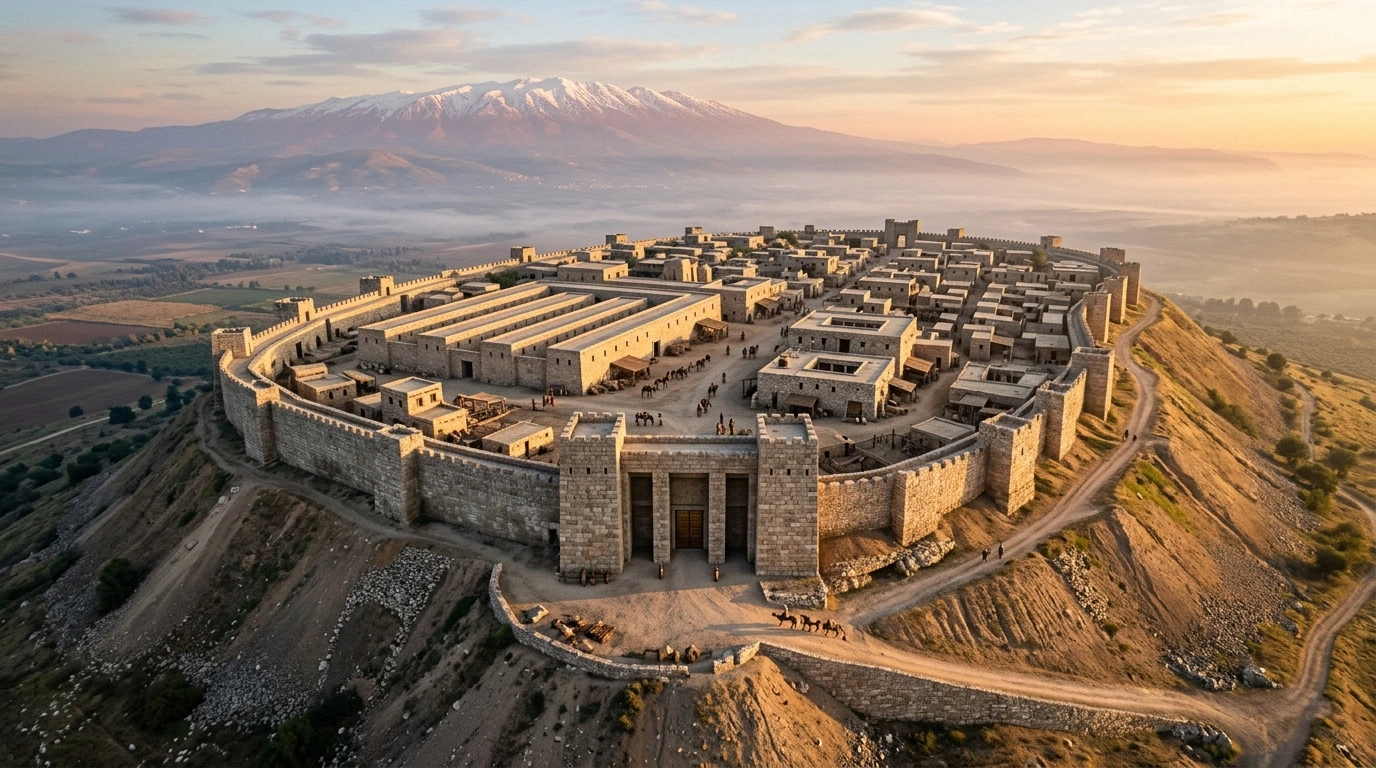
Nowhere is this principle demonstrated more dramatically than at Tel Hazor in Upper Galilee. When a pilgrim, pastor, or scholar stands upon the crest of the ancient acropolis, gazing north across the glittering waters of the Hula Basin toward the snow-capped peak of Mount Hermon, the geopolitical tensions of the Hebrew Bible snap into sharp, three-dimensional focus. Hazor was not merely one city among many; it was the strategic gateway to the Holy Land, the geopolitical pivot upon which the fate of northern Israel repeatedly turned.
+----------------------------------------------------------------------------------------------------+
|               GEOGRAPHICAL VISTAS FROM THE ACROPOLIS OF TEL HAZOR                                  |
+--------------------------+-----------------------+-------------------+-----------------------------+
| CARDINAL DIRECTION       | PHYSICAL LANDMARK     | STRATEGIC IMPACT  | BIBLICAL CONNECTION         |
+--------------------------+-----------------------+-------------------+-----------------------------+
| North (0°)               | Mount Hermon & Hula   | Highway to Syria  | Joshua 11:3 / Psalm 133:3   |
| South (180°)             | Sea of Galilee Basin  | Route to Jordan   | Matthew 4:15 / Isaiah 9:1   |
| East (90°)               | Golan Heights Ridge   | Border of Bashan  | Deuteronomy 3:1–11 (Og)     |
| West (270°)              | Upper Galilee Hills   | Mountain Refuge   | Judges 4:6 (Mount Tabor)    |
+--------------------------+-----------------------+-------------------+-----------------------------+
Joshua 11:10–13: The Sole Mound Burned With Fire
When readers encounter Joshua 11:13, the phrasing appears curious at first glance:
"Yet Israel did not burn any of the cities built on their mounds (al-tilla)—except Hazor, which Joshua burned."
The Hebrew phrase al-tilla (עַל־תִּלָּהּ) specifically employs the technical semitic topographical noun tel (an artificial accumulation mound created by successive layers of ruined cities). Why did Joshua intentionally preserve the other fortified mounds of northern Canaan while subjecting Hazor to total fiery eradication?
The Geopolitical Exegesis
- Divine Judgment on the Canaanite Hegemony: As the "head of all those kingdoms" (Joshua 11:10), Hazor was the ideological and spiritual command center of northern Canaanite paganism. To destroy Hazor was to shatter the head of the serpent, dissolving the political unity of the northern confederacy forever.
- Economic Inheritance vs. Theological Anathema: God had promised Israel that they would inherit "great and goodly cities which you did not build, and houses full of all good things which you did not fill" (Deuteronomy 6:10–11). Israel spared cities like Megiddo, Beth-shean, and Gezer to preserve their infrastructure for future settlement. Hazor, however, was placed under the absolute divine ban (cherem, חֵרֶם)—devoted completely to destruction as an unrepeatable holy sacrifice.
- The Archaeological Witness: When you walk the ruins of Hazor's ceremonial palace today, you can literally touch the blackened, charred surfaces of basalt orthostats and see the vitrified mudbrick blocks that melted like lava during this exact conflagration. The stones cry out from the earth, bearing physical testimony to Joshua 11.
The Canaanite Stelae Temple: Standing Stones (Massebot)
In Area C of Hazor's Lower City, Yigael Yadin's team uncovered one of the most remarkable religious shrines ever found in biblical archaeology: the Canaanite Stelae Temple (Area C Shrine), dating to the Late Bronze Age (fourteenth to thirteenth century BC).
Inside a small, semi-circular niche cut into the earthen rampart, excavators found a row of ten smooth, rounded basalt standing stones (massebot, מַצֵּבוֹת) arranged in a semi-circle:
- The Central Stele: Carved in low relief on the central stone is a pair of human hands raised in prayer toward a crescent moon with a central disc, representing the lunar deity Sin or Baal-Hadad.
- The Basalt Deity Statue: Sitting beside the stelae was a small, finely carved basalt statue of a headless male figure seated on a low stool, wearing a crescent pectoral pendant, holding a sacrificial cup.
- The Biblical Prohibition: Throughout the Pentateuch, God repeatedly commands Israel: "Do not erect a sacred stone (massebah), for these the LORD your God hates" (Deuteronomy 16:22; Exodus 23:24). Seeing the actual basalt stelae of Hazor illuminates why God commanded Israel to smash these standing stones: they were not decorative markers, but idolatrous pagan focal points where ancient worshipers believed the divine essence of false gods resided.
+----------------------------------------------------------------------------------------------------+
|               THE ANATOMY OF HAZOR'S CANAANITE STELAE TEMPLE (AREA C)                              |
+--------------------------+---------------------------------+---------------------------------------+
| ARTIFACT COMPONENT       | PHYSICAL DESCRIPTION            | BIBLICAL & CULTIC FUNCTION            |
+--------------------------+---------------------------------+---------------------------------------+
| 10 Basalt Standing Stones| Smooth volcanic pillars (1.5 ft)| Commemoration of pagan gods & deceased|
| Raised Hands Relief      | Carved crescent & raised hands  | Supplication to the Canaanite Moon God|
| Basalt Priest/King Statue| Headless seated figure with cup | Royal intercessor or ancestral idol   |
| Lion Orthostat           | Snarling basalt guardian lion   | Apotropaic portal guardian at entrance|
+--------------------------+---------------------------------+---------------------------------------+
Judges 4–5: Iron Chariots and the Hula Bottleneck
In the Book of Judges, the narrative of Deborah and Barak highlights the terrifying military technology possessed by Hazor's army:
"The Israelites cried to the LORD for help, because he had nine hundred iron chariots and had cruelly oppressed the Israelites for twenty years... Deborah said to Barak, 'Go! This is the day the LORD has given Sisera into your hands!'" (Judges 4:3, 14).
Why were chariots so decisive, and why did God orchestrate the battle at the foot of Mount Tabor along the Kishon River?
- Topographical Chariot Warfare: In the flat, hard-packed alluvial soils of the Hula Valley and Jezreel Valley, two-horse light war chariots equipped with archers were the ancient equivalent of modern mechanized armor. A squad of charging chariots could flank, trample, and shred infantries armed merely with bronze spears and wooden shields.
- The Trap of Mount Tabor: Barak gathered 10,000 Israelite infantry atop the steep, forested slopes of Mount Tabor (Judges 4:12), where Sisera's 900 chariots could not climb. When Sisera advanced into the valley plain below, a torrential cloudburst caused the Kishon River to overflow its banks, transforming the valley floor into a sea of viscous mud (Judges 5:21).
- The Chariot Wheel Stall: The heavy iron-clad wheels of the chariots sank up to their axles, immobilizing Sisera's elite mechanized army. The panicked drivers abandoned their vehicles, and the nimble Israelite infantry routed the enemy force on foot.
1 Kings 9:15: Solomon’s Frontier Fortress and Tax Network
When King Solomon ascended the throne of David, he inherited an empire stretching from the Euphrates River to the border of Egypt (1 Kings 4:21). To secure this vast domain, Solomon did not rely on unfortified villages; he established an elite network of royal frontier garrisons:
- The Imperial Triad: 1 Kings 9:15 explicitly groups Hazor, Megiddo, and Gezer together as the royal fortresses built with conscripted labor. Hazor secured the northern frontier against Aram-Damascus; Megiddo commanded the central agricultural valley; Gezer secured the western maritime access from the Mediterranean coast to Jerusalem.
- The Solomonic Storehouses: Excavations at Hazor uncovered vast, pillared storehouses filled with standardized ceramic storage jars (l'melekh predecessors) used to hold royal rations of grain, wine, and olive oil for the king's standing chariot corps and border patrols.
- The Lesson of the Stones: Walking through the Solomonic gatehouse at Hazor today, visitors touch the identical stone masonry found at Jerusalem and Megiddo. The stones confirm that the United Monarchy of Israel was an architectural, geopolitical, and historical reality of the first order.
Three-Tier Evidentiary Evaluation: Material Artifacts
+----------------------------------------------------------------------------------------------------+
|               THREE-TIER EVIDENTIARY EVALUATION: BIBLICAL PASSAGES & TEL HAZOR                     |
+----+----------------------+-----------------------------+-------------------+----------------------+
| #  | SCRIPTURE PASSAGE    | BIBLICAL STATEMENT          | MATERIAL EVIDENCE | EVIDENTIARY VERDICT  |
+----+----------------------+-----------------------------+-------------------+----------------------+
| 1  | Joshua 11:13         | "Hazor alone Joshua burned  | 3–5 ft ash bed,   | CONFIRMED: Hazor     |
|    |                      | with fire among the mounds" | melted mudbricks, | uniquely burned in   |
|    |                      |                             | fractured basalt  | Late Bronze conflag. |
+----+----------------------+-----------------------------+-------------------+----------------------+
| 2  | Deuteronomy 16:22    | "Do not set up standing     | Canaanite Stelae  | CONFIRMED: Exact     |
|    |                      | stones (massebot) to gods"  | Temple with 10    | pagan standing stones|
|    |                      |                             | basalt massebot   | discovered in Area C |
+----+----------------------+-----------------------------+-------------------+----------------------+
| 3  | 1 Kings 9:15         | "King Solomon built Hazor,  | Identical 6-cham- | CONFIRMED: Standard  |
|    |                      | Megiddo, and Gezer"         | bered ashlar gate | royal architecture   |
|    |                      |                             | and casemate wall | across all 3 cities  |
+----+----------------------+-----------------------------+-------------------+----------------------+
Kingdom Governance, Stewardship & Blueprint 2027
Biblical economic theology, marketplace authority, generational wealth stewardship, and strategic preparedness in uncertain times. Each investigation in this pillar is corroborated by primary classical manuscripts, epigraphy, and peer-reviewed historical forensics.
Pillar Dossiers in this Corpus
The Statistical Impossibility of 8 Messianic Prophecies Fulfilled in One Man
16 min read · Verified Primary DossierThe Coin in the Fish’s Mouth: The Tilapia Nilotica and the Lake of Galilee Tax
14 min read · Verified Primary DossierThe Kingdom Builder Blueprint 2027 (Special Edition)
The Joseph Storehouse Principle (Genesis 41) applied to generational wealth, family sovereignty, and kingdom capital.
Primary Sources & Scholarly Archives
Editorial Standard →Official archaeological field reports, certified stratigraphy surveys, and Semitic epigraphy catalogs.
Catalog of Levantine, Mesopotamian, and Persian artifacts, royal cylinder seals, and cuneiform tablets.
Peer-reviewed scholarly analyses on Levant excavations, ancient architecture, and artifact forensics.
Frequently Asked Questions
What is the theological significance of Joshua burning Hazor alone?
As the 'head of all those kingdoms,' Hazor was the ideological and spiritual capital of Canaanite paganism, requiring complete destruction under the divine ban (cherem) to permanently break the northern confederacy.
What are the 'massebot' discovered at Hazor?
The massebot are ten basalt standing stones discovered in a Late Bronze Canaanite shrine in Area C of Hazor, directly illustrating the forbidden pagan cultic stones condemned in Deuteronomy 16:22.
How does the topography of Hazor illuminate the battle in Judges 4–5?
Hazor's chariots dominated the flat valley floor, but when flash floods turned the Kishon valley into deep mud, Sisera's 900 iron chariots became stuck, neutralizing Canaanite technological superiority.
Related Research Dossiers
View all 515 research dossiers →
The Statistical Impossibility of 8 Messianic Prophecies Fulfilled in One Man

The Coin in the Fish’s Mouth: The Tilapia Nilotica and the Lake of Galilee Tax
