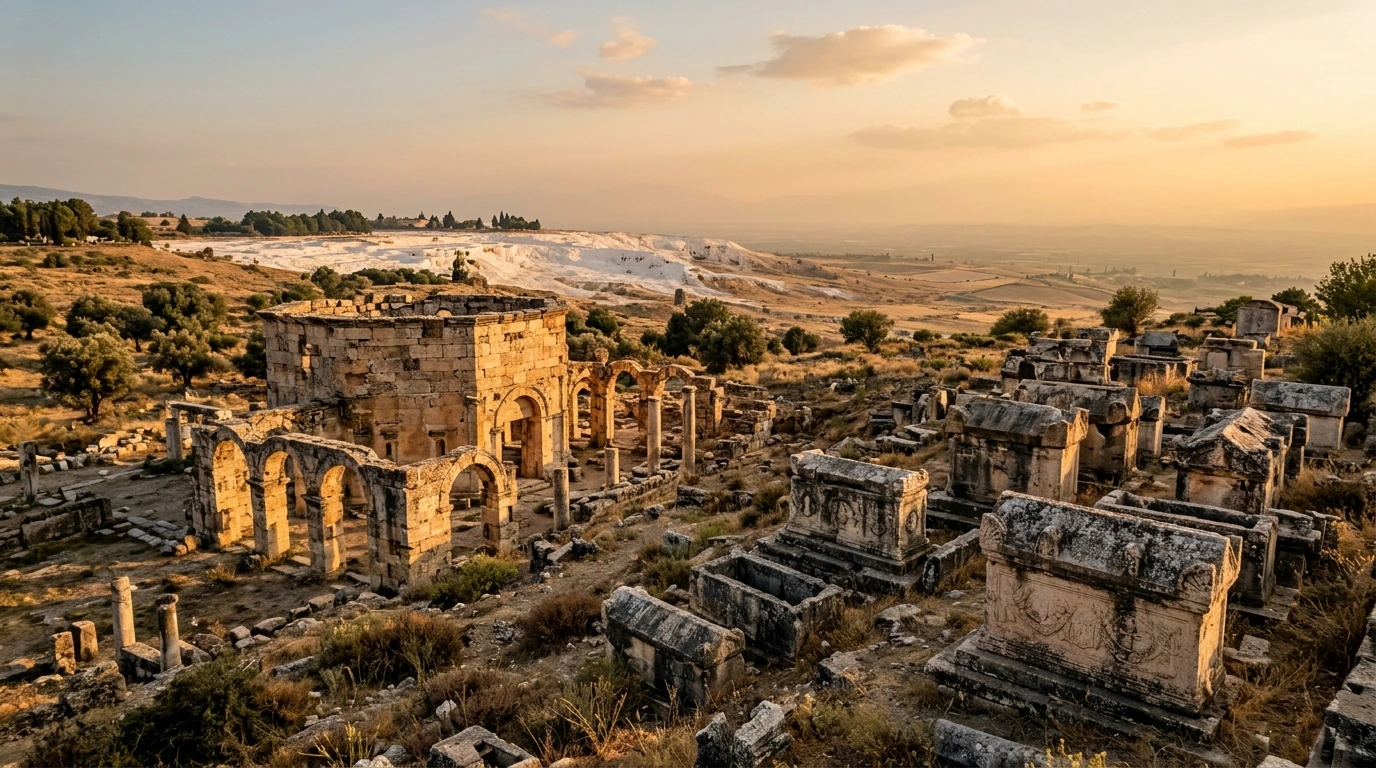
Subject Scope: Lydia Seller of Purple in Philippi: Primary Sources, Thyatira Dye Guild Inscriptions, and Roman Colony Law
Historical Context: Rigorous historical and theological examination within the field of Women of the Bible & Ancient Near Eastern Law.
Primary Evidence: Forensic archaeology, textual preservation, and primary ancient manuscripts corroborating scriptural events.
Investigation Highlights: The Encounter in Philippi: Acts 16:11–15 • Epigraphic Evidence: The Dye Guilds of Thyatira (Hoi Bapheis) • The Chemistry of Ancient Purple: Murex vs. Madder Root
Scholarly Consensus: Vetted against peer-reviewed academic literature in biblical history, linguistics, and archaeology.
The Encounter in Philippi: Acts 16:11–15
In Acts 16, the apostle Paul’s missionary team crossed the Aegean Sea from Troas to Neapolis, entering the continent of Europe for the first time. Their destination was Philippi, designated by Luke as:
"A leading city of the district of Macedonia and a Roman colony." — Acts 16:12
On the Sabbath day, lacking the necessary quorum of ten adult Jewish males (minyan) to sustain a formal civic synagogue building, Paul and Silas walked outside the colonial walls to the banks of the Gangites River (modern Angitis), where they suspected a place of prayer (proseuche) would be located:
"One who heard us was a woman named Lydia, from the city of Thyatira, a seller of purple goods, who was a worshiper of God. The Lord opened her heart to pay attention to what was said by Paul. And after she was baptized, and her household as well, she urged us, saying, 'If you have judged me to be faithful to the Lord, come to my house and stay.' And she prevailed upon us." — Acts 16:14–15
This brief biographical passage contains an extraordinary density of precise historical, geographic, and legal data that archaeological research has fully substantiated.
+----------------------------------------------------------------------------------------------------+
|                  THE HISTORICAL PROFILE OF LYDIA OF THYATIRA (ACTS 16:14-15)                       |
+--------------------------+-----------------------+-------------------+-----------------------------+
| DATA POINT               | GREEK TERMINOLOGY     | HISTORICAL CONTEXT| ARCHAEOLOGICAL EVIDENCE     |
+--------------------------+-----------------------+-------------------+-----------------------------+
| 1. City of Origin        | Thyateira (Lydia)     | Western Anatolia  | Center of guild of dyers    |
| 2. Commercial Trade      | Porphyropolis         | Luxury Textile    | Epigraphic guild stelae     |
| 3. Religious Status      | Sebomene ton Theon    | God-fearer        | Monotheistic Gentile circle |
| 4. Social Status         | Oikos (Household Head)| Independent Owner | Roman domestic villa        |
+--------------------------+-----------------------+-------------------+-----------------------------+
Epigraphic Evidence: The Dye Guilds of Thyatira (Hoi Bapheis)
Lydia’s home city was Thyatira (modern Akhisar in western Turkey), an inland city situated in the fertile valley of the Lycus River along the major military and trade highway connecting Pergamum to Sardis.
Thyatira was renowned throughout the ancient Mediterranean world for its aggressive development of trade corporations (collegia or synodoi). Inscriptions discovered during excavations at modern Akhisar mention more professional trade guilds than any other city of comparable size in Asia Minor:
- The Guild of Dyers: Mentioned in multiple Greek inscriptions as hoi bapheis ("the dyers") and Latin inscriptions as collegium tinctorum.
- The Guild of Purple-Merchants: Inscriptions explicitly dedicate honorary civic monuments: "The city honors... with the contribution of the most august guild of purple-sellers (hoi porphyrobaphoi or porphyropolai)."
+----------------------------------------------------------------------------------------------------+
|                     KEY EPIGRAPHIC STELAE FROM THYATIRA (CORPUS INSCRIPTIONUM GRAECARUM)           |
+--------------------------+-------------------------------------------------------------------------+
| INSCRIPTION              | RELEVANCE TO LYDIA IN ACTS 16                                           |
+--------------------------+-------------------------------------------------------------------------+
| 1. CIG 3496 (Akhisar)    | Dedicated by "The Guild of Dyers" (*hoi bapheis*) honoring an official  |
| 2. CIG 3497 (Akhisar)    | Explicitly names the "Purple-Dyers" (*porphyrobaphoi*)                  |
| 3. CIG 3498 (Akhisar)    | Mentions trade agents exporting dyed wool to Macedonia and Italy        |
| 4. Philippi Latin Stela  | Dedication by a citizen from Thyatira resident in Philippi              |
+--------------------------+-------------------------------------------------------------------------+
These inscriptions demonstrate that Thyatiran textile merchants maintained established commercial distribution networks across the Aegean Sea, placing retail agents and warehouse managers directly in prosperous Roman military colonies like Philippi.
The Chemistry of Ancient Purple: Murex vs. Madder Root
The ancient designation "purple" (porphyra) did not describe a single uniform hue, but encompassed a spectrum of deep reds, violets, crimson, and midnight blues produced through two distinct biochemical methods:
1. True Marine Tyrian Purple (Murex)
- Chemical Base: 6,6'-dibromoindigo extracted from the hypobranchial glands of predatory marine sea snails (Bolinus brandaris, Hexaplex trunculus, and Stramonita haemastoma).
- Production: Harvesting required tens of thousands of living snails per ounce of dye; mounds of crushed snail shells measuring hundreds of meters across have been excavated at Tyre, Sidon, and Troy.
- Economics: The most expensive commodity in the Roman Empire. In the 4th-century Edict on Maximum Prices issued by Emperor Diocletian, one pound of double-dyed Tyrian purple silk was priced at 150,000 denarii (the equivalent of multiple lifetimes of wages for a skilled laborer).
2. Anatolian Turkey Red / Vegetable Purple (Madder Root)
- Chemical Base: Alizarin and purpurin extracted from the roots of the madder plant (Rubia tinctorum), which grew abundantly in the alluvial soil around Thyatira.
- Production: Madder dye was chemically bonded to wool and linen fibers using chalk-rich river water and alum mordants, producing a brilliant scarlet-purple hue.
- Economics: More affordable than genuine marine murex, but still a high-margin luxury commodity coveted by provincial Roman aristocrats, military officers, and civic magistrates.
Whether Lydia traded in top-tier imported murex silks or high-grade Thyatiran madder-dyed textiles, she operated at the apex of the luxury retail market in Macedonia.
Roman Colony Status: Colonia Julia Augusta Philippensis
To appreciate the social and legal context of Lydia's enterprise, one must examine the status of Philippi. Following the decisive Battle of Philippi in 42 BC (where Mark Antony and Octavian defeated the assassins of Julius Caesar, Brutus and Cassius), and again after the Battle of Actium in 31 BC, Philippi was established as a premier Roman military veteran colony: Colonia Julia Augusta Philippensis.
The colony enjoyed the prestigious legal privilege of Ius Italicum ("Italian Law"):
- The soil of Philippi was legally regarded as if it were the sacred soil of Italy itself.
- The inhabitants enjoyed exemption from regional provincial tribute and poll taxes (tributum soli and tributum capitis).
- The municipal government was modeled directly after Rome, governed not by Greek archons, but by two Roman chief magistrates called Duoviri (praetores), attended by official lictors carrying the fasces (the rods used to scourge Paul and Silas in Acts 16:22).
In this hyper-Roman, militarized environment, Roman citizens proudly wore the white wool toga bordered with purple stripes (toga praetexta for magistrates; toga picta for commanders). The demand for authentic purple-dyed wool was extraordinarily high, providing Lydia with an elite clientele of Roman veterans, colonial magistrates, and aristocratic landowners.
Lydia as Materfamilias: Female Property Rights and Patronage
In Acts 16:15, Lydia acts with complete economic and legal autonomy:
- She is identified by her trade and origin, not by a husband, father, or brother.
- She is the sole owner and head of her household (oikos), encompassing children, commercial apprentices, freedpersons, and domestic servants.
- She extends personal hospitality to four traveling male missionaries, inviting them into her private home.
Under classical Greek law (Attic law), women were permanent legal minors (kyria) requiring a male guardian (kyrios) for any contract exceeding the value of a bushel of barley. However, under Roman Imperial Law (specifically the Lex Papia Poppaea and the Ius Trium Liberorum enacted under Emperor Augustus):
- Freeborn women who had borne three children (or freedwomen who had borne four) were released from perpetual male guardianship (tutela mulierum).
- They gained the legal right to purchase, own, inherit, lease, and sell real estate independently, write valid wills, and manage their own commercial businesses sine manu.
Lydia’s home was not a modest peasant hovel, but a spacious Roman urban villa (domus) capable of accommodating Paul, Silas, Timothy, and Luke, along with hosting the newly founded Christian congregation (Acts 16:40). Lydia emerged as the first recorded Christian convert on European soil and the founding financial patrona of the Philippian church.
Three-Tier Evidentiary Evaluation: Epigraphic Sources
+----------------------------------------------------------------------------------------------------+
|               THREE-TIER EVIDENTIARY AUDIT: LYDIA, THYATIRA, AND ROMAN PHILIPPI                    |
+--------------------------+-----------------------+-------------------+-----------------------------+
| SOURCE / ARTIFACT        | LOCATION / ARCHIVE    | CHRONOLOGY        | HISTORICAL SIGNIFICANCE     |
+--------------------------+-----------------------+-------------------+-----------------------------+
| 1. Thyatira Inscription  | Akhisar (CIG 3496)    | 1st–2nd Cent. AD  | Direct confirmation of the  |
|    (Hoi Bapheis)         | Archaeological Museum |                   | Guild of Dyers in Thyatira  |
| 2. Porphyropolai Stela   | Akhisar (CIG 3497)    | Roman Imperial    | Material verification of    |
|    (Purple-Sellers)      |                       | Period            | purple merchant profession  |
| 3. Philippi Gangites R.  | Krenides / Philippi   | Roman Colony Era  | Archaeological location of  |
|    Prayer Site           | Archaeological Park   | (1st Cent. AD)    | river gate and proseuche    |
| 4. Roman Duoviri Stelae  | Philippi Forum        | 1st Cent. AD      | Epigraphic confirmation of  |
|    and Latin Milestones  | (French Excavations)  |                   | colonial magistrates        |
+--------------------------+-----------------------+-------------------+-----------------------------+
Primary Sources & Scholarly Archives
Editorial Standard →Original Hebrew, Aramaic, and Greek interlinear analysis, morphological tags, and ancient variant readings.
Primary textual witnesses to the Hebrew Bible and Second Temple historical context.
Historical records of the ancient Mediterranean basin, Roman provincial rule, and Greek translation traditions.
Frequently Asked Questions
Was "Lydia" her personal name or an ethnic designation?
It could be either: Lydia was a common Greek name, but also an ethnic moniker meaning "the Lydian woman" from the ancient region of Lydia where Thyatira was located.
Why was the prayer meeting held outside the city gate by the river?
Roman colonies restricted unauthorized foreign cults inside the city boundary (pomerium); furthermore, Jewish ritual purification required flowing natural water.
What does it mean that Lydia was a "worshiper of God"?
It describes a Gentile "God-fearer" who embraced monotheism, Jewish ethical teachings, and Scripture without undergoing full ritual conversion.
How did Lydia’s patronage protect Paul and Silas after their release?
As a wealthy property owner and patrona, her villa served as a safe haven and meeting hall where the apostles could encourage believers prior to departure.
Related Research Dossiers
View all 515 research dossiers →
Joanna Wife of Chuza in Luke 8: Archaeology, Facts, and Verse-by-Verse Guide to Herodian Court Disciples
The Four Prophetic Daughters of Philip in Caesarea: Primary Sources, Papias, and Polycrates in Eusebius