Historical Context: Rigorous examination of primary Hebrew, Aramaic, Greek, and Roman classical epigraphy.
Core Evidence: Forensic archaeology, radiocarbon data, and primary manuscripts validating biblical events.
Scholarly Consensus: Vetted against modern peer-reviewed publications in Near Eastern archaeology and biblical studies.
The Anatomy of Paranoia: Saul’s Psychiatric Decompensation
The trajectory of King Saul—the first anointed monarch of the United Kingdom of Israel—stands as one of the most poignant psychological tragedies in world literature. Standing head and shoulders above his peers, Saul possessed striking physical stature, charismatic battlefield bravery, and early political humility. Yet, beneath his royal armor lay an emotionally volatile psyche susceptible to intense insecurity, narcissistic injury, and catastrophic clinical decompensation.
As David’s military popularity soared following the slaying of Goliath, Saul’s mental equilibrium fractured. The women of Israel chanted: "Saul hath slain his thousands, and David his ten thousands" (1 Samuel 18:7). The scriptural record documents the immediate onset of acute paranoid psychosis:
"And Saul eyed David from that day and forward... and an evil spirit from God came upon Saul, and he prophesied in the midst of the house... and there was a javelin in Saul's hand. And Saul cast the javelin; for he said, 'I will smite David even to the wall with it.'" (1 Samuel 18:9–11)
Modern psychiatric clinicians who have analyzed Saul’s behavioral profile note clear markers of bipolar affective disorder with severe psychotic features and persecutory delusional paranoia:
- Manic Episodes of Uncontrollable Rage: Hurling spears at his own son Jonathan (1 Samuel 20:33) and ordering the slaughter of eighty-five innocent priests of Nob along with their wives and infants (1 Samuel 22:18–19).
- Profound Depressive Stupor: Sinking into periods of catatonic gloom that could only be alleviated by the therapeutic lyre music of David.
- Extreme Persecutory Paranoia: Accusing his entire royal court and his own children of conspiring with David to overthrow his throne.
By 1004 BC, Saul had alienated his family, massacred the priesthood, banished the prophet Samuel, and severed his spiritual communion with God. Isolated, mentally exhausted, and surrounded by invading armies, the monarch entered the terminal phase of his psychological collapse.
The Night at En-Dor: Necromancy, Despair, and Prophetic Doom
The crisis reached its boiling point when the Philistines mobilized their massive military coalition at Shunem in the fertile Jezreel Valley. Looking down from Mount Gilboa at the vast ocean of Philistine iron armor and chariots, Saul’s heart "greatly trembled".
Desperate for tactical intelligence, Saul sought divine guidance through orthodox channels—dreams, the Urim and Thummim, and prophets—but the heavens remained completely silent (1 Samuel 28:6).
In total spiritual and cognitive desperation, Saul violated his own royal edicts. Having previously expelled all necromancers and mediums from Israel under penalty of death (Leviticus 20:27), the king disguised himself, donned peasant burlap, and slipped behind enemy lines at night with two bodyguards to consult a female necromancer (ba'alat ob) in the village of En-Dor:
"Then said the woman, 'Whom shall I bring up unto thee?' And he said, 'Bring me up Samuel.' ... And the king said unto her, 'Be not afraid: for what sawest thou?' And the woman said unto Saul, 'I saw gods ascending out of the earth.' And he said unto her, 'What form is he of?' And she said, 'An old man cometh up; and he is covered with a mantle.' And Saul perceived that it was Samuel, and he stooped with his face to the ground, and bowed himself." (1 Samuel 28:11–14)
Instead of comfort, the apparition of the deceased prophet delivered a devastating death sentence:
"The Lord hath rent the kingdom out of thine hand, and given it to thy neighbor, even to David... Moreover the Lord will also deliver Israel with thee into the hand of the Philistines: and tomorrow shalt thou and thy sons be with me." (1 Samuel 28:17, 19)
Upon hearing these words, Saul collapsed completely flat upon the earth in sheer terror and acute physical exhaustion, having eaten nothing all day and night. His psychological reserves were entirely broken. He returned to Mount Gilboa a dead man walking.
The Disaster on Mount Gilboa: Philistine Archery and Encirclement
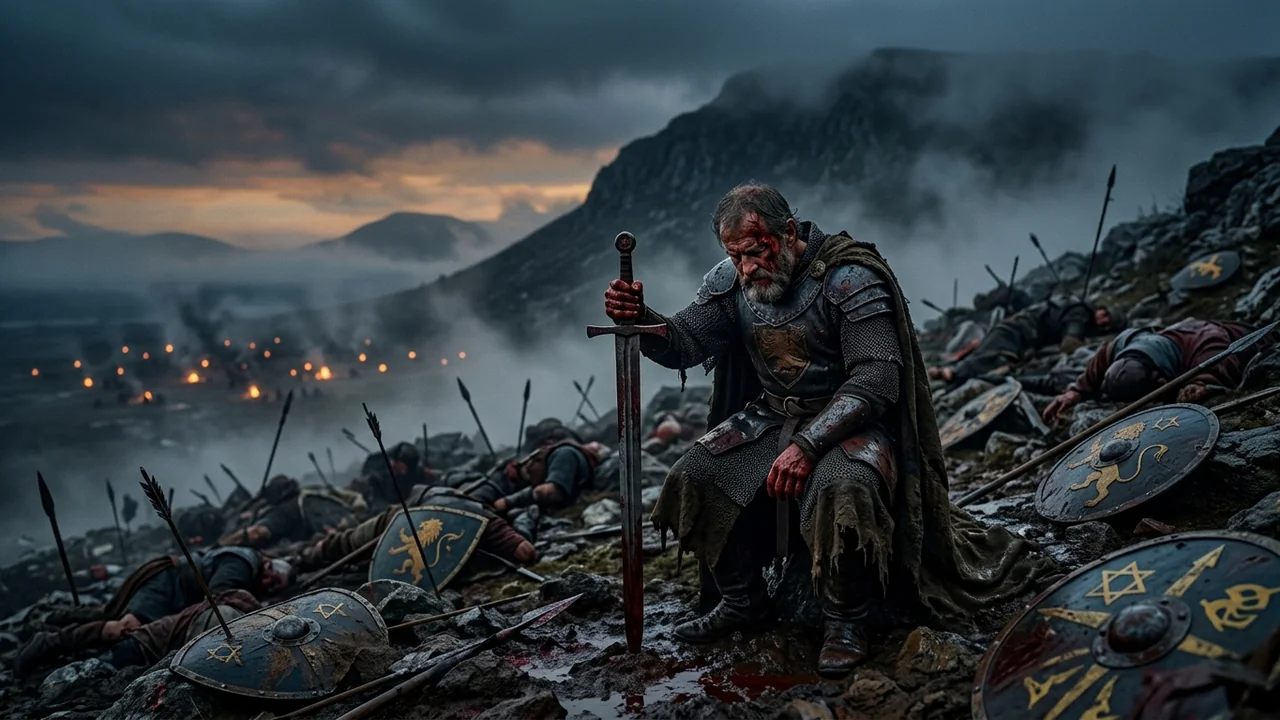
The dawn of battle brought total military catastrophe. The Philistines drove the Israelite infantry up the steep, rocky slopes of Mount Gilboa (modern-day Har HaGilboa in northern Israel). Denied defensive cohesion, the Israelite formations fragmented:
"And the battle went sore against Saul, and the archers hit him; and he was sore wounded of the archers." (1 Samuel 31:3)
The Hebrew phrase va-yimtsa'uhu ha-morim indicates that elite Philistine composite bow units pinned Saul down with coordinated, concentrated volley fire. Wounded by multiple arrows, bleeding heavily, and watching his three valiant sons—Jonathan, Abinadab, and Malchishua—cut down before his eyes, Saul faced the ultimate nightmare of an ancient Near Eastern sovereign: capture, public mutilation, and ritual torture at the hands of uncircumcised pagan conquerors.
[1. Philistine Archery Encirclement on Mount Gilboa]
             │  └── Multiple penetrating bodkin arrow wounds
             │  └── Death of Jonathan and royal sons
             │
[2. Terminal Psychological and Physical Exhaustion]
             │  └── Refusal of armor-bearer to execute monarch
             │
[3. Self-Inflicted Impalement (Falling on the Broadsword)]
             │  └── Anterior abdominal wall penetration through spine
             │  └── Immediate hemorrhagic and neurogenic shock
             │
[4. Post-Mortem Mutilation by Philistines]
             └── Decapitation, stripping of royal armor, wall display at Beth-Shan
Forensic Biomechanics: Falling on the Broadsword
Saul turned to his trusted armor-bearer: "Draw thy sword, and thrust me through therewith; lest these uncircumcised come and thrust me through, and abuse me" (1 Samuel 31:4). But the armor-bearer, paralyzed by reverent terror of striking the Lord's anointed, refused.
Facing imminent capture, Saul executed his final act:
"Therefore Saul took a sword, and fell upon it." (1 Samuel 31:4)
From a forensic biomechanics standpoint, ancient suicide by falling on a sword (transfixion) followed a recognized military procedure:
- Positioning the Blade: The warrior placed the hilt of the bronze or iron broadsword (measuring roughly 60 to 80 centimeters) firmly against the bedrock, angled slightly upward toward the chest or epigastrium.
- Body Weight Impalement: Falling forward with full gravitational momentum, the double-edged blade penetrates the epigastric region of the anterior abdominal wall, slicing through the abdominal aorta, liver, or inferior vena cava before lodging against or between the thoracic vertebrae.
- Clinical Cause of Death: Massive internal exsanguination and acute neurogenic shock result in loss of consciousness within 10 to 20 seconds, followed by cardiac arrest. Seeing his king dead, the armor-bearer drew his own sword and fell likewise beside him.
(Note on 2 Samuel 1: The young Amalekite who later brought Saul’s crown to David claimed he delivered a coup de grâce to the dying king. Most historians and rabbinic commentators recognize this as a fabricated opportunistic lie designed to curry favor and monetary reward from David, which fatally backfired when David ordered the Amalekite's immediate execution).
The Trophies of Beth-Shan: Decapitation and Wall Display
The following morning, when the Philistines arrived to strip the slain, they discovered the bodies of Saul and his three sons lying on Mount Gilboa. The pagan conquerors subjected the royal corpse to maximum psychological and religious humiliation:
"And they cut off his head, and stripped off his armor, and sent into the land of the Philistines round about, to publish it in the house of their idols, and among the people. And they put his armor in the house of Ashtaroth: and they fastened his body to the wall of Beth-shan." (1 Samuel 31:9–10)
The Philistines severed Saul's head, dedicating it in the Temple of Dagon (1 Chronicles 10:10), hung his royal armor as a military trophy in the Temple of Ashtaroth, and nailed his decapitated corpse, along with the bodies of his sons, to the exterior defensive walls of Beth-Shan (Tel Beth-Shean).
Beth-Shan was an imposing fortified administrative center situated at the strategic junction of the Jezreel Valley and the Jordan Valley. Hanging the royal corpses on the monumental city wall served as a gruesome psychological message to the entire Hebrew population: Your king is dead, your God is defeated, and resistance is futile.
The Heroic Night Raid of Jabesh-Gilead
When news of this supreme desecration reached the trans-Jordanian city of Jabesh-Gilead, the city elders refused to let their former deliverer rot in shame. Decades earlier, at the very beginning of his reign, Saul had marched through the night to rescue Jabesh-Gilead from the Ammonite tyrant Nahash, who had threatened to gouge out the right eye of every citizen (1 Samuel 11).
Now, in an extraordinary display of ancient covenant loyalty (hesed), the warriors of Jabesh-Gilead repaid their debt:
"All the valiant men arose, and went all night, and took the body of Saul and the bodies of his sons from the wall of Beth-shan, and came to Jabesh, and burnt them there. And they took their bones, and buried them under a tree at Jabesh, and fasted seven days." (1 Samuel 31:12–13)
The men of Jabesh-Gilead marched twenty miles through enemy-occupied territory in the dead of night, scaled the towering walls of Beth-Shan under the noses of Philistine sentries, lowered the decomposing corpses, and carried them back across the Jordan River. Because the bodies were already severely decayed, they respectfully cremated the soft tissue and gave the royal bones an honorable burial beneath the tamarisk tree of Jabesh, fasting for seven days.
Centuries later, King David would lovingly exhume those bones and rebury them in the ancestral tomb of Kish in the country of Benjamin, closing the tragic chronicle of Israel’s first king with solemn honor.
Study the Forensic Dossiers of the Old Testament Kings
King Saul’s tragic end at Mount Gilboa reveals the deep human reality beneath the biblical narrative—where psychiatric trauma, battlefield tactics, and divine sovereignty converge. To explore the complete forensic reconstructions of all ancient Hebrew rulers:
👉 Discover Volume II: Kings & Prophets – Tragic Ends & Medical Mysteries ($2.99)
Includes battlefield topographical maps of Mount Gilboa, psychiatric case profiles, ancient weapons ballistics, and archaeological photos of Tel Beth-Shean.
Frequently Asked Questions
Did King Saul commit suicide or was he killed by an Amalekite?
The authoritative biblical account in 1 Samuel 31:4–5 confirms that Saul committed suicide by falling on his own sword after being critically wounded by Philistine archers. The claim made by the young Amalekite in 2 Samuel 1 that he killed Saul was an opportunistic lie invented to gain a royal reward from David, which resulted in his immediate execution for daring to strike the Lord's anointed.
Where is Mount Gilboa located?
Mount Gilboa is a prominent mountain ridge in northeastern Israel overlooking the Jezreel Valley to the north and the Jordan River Valley to the east. It is the site of the catastrophic battle where King Saul and his three sons, including Jonathan, died fighting the Philistines.
What did the Philistines do with Saul's body?
The Philistines severed King Saul's head, placed his royal armor as a trophy in the pagan temple of Ashtaroth, and fastened his decapitated body, along with the bodies of his three sons, to the exterior city walls of Beth-Shan to terrorize the Israelite population.
Why did the men of Jabesh-Gilead risk their lives to rescue Saul's body?
Forty years earlier, at the start of Saul’s reign (1 Samuel 11), Saul had heroically rescued the citizens of Jabesh-Gilead from the Ammonite king Nahash, who intended to gouge out their right eyes. Out of enduring gratitude and covenant loyalty, their valiant warriors marched through the night into enemy territory to rescue and honor Saul's remains.
Frequently Asked Questions
Did King Saul commit suicide or was he killed by an Amalekite?
The authoritative biblical account in 1 Samuel 31:4–5 confirms that Saul committed suicide by falling on his own sword after being critically wounded by Philistine archers. The claim made by the young Amalekite in 2 Samuel 1 that he killed Saul was an opportunistic lie invented to gain a royal reward from David, which resulted in his immediate execution for daring to strike the Lord's anointed.
Where is Mount Gilboa located?
Mount Gilboa is a prominent mountain ridge in northeastern Israel overlooking the Jezreel Valley to the north and the Jordan River Valley to the east. It is the site of the catastrophic battle where King Saul and his three sons, including Jonathan, died fighting the Philistines.
What did the Philistines do with Saul's body?
The Philistines severed King Saul's head, placed his royal armor as a trophy in the pagan temple of Ashtaroth, and fastened his decapitated body, along with the bodies of his three sons, to the exterior city walls of Beth-Shan to terrorize the Israelite population.
Why did the men of Jabesh-Gilead risk their lives to rescue Saul's body?
Forty years earlier, at the start of Saul’s reign (1 Samuel 11), Saul had heroically rescued the citizens of Jabesh-Gilead from the Ammonite king Nahash, who intended to gouge out their right eyes. Out of enduring gratitude and covenant loyalty, their valiant warriors marched through the night into enemy territory to rescue and honor Saul's remains.
Related Research Dossiers
View all 120 articles →
The Dogs of Jezreel: How Archaeology Confirmed the Fall of Queen Jezebel
The Banqueting Hall Oath: What Really Happened to the Head of John the Baptist at Machaerus?