Historical Context: Rigorous examination of primary Hebrew, Aramaic, Greek, and Roman classical epigraphy.
Core Evidence: Forensic archaeology, radiocarbon data, and primary manuscripts validating biblical events.
Scholarly Consensus: Vetted against modern peer-reviewed publications in Near Eastern archaeology and biblical studies.
The Impregnable Eagle’s Nest: The Mountain Citadel of Machaerus
Perched 1,100 meters above the eastern shores of the Dead Sea in modern-day Jordan lies one of the most dramatic and forbidding fortresses of antiquity: Machaerus (Arabic: Qal'at al-Mishnaqa, "The Castle of the Gallows"). Originally constructed around 90 BC by the Hasmonean king Alexander Jannaeus to guard Judea against Nabataean incursions, the fortress was subsequently demolished by the Roman general Gabinius in 57 BC.
Recognizing its supreme geopolitical and defensive value, King Herod the Great rebuilt Machaerus in 30 BC on a colossal, imperial scale. Herod transformed the isolated basalt peak into an impregnable palace-citadel. He enclosed the summit in a massive ring wall fortified with ninety-foot defensive towers, carved colossal water cisterns deep into the living rock to survive multi-year sieges, and constructed a lavish royal palace complete with Roman peristyle courtyards, opulent bathhouses (thermae), and breathtaking mosaics.
To the south, Herod’s palace commanded a sweeping panoramic view across the Dead Sea: on clear nights, the flickering torchlights of Jerusalem, the Mount of Olives, and Herodium were clearly visible across the dark chasm.
Upon Herod the Great's death in 4 BC, the fortress passed to his son, Tetrarch Herod Antipas, who utilized Machaerus as his southern administrative palace and military headquarters on the volatile border of the Nabataean Kingdom. It was within this isolated desert citadel—where absolute luxury sat directly atop dark subterranean dungeons—that the greatest prophet of the Second Temple era was imprisoned and put to death.
The Incestuous Royal Scandal: Antipas, Herodias, and the Prophetic Rebuke
The crisis that led to John the Baptist's execution was neither theological nor philosophical; it was an explosive political and moral confrontation that threatened the stability of the Herodian dynasty.
While visiting his half-brother Herod Philip I in Rome, Herod Antipas fell in love with Philip's wife, Princess Herodias. Herodias was not only Philip’s wife; she was also the niece of both brothers (the daughter of their executed half-brother Aristobulus IV). Antipas proposed an illicit union: Herodias would divorce Philip and marry Antipas, who in turn agreed to repudiate and banish his lawful wife, Phasaelis—the daughter of King Aretas IV of Nabataea.
When Phasaelis discovered the conspiracy, she fled south across the border to her father’s desert fortress in Petra. The impending political fallout was catastrophic: Antipas had insulted the sovereign pride of Nabataea, sparking a military border war that would later annihilate his armies.
More dangerously, the marriage flagrantly violated the Torah of Moses. Leviticus 18:16 and Leviticus 20:21 strictly forbade a man from taking his brother's wife while the brother was still living: "It is an unclean thing; he hath uncovered his brother's nakedness."
From the wilderness of the Jordan Valley, where tens of thousands flocked to his baptism of repentance, John the Baptist boldly confronted the tetrarch. John did not mince words before imperial authority:
"For John had said unto Herod, 'It is not lawful for thee to have thy brother's wife.'" (Mark 6:18)
For Herodias, John’s public condemnation was an existential threat. If the Jewish populace deemed her royal marriage illegitimate, her social standing, political ambition, and her daughter Salome’s dynastic legitimacy were destroyed. Herodias demanded John's execution. Antipas, however, feared a popular uprising, knowing that the multitudes considered John a genuine prophet of God. As a compromise, Antipas arrested John and dragged him in chains to the remote desert fortress of Machaerus.
The Fatal Banquet: Salome’s Dance and the Rash Imperial Oath
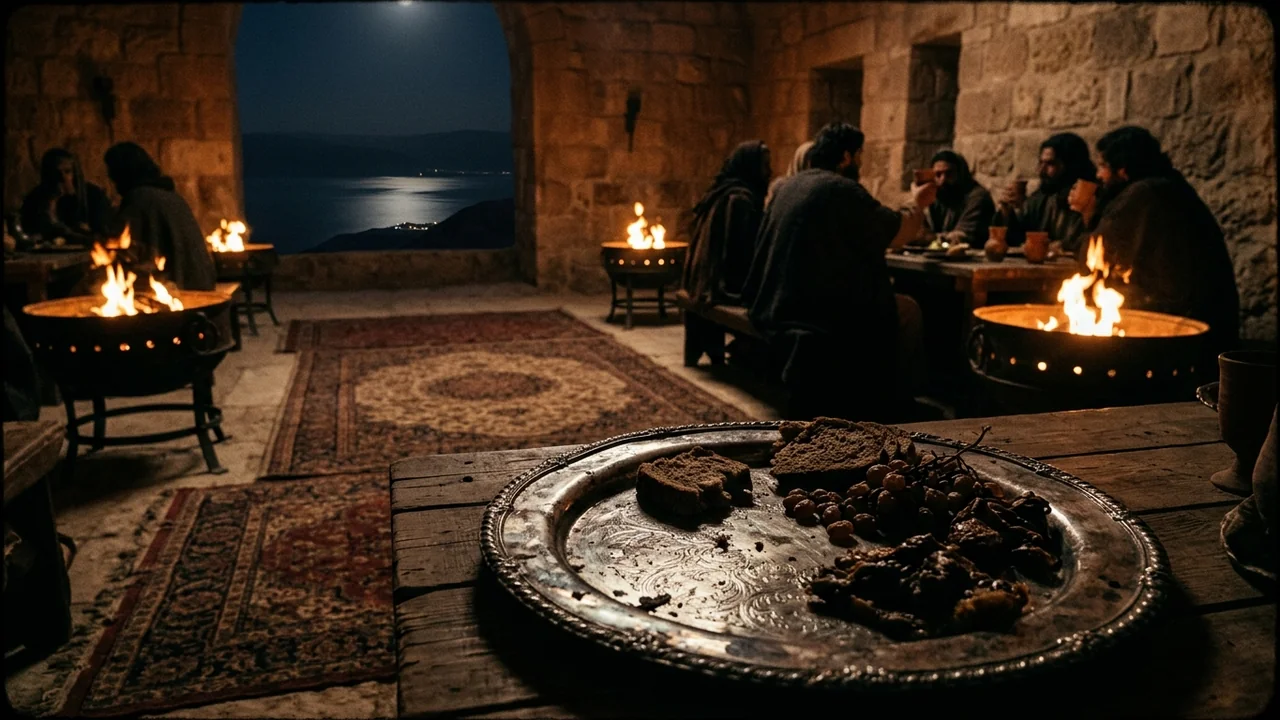
In the winter of 31–32 AD, Herod Antipas hosted a lavish birthday gala inside the monumental banquet hall of Machaerus. The guest list included the military tribunes (chiliarchs), Roman provincial officials, and the civic nobility of Galilee and Perea.
Fueled by heavy vintage wine and opulent Greco-Roman entertainment, the banquet reached a fever pitch when Salome, the teenage daughter of Herodias, entered the grand hall to dance before the drunken assembly:
"And when the daughter of the said Herodias came in, and danced, and pleased Herod and them that sat with him, the king said unto the damsel, 'Ask of me whatsoever thou wilt, and I will give it thee.' And he sware unto her, 'Whatsoever thou shalt ask of me, I will give it thee, unto the half of my kingdom.'" (Mark 6:22–23)
Antipas’s boastful oath—borrowed from ancient Persian royal formulas (Ester 5:3)—was intended as drunken imperial swagger before his Roman peers. Salome slipped out of the hall and ran to her mother: "What shall I ask?"
Herodias seized her moment of ruthless vengeance. Without hesitation, she whispered: "The head of John the Baptist."
Returning immediately to the dining hall, the girl declared before the silent court: "I will that thou give me by and by in a charger the head of John the Baptist."
Mark’s Gospel records that the tetrarch was "exceeding sorry", yet out of pride, shame, and fear of losing face before his elite dinner guests, he refused to break his public oath. He summoned a royal bodyguard (speculator) and ordered the immediate decapitation of the prisoner in the cells below.
Forensic Mechanics of Ancient Decapitation (Decollatio)
The Roman term used in the Greek text for the executioner is spekoulator (Latin: speculator). In the Roman imperial military, a speculator was an elite bodyguard, scout, and designated executioner attached to high magistrates.
Forensic pathology and Roman military archaeology reveal the precise physical mechanics of 1st-century provincial beheadings (decollatio):
[Roman Executioner (Speculator) Protocol]
                    │
                    ├──► Weapon: Roman Short Sword (Gladius) or Heavy Spatha
                    │         └── Wide, double-edged leaf blade optimized for slicing
                    │
                    ├──► Position: Condemned Prisoner Forced Kneeling (Prone)
                    │         └── Neck flexed forward to separate cervical vertebrae
                    │
                    └──► Impact: Transverse Blow Through C3–C5 Vertebrae
                              └── Instantaneous spinal cord transection & carotid rupture
- Anatomical Target: Executioners aimed for the mid-cervical vertebrae (C3 through C5). Forward flexion of the head stretches the posterior neck musculature (trapezius and splenius capitis) and widens the intervertebral spaces.
- Terminal Pathology:
- Complete transection of the spinal cord causes immediate cessation of all motor function and respiratory drive.
- Bilateral severance of the carotid arteries and internal jugular veins causes instantaneous intracranial pressure collapse and total cerebral exsanguination.
- Clinical studies in forensic neurology indicate that loss of visual and sensory consciousness occurs within 2 to 4 seconds due to catastrophic hypoperfusion of the cerebral cortex.
- The Presentation on a "Charger": The Greek word pinax designates a large, flat wooden or silver serving platter used for butchered meats at royal feasts. The severed head, still draining blood, was placed upon this banquet dish and carried through the corridors of Machaerus into the dining hall, presented to the teenage girl, who handed it to her mother.
Flavius Josephus vs. The Gospels: Reconciling the Motivations
One of the great triumphs of modern biblical historiography is the harmonious cross-examination of the Gospels with the secular writings of Flavius Josephus. In Antiquities of the Jews (Book XVIII, Chapter 5, Paragraph 2), Josephus provides an extensive independent account of John’s execution at Machaerus:
"Now some of the Jews thought that the destruction of Herod’s army came from God, and that very justly, as a punishment of what he did against John, that was called the Baptist; for Herod slew him, who was a good man, and commanded the Jews to exercise virtue, both as to righteousness towards one another, and piety towards God, and so to come to baptism... Now when many others came in crowds about him, for they were very greatly moved by hearing his words, Herod, who feared lest the great influence John had over the people might put it into his power and inclination to raise a rebellion... thought it best, by putting him to death, to prevent any mischief he might cause... Accordingly he was sent a prisoner, out of Herod’s suspicious temper, to Machaerus, the castle I before mentioned, and was there put to death."
| Aspect | The Synoptic Gospels (Matthew 14 / Mark 6) | Flavius Josephus (Antiquities XVIII.5.2) | Historical Synthesis |
|---|---|---|---|
| Primary Motivation | Moral & personal: John's rebuke of Herod's illicit marriage to Herodias | Political & military: Fear of popular insurrection and rebellion | Complementary: John's religious rebuke undermined the dynasty's political authority; Herodias exploited Antipas’s existing political paranoia. |
| Location of Execution | Unnamed royal palace / banquet hall | Explicitly names the fortress of Machaerus (Makhairos) | Identifies Machaerus as the exact geographical setting of the Gospel banquet. |
| Instigator of Execution | Princess Salome's dance and Herodias’s demand for the head on a platter | Herod's sovereign fear of popular revolt | The Gospels reveal the private palace drama behind the public political execution recorded by Josephus. |
| Character of John | Righteous prophet, forerunner of the Messiah | "A good man" who commanded righteousness and piety | Universal consensus that John was an incorruptible, saintly figure. |
Archaeological Excavations: The Royal Courtyard and Dungeons Unearthed
Between 2009 and 2021, the Hungarian Academy of Arts and the Department of Antiquities of Jordan, directed by world-renowned classical archaeologist Prof. Győző Vörös, conducted monumental excavations at Machaerus.
Their discoveries provided breathtaking physical confirmation of the Gospel setting:
- The Royal Throne Room and Apse: Prof. Vörös uncovered the complete architectural foundations of Herod’s royal banquet hall. The room features a semi-circular royal apse where the elevated throne of Herod Antipas stood, surrounded by classical Ionic columns, Roman opus sectile marble floors, and the exact open courtyard floor where Salome danced!
- The Subterranean Prison Cisterns: Directly beneath the fortified residential complex, archaeologists excavated two rock-hewn subterranean prison dungeons. Deep vertical shafts, iron chain rings, and ancient plaster confirm that high-profile political prisoners were kept beneath the banquet floors.
- The Roman Siege Works of 72 AD: Excavations revealed that Machaerus suffered a fate identical to Masada during the Jewish War. Roman Legio X Fretensis surrounded the fortress with a circumvallation wall and built a massive stone siege ramp to take the summit, preserving the 1st-century Herodian stratum in pristine condition beneath the destruction rubble.
Standing today atop the windswept summit of Machaerus, looking down into the deep rock cisterns where John was held, the silent stones bear unyielding witness to the courage of a prophet who refused to bow before imperial corruption.
Uncover the Lost Archaeological Dossiers of the Gospels
The banquet of Machaerus is only one of many dramatic historical trials recorded in Scripture. If you want to explore the archaeological ruins, Roman legal codes, and forensic reconstructions of the trials of Jesus, Peter, Paul, and John:
👉 Discover Volume II: Kings & Prophets – Tragic Ends & Medical Mysteries ($2.99)
Includes architectural reconstructions of Machaerus, Pilate’s Praetorium, the Caiaphas Ossuary, and unabridged excerpts from Flavius Josephus.
Frequently Asked Questions
Where was John the Baptist executed?
John the Baptist was executed in the remote mountain fortress-palace of Machaerus (Arabic: Qal'at al-Mishnaqa), located in modern-day Jordan on a high peak overlooking the eastern shore of the Dead Sea. This location is explicitly confirmed by ancient historian Flavius Josephus in Antiquities of the Jews (XVIII.5.2) and confirmed by modern excavations.
What did archaeologists find at Machaerus?
Archaeological excavations led by Prof. Győző Vörös uncovered the royal palace of Herod Antipas, including the apsidal throne room, the stone banquet hall with mosaic floors where Salome danced, and the deep underground rock-cut prison chambers directly beneath the palace where John was held in chains.
Who was Salome, and why did she ask for John’s head?
Salome was the daughter of Princess Herodias and Herod Philip I, and the stepdaughter/grand-niece of Herod Antipas. When Antipas drunkenly promised her whatever she requested after her dance, her mother Herodias instructed her to demand "the head of John the Baptist on a platter" to eliminate John, who had denounced their incestuous marriage.
Why did Flavius Josephus say Herod killed John?
Josephus explains the political aspect: Antipas was terrified that John's immense popularity and fiery preaching in the Jordan Valley would spark a massive popular uprising against his regime. The Gospels provide the personal palace intrigue (Herodias’s vengeance), showing the two accounts are mutually reinforcing perspectives of the same event.
Frequently Asked Questions
Where was John the Baptist executed?
John the Baptist was executed in the remote mountain fortress-palace of Machaerus (Arabic: Qal'at al-Mishnaqa), located in modern-day Jordan on a high peak overlooking the eastern shore of the Dead Sea. This location is explicitly confirmed by ancient historian Flavius Josephus in Antiquities of the Jews (XVIII.5.2) and confirmed by modern excavations.
What did archaeologists find at Machaerus?
Archaeological excavations led by Prof. Győző Vörös uncovered the royal palace of Herod Antipas, including the apsidal throne room, the stone banquet hall with mosaic floors where Salome danced, and the deep underground rock-cut prison chambers directly beneath the palace where John was held in chains.
Who was Salome, and why did she ask for John’s head?
Salome was the daughter of Princess Herodias and Herod Philip I, and the stepdaughter/grand-niece of Herod Antipas. When Antipas drunkenly promised her whatever she requested after her dance, her mother Herodias instructed her to demand "the head of John the Baptist on a platter" to eliminate John, who had denounced their incestuous marriage.
Why did Flavius Josephus say Herod killed John?
Josephus explains the political aspect: Antipas was terrified that John's immense popularity and fiery preaching in the Jordan Valley would spark a massive popular uprising against his regime. The Gospels provide the personal palace intrigue (Herodias’s vengeance), showing the two accounts are mutually reinforcing perspectives of the same event.
Related Research Dossiers
View all 120 articles →
The Secret Codices of Nag Hammadi: Why the Early Church Barred the Gnostic Gospels
Eaten Alive by Worms: The Gruesome Clinical Pathology Behind Herod Agrippa’s Sudden Collapse