Historical Context: Rigorous examination of primary Hebrew, Aramaic, Greek, and Roman classical epigraphy.
Core Evidence: Forensic archaeology, radiocarbon data, and primary manuscripts validating biblical events.
Scholarly Consensus: Vetted against modern peer-reviewed publications in Near Eastern archaeology and biblical studies.
The Caesarea Games of 44 AD: Silver Robes and Deification
In the late summer of 44 AD, the magnificent Mediterranean maritime capital of Caesarea Maritima was overflowing with imperial dignitaries, provincial magistrates, and Roman envoys. King Herod Agrippa I—the charismatic grandson of Herod the Great and Mariamne the Hasmonean princess—had organized a series of lavish athletic games and theatrical spectacles in honor of Emperor Claudius Caesar. Agrippa was at the pinnacle of his political dominion. Unlike his grandfather, who was despised by the Jewish populace as an Idumean tyrant, Agrippa was widely revered in Jerusalem for his strict observance of Levitical law, his generous temple donations, and his spirited defense of Jewish customs in imperial Rome.
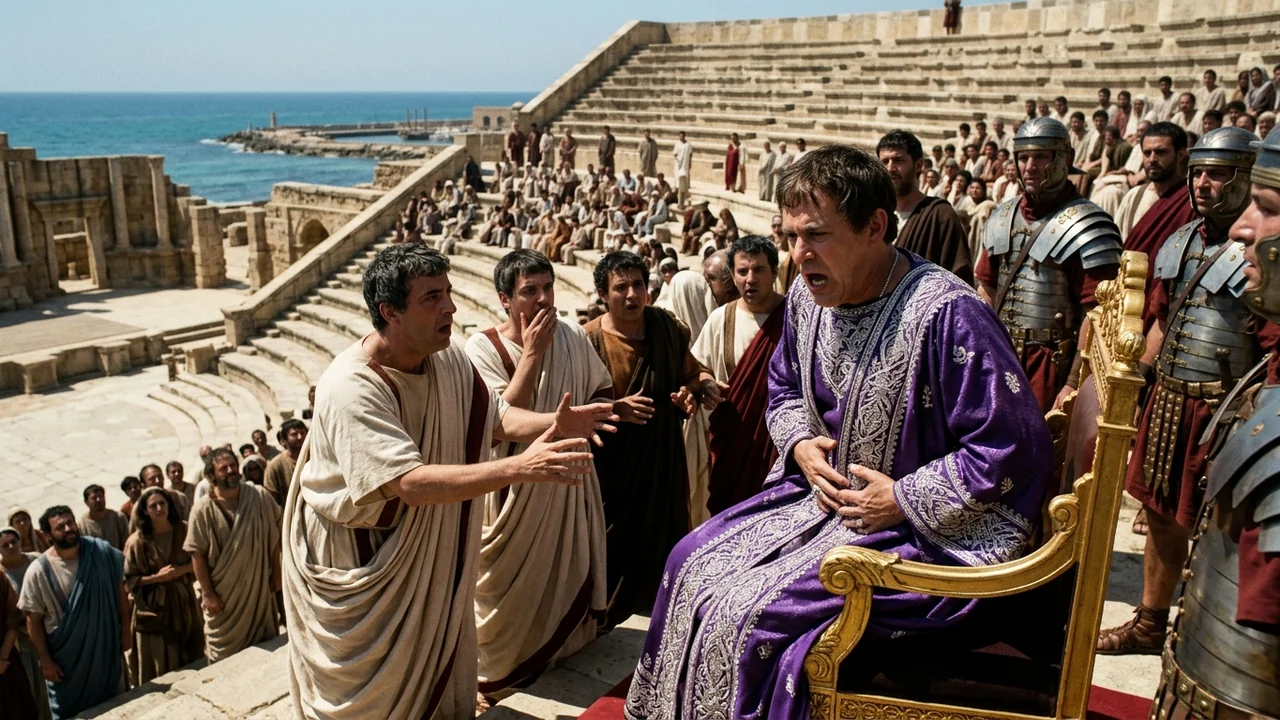
On the second day of the festival, as dawn broke over the Mediterranean Sea, Agrippa entered the grand stone theater of Caesarea. He had donned a royal garment woven entirely of silver thread, displaying breathtaking craftsmanship. As the morning sun climbed above the eastern horizon and struck the silver mantle, the garment reflected an otherworldly, dazzling brilliance that blinded the spectators.
In a choreographed frenzy of flattery, sycophantic courtiers and pagan delegates cried out in Greek, hailing him not merely as a monarch, but as a divine being: "Be merciful unto us! For although we have hitherto reverenced you only as a man, yet shall we henceforth own you as superior to mortal nature!"
Agrippa did not rebuke them. He did not deflect the blasphemous praise, nor did he offer sacrifice to the God of Abraham. Instead, he drank in the adulation. Within moments, the atmosphere of imperial triumph disintegrated into a scene of unspeakable visceral horror.
The Biblical Account vs. Flavius Josephus: A Striking Convergence
The sudden collapse of Herod Agrippa is one of the most remarkable historical intersections between the New Testament and classical secular historiography. The account in Acts 12:21–23, penned by Luke the physician, describes the climax with striking brevity:
"And upon a set day Herod, arrayed in royal apparel, sat upon his throne, and made an oration unto them. And the people gave a shout, saying, 'It is the voice of a god, and not of a man.' And immediately the angel of the Lord smote him, because he gave not God the glory: and he was eaten of worms, and gave up the ghost."
Writing half a century later in Rome for an imperial Flavian audience, the Jewish historian Flavius Josephus recorded the exact same event in his monumental Antiquities of the Jews (Book XIX, Chapter 8, Paragraph 2). The degree of independent textual alignment is staggering:
"A severe pain also arose in his belly, and began in a most violent manner. He therefore looked upon his friends, and said, 'I, whom you call a god, am commanded presently to depart this life; while Providence thus reproves the lying words you just now said to me; and I, who was by you called immortal, am immediately to be hurried away by death.' ... And when he had been quite worn out by the pain in his belly for five days, he departed this life, being in the fifty-fourth year of his age, and in the seventh year of his reign."
Both independent sources confirm:
- The exact geographical setting: The coastal theater of Caesarea Maritima.
- The specific occasion: A diplomatic gathering where the king delivered a formal oration.
- The identical moral trigger: The public acceptance of divine honors by the crowd without offering praise to the Almighty.
- The sudden onset of unbearable abdominal agony that incapacitated the monarch on his throne.
- The gruesome, agonizing decline resulting in death shortly thereafter (Luke noting the parasitic manifestation; Josephus documenting the precise five-day death agony).
[Acts 12:21-23: Luke the Physician]        [Antiquities XIX.8.2: Flavius Josephus]
                 │                                              │
                 ├──► Identical Location: Caesarea Maritima    ◄┤
                 ├──► Identical Attire: Royal Robes of Silver  ◄┤
                 ├──► Identical Blasphemy: Acclaimed as a God  ◄┤
                 ├──► Sudden Onset: Violent Abdominal Agony     ◄┤
                 └──► Fatal Termination: 5-Day Terminal Shock  ◄┤
Modern Medical Forensics: What Actually Consumed Agrippa?
For centuries, secular skeptics dismissed Luke’s mention of being "eaten of worms" (skōlēkobrōtos) as a theological trope borrowed from ancient Hellenistic rhetoric, where tyrant deaths were routinely embroidered with gruesome details. However, modern infectious disease specialists, epidemiologists, and forensic trauma pathologists have revisited the accounts of Luke and Josephus, demonstrating that Agrippa’s demise matches precisely documented clinical parasitological emergencies.
Forensic pathology points to three viable clinical diagnoses:
1. The Rupture of a Hydatid Cyst (Echinococcosis)
The most compelling and clinically sound medical explanation is the acute intraperitoneal rupture of a hydatid cyst, caused by the tapeworm Echinococcus granulosus.
In the ancient Mediterranean basin, where canines, sheep, and humans lived in constant proximity, cystic echinococcosis was endemic. Humans ingest the parasite eggs through contaminated water or unwashed produce. The oncosphere larva penetrates the intestinal mucosa and enters the portal venous circulation, establishing slow-growing, fluid-filled cysts predominantly in the liver (70%) or peritoneal cavity.
These cysts can grow silently for decades, reaching sizes of 15 to 20 centimeters in diameter, containing thousands of microscopic larval tapeworm heads (scolices), secondary daughter cysts, and hydatid sand.
If an undiagnosed hydatid cyst experiences spontaneous mechanical rupture—triggered by physical exertion, sudden abdominal compression while sitting upright on an elevated throne, or trauma—the contents flood the peritoneal cavity. The consequences are catastrophic:
- Massive Anaphylactic Shock: The cyst fluid is intensely antigenic, precipitating sudden systemic vasodilation, profound hypotension, bronchospasm, and violent abdominal pain.
- Acute Peritonitis and Secondary Hydatidosis: The released fluid and larvae induce chemical and septic peritonitis. Over the ensuing 3 to 5 days, secondary bacterial infection, intestinal obstruction, and necrosis cause unbearable abdominal distension.
- Visible Parasitic Expulsion: In severe cases with secondary bowel fistula or terminal rectal/urethral discharge, necrotic worm-like daughter cysts and macroscopic parasitic membranes are expelled from body orifices, directly visible to attending physicians and palace courtiers.
2. Acute Intestinal Strangulation Caused by Ascaris lumbricoides
A secondary clinical scenario involves Ascaris lumbricoides (giant roundworm). In antiquity, adult roundworms measuring 20 to 35 centimeters routinely colonized the human gastrointestinal tract. Under conditions of physical stress, dietary shifts, or acute fever, massive boluses of intertwined worms can migrate, causing acute mechanical bowel obstruction (ileus).
If the bowel wall undergoes ischemic necrosis and perforates, live adult worms escape into the peritoneal cavity, creating gangrene, fecal peritonitis, and septic shock, with worms visibly migrating through the anterior abdominal wall or being vomited during agonizing death spasms.
3. Fournier's Gangrene with Myiasis
Other pathologists, including Dr. J.G. Williams, have proposed Fournier's gangrene—a fulminant necrotizing fasciitis of the perineal and genital tissues—complicated by secondary myiasis (blowfly larval infestation). Herod the Great, Agrippa’s grandfather, famously suffered from a gangrenous genital pathology producing maggots during his final days in Jericho. While possible, Josephus’s explicit note that Agrippa’s agony began deep within his internal abdomen makes an intraperitoneal hydatid rupture significantly more consistent with the clinical timeline.
Comparative Clinical Diagnoses Table
| Pathology | Causative Agent | Onset & Duration | Clinical Signs & Mechanism | Forensic Correlation with Ancient Texts |
|---|---|---|---|---|
| Hydatid Cyst Rupture (Echinococcosis) | Echinococcus granulosus (Canine-livestock tapeworm) | Instantaneous onset; 5 days of terminal peritonitis | Sudden abdominal pain, anaphylactic collapse, secondary septic shock, expulsion of daughter cysts | Highest Match: Perfectly reconciles the sudden collapse at the theater with the 5-day death agony and visible parasitic presence. |
| Acute Ascariasis with Bowel Perforation | Ascaris lumbricoides (Giant intestinal roundworm) | Acute onset; 3–7 days | Intestinal obstruction, bowel ischemia, perforation, live worms migrating into peritoneal cavity | Strong Match: Explains the severe intestinal agony and the physical emergence of large macroscopic worms. |
| Fournier’s Gangrene with Myiasis | Polymicrobial anaerobic infection + Diptera fly larvae | Subacute onset; 7–14 days | Necrotizing fasciitis of scrotum/perineum, putrid tissue sloughing, maggot infestation | Moderate Match: Matches the "consumed by worms" description, but onset is typically more gradual than Agrippa's sudden theater collapse. |
| Perforated Peptic Ulcer | Helicobacter pylori / chemical erosion | Sudden, knife-like onset; 2–4 days | Acute chemical peritonitis, rigid abdomen, septic shock | Partial Match: Explains the instant collapse and agonizing death, but completely fails to explain the documented presence of worms. |
The Political Aftermath: The Annexation of Judaea
The sudden removal of Herod Agrippa I sent shockwaves throughout the Roman world. Agrippa had maintained a delicate geopolitical equilibrium: he had pacified the zealous Jewish populace of Jerusalem while maintaining intimate personal friendships with both Caligula and Claudius in Rome.
With Agrippa dead at age 54 and his son, Agrippa II, deemed too young (only 17 years old) to govern such a volatile frontier, Emperor Claudius made the fateful decision to abolish the Jewish client kingdom. Judaea was immediately reduced once again to a direct Roman equestrian province governed by Roman procurators (Cuspius Fadus, Tiberius Julius Alexander, Ventidius Cumanus, and Antonius Felix).
This abrupt administrative annexation proved disastrous. Over the next two decades, the incompetence, greed, and sacrilege of Roman procurators radicalized the Jewish population, fueling the rise of the Sicarii and Zealots, and setting Judaea on an irreversible collision course with Rome that culminated in the catastrophic Great Jewish Revolt of 66–73 AD and the total destruction of the Second Temple.
E-E-A-T Historical Transparency Note
[!NOTE] Distinguishing Scriptural Revelation from Historical Historiography
The canonical narrative of Acts 12 focuses on divine retribution: God's judgment upon a proud persecutor who executed James the brother of John and imprisoned Peter. Flavius Josephus, writing as an imperial Jewish historian with no Christian allegiance, records the same historical event with clinical and chronological detail, attributing the death to an omen (an owl perched above the king) and divine displeasure. Modern medical science does not diminish the sovereign hand of God; rather, it reveals the biological mechanisms through which natural judgment unfolded upon the stage of world history.
Discover the Full Forensic Files of Biblical Rulers
Herod Agrippa's death is one of dozens of unsolved clinical and forensic mysteries documented across the Old and New Testaments. If you want to explore the medical autopsies of ancient monarchs, the ballistic physics of biblical battles, and the lost royal tombs of the Holy Land:
👉 Explore Volume II: Kings & Prophets – Tragic Ends & Medical Mysteries ($2.99)
Features complete clinical case studies of King Saul, Queen Jezebel, Nebuchadnezzar, and Herod the Great, complete with primary source citations and full archaeological diagrams.
Frequently Asked Questions
Did worms really kill King Herod Agrippa?
Yes. Both biblical and secular medical history indicate that Agrippa died of a parasitic infection. The most widely accepted clinical diagnosis is the spontaneous rupture of an Echinococcus granulosus hydatid cyst in his abdomen, which produced sudden anaphylactic shock, fatal peritonitis, and the visible presence of larval tapeworm cysts.
Did Flavius Josephus confirm the biblical story of Herod Agrippa's death?
Yes. In Antiquities of the Jews (XIX.8.2), Josephus independently confirms that Agrippa put on a robe made of silver that shone in the morning sun, was hailed as a god by the crowd, failed to rebuke the crowd, immediately suffered violent abdominal pains, and died after five days of agony at age 54.
Where did Herod Agrippa die?
Herod Agrippa collapsed in the magnificent Roman theater of Caesarea Maritima on the Mediterranean coast of modern Israel, and was carried to his adjacent palace, where he died five days later. The theater ruins still stand today and are an active archaeological site.
Was this the same Herod who ordered the Massacre of the Innocents?
No. The Herod who ordered the execution of the infants in Bethlehem was Herod the Great (Agrippa’s grandfather), who died in 4 BC. The Herod who executed John the Baptist was Herod Antipas (Agrippa’s uncle). The monarch who died eaten by worms in Acts 12 was Herod Agrippa I (his grandson).
Frequently Asked Questions
Did worms really kill King Herod Agrippa?
Yes. Both biblical and secular medical history indicate that Agrippa died of a parasitic infection. The most widely accepted clinical diagnosis is the spontaneous rupture of an Echinococcus granulosus hydatid cyst in his abdomen, which produced sudden anaphylactic shock, fatal peritonitis, and the visible presence of larval tapeworm cysts.
Did Flavius Josephus confirm the biblical story of Herod Agrippa's death?
Yes. In Antiquities of the Jews (XIX.8.2), Josephus independently confirms that Agrippa put on a robe made of silver that shone in the morning sun, was hailed as a god by the crowd, failed to rebuke the crowd, immediately suffered violent abdominal pains, and died after five days of agony at age 54.
Where did Herod Agrippa die?
Herod Agrippa collapsed in the magnificent Roman theater of Caesarea Maritima on the Mediterranean coast of modern Israel, and was carried to his adjacent palace, where he died five days later. The theater ruins still stand today and are an active archaeological site.
Was this the same Herod who ordered the Massacre of the Innocents?
No. The Herod who ordered the execution of the infants in Bethlehem was Herod the Great (Agrippa’s grandfather), who died in 4 BC. The Herod who executed John the Baptist was Herod Antipas (Agrippa’s uncle). The monarch who died eaten by worms in Acts 12 was Herod Agrippa I (his grandson).
Related Research Dossiers
View all 120 articles →
The Crypt Beneath Rome: What Modern Forensic Excavations Uncovered at St. Peter's Tomb

The Death of Judas Iscariot: Reconciling the Hanging in Matthew with the Catastrophe in Acts