Historical Context: Rigorous examination of primary Hebrew, Aramaic, Greek, and Roman classical epigraphy.
Core Evidence: Forensic archaeology, radiocarbon data, and primary manuscripts validating biblical events.
Scholarly Consensus: Vetted against modern peer-reviewed publications in Near Eastern archaeology and biblical studies.
The Textual Paradox: Matthew 27 vs. Acts 1
For centuries, secular skeptics, biblical critics, and anti-Christian polemicists have pointed to the death of Judas Iscariot as the quintessential, irreconcilable contradiction in the New Testament.
When a reader places the two canonical accounts side by side, the apparent divergence seems stark and total:
The Account of Matthew 27:3–5:
"Then when Judas, his betrayer, saw that Jesus was condemned, he repented and brought back the thirty pieces of silver to the chief priests and the elders, saying, 'I have sinned by betraying innocent blood'... And throwing down the pieces of silver into the temple sanctuary, he departed, and he went and hanged himself (apēnxato)."
The Account of Acts 1:18–19:
"Now this man acquired a field with the reward of his wickedness, and falling headlong he burst open in the middle and all his bowels gushed out (kai prēnēs genomenos elakēsen mesos, kai exechythē panta ta splanchna autou). And it became known to all the inhabitants of Jerusalem, so that the field was called in their own language Akeldama, that is, Field of Blood."
[The Alleged Biblical Contradiction]
┌──────────────────────────────────────┬──────────────────────────────────────┐
│        MATTHEW 27:5                  │         ACTS 1:18                    │
├──────────────────────────────────────┼──────────────────────────────────────┤
│ Judas returned the silver to priests │ Judas bought a field with the reward │
│ Death method: Hanged himself         │ Death method: Fell headlong & burst  │
│ Location: Private, sorrowful act     │ Result: Bowels gushed out publicly   │
└──────────────────────────────────────┴──────────────────────────────────────┘
Critical commentators routinely declare: "Either Matthew was wrong, or Luke was wrong; both cannot be historically true."
However, when this ancient puzzle is submitted to modern forensic taphonomy, trauma pathology, and 1st-century Jerusalem topography, the apparent contradiction dissolves completely. Far from contradicting one another, Matthew and Luke are providing two chronologically sequential, medically coherent snapshots of the identical gruesome physical catastrophe.
The Topography of Akeldama: The Cliffs of the Valley of Hinnom
The first key to unlocking this mystery is the physical geography of ancient Jerusalem.
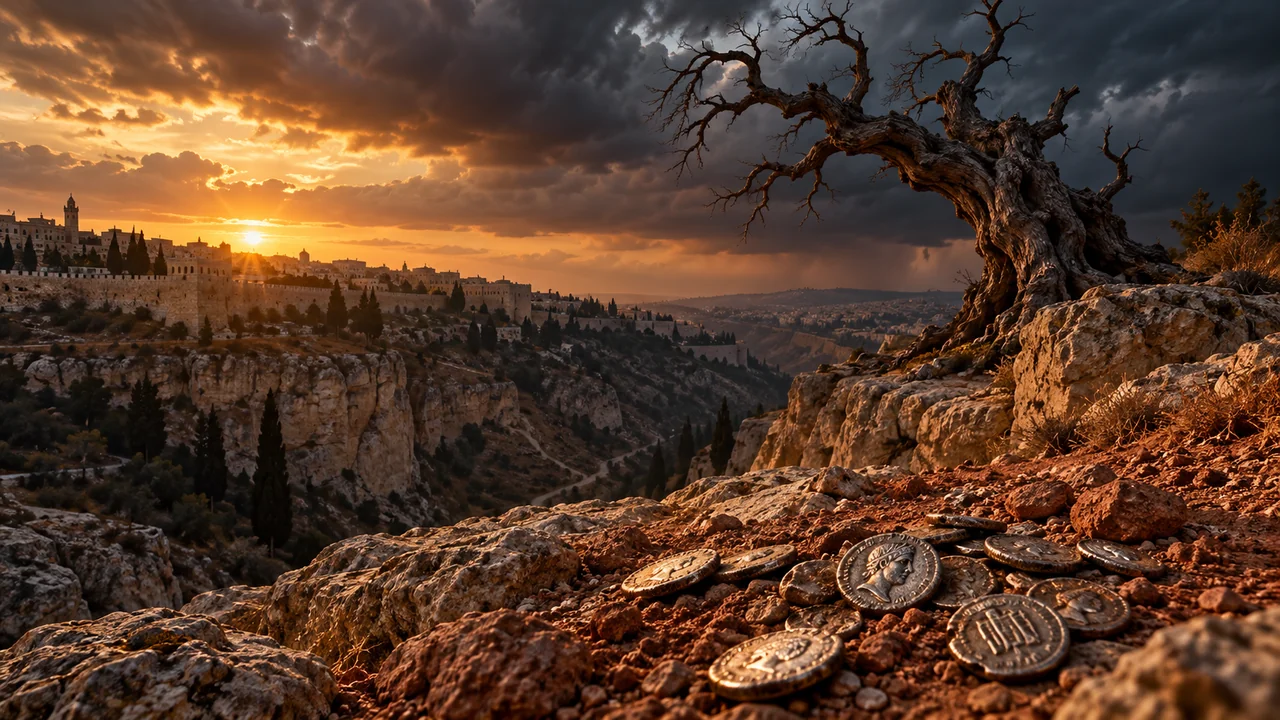
Both Jewish tradition and Christian archaeology universally locate Akeldama (Haqel D'ma, Aramaic for "The Field of Blood") on the steep southern slope of the Valley of Hinnom (Gehenna / modern Wadi er-Rababi), precisely where it merges with the Kidron Valley south of Mount Zion:
[Topography of the Valley of Hinnom (Gehenna)]
       │
       ▼ (South of Mount Zion)
[Vertical Limestone Cliffs (40 to 60 Feet High)]
       │
       ├──► Upper Edge: Gnarled wild fig and olive trees overhanging precipice
       │
       └──► Rocky Ravine Floor Below:
                 └── Jagged limestone bedrock, abandoned pottery clay pits (Akeldama)
- The Sheer Limestone Precipices: The Valley of Hinnom is bounded by dramatic, vertical limestone cliff faces dropping anywhere from 40 to 60 feet straight down onto jagged bedrock terraces.
- Overhanging Vegetation: Gnarled, wild fig trees, carob trees, and ancient olive trees routinely grow out of the crevices along the top of the cliff margins, extending dry, thick wooden branches out over the deep rocky ravine.
- The Potter's Clay Pits: The base of this valley was historically utilized by local artisans as a potter's clay pit (The Potter's Field). Over centuries of digging, the clay extraction left deep rocky chasms littered with sharp, fractured ceramic shards and jagged limestone rubble.
- Ritual Impurity of the Site: Gehenna was the ancient site of child sacrifices to Molech in the Old Testament (Jeremiah 7:31). By the 1st century, it was regarded by Jewish law as the most ritually defiled, cursed location outside the city walls—the municipal refuse dump where the corpses of executed criminals and suicides were abandoned to rot.
It was into this desolate, vertical gorge that Judas Iscariot retreated in the dark hours of Friday morning.
Forensic Taphonomy: Post-Mortem Decomposition in Middle Eastern Heat
The timeline of Passover week explains the biological sequence.
Judas hanged himself on the morning of Christ's trial (Friday, 14th of Nisan). Because it was the eve of the Passover Sabbath, Jewish ritual law strictly prohibited any Jew from handling a dead body, which would incur seven days of ritual defilement (Numbers 19:11). Furthermore, suicide was regarded with unspeakable horror; no relative or friend was willing to claim the body of the traitor.
Judas’s body hung suspended over the cliff face of the Valley of Hinnom under the scorching Middle Eastern sun:
[Timeline of Post-Mortem Decomposition in Mid-April Jerusalem Heat]
       │
       ├──► 0 to 12 Hours:
       │         Algor mortis, livor mortis, and rigor mortis set in
       │
       ├──► 24 to 48 Hours (Rapid Putrefaction):
       │         - Intestinal anaerobic bacteria (Clostridium perfringens) multiply rapidly
       │         - Massive production of putrefactive gases (H₂S, CH₄, CO₂, NH₃)
       │         - Extreme abdominal distension (Meteorism / Cadaveric Bloating)
       │
       └──► 48 to 72 Hours:
                 - Liquefactive tissue autolysis; abdominal wall becomes paper-thin
                 - Tensile strength of human tissues and rope severely compromised
Modern forensic pathologists, including Dr. Pierre Barbet and forensic anthropologists, describe what occurs to a suspended corpse in ambient temperatures exceeding $28^circ ext{C}$ ($82^circ ext{F}$):
- Anaerobic Bacterial Explosion: Within hours of circulatory cessation, the trillions of anaerobic bacteria residing within the human gastrointestinal tract multiply exponentially.
- Cadaveric Bloating (Meteorism): The bacteria ferment sugars and proteins, producing colossal volumes of high-pressure toxic gases: hydrogen sulfide, methane, carbon dioxide, and ammonia.
- Severe Visceral Autolysis: The abdomen swells to twice its normal volume, ballooning under immense internal gas pressure. Simultaneously, digestive enzymes (pancreatic proteases and gastric acids) dissolve the internal organs, turning the intestines, stomach, and liver into a liquefied, foul, high-pressure slurry held back only by a stretched, decomposing anterior abdominal wall.
The Mechanical Rupture: Kinetic Deceleration and Evisceration
Now, consider the physical mechanics of what happened next:
Judas’s bloated corpse, weighing significantly more than in life due to massive fluid accumulation, hung from a branch or rough hemp rope over a 50-foot vertical drop:
[Mechanical Failure of Suspension]
       │ (Rough hemp rope snaps, dry branch fractures, or body is cut down)
       ▼
[Free Fall Plunge: 40 to 60 Feet onto Jagged Bedrock]
       │ Terminal Impact Velocity: ~18 to 22 meters/sec (40 to 50 mph)
       ▼
[Kinetic Deceleration Shock Wave]
       │ Internal hydraulic pressure spike exceeds tensile strength of skin
       ▼
[Complete Abdominal Rupture (Evisceration)]
       │ Abdominal wall splits transversely: "He burst open in the middle"
       └── Entire liquefied visceral contents gush out across the stones (Akeldama)
- The Structural Failure: Under the combination of intense solar heat, wind currents, and increasing gravitational weight, either:
- The rough fiber rope snapped under tension.
- The dry tree branch fractured.
- Or, as local tradition records, municipal temple workers or Roman soldiers, discovering the foul, putrefying corpse swinging over the public path, took a long pole-blade and severed the rope to dispose of the biohazard.
- The Terminal Velocity Impact: A human body falling 50 feet strikes the rocky terrace below at a velocity of approximately 18 to 20 meters per second (over 40 mph).
- The Forensic Rupture (Elakēsen Mesos): In Luke’s medical Greek, the phrase elakēsen mesos literally means "burst open with a loud cracking sound in the middle." When a severely bloated, gas-pressurized, decomposing abdomen strikes jagged limestone bedrock headlong, the sudden, violent deceleration creates a massive hydraulic shockwave. The thin, autolyzed abdominal wall ruptures instantaneously, splitting open across the umbilical region.
- Evisceration (Exechythē Panta Ta Splanchna): Luke (the physician) precisely notes that "all his bowels gushed out" (exechythē panta ta splanchna). The liquefied intestines, liver, and abdominal organs were violently expelled across the red clay rocks of the Potter's Field, creating a gruesome, unforgettable spectacle witnessed by the residents of Jerusalem.
Matthew describes the act of suicide (he hanged himself); Luke describes the grotesque ultimate aftermath (the body fell and burst open). There is zero contradiction; they are two consecutive chapters of the identical tragedy.
Comparative Table: Reconciling the Two Canonical Accounts of Judas's End
| Historical Category | Matthew 27:3–10 (The Hebrew Perspective) | Acts 1:18–19 (The Greco-Roman Medical Perspective) | Forensic Harmonization |
|---|---|---|---|
| Primary Theme | Fulfillment of prophecy (Zechariah & Jeremiah) | Divine judgment and apostolic vacancy | The full narrative from intent to biological conclusion |
| Cause of Death | Hanging (Apēnxato) | Falling Headlong & Rupturing (Prēnēs genomenos) | Judas hanged himself; the rope broke, and the decomposing body ruptured on impact |
| Financial Transaction | Judas threw silver into the Temple; priests bought field | Judas acquired a field with the reward of iniquity | The field was bought with Judas's money, legally credited to his estate |
| Name of the Field | "Field of Blood" (Haqel D'ma) | "Akeldama" (Field of Blood) | Known by all of Jerusalem for the blood spilled upon its stones |
| Author Perspective | Matthew (Tax collector: details monetary transaction) | Luke (Physician: details anatomical evisceration) | Each author recorded details matching their professional background |
Ancient Jewish Jurisprudence: The Legal Purchase of the Potter's Field
What about the apparent contradiction regarding who bought the field?
- Matthew 27:7 states: "The chief priests took the pieces of silver... and bought with them the potter's field."
- Acts 1:18 states: "Now this man [Judas] acquired a field with the reward of his wickedness."
To modern Western readers unfamiliar with ancient Near Eastern and Jewish jurisprudence, this appears contradictory. To a 1st-century Jew, it was standard legal terminology:
- The Blood Money Statute: The chief priests explicitly stated: "It is not lawful to put them into the treasury, since it is blood money" (Matthew 27:6), citing Deuteronomy 23:18. The silver could not be absorbed into the sacred Temple funds (Corban).
- Legal Agency and Estate Attribution: Under ancient Jewish rabbinic law (Mishnah Baba Kamma), when tainted money was surrendered by a criminal, the authorities could not legally confiscate it for public revenue. Instead, they acted as involuntary legal executors of the donor's estate.
- They purchased a burying ground for impoverished foreign Gentiles (The Potter's Field), formally registering the deed in the name of Judas Iscariot, whose money had funded the transaction.
In the eyes of Roman property records and Jewish property law, Judas was the legal purchaser of the field, exactly as Luke describes, even though the priests signed the contract!
The Bizarre Tradition of Papias: Extreme Edema and Swelling
One final historical testament confirms that the early church preserved vivid memories of the horrifying physical state of Judas’s body.
In the early 2nd century (c. 110–130 AD), Papias, Bishop of Hierapolis, who personally gathered oral traditions from the daughters of Philip and the elders who knew the apostles, recorded an extraordinary description of Judas’s final days, preserved in fragments by Apollinaris of Laodicea:
"Judas walked about in this world a terrible example of impiety; his flesh was so bloated that where a wagon could easily pass, he could not pass... His eyelids were so swollen that he could not see the light at all, and his eyes could not be seen, even by a physician using an optical instrument... And after much torment and punishment, he died in his own place, and on account of the stench the area is deserted and uninhabitable even now; nor to this day can anyone pass that place without holding their nose."
While Papias's account features dramatic oral exaggerations typical of 2nd-century popular memory, it preserves an unmistakable clinical core: Judas’s body was remembered across the ancient world for catastrophic, grotesque post-mortem swelling (anasarca) and unbearable decomposition.
This bizarre early tradition independently confirms that Judas did not die a simple, clean death; his demise was a prolonged, horrific physical catastrophe that left an indelible mark on the collective consciousness of 1st-century Jerusalem.
Judas sought thirty pieces of silver; he inherited a jagged rock in the Valley of Hinnom and an eternity of infamy. His tragic end remains a solemn warning across human history: the wages of betrayal are bitter, and truth cannot be silenced by silver.
Uncover the Untold Historical Dossiers
The forensic reconciliation of Judas's death is a masterclass in historical apologetics. To explore the unabridged patristic fragments, archaeological site maps of Akeldama, and comprehensive medical analyses:
👉 Download Volume I: The Twelve Apostles – Historical Dossier ($2.99)
Features high-resolution topographical maps of the Valley of Hinnom, complete Greek transcripts of Papias, and comparative forensic analyses of ancient traumatic falls.
Frequently Asked Questions
Did Judas die by hanging or by falling and bursting open?
Both accounts describe consecutive chronological stages of the same event. Matthew 27:5 describes the act of suicide: Judas hanged himself from a tree overhanging the cliffs of the Valley of Hinnom. Acts 1:18 describes the subsequent mechanical aftermath: after hanging in the sun for days, the decomposing and bloated body fell onto the jagged rocks below, causing the abdominal wall to rupture.
Who bought the Field of Blood—Judas or the chief priests?
Both accounts are legally accurate. Matthew records that the chief priests physically transacted the purchase because the thirty pieces of silver were "blood money" and could not enter the Temple treasury. Under ancient Jewish jurisprudence, the priests acted as legal executors using Judas's funds, meaning the property deed was legally registered in Judas's name, as Luke records in Acts.
Where is Akeldama located today?
Akeldama (The Field of Blood) is located on the steep southern terraced slopes of the Valley of Hinnom (Wadi er-Rababi) south of the Old City of Jerusalem. Today, the historic Greek Orthodox Monastery of Saint Onuphrius stands on the site, built over ancient rock-cut burial caves and potter's clay quarries.
What is the medical cause of the body "bursting open"?
Forensic taphonomy explains that in Middle Eastern ambient heat, a suspended corpse undergoes rapid putrefaction within 24 to 48 hours. Anaerobic bacteria produce immense volumes of gas, causing severe abdominal distension (bloating) and liquefaction of internal organs. When the rope snapped and the body struck the jagged rocks below, the kinetic impact caused the paper-thin abdominal wall to rupture, resulting in traumatic evisceration.
Frequently Asked Questions
Did Judas die by hanging or by falling and bursting open?
Both accounts describe consecutive chronological stages of the same event. Matthew 27:5 describes the act of suicide: Judas hanged himself from a tree overhanging the cliffs of the Valley of Hinnom. Acts 1:18 describes the subsequent mechanical aftermath: after hanging in the sun for days, the decomposing and bloated body fell onto the jagged rocks below, causing the abdominal wall to rupture.
Who bought the Field of Blood—Judas or the chief priests?
Both accounts are legally accurate. Matthew records that the chief priests physically transacted the purchase because the thirty pieces of silver were "blood money" and could not enter the Temple treasury. Under ancient Jewish jurisprudence, the priests acted as legal executors using Judas's funds, meaning the property deed was legally registered in Judas's name, as Luke records in Acts.
Where is Akeldama located today?
Akeldama (The Field of Blood) is located on the steep southern terraced slopes of the Valley of Hinnom (Wadi er-Rababi) south of the Old City of Jerusalem. Today, the historic Greek Orthodox Monastery of Saint Onuphrius stands on the site, built over ancient rock-cut burial caves and potter's clay quarries.
What is the medical cause of the body "bursting open"?
Forensic taphonomy explains that in Middle Eastern ambient heat, a suspended corpse undergoes rapid putrefaction within 24 to 48 hours. Anaerobic bacteria produce immense volumes of gas, causing severe abdominal distension (bloating) and liquefaction of internal organs. When the rope snapped and the body struck the jagged rocks below, the kinetic impact caused the paper-thin abdominal wall to rupture, resulting in traumatic evisceration.
Related Research Dossiers
View all 120 articles →
The Forensic Truth About Roman Scourging: Why Flagrum Whips Were Lethal Before the Cross
Why None of the Twelve Recanted: The Psychological Proof of the Resurrected Eyewitnesses