Historical Context: Rigorous examination of primary Hebrew, Aramaic, Greek, and Roman classical epigraphy.
Core Evidence: Forensic archaeology, radiocarbon data, and primary manuscripts validating biblical events.
Scholarly Consensus: Vetted against modern peer-reviewed publications in Near Eastern archaeology and biblical studies.
The Coalition Against Aram: The Strategic Prize of Ramoth-Gilead
In 853 BC, King Ahab of Israel had demonstrated unmatched military might. According to the Assyrian Kurkh Monolith erected by Shalmaneser III (now in the British Museum), Ahab fielded the largest armored chariot corps of any king in the ancient Levant—supplying 2,000 war chariots and 10,000 infantry to the Battle of Qarqar to halt the imperial Assyrian advance.
Despite this international triumph, an unresolved territorial dispute festered on Israel’s eastern frontier: the strategic fortified city of Ramoth-Gilead (modern-day Tell er-Rumeith in northwestern Jordan). Perched along the King's Highway, Ramoth-Gilead controlled lucrative trans-Jordanian trade routes and fertile agricultural plateaus. Ben-Hadad II, the king of Aram-Damascus (Syria), had pledged to return the captured city to Israel under treaty, but failed to honor his word.
Eager to liberate the city, Ahab formed a military coalition with King Jehoshaphat of Judah. Before marching, four hundred royal court prophets assured Ahab of a sweeping victory. Only one man dared speak truth to power: the imprisoned prophet Micaiah son of Imlah.
When pressed by the kings, Micaiah delivered a haunting, unvarnished prophecy:
"I saw all Israel scattered upon the hills, as sheep that have not a shepherd: and the Lord said, 'These have no master: let them return every man to his house in peace.' ... If thou return at all in peace, the Lord hath not spoken by me." (1 Kings 22:17, 28)
Enraged yet secretly terrified by Micaiah’s ominous words, Ahab formulated a cunning battlefield deception to outwit both destiny and the Aramean army.
The Royal Disguise: Ahab’s Calculated Tactical Deception
As the allied armies reached the plains of Ramoth-Gilead, Ahab addressed King Jehoshaphat with a calculated proposition:
"And the king of Israel said unto Jehoshaphat, 'I will disguise myself, and enter into the battle; but put thou on thy robes.' And the king of Israel disguised himself, and went into the battle." (1 Kings 22:30)
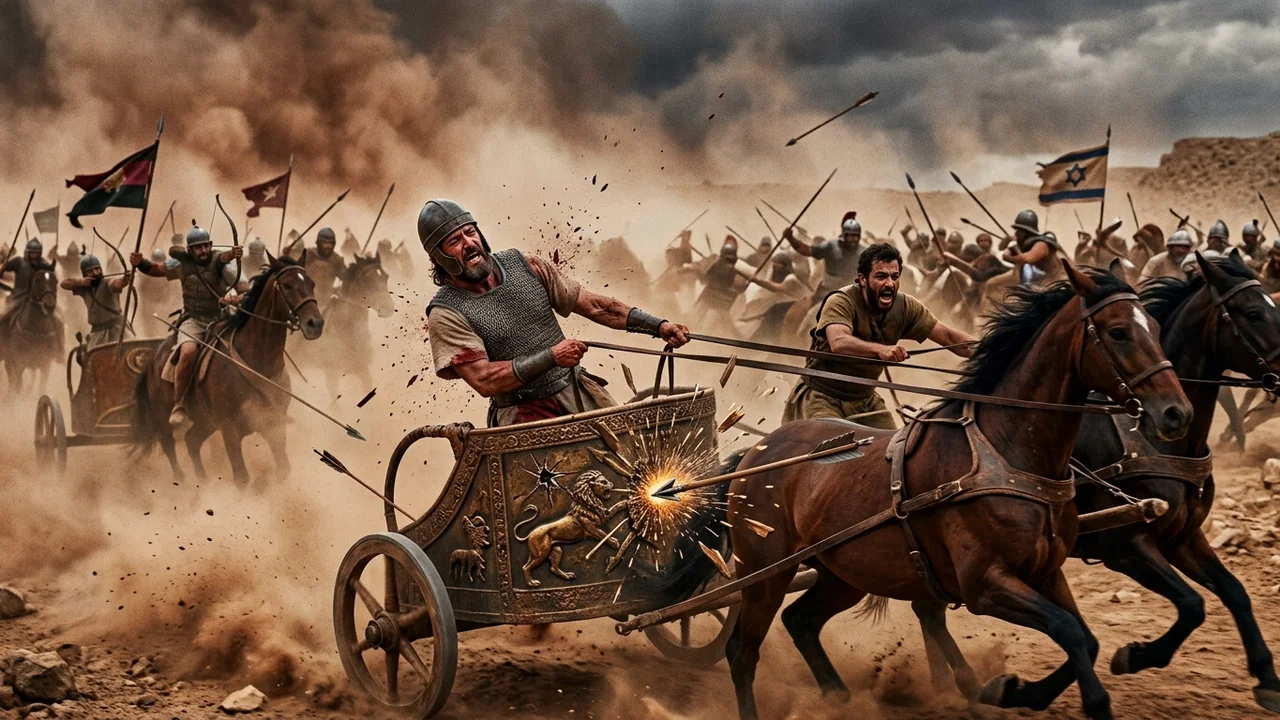
Ahab’s maneuver was cold, ruthless battlefield pragmatism. By stripping off his royal crowns, insignia, and gilded chariot banners, Ahab took the field disguised as a common chariot warrior. Meanwhile, he flattered Jehoshaphat into wearing full royal vestments, effectively turning the King of Judah into a conspicuous, primary target for Syrian archers.
Ahab’s fears were well-founded. King Ben-Hadad had issued a ruthless, highly focused tactical command to his thirty-two chariot captains:
"Fight neither with small nor great, save only with the king of Israel." (1 Kings 22:31)
Spotting Jehoshaphat in his dazzling royal robes, the Aramean chariot squadrons swarmed him with drawn bows. In sheer panic, Jehoshaphat cried out—likely invoking the name of Yahweh in a Hebrew dialect distinct from the northern court—causing the Syrian captains to realize he was not Ahab and call off the pursuit.
Ahab’s tactical subterfuge appeared to have succeeded flawlessly. He had survived the focused royal manhunt. Yet, human cunning could not divert the arrow of divine judgment.
The Ballistics of the "Stray" Arrow: 1 Kings 22:34 Decoded
The turning point of the battle is described in 1 Kings 22:34 with breathtaking literary and ballistic precision:
"And a certain man drew a bow at a venture, and smote the king of Israel between the joints of the harness: wherefore he said unto the driver of his chariot, 'Turn thine hand, and carry me out of the host; for I am wounded.'"
The Hebrew phrase for "at a venture" is le-thumo (literally, "in his simplicity", "innocently", or "without specific aim"). The Syrian archer was not an elite sniper tracking a decorated royal target. He was an ordinary soldier releasing an arrow into the swirling dust of the chariot melee without knowing the identity or status of the man he was targeting.
[Syrian Composite Bow Launch]
             │
             ├──► High Velocity: ~55–65 meters/sec (120–145 mph)
             ├──► Armor Penetration: Hardened Bronze/Iron Bodkin Point
             │
             └──► Trajectory Target: "Between the Joints" (Bein Ha-Deveqim)
                       │
                       ▼
         [Gap Between Bronze Scales & Corslet]
                       │
                       ▼
       [Thoracic Penetration: Intercostal & Internal Hemorrhage]
From a modern ballistics standpoint, ancient composite bows constructed of wood, horn, and sinew fired bronze or iron-tipped arrows at velocities between 55 and 65 meters per second (120 to 145 mph), generating substantial kinetic energy capable of penetrating leather and bronze sheet armor at ranges up to 100 meters.
The Anatomy of Iron Age Scale Armor: Deveqim and Shiryon
The critical anatomical phrase in the Hebrew text is: bein ha-deveqim u-vein ha-shiryon (literally, "between the joints and between the breastplate").
Archaeological excavations of 9th-century BC military strata across the Levant have recovered hundreds of authentic Iron Age armor scales, shedding definitive light on this phrase:
- The Shiryon (Scale Corslet): Ancient royal armor consisted of a thick linen or leather tunic onto which hundreds of small, overlapping bronze scales (measuring approximately 2 by 8 centimeters) were laced with rawhide cords. While the overlapping scales provided excellent protection against direct slashing swords and downward spear thrusts, the armor was inevitably interrupted by functional articulation points.
- The Deveqim (The Joints/Laminations): The Hebrew word deveqim (from the root d-b-q, "to cling" or "join") designates the flexible seams where separate protective garments met:
- The narrow junction between the lower edge of the bronze chest-corslet and the flexible skirt (pteruges) protecting the lower abdomen.
- The armpit seam (axilla) where the armhole joins the rigid chest plate.
- The collar seam between the bronze throat-guard (gorget) and the breastplate.
When a warrior holds the reins of a chariot or raises a shield, the arm elevates, stretching the joint and creating a fleeting gap measuring barely 1 to 2 centimeters wide. For an unguided arrow fired at random across a chaotic battlefield to strike this microscopic, moving target while the chariot bounced over uneven terrain represents a statistical impossibility that defies secular probability.
Forensic Pathology: Hemorrhagic Shock in the Chariot
Following the strike, Ahab realized the wound was grave. He commanded his charioteer: "Turn your hand and carry me out of the host, for I am wounded." But the battle raged so fiercely that Ahab could not easily withdraw without precipitating a general rout of his forces. In a display of remarkable physical fortitude, the king chose to remain upright:
"And the battle increased that day: and the king was stayed up in his chariot against the Syrians, and died at even: and the blood ran out of the wound into the midst of the chariot." (1 Kings 22:35)
Modern forensic trauma analysis reveals the precise pathophysiology of Ahab’s slow, agonizing death:
- Thoracic Vascular Transection: The arrow penetrated between the armor scales into the thoracic or upper abdominal cavity. Given that Ahab survived for several hours until sunset, the arrow did not sever the ascending aorta or heart (which would have caused death within 60 seconds). Instead, it likely lacerated the intercostal artery, the internal thoracic artery, or pierced the lower lobe of the lung, causing a massive, progressive hemothorax.
- Internal and External Exsanguination: Blood poured internally into the pleural cavity, compressing the lung, while simultaneously draining externally down his armor onto the wooden floor of the chariot (el heik ha-rekhev, "into the bosom/floor of the chariot").
- Hypovolemic Shock: As systemic arterial blood pressure plummeted from the loss of 2 to 3 liters of blood, Ahab experienced severe hypovolemic shock—characterized by extreme thirst, cold extremities, tachycardia, and progressive mental disorientation. Yet, propped up by his charioteer to maintain troop morale, Ahab stood motionless until hypovolemic cardiac arrest claimed his life at sunset.
The Pool of Samaria: The Dogs Lick the Royal Blood
With the king dead, a cry echoed through the ranks at twilight: "Every man to his city, and every man to his country!" (1 Kings 22:36). The coalition dispersed exactly as Micaiah had prophesied: like sheep without a shepherd.
Ahab’s body was transported back to the capital city of Samaria for royal burial. Then, the grim climax unfolded:
"And one washed the chariot in the pool of Samaria; and the dogs licked up his blood; and they washed his armor; according unto the word of the Lord which He spake." (1 Kings 22:38)
Years earlier, when Ahab had orchestrated the murder of Naboth, the prophet Elijah had met the king in Naboth’s seized vineyard with a terrifying decree: "In the place where dogs licked the blood of Naboth shall dogs lick thy blood, even thine" (1 Kings 21:19).
Excavations at the capital city of Samaria by Harvard University uncovered the massive royal palace acropolis built by Omri and Ahab, including deep rock-cut water reservoirs identified as the public pools where royal chariots were cleaned. The random arrow at Ramoth-Gilead and the blood-washed chariot in the pool of Samaria formed an unbroken chain of fulfilled prophetic justice.
Deepen Your Study of Biblical Military Battles
King Ahab's demise at Ramoth-Gilead is a masterclass in ancient ballistics, military armor engineering, and prophetic fulfillment. To explore the tactical battle maps, weapon mechanics, and medical case studies of biblical warfare:
👉 Discover Volume II: Kings & Prophets – Tragic Ends & Medical Mysteries ($2.99)
Includes exhaustive analyses of the Battle of Gilboa, David's sling ballistics, ancient chariot warfare, and the complete archaeological finds from Samaria and Jezreel.
Frequently Asked Questions
Was Ahab wearing armor when he was shot?
Yes. 1 Kings 22:34 explicitly states that Ahab was struck "between the joints of the harness" (bein ha-deveqim u-vein ha-shiryon). He was wearing a heavy Iron Age scale-armor corslet made of overlapping bronze scales, but the arrow penetrated the narrow, flexible seam where the plates met.
Why did Ahab disguise himself in battle?
Ahab disguised himself as a common soldier to evade the Aramean chariot captains, whom he suspected would target him personally. He persuaded King Jehoshaphat of Judah to wear his royal robes, using Jehoshaphat as a decoy while he fought in the ranks.
Did the Assyrian records mention King Ahab?
Yes. The famous Kurkh Monolith in the British Museum, inscribed by Assyrian King Shalmaneser III, explicitly mentions "Ahab the Israelite" (A-ha-ab-bu mat Sir-'a-la-a-a) as a key leader of the anti-Assyrian military coalition at the Battle of Qarqar in 853 BC, contributing 2,000 chariots and 10,000 troops.
What is the theological lesson of Ahab’s death?
Ahab’s death demonstrates that human deception, royal power, and armored defenses cannot alter or escape divine justice. Despite Ahab's elaborate disguise and the archer shooting "at random," God guided the trajectory of the arrow to fulfill the precise prophecies of Elijah and Micaiah.
Frequently Asked Questions
Was Ahab wearing armor when he was shot?
Yes. 1 Kings 22:34 explicitly states that Ahab was struck "between the joints of the harness" (bein ha-deveqim u-vein ha-shiryon). He was wearing a heavy Iron Age scale-armor corslet made of overlapping bronze scales, but the arrow penetrated the narrow, flexible seam where the plates met.
Why did Ahab disguise himself in battle?
Ahab disguised himself as a common soldier to evade the Aramean chariot captains, whom he suspected would target him personally. He persuaded King Jehoshaphat of Judah to wear his royal robes, using Jehoshaphat as a decoy while he fought in the ranks.
Did the Assyrian records mention King Ahab?
Yes. The famous Kurkh Monolith in the British Museum, inscribed by Assyrian King Shalmaneser III, explicitly mentions "Ahab the Israelite" (A-ha-ab-bu mat Sir-'a-la-a-a) as a key leader of the anti-Assyrian military coalition at the Battle of Qarqar in 853 BC, contributing 2,000 chariots and 10,000 troops.
What is the theological lesson of Ahab’s death?
Ahab’s death demonstrates that human deception, royal power, and armored defenses cannot alter or escape divine justice. Despite Ahab's elaborate disguise and the archer shooting "at random," God guided the trajectory of the arrow to fulfill the precise prophecies of Elijah and Micaiah.
Related Research Dossiers
View all 120 articles →
Sawn in Half Inside a Cedar Tree: The Ancient Jewish Record of Isaiah’s Execution
The Dogs of Jezreel: How Archaeology Confirmed the Fall of Queen Jezebel