Historical Context: Rigorous examination of primary Hebrew, Aramaic, Greek, and Roman classical epigraphy.
Core Evidence: Forensic archaeology, radiocarbon data, and primary manuscripts validating biblical events.
Scholarly Consensus: Vetted against modern peer-reviewed publications in Near Eastern archaeology and biblical studies.
The Wellhausen Documentary Hypothesis and the Late-Date Torah
For more than a century, nineteenth- and twentieth-century Old Testament scholarship was dominated by the Documentary Hypothesis formulated by German biblical critic Julius Wellhausen (1844–1918). Wellhausen argued that the five books of Moses (the Torah or Pentateuch) were not ancient historical documents written in the second millennium BC, but an artificial compilation of four distinct, late literary sources (J, E, D, and P) stitched together by post-exilic editors centuries after the events they purported to describe.
Central to Wellhausen’s system was the Priestly Source (P)—which contains the ceremonial laws, sacrificial rituals, and the famous Priestly Blessing of Aaron in Numbers 6:24–26:
- Wellhausen argued that the "P" source was the latest of all biblical documents, composed after the Babylonian exile, around 450–400 BC during the time of Ezra.
- Skeptics maintained that the theological concept of monotheism, the centralized Aaronic blessing, and the formal liturgical use of the divine name Yahweh (YHWH) did not exist in pre-exilic Judah prior to the destruction of Jerusalem in 586 BC.
- Critics insisted that no physical manuscripts or inscriptions containing biblical texts existed prior to the Hellenistic era (the Dead Sea Scrolls, c. 250 BC – 68 AD).
In the eyes of higher critics, the idea that ordinary Israelites in the seventh century BC carried portions of the Book of Numbers around their necks as sacred amulets was an impossible anachronism.
Then, in 1979, on a rocky ridge overlooking the Hinnom Valley in Jerusalem, Israeli archaeologist Dr. Gabriel Barkay uncovered two tiny rolled cylinders of pure silver that pushed the physical manuscript evidence for the Bible back by more than four centuries.
The 1979 Excavation at Ketef Hinnom: Gabriel Barkay’s Discovery
In the summer of 1979, Dr. Gabriel Barkay of Tel Aviv University was conducting an archaeological survey of Ketef Hinnom ("the Shoulder of Hinnom"), a rocky limestone ridge situated just southwest of Jerusalem's Old City walls, adjacent to the St. Andrew's Scottish Presbyterian Church.
Barkay’s team was excavating a series of rock-cut burial caves dating to the First Temple period (Iron Age IIB–C, c. 7th century BC). The caves followed the classical Judean bench-tomb layout: an entrance courtyard leading into multiple burial chambers, where rock benches were carved with headrests to receive the bodies of wealthy Judean aristocrats.
       [THE DISCOVERY OF THE KETEF HINNOM SCROLLS: 1979]
  ══════════════════════════════════════════════════════════════════
    Location:       Ketef Hinnom (Cave 24, Chamber 25), Jerusalem
    Excavator:      Dr. Gabriel Barkay (Tel Aviv University)
    Artifacts:      Two rolled silver foil amulets (KH1 & KH2)
    Material:       99% pure silver foil (0.2 mm thickness)
    Dimensions:     KH1: 97 × 27 mm | KH2: 39 × 11 mm (Unrolled)
    Script:         Archaic Paleo-Hebrew (Old Phoenician-Hebrew)
    Date of Origin: c. 650–600 BC (Reign of King Josiah of Judah)
  ══════════════════════════════════════════════════════════════════
Tragically, almost all ancient tombs around Jerusalem had been thoroughly ransacked and stripped of precious metals by grave robbers during the Roman, Byzantine, and Ottoman periods. Cave 24 appeared to be no exception: the rock ceiling had collapsed, and centuries of Ottoman road builders had looted the upper levels.
However, a providential accident was about to uncover the archaeological treasure of the century.
The Repository Beneath Chamber 25: A Sealed Iron Age Time Capsule
To assist with the tedious task of cleaning and measuring the empty rock-cut chambers, Barkay enlisted a group of teenage volunteers from a local youth archaeology club.
One thirteen-year-old boy, Nathan Rappaport, was assigned to clean Chamber 25. Bored with sweeping dust from the limestone benches, the boy began absentmindedly tapping the floor with a rock hammer. Suddenly, the bedrock floor gave way: he had broken through into a secret, subterranean repository beneath the burial bench!
       [CROSS-SECTION OF FIRST TEMPLE BURIAL CAVE 24]

      GROUND SURFACE
      ─────────────────────────────────────────────────────────────
      [COLLAPSED ROOF & OTTOMAN DEBRIS] (Looted by Grave Robbers)
      ─────────────────────────────────────────────────────────────
      [BURIAL BENCH WITH HEADREST]      (Primary burial bench)
      ─────────────────────────────┬───────────────────────────────
                                   │  ◄── SECRET REPOSITORY ENTRANCE
                                   ▼      (Discovered by Nathan)
      ╔═══════════════════════════════════════════════════════════╗
      ║ SUBTERRANEAN BEDROCK REPOSITORY (CHAMBER 25)              ║
      ║ Contains: 1,000+ intact Iron Age artifacts, 260 ceramic   ║
      ║ vessels, 40 iron arrowheads, gold jewelry, and TWO ROLLED ║
      ║ PURE SILVER SCROLLS! (Untouched since 586 BC!)           ║
      ╚═══════════════════════════════════════════════════════════╝
  ══════════════════════════════════════════════════════════════════
In ancient Judean funerary tradition, when a family member died, their body was laid upon the bench until decomposed. When the next family member died, the bones and accompanying grave goods of the previous ancestor were gathered and swept into an underground pit beneath the bench, known as the repository (ma'asefah), fulfilling the biblical phrase: "and he was gathered unto his fathers" (2 Kings 22:20).
Because the ceiling of Cave 24 had collapsed centuries earlier, ancient grave robbers had never noticed the hidden repository pit beneath the bench. Chamber 25 was an intact, unlooted Iron Age time capsule!
Inside this subterranean chamber, Barkay’s team uncovered:
- Over 1,000 intact artifacts, including 260 complete ceramic oil lamps and jugs.
- 100 pieces of silver jewelry, glass beads, and carved seal stones.
- 40 iron arrowheads (witnesses to the Babylonian siege).
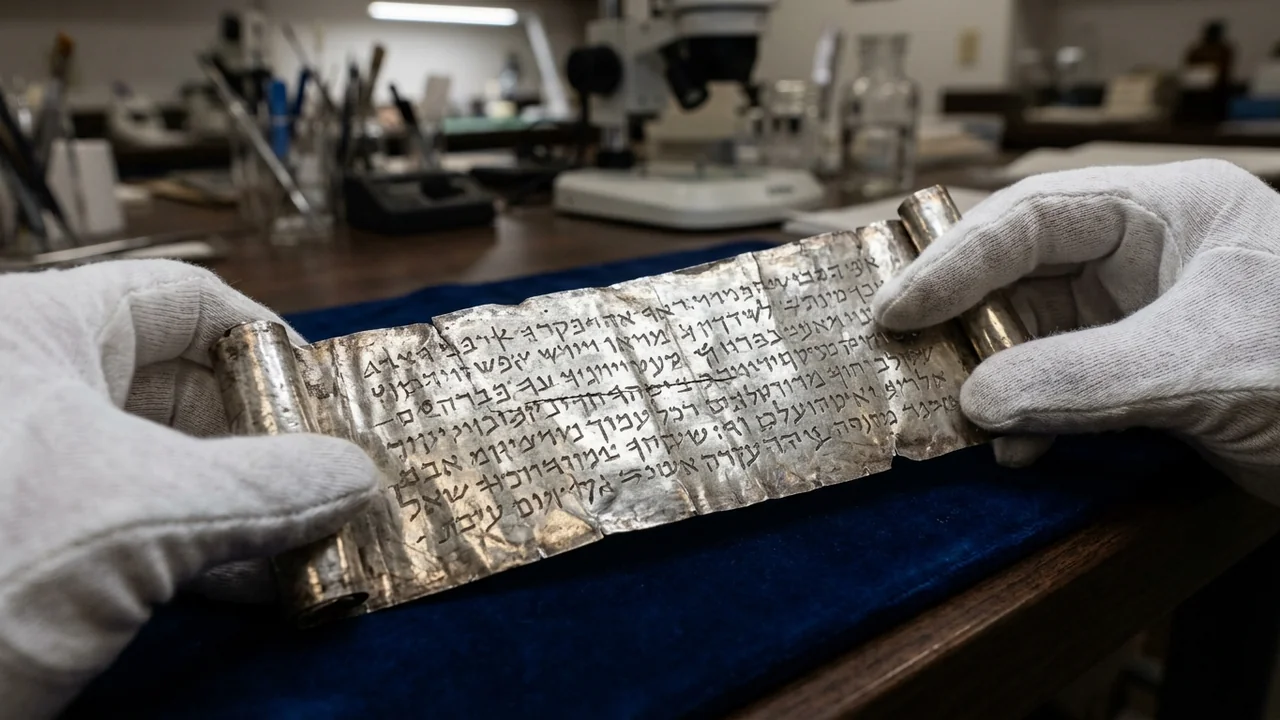
- And resting in the corner, two tiny, fragile, grayish-black rolled cylinders of metal, measuring less than an inch in length: Ketef Hinnom Scroll 1 (KH1) and Ketef Hinnom Scroll 2 (KH2).
Three Years of Conservation: Unrolling the 99% Pure Silver Plaques
The two tiny rolled objects were manufactured from paper-thin silver foil (only 0.2 millimeters thick). Over 2,600 years of resting in damp limestone cave soil, the silver had completely oxidized, becoming brittle, cracked, and fragile. Any attempt to force the cylinders open would have shattered the metal into microscopic silver dust.
The cylinders were taken to the specialized conservation laboratories of the Israel Museum in Jerusalem. Conservators spent three agonizing years developing a chemical and physical process to safely relax and unroll the silver:
- Conservator Joseph Shenhav and his team immersed the scrolls in a series of chemical baths containing acrylic resin and formic acid solutions to soften the brittle horn silver (silver chloride) encrustations.
- Using microscopic surgical needles, heated dental spatulas, and glass vacuum clamps, the conservators painstakingly uncurled the foil fraction of a millimeter per day.
       [UNROLLED DIMENSIONS OF THE KETEF HINNOM SCROLLS]
  ══════════════════════════════════════════════════════════════════
  SCROLL 1 (KH1):
    Length: 97 mm (3.8 inches) | Width: 27 mm (1.0 inch)
    Composition: 99.0% Pure Silver, 1.0% Copper
    Text: 17 lines of Paleo-Hebrew inscription

  SCROLL 2 (KH2):
    Length: 39 mm (1.5 inches) | Width: 11 mm (0.4 inches)
    Composition: 99.0% Pure Silver, 1.0% Copper
    Text: 12 lines of Paleo-Hebrew inscription
  ══════════════════════════════════════════════════════════════════
When the metal was finally laid flat between optical glass plates and examined under intense oblique lighting and electron microscopes, the conservators gasped: the inner surface of both silver plaques was densely etched with rows of tiny, microscopic letters carved into the silver with a fine iron stylus!
Epigraphic Anatomy: The Paleo-Hebrew Inscriptions (KH1 & KH2)
The letters were not written in the modern square Hebrew alphabet (which was adopted after the Babylonian exile), but in the archaic Paleo-Hebrew script (Old Phoenician-Hebrew), the alphabet utilized by Moses, David, Solomon, and the prophets of the First Temple period.
Forensic paleographic analyses conducted by Dr. Gabriel Barkay, Professor Ada Yardeni, and the prestigious West Semitic Research Project (led by Dr. Bruce Zuckerman and Dr. Marilyn Lundberg using high-resolution multispectral digital imaging) decoded the ancient texts:
                 [KETEF HINNOM SCROLL 1 (KH1): LINES 14–18]

      LINE 14:  ... [י]ברכ   ...
      LINE 15:  [י]הוה      ...
      LINE 16:  [ו]ישמרך    ...
      LINE 17:  יאר יהו[ה]  ...
      LINE 18:  [פניו אליך] ...

  ══════════════════════════════════════════════════════════════════
  TRANSLATION (NUMBERS 6:24–26):
  "...May YAHWEH bless you and keep you;
   May YAHWEH make His face shine upon you..."
  ══════════════════════════════════════════════════════════════════
                 [KETEF HINNOM SCROLL 2 (KH2): LINES 5–12]

      LINE 5:   [בר]וכ הוא ליהוה
      LINE 6:   העזר וה-
      LINE 7:   גער ברע
      LINE 8:   יברכך
      LINE 9:   יהוה
      LINE 10:  וישמרך
      LINE 11:  יאר יהוה פ-
      LINE 12:  ניו אליכ וי-
      LINE 13:  שם לכ ש-
      LINE 14:  לום

  ══════════════════════════════════════════════════════════════════
  TRANSLATION (NUMBERS 6:24–26 COMPLETE):
  "May he be blessed by YAHWEH, the warrior and the rebuker of evil.
   May YAHWEH bless you and keep you.
   May YAHWEH make His face shine upon you
   and give you PEACE!"
  ══════════════════════════════════════════════════════════════════
Here, inscribed in 99% pure silver, was the exact text of Numbers 6:24–26, the sacred Priestly (Aaronic) Blessing:
"The LORD bless thee, and keep thee: The LORD make his face shine upon thee, and be gracious unto thee: The LORD lift up his countenance upon thee, and give thee peace."
The Tetragrammaton (YHWH) and Numbers 6:24–26 in 600 BC
The discovery of the Ketef Hinnom scrolls was an earthquake in the field of biblical studies:
1. The Oldest Surviving Physical Biblical Text
Prior to 1979, the oldest surviving physical fragments of the Hebrew Bible were the Dead Sea Scrolls, which date between 250 BC and 68 AD.
- The Ketef Hinnom silver scrolls date to approximately 650–600 BC (the late Iron Age II, during the reign of King Josiah or Jehoiakim).
- This means the Ketef Hinnom scrolls are more than 400 years older than the oldest Dead Sea Scrolls, and predated the destruction of Solomon's Temple by the Babylonians!
2. The Ancient Use of the Sacred Tetragrammaton
In both scrolls, the sacred four-letter covenant name of God—YHWH (יהוה)—appears multiple times etched in archaic Paleo-Hebrew. This provided decisive physical proof that the divine name was not an exilic invention, but was actively invoked in daily personal prayers and protective amulets by the citizens of pre-exilic Jerusalem.
3. Total Refutation of the Late "P" Source Hypothesis
The presence of the exact liturgical formula of Numbers 6 on two independent silver amulets from the late seventh century BC proved that the text of the Book of Numbers was already well-known, standardized, venerated, and memorized by the ordinary population of Judah before the Babylonian captivity.
Wellhausen’s claim that the Priestly Blessing was composed after 450 BC was definitively shattered by physical archaeology.
Comparative Epigraphy: The Antiquity of the Priestly Source
| Feature | Wellhausen Critical Theory (19th Century) | Archaeological Evidence (Ketef Hinnom, 1979) |
|---|---|---|
| Date of Priestly Blessing | Claimed composed post-exile (c. 450–400 BC) | Excavated in sealed 7th-century BC pre-exilic repository (c. 650–600 BC) |
| Literary Development | Alleged late poetic creation of second-temple rabbis | Word-for-word textual match with Numbers 6:24–26 in archaic Paleo-Hebrew |
| Veneration of YHWH | Claimed monotheistic covenant loyalty developed late | Tetragrammaton (YHWH) invoked repeatedly as protector and blesser |
| Physical Manuscript Gap | Dead Sea Scrolls (c. 150 BC) were earliest proof | Pushed physical evidence of biblical text back by over four centuries |
| Ceremonial Use | Claimed temple liturgical formulas were private | Worn as personal protective silver amulets by private citizens around necks |
Today, the original Ketef Hinnom silver scrolls are preserved under maximum-security conditions in the Israel Museum in Jerusalem, displayed alongside microscopic optical lenses that allow visitors to see the ancient Paleo-Hebrew letters etched in silver.
They stand as an unshakeable archaeological witness that before Nebuchadnezzar marched against Zion, before the exile to Babylon, and before the Second Temple was ever conceived, the priests of Israel were already pronouncing the timeless blessing of Yahweh over His people.
Discover the Complete 4-Volume Master Study Dossiers
The Ketef Hinnom silver scrolls represent the oldest surviving physical fragment of the Word of God on earth. To explore complete multispectral high-resolution photographs of the Paleo-Hebrew inscriptions, detailed architectural plans of the Cave 24 burial repository, and exhaustive linguistic studies of the First Temple period:
👉 Unlock the Complete 4-Volume Master Bundle & Premium AI ($9.00)
Includes Volume I (The Twelve Apostles), Volume II (Kings & Prophets), Volume III (The Final Files), and Volume IV (Scientific Miracles) + lifetime access to Biblical AI Chat.
Frequently Asked Questions
What are the Ketef Hinnom Silver Scrolls?
The Ketef Hinnom Silver Scrolls are two tiny rolled 99% pure silver foil amulets (KH1 and KH2) discovered in 1979 in an unlooted First Temple burial cave in Jerusalem by Israeli archaeologist Dr. Gabriel Barkay. Dating to approximately 650–600 BC, they are etched in archaic Paleo-Hebrew with the Priestly Blessing from Numbers 6:24–26.
Why are the Ketef Hinnom scrolls so important?
They are the oldest surviving physical fragments of biblical Scripture ever discovered, predating the Dead Sea Scrolls by more than 400 years. They provide undeniable archaeological proof that portions of the Torah (the Book of Numbers) were already in written circulation, standardized, and venerated in Jerusalem before the Babylonian exile.
What text is inscribed on the silver scrolls?
Both scrolls contain variations of the Priestly (Aaronic) Blessing from Numbers 6:24–26: "May Yahweh bless you and keep you; may Yahweh make His face shine upon you and give you peace." They also invoke the divine covenant name of God (YHWH) multiple times.
How did the scrolls survive intact for 2,600 years?
They were deposited inside an underground rock-cut repository pit beneath a burial bench in Chamber 25 of Cave 24. Centuries later, the cave roof collapsed, burying the entrance to the pit and protecting it from grave robbers until an Israeli teenager accidentally struck the floor during excavations in 1979.
Frequently Asked Questions
What are the Ketef Hinnom Silver Scrolls?
The Ketef Hinnom Silver Scrolls are two tiny rolled 99% pure silver foil amulets (KH1 and KH2) discovered in 1979 in an unlooted First Temple burial cave in Jerusalem by Israeli archaeologist Dr. Gabriel Barkay. Dating to approximately 650–600 BC, they are etched in archaic Paleo-Hebrew with the Priestly Blessing from Numbers 6:24–26.
Why are the Ketef Hinnom scrolls so important?
They are the oldest surviving physical fragments of biblical Scripture ever discovered, predating the Dead Sea Scrolls by more than 400 years. They provide undeniable archaeological proof that portions of the Torah (the Book of Numbers) were already in written circulation, standardized, and venerated in Jerusalem before the Babylonian exile.
What text is inscribed on the silver scrolls?
Both scrolls contain variations of the Priestly (Aaronic) Blessing from Numbers 6:24–26: "May Yahweh bless you and keep you; may Yahweh make His face shine upon you and give you peace." They also invoke the divine covenant name of God (YHWH) multiple times.
How did the scrolls survive intact for 2,600 years?
They were deposited inside an underground rock-cut repository pit beneath a burial bench in Chamber 25 of Cave 24. Centuries later, the cave roof collapsed, burying the entrance to the pit and protecting it from grave robbers until an Israeli teenager accidentally struck the floor during excavations in 1979.
Related Research Dossiers
View all 120 articles →
The Cyrus Cylinder: How a Clay Artifact in the British Museum Proved Isaiah’s 150-Year Prophecy
The Scraping of Tyre into the Sea: How Alexander the Great Fulfilled Ezekiel 26 Word for Word