Historical Context: Rigorous examination of primary Hebrew, Aramaic, Greek, and Roman classical epigraphy.
Core Evidence: Forensic archaeology, radiocarbon data, and primary manuscripts validating biblical events.
Scholarly Consensus: Vetted against modern peer-reviewed publications in Near Eastern archaeology and biblical studies.
The Audacious Claim of the Prophet Isaiah
In the annals of ancient Near Eastern literature, few prophetic oracles generated as much fierce scholarly debate, skeptical resistance, and historical astonishment as the specific prophecies of Isaiah son of Amoz. Writing in Jerusalem during the reigns of Uzziah, Jotham, Ahaz, and Hezekiah (c. 740–686 BC), Isaiah looked beyond the imminent Assyrian threat and foresaw the distant destruction of Jerusalem by the Babylonian Empire, the seventy-year exile of the Jewish people, and their miraculous restoration under a non-Jewish foreign conqueror.
Most extraordinary of all, Isaiah did not merely predict that an unnamed king would liberate the captives; he called this monarch by his specific personal name Cyrus (Koresh in Hebrew, Kūruš in Old Persian) approximately 150 years before the king ascended the throne, and more than a century before the Babylonian Empire had even reached its zenith:
"That saith of Cyrus, He is my shepherd, and shall perform all my pleasure: even saying to Jerusalem, Thou shalt be built; and to the temple, Thy foundation shall be laid. Thus saith the LORD to his anointed, to Cyrus, whose right hand I have holden, to subdue nations before him; and I will loose the loins of kings, to open before him the two leaved gates; and the gates shall not be shut." — Isaiah 44:28; 45:1
For nineteenth-century rationalists and Enlightenment historians, this level of detailed foreknowledge was deemed an impossibility. Skeptics argued that no human prophet in the eighth century BC could have named a Persian ruler who lived in the sixth century BC (559–530 BC). Consequently, higher critics such as Bernhard Duhm (1892) invented the theory of a "Deutero-Isaiah" (Second Isaiah)—an anonymous scribe living in Babylon during or after the Persian conquest who retroactively forged the prophecies as history masquerading as prophecy (vaticinium ex eventu).
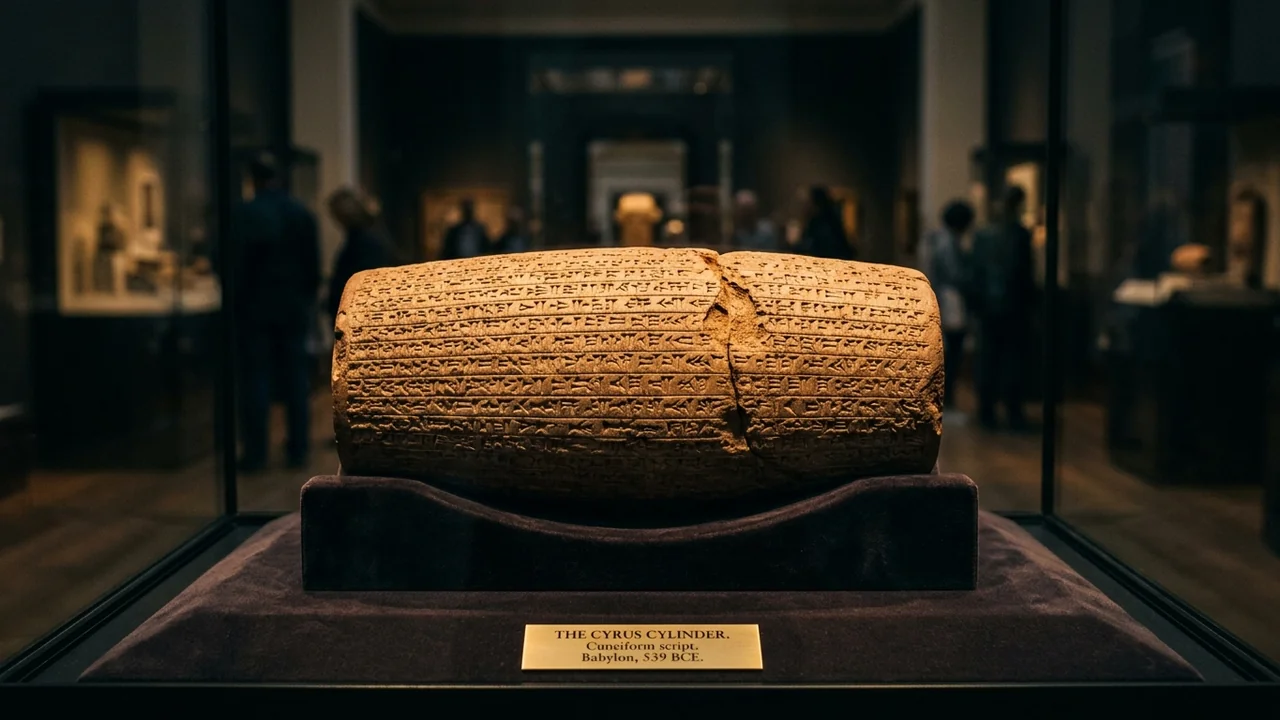
However, in March 1879, deep within the subterranean mounds of ancient Mesopotamia, a team of archaeologists uncovered a small, football-shaped cylinder of baked clay that shattered nineteenth-century skepticism and provided independent, extrabiblical confirmation of the Persian king's edicts: The Cyrus Cylinder.
The 1879 Excavation in Babylon: Hormuzd Rassam’s Discovery
In early 1879, the British Museum commissioned Ottoman-born Christian Assyriologist and explorer Hormuzd Rassam—a protege of Sir Austen Henry Layard—to conduct archaeological excavations in the ruins of Babylon (modern-day Hillah, Babil Governorate, Iraq). Rassam focused his field operations on the Amran ibn Ali mound, the ancient ruins of the magnificent temple complex of Esagila, sacred to the patron god of Babylon, Marduk.
While digging into the foundation deposits beneath the monumental sanctuary, Rassam’s crew struck a foundation deposit containing an unbaked clay cylinder, measuring approximately 22.5 centimeters (8.9 inches) in length and 10 centimeters (3.9 inches) in maximum diameter, shaped like a barrel. The surface was densely inscribed in fine Babylonian cuneiform script, consisting of forty-five lines of preserved text.
       [THE DISCOVERY OF THE CYRUS CYLINDER: BABYLON, 1879]
  ══════════════════════════════════════════════════════════════════
    Location:       Esagila Temple Complex (Sanctuary of Marduk)
    Archaeologist:  Hormuzd Rassam (British Museum Expedition)
    Artifact ID:    BM 90920 (British Museum, London)
    Material:       Kiln-baked terracotta clay barrel
    Script:         Late Babylonian Cuneiform (Akkadian language)
    Date of Origin: Autumn 539 BC (Immediately post-conquest)
  ══════════════════════════════════════════════════════════════════
The cylinder was carefully packed and transported to the British Museum in London. Sir Henry Rawlinson, the legendary linguist who had cracked the trilingual Behistun Inscription, undertook the arduous task of translating the damaged cuneiform text. On November 17, 1879, Rawlinson announced his preliminary findings to the Royal Asiatic Society: the cylinder was the official royal declaration of Cyrus the Great, King of Anshan and founder of the Achaemenid Empire, issued immediately following his peaceful conquest of Babylon on October 29, 539 BC (Nisanu calendar).
Epigraphic Autopsy of the Cuneiform Inscription (BM 90920)
The inscription on the Cyrus Cylinder is written from the perspective of Cyrus himself, recorded by Babylonian temple scribes who viewed the Persian monarch as a divine deliverer sent to liberate the city from the tyrannical and religiously aberrant reign of Nabonidus, the last native king of Babylon.
Lines 1–19 establish Nabonidus’s apostasy, his neglect of the cult of Marduk, and the divine summons of Cyrus. Lines 20–22 recite Cyrus’s royal lineage, while lines 28–36 contain the core geopolitical decree that directly mirrors the biblical decrees recorded in Ezra 1:1–4 and 2 Chronicles 36:22–23:
                      [CYRUS CYLINDER: LINES 30–35]
  "From [Nineveh], Assur, and Susa, Agade, Eshnunna, the cities of
   Zamban, Meturnu, and Der, as far as the region of the Gutium,
   the sanctuaries across the Tigris whose shrines had long been
   in ruins, I returned to their places the gods who lived in them,
   and I restored them to eternal dwellings.

   I gathered ALL THEIR INHABITANTS AND RETURNED THEM TO THEIR HOMES..."
  ═══════════════════════════════════════════════════════════════════
   Translation: British Museum / Dr. Irving Finkel (2013)
                  [TRANSCRIPTION OF CRITICAL AKKADIAN LINES]
  Line 32:  ...a-na aš-ri-šu-nu ú-tir-ma ú-šar-ma-a šu-ba-at da-er-a-ta...
            ("to their places I restored and made them dwell in permanent sanctuaries...")
  Line 34:  ...kúl-lat un-me-šu-nu ú-pa-ah-hi-ra-am-ma ú-te-er a-na ma-aš-ka-ni-šu-un...
            ("all of their peoples I gathered together and restored to their habitations...")
Prior to this discovery, secular historians routinely dismissed the biblical account in Ezra 1—which claimed that a pagan Persian emperor had voluntarily permitted conquered exiles to return to their ancestral lands and rebuild their destroyed provincial temples—as a pious Jewish fantasy. Historians argued that ancient conquerors never surrendered enslaved populations or financed the reconstruction of foreign sanctuaries.
The Cyrus Cylinder proved that this unprecedented, enlightened policy of repatriation and temple restitution was not an invention of Jewish scribes; it was the official, public imperial policy of Cyrus the Great.
The Imperial Policy of Cyrus vs. Assyrian-Babylonian Deportations
To appreciate the revolutionary nature of the Cyrus Cylinder and its alignment with biblical prophecy, one must understand the standard geopolitical doctrine of the ancient Near East during the Iron Age. For over three centuries, the superpowers of Mesopotamia maintained imperial dominance through systematic, brutal mass deportations:
- The Neo-Assyrian Empire (c. 911–609 BC): Pioneered by Tiglath-Pileser III and Sargon II, the Assyrians systematically uprooted conquered populations, dispersed them across distant provinces, and severed their ethnic, linguistic, and religious roots (as suffered by the Northern Kingdom of Israel in 722 BC).
- The Neo-Babylonian Empire (c. 626–539 BC): Nebuchadnezzar II continued this scorched-earth strategy, razing Jerusalem to the ground in 586 BC, burning the First Temple, confiscating the sacred gold and silver vessels, and dragging the surviving Judean elites in chains to Babylon (2 Kings 25).
- The Achaemenid Persian Empire (c. 550–330 BC): Cyrus the Great instituted a radically new paradigm of imperial governance. Recognizing that brutal suppression fostered chronic rebellion, Cyrus replaced forced assimilation with cultural and religious autonomy. Conquered peoples were allowed to return to their native homelands, resurrect their ancestral temples, and pray to their local deities on behalf of the Persian king and his sons.
                     [PARADIGM SHIFT IN IMPERIAL GOVERNANCE]
  ┌───────────────────────┬────────────────────────┬─────────────────────────┐
  │   ASSYRIAN EMPIRE     │   BABYLONIAN EMPIRE    │     PERSIAN EMPIRE      │
  │   (Tiglath-Pileser)   │   (Nebuchadnezzar II)  │   (Cyrus the Great)     │
  ├───────────────────────┼────────────────────────┼─────────────────────────┤
  │ Total population      │ Complete destruction   │ Universal repatriation  │
  │ fragmentation and     │ of national temples;   │ of displaced exiles;    │
  │ cultural annihilation │ gold vessels looted;   │ royal financing for     │
  │ across provinces.     │ populations exiled.    │ temple reconstruction.  │
  └───────────────────────┴────────────────────────┴─────────────────────────┘
When Ezra 1:2–3 records Cyrus's proclamation—"The LORD God of heaven hath given me all the kingdoms of the earth; and he hath charged me to build him an house at Jerusalem, which is in Judah. Who is there among you of all his people? his God be with him, and let him go up to Jerusalem..."—it reflects the localized Judean application of the universal edict preserved on the clay cylinder in the British Museum.
Comparative Historical Analysis: The Hebrew Bible vs. Cuneiform Text
The linguistic, conceptual, and thematic correspondences between the Cyrus Cylinder and the biblical books of Isaiah, Ezra, and 2 Chronicles are striking:
| Thematic Feature | The Cyrus Cylinder (BM 90920, Babylon) | The Hebrew Scriptures (Isaiah & Ezra) |
|---|---|---|
| Divine Sovereign Calling | Marduk "searched through all the countries... he named Cyrus, king of Anshan, by name" (Lines 11–12) | "The LORD, which call thee by thy name, even the God of Israel... I have surnamed thee" (Isaiah 45:3–4) |
| Victorious Conquest | Cyrus entered Babylon "without battle or conflict... he took his hand" (Lines 14–17) | "Whose right hand I have holden, to subdue nations before him... to open the gates" (Isaiah 45:1) |
| Liberation of Captives | "I gathered all their inhabitants and returned them to their habitations" (Line 34) | "He shall build my city, and he shall let go my captives, not for price nor reward" (Isaiah 45:13) |
| Restoration of Sanctuaries | "I returned the sanctuaries across the Tigris... and restored them to eternal dwellings" (Line 32) | "Even saying to Jerusalem, Thou shalt be built; and to the temple, Thy foundation laid" (Isaiah 44:28) |
| Restitution of Sacred Vessels | Returned the statues and religious emblems to their original cult centers (Lines 31–33) | Cyrus ordered the return of 5,400 gold and silver vessels taken by Nebuchadnezzar (Ezra 1:7–11) |
| Prayer for the Royal Dynasty | "May all the gods whom I returned to their sanctuaries plead daily for a long life for me" (Line 35) | "That they may offer sacrifices of sweet savours... and pray for the life of the king" (Ezra 6:10) |
While the Cyrus Cylinder uses Babylonian theological nomenclature (crediting Marduk, the national deity of Babylon) to win the political loyalty of the Babylonian priesthood, the underlying administrative policy is identical to that described in the Hebrew text. Ancient rulers customarily framed their official proclamations in the theological language of the specific audience they were addressing.
The Skeptical Dilemma: Deutero-Isaiah and Textual Integrity
The archaeological authentication of Cyrus's policy created a profound dilemma for nineteenth- and twentieth-century higher criticism. Having conceded that the policy described in Ezra was historically authentic, critics redoubled their efforts to prove that Isaiah 40–66 could not have been written by Isaiah of Jerusalem in the eighth century BC.
However, several decisive lines of physical, literary, and manuscript evidence refute the late-date Deutero-Isaiah hypothesis:
1. The Great Isaiah Scroll (1QIsa) from Qumran
When the Dead Sea Scrolls were discovered in Cave 1 at Qumran in 1947, archaeologists recovered the intact Great Isaiah Scroll, dated by carbon-14 and paleographic analysis to approximately 125–100 BC.
- In this ancient Hebrew manuscript, Isaiah chapter 40 begins on the very same column (Column XXVIII) as chapter 39, with only a standard line break.
- There is no division, no textual gap, no change in scribal hand, and no title indicating a different author.
- To the ancient Jewish community at Qumran—who guarded their sacred texts with meticulous precision—the Book of Isaiah was a unified, indivisible composition authored solely by Isaiah son of Amoz.
2. Historical Topography and Botanical Metaphors
Linguistic analysis of Isaiah 40–66 reveals that the botanical and geographical descriptions reflect the flora, climate, and topography of pre-exilic Judea, not sixth-century alluvial Mesopotamia:
- The text refers repeatedly to cedars of Lebanon, oaks, cypresses, and stone-quarried hills characteristic of the Judean highlands.
- In contrast, Babylon was an alluvial mud-brick plain completely devoid of native stone quarries and Mediterranean conifers.
3. The Predictive Purpose of Predictive Prophecy
In Isaiah 41:21–23, Yahweh explicitly issues a judicial challenge to the idols of the pagan nations, staking His claim to being the one true God on His unique ability to predict specific future events centuries before they occur:
"Produce your cause, saith the LORD; bring forth your strong reasons, saith the King of Jacob. Let them bring them forth, and shew us what shall happen: let them shew the former things, what they be, that we may consider them... Shew the things that are to come hereafter, that we may know that ye are gods!"
To excise predictive prophecy from Isaiah by late-dating every fulfilled passage is to destroy the very theological premise of the book. The naming of Cyrus was intentionally given 150 years in advance precisely so that when the decree was finally issued, the Jewish exiles in Babylon would recognize that their redemption was orchestrated not by the pagan pantheon of Babylon, but by the sovereign Lord of history.
Discover the Complete 4-Volume Master Study Dossiers
The Cyrus Cylinder is merely one of hundreds of ancient inscriptions, cylinder seals, and cuneiform tablets that have verified the historical precision of the Old and New Testaments. To explore comprehensive primary source translations, archaeological blueprints of the Babylonian excavation sites, and line-by-line analyses of fulfilled messianic prophecies:
👉 Unlock the Complete 4-Volume Master Bundle & Premium AI ($9.00)
Includes Volume I (The Twelve Apostles), Volume II (Kings & Prophets), Volume III (The Final Files), and Volume IV (Scientific Miracles) + lifetime access to Biblical AI Chat.
Frequently Asked Questions
What is the Cyrus Cylinder and why is it historically significant?
The Cyrus Cylinder is a 9-inch barrel-shaped clay artifact inscribed in Akkadian cuneiform in 539 BC, discovered in 1879 in the ruins of Babylon by Hormuzd Rassam. It documents Cyrus the Great's conquest of Babylon and his unprecedented imperial decree allowing conquered exiles to return to their native homelands and rebuild their destroyed sanctuaries, directly confirming the biblical accounts in Ezra and 2 Chronicles.
How did the Cyrus Cylinder prove Isaiah's prophecy?
Isaiah 44:28 and 45:1 named Cyrus more than 150 years before his reign, prophesying that he would conquer nations, free the Jewish captives without ransom, and order the rebuilding of Jerusalem and its Temple. Skeptics long claimed this was an unhistorical myth because ancient kings did not repatriate captives. The Cyrus Cylinder provided extrabiblical, contemporary proof that repatriation and temple restoration were Cyrus's exact official imperial policy.
Where is the Cyrus Cylinder kept today?
The original artifact is housed in the British Museum in London (Room 55, Mesopotamia, artifact number BM 90920). It has been hailed as one of the most important archaeological discoveries in world history and is frequently referred to as the world's first declaration of human rights and religious freedom.
Does the Cyrus Cylinder mention the Jews by name?
The cylinder does not explicitly mention the Jews or Jerusalem by name; instead, it articulates Cyrus's broad, empire-wide imperial policy regarding all displaced peoples and regional sanctuaries across Mesopotamia and adjacent territories. The specific edict concerning Judea, preserved in the royal archives of Ecbatana and Jerusalem, is recorded in Hebrew and Aramaic in Ezra 1:1–4 and Ezra 6:1–5.
Frequently Asked Questions
What is the Cyrus Cylinder and why is it historically significant?
The Cyrus Cylinder is a 9-inch barrel-shaped clay artifact inscribed in Akkadian cuneiform in 539 BC, discovered in 1879 in the ruins of Babylon by Hormuzd Rassam. It documents Cyrus the Great's conquest of Babylon and his unprecedented imperial decree allowing conquered exiles to return to their native homelands and rebuild their destroyed sanctuaries, directly confirming the biblical accounts in Ezra and 2 Chronicles.
How did the Cyrus Cylinder prove Isaiah's prophecy?
Isaiah 44:28 and 45:1 named Cyrus more than 150 years before his reign, prophesying that he would conquer nations, free the Jewish captives without ransom, and order the rebuilding of Jerusalem and its Temple. Skeptics long claimed this was an unhistorical myth because ancient kings did not repatriate captives. The Cyrus Cylinder provided extrabiblical, contemporary proof that repatriation and temple restoration were Cyrus's exact official imperial policy.
Where is the Cyrus Cylinder kept today?
The original artifact is housed in the British Museum in London (Room 55, Mesopotamia, artifact number BM 90920). It has been hailed as one of the most important archaeological discoveries in world history and is frequently referred to as the world's first declaration of human rights and religious freedom.
Does the Cyrus Cylinder mention the Jews by name?
The cylinder does not explicitly mention the Jews or Jerusalem by name; instead, it articulates Cyrus's broad, empire-wide imperial policy regarding all displaced peoples and regional sanctuaries across Mesopotamia and adjacent territories. The specific edict concerning Judea, preserved in the royal archives of Ecbatana and Jerusalem, is recorded in Hebrew and Aramaic in Ezra 1:1–4 and Ezra 6:1–5.
Related Research Dossiers
View all 120 articles →
The Healing of the Ten Lepers: Ancient Quarantine Laws and the Stigma of Hansen’s Disease
The Sudden Death of Ananias and Sapphira: Fatal Shock Syndrome or Immediate Divine Judgment?