Historical Context: Rigorous examination of primary Hebrew, Aramaic, Greek, and Roman classical epigraphy.
Core Evidence: Forensic archaeology, radiocarbon data, and primary manuscripts validating biblical events.
Scholarly Consensus: Vetted against modern peer-reviewed publications in Near Eastern archaeology and biblical studies.
The Crisis at Gibeon: The Amorite Coalition Offensive
Following the fall of Jericho and Ai, the prominent highland city of Gibeon—the leader of a four-city Hivite confederation (Gibeon, Chephirah, Beeroth, and Kiriath-Jearim)—recognized that resistance was futile. Through a famous diplomatic ruse of moldy bread and patched wineskins, the Gibeonites negotiated a mutual non-aggression covenant with Joshua (Joshua 9).
When Adoni-Zedek, the Amorite King of Jerusalem, discovered that the formidable warriors of Gibeon had defected to the Hebrew alliance, panic swept the Canaanite city-states:
"Wherefore Adoni-zedek king of Jerusalem sent unto Hoham king of Hebron, and unto Piram king of Jarmuth, and unto Japhia king of Lachish, and unto Debir king of Eglon, saying, 'Come up unto me, and help me, that we may smite Gibeon: for it hath made peace with Joshua and with the children of Israel.'" (Joshua 10:3–4)
The combined Amorite military coalition marched north into the hill country of Benjamin, laying a suffocating siege to Gibeon. Trapped behind their walls, the Gibeonite elders dispatched an urgent courier to Joshua's military base camp at Gilgal: "Slack not thy hand from thy servants; come up to us quickly, and save us!" (Joshua 10:6).
The All-Night Forced March and the Lethal Hailstorm
Joshua responded with extraordinary military audacity. Under cover of total darkness, the Israelite army executed an all-night forced march ascending over 3,300 vertical feet across twenty miles of steep mountain terrain from Gilgal in the Jordan Valley to the high plateau of Gibeon:
"Joshua therefore came unto them suddenly, and went up from Gilgal all night. And the Lord discomfited them before Israel, and slew them with a great slaughter at Gibeon, and chased them along the way that goeth up to Beth-horon..." (Joshua 10:9–10)
Caught in a dawn ambush, the Amorite coalition broke and fled down the treacherous mountain pass of the Ascent of Beth-Horon—a steep, narrow limestone staircase descending into the Valley of Aijalon.
As the retreating armies jammed into the narrow ravines, an atmospheric catastrophe struck:
"And it came to pass, as they fled from before Israel, and were in the going down to Beth-horon, that the Lord cast down great stones from heaven upon them unto Azekah, and they died: they were more which died with hailstones than they whom the children of Israel slew with the sword." (Joshua 10:11)
Terminal-velocity hailstones weighing multiple kilograms pummeled the Amorites across the foothills, devastating their rear guard with fatal blunt force trauma.
The Command of Joshua: Linguistics of the Ancient Hebrew Text
As the enemy fled toward the coastal plain, Joshua faced a critical tactical challenge: the day was slipping away, and if darkness fell, the broken Amorite forces would disperse into the fortified cities of Makkedah, Libnah, and Lachish.
Standing on the ridge overlooking Gibeon to the east and the wide Valley of Aijalon to the west, Joshua uttered his famous command before all Israel:
"Then spake Joshua to the Lord in the day when the Lord delivered up the Amorites before the children of Israel, and he said in the sight of Israel, 'Sun, stand thou still upon Gibeon; and thou, Moon, in the valley of Aijalon.' And the sun stood still, and the moon stayed, until the people had avenged themselves upon their enemies." (Joshua 10:12–13)
For centuries, popular English translations portrayed this event as the physical Earth halting its rotational axis for 24 hours, keeping the sun frozen overhead at high noon. Skeptics routinely ridiculed the narrative, noting that stopping the Earth's 1,000 mph equatorial rotational velocity would unleash catastrophic kinetic shockwaves, oceanic megatsunamis, and atmospheric disintegration.
However, modern Semitic linguistics and textual analysis have unveiled a profound, alternative understanding:
- The Hebrew Verb "Dom": In Joshua 10:12, Joshua does not use the standard Hebrew verb for "stop" or "halt" (amad). Instead, he commands: shemesh b'Giv'on dom! The root d-m-m literally means:
- "To be silent" or "to cease speaking" (Leviticus 10:3; Psalm 62:5).
- In ancient astronomical and celestial contexts, for a luminary to "be silent" means to stop shining, to lose its radiance, or to be extinguished/darkened!
- The Simultaneous Visibility of Sun and Moon: The text specifies that the sun was over Gibeon (in the east/southeast) while the moon was over the Valley of Aijalon (in the west/northwest). This optical alignment occurs exclusively during specific astronomical configurations!
- The Celestial Darkening: The phrase in verse 13 notes: "and the sun stood still [amad, remained in place], and the moon stayed [amad]... and hasted not to go down about a whole day." The ancient root can denote the cessation of normal daylight behavior—the sun failing to provide its normal light, prolonging an unnatural twilight that terrified the enemy.
[Astronomical Alignment in the Valley of Aijalon]
                      SUN (East over Gibeon)
                                 │
                         [Annular Eclipse]
                                 │
                      MOON (West over Aijalon)
                                 │
                         ▼               ▼
         [Eerie Midday Twilight: "The Sun Ceased Shining (Dom)"]
The Cambridge University Discovery: The Annular Eclipse of 1207 BC
In October 2017, a landmark scientific paper was published in the prestigious journal Astronomy & Geophysics (Royal Astronomical Society) by Prof. Sir Colin Humphreys (Director of Research at Cambridge University) and astrophysicist Graeme Waddington.
Humphreys and Waddington conducted exhaustive computer retro-calculations of every solar eclipse visible in the ancient Near East between 1500 BC and 1050 BC, discovering an astonishing astronomical match:
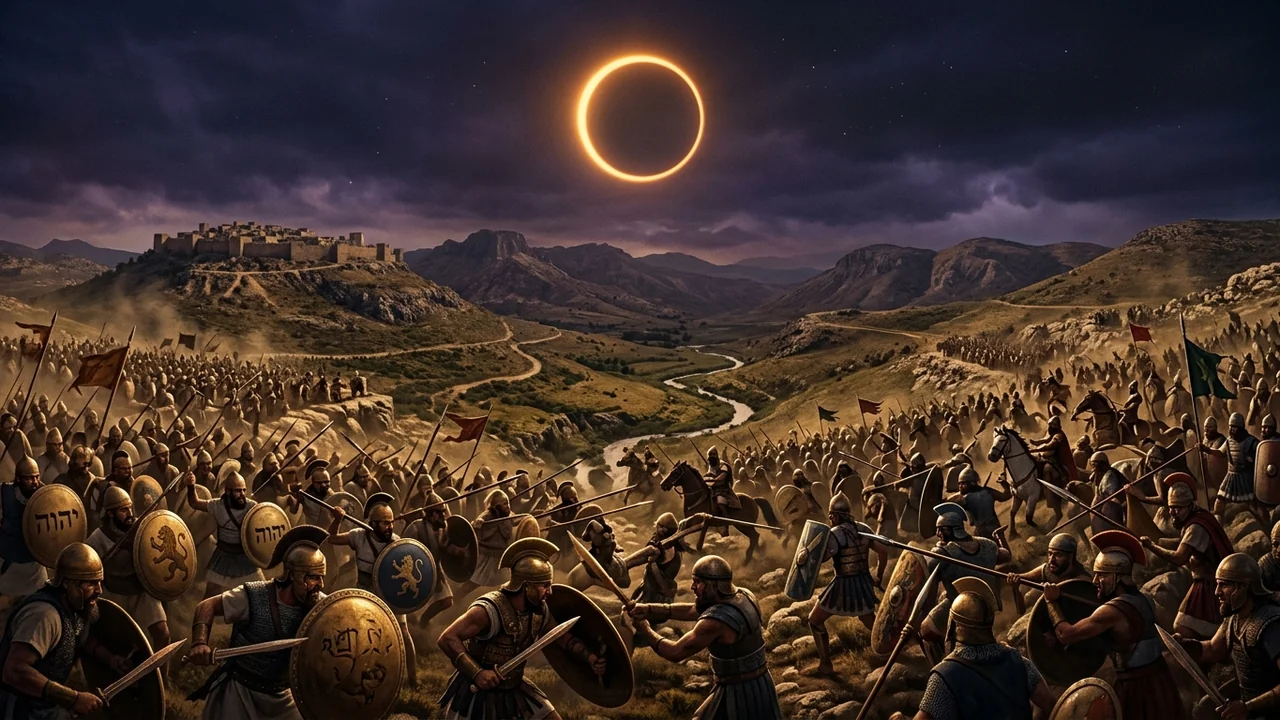
- The Annular Solar Eclipse of October 30, 1207 BC: On the afternoon of October 30, 1207 BC, a spectacular annular solar eclipse passed directly over the Judean hill country and the Valley of Aijalon!
- The "Ring of Fire" Twilight: In an annular eclipse, the moon passes directly in front of the sun but is too distant to cover the disk completely, leaving a brilliant, blazing "ring of fire" (annulus) blazing in a deep, darkened indigo sky.
- Midday Gloom: As the eclipse peaked at approximately 4:30 PM, the sunlight was reduced by over 86%. The scorching Mediterranean heat vanished instantly, replaced by a sudden, eerie midday gloom that made the sun appear as a cold, glowing crescent or ring that "ceased shining" (dom), while the moon was directly aligned across the celestial sphere!
- The Oldest Solar Eclipse Record in World History: Humphreys and Waddington proved that Joshua 10 represents the oldest recorded solar eclipse in human history, predating previously known Chinese and Babylonian eclipse records!
The Merneptah Stele: Cross-Referencing Egyptian Chronology
The scientific dating of the eclipse to October 30, 1207 BC aligns with breathtaking precision with secular Egyptian historical chronology:
In 1896, legendary British archaeologist Sir Flinders Petrie excavated the famous Merneptah Stele (the "Israel Stele") in the mortuary temple of Pharaoh Merneptah at Thebes (now in the Cairo Museum). Dated to the fifth year of Merneptah (reigned 1213–1203 BC):
"Canaan is plundered with every evil... Ashkelon is carried off; Gezer is seized; Yanoam is made as that which does not exist; Israel is laid waste, his seed is not."
The Merneptah Stele represents the earliest extrabiblical inscription naming "Israel" in human history!
Crucially, the hieroglyphic determinative used for "Israel" designates them not as a foreign city or kingdom, but as a distinct socio-ethnic people group already established in the highlands of Canaan by 1208–1207 BC—the exact year the solar eclipse darkened the skies of Gibeon!
Theological and Cosmic Meaning: Deposing the Canaanite Sun and Moon Gods
Why did God darken or alter the celestial course over Gibeon?
In the ancient pagan Canaanite pantheon, the sun (Shapash) and the moon (Yarikh) were high cosmic deities worshiped across the Levant. In fact:
- The ancient city of Beth-Shemesh was the dedicated "House of the Sun."
- The ancient city of Jericho (Yerecho) derived its name directly from Yarikh, the moon god!
The Amorite kings worshiped the sun and moon as their divine military protectors. When Joshua commanded the sun and moon to be silent, God demonstrated total sovereign supremacy over the very gods the Amorites worshiped!
As the sun blackened into an eerie ring of fire and the moon froze in celestial alignment while lethal hailstones pummeled the valley, the Amorites were struck by overwhelming psychological and spiritual terror, believing their gods had abandoned them to the God of Israel.
The author of Joshua concludes with awe:
"And there was no day like that before it or after it, that the Lord hearkened unto the voice of a man: for the Lord fought for Israel." (Joshua 10:14)
Investigate the Astronomical Miracles of Scripture
The solar eclipse of Joshua 10 and the Merneptah Stele demonstrate that ancient biblical history, astronomical retro-calculations, and Egyptian archaeology form an unbroken circle of truth. If you want to explore the complete astronomical datasets, orbital trajectory calculations, and archaeological excavation reports of ancient Canaan:
👉 Discover Volume III: The Final Files – Biblical Disasters & Ancient Wonders ($2.99)
Features the complete Cambridge University eclipse charts, hieroglyphic translations of the Merneptah Stele, and military maps of Joshua’s northern and southern campaigns.
Frequently Asked Questions
Did the Earth stop spinning in Joshua 10?
While traditional interpreters envisioned the physical rotation of the Earth stopping, modern Semitic linguistic scholars and Cambridge University astrophysicists demonstrate that the Hebrew root d-m-m (dom) means "to be silent" or "to stop shining." The text describes a miraculous celestial darkening—most notably matching the annular solar eclipse of October 30, 1207 BC—where the sun ceased its normal light.
What did Cambridge University scientists discover about Joshua's long day?
In 2017, Cambridge University researchers Prof. Sir Colin Humphreys and Graeme Waddington published a paper in Astronomy & Geophysics proving that an annular solar eclipse occurred on October 30, 1207 BC directly over the Valley of Aijalon. This is recognized as the oldest recorded solar eclipse in world history.
What is the Merneptah Stele?
The Merneptah Stele (also called the Israel Stele) is an Egyptian granite monument erected by Pharaoh Merneptah in 1208 BC, discovered in 1896 in Thebes. It contains the earliest known secular historical mention of Israel, confirming that the Israelites were already an established people in the hill country of Canaan at the exact time of the 1207 BC eclipse.
What caused more deaths in the battle: swords or hailstones?
Joshua 10:11 explicitly states that more Amorite soldiers died from the great hailstones cast down from heaven along the pass of Beth-Horon than were slain by the swords of the children of Israel, demonstrating direct divine intervention in the battle.
Frequently Asked Questions
Did the Earth stop spinning in Joshua 10?
While traditional interpreters envisioned the physical rotation of the Earth stopping, modern Semitic linguistic scholars and Cambridge University astrophysicists demonstrate that the Hebrew root d-m-m (dom) means "to be silent" or "to stop shining." The text describes a miraculous celestial darkening—most notably matching the annular solar eclipse of October 30, 1207 BC—where the sun ceased its normal light.
What did Cambridge University scientists discover about Joshua's long day?
In 2017, Cambridge University researchers Prof. Sir Colin Humphreys and Graeme Waddington published a paper in Astronomy & Geophysics proving that an annular solar eclipse occurred on October 30, 1207 BC directly over the Valley of Aijalon. This is recognized as the oldest recorded solar eclipse in world history.
What is the Merneptah Stele?
The Merneptah Stele (also called the Israel Stele) is an Egyptian granite monument erected by Pharaoh Merneptah in 1208 BC, discovered in 1896 in Thebes. It contains the earliest known secular historical mention of Israel, confirming that the Israelites were already an established people in the hill country of Canaan at the exact time of the 1207 BC eclipse.
What caused more deaths in the battle: swords or hailstones?
Joshua 10:11 explicitly states that more Amorite soldiers died from the great hailstones cast down from heaven along the pass of Beth-Horon than were slain by the swords of the children of Israel, demonstrating direct divine intervention in the battle.
Related Research Dossiers
View all 120 articles →
The Concealed Two-Edged Dagger: The Assassination of King Eglon of Moab

The Instant Death of Uzzah: Why Touching the Ark of the Covenant Carried a Death Sentence