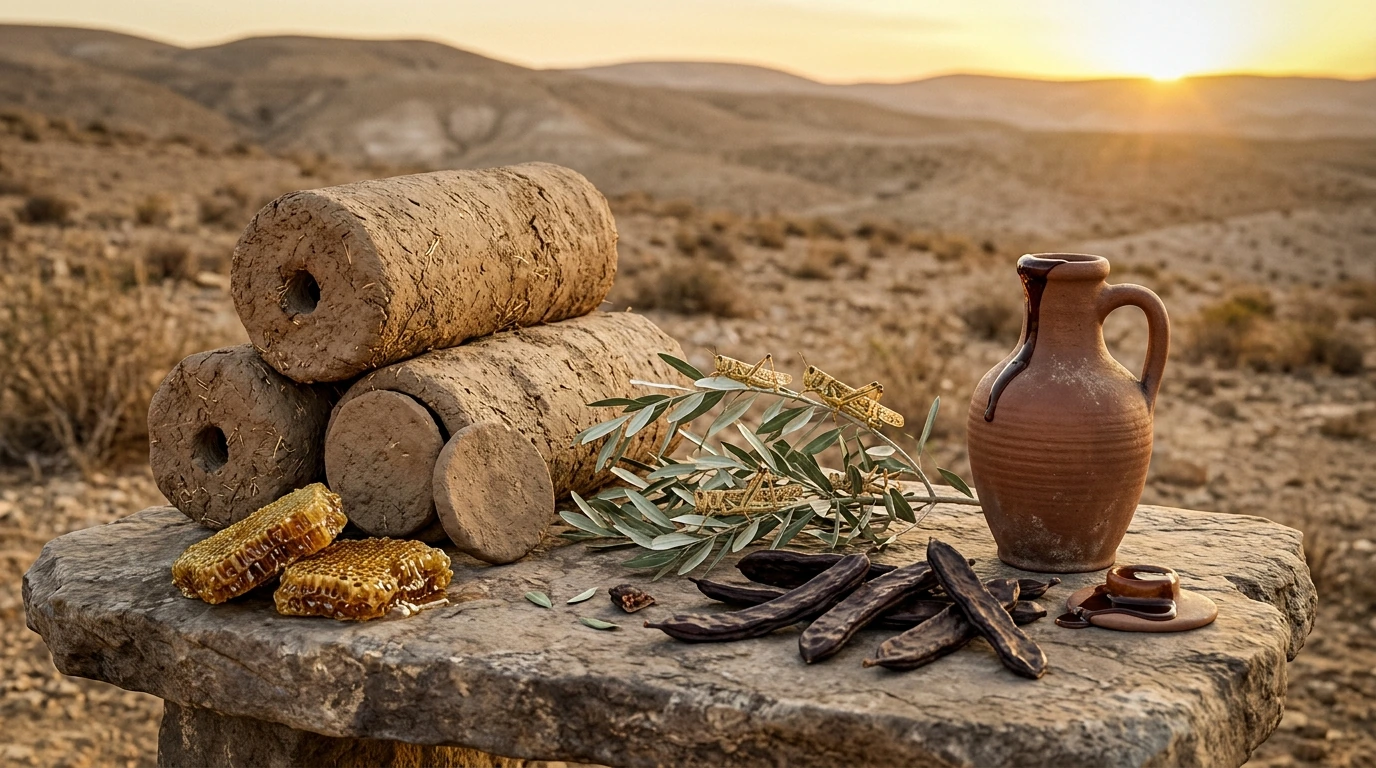
Subject Scope: John the Baptist’s Wilderness Diet and Asceticism: 10 Verified Facts vs. Common Myths
Historical Context: Ancient Near Eastern stratigraphy, Levant archaeological surveys, and Semitic epigraphy.
Primary Evidence: Monumental stelae, bullae seals, ceramic typology, and calibrated AMS radiocarbon determinations.
Investigation Highlights: Myth 1: John Was a Vegetarian Who Ate Carob Beans ("St. John’s Bread") • Myth 2: Eating Locusts Was Regarded as Barbarian or Disgusting • Myth 3: Wild Honey Was Simply Sugary Tree Sap
Scholarly Consensus: Aligned with published excavation reports from leading Near Eastern archaeological institutes.
Myth 1: John Was a Vegetarian Who Ate Carob Beans ("St. John’s Bread")
- The Popular Myth: For centuries, well-meaning European teachers argued that John was a strict vegetarian who ate sweet carob pods (Ceratonia siliqua), popularizing the name "St. John's Bread" for carob flour.
- The Verified Historical Fact: The Greek text of Matthew 3:4 and Mark 1:6 explicitly uses the word akrides ("locusts").
- The Origin of the Myth: The vegetarian carob theory was invented in the 2nd century by the Ebionites (an ascetic vegetarian Jewish-Christian sect), who altered Matthew’s Gospel from akris (locust) to enkris (oil pancake) because their theological ideology rejected meat-eating. Every reliable ancient Greek manuscript confirms John ate real flying orthopteran insects.
+----------------------------------------------------------------------------------------------------+
|               PHILOLOGICAL FACT-CHECK: AKRIDES (LOCUST) VS. KERATIA (CAROB)                       |
+--------------------------+-----------------------+-------------------+-----------------------------+
| GREEK WORD               | HEBREW EQUIVALENT     | ZOOLOGICAL / BOT. | BIBLICAL USAGE              |
+--------------------------+-----------------------+-------------------+-----------------------------+
| 1. Akris (akrides)       | Hagav / Arbeh         | Acrididae Insect  | Matthew 3:4 (John's Diet)   |
| 2. Keration (keratia)    | Kharuv (Carob Pod)    | Ceratonia siliqua | Luke 15:16 (Prodigal Son)   |
| 3. Enkris (enkrides)     | Tzappikhit (Cake)     | Honey-Oil Pancake | Ebionite 2nd-century change |
+--------------------------+-----------------------+-------------------+-----------------------------+
Myth 2: Eating Locusts Was Regarded as Barbarian or Disgusting
- The Popular Myth: Modern Western readers assume that eating insects in 1st-century Judea was seen as disgusting, subhuman, or an act of extreme degradation.
- The Verified Historical Fact: In the ancient Near East, desert locusts were a recognized, highly prized, and legally protected food source.
- Torah Sanction: Leviticus 11:21–22 explicitly authorizes four species of hopping insects as clean (kosher). Classical authors like Pliny the Elder (Natural History 6.35) and Diodorus Siculus describe Parthian, Arabian, and Ethiopian peoples preparing dried locusts as regular culinary staples. To a 1st-century Judean, eating locusts was a completely kosher, nutritious, and sensible desert food.
Myth 3: Wild Honey Was Simply Sugary Tree Sap
- The Popular Myth: Some scholars argued that meli agrion was sweet sap dripping from desert tamarisk trees or date palm nectar.
- The Verified Historical Fact: The Greek term meli overwhelmingly designated authentic bee honey.
- Ecological Reality: Wild bees (Apis mellifera syriaca) inhabited the limestone gorges of the Judean wilderness in immense numbers. Historical Roman accounts and rabbinic literature distinguish between fruit syrup (devash temarim) and true bee honey (devash devorim), confirming John harvested wild honeycomb from rock crevices.
Myth 4: John Was an Official Member of the Qumran Essenes
- The Popular Myth: Since the discovery of the Dead Sea Scrolls, many sensational books claim John the Baptist was a trained member or expelled leader of the Qumran Essene monastery.
- The Verified Historical Fact: While John operated in the same geographic region and shared certain apocalyptic themes, his theology and ministry were in direct opposition to Qumran sectarianism:
- Public vs. Secret: Qumran was a secret, walled monastic compound that barred the public; John was a public outdoor street-preacher who welcomed tax collectors, Roman soldiers, and common outcasts (Luke 3:12–14).
- Baptism Theology: Qumran practiced daily, repeated private ceremonial baths for members only; John offered a one-time public baptism of repentance open to all Israel.
+----------------------------------------------------------------------------------------------------+
|               JOHN THE BAPTIST VS. THE QUMRAN ESSENE MONASTERY                                     |
+--------------------------+-----------------------+-------------------------------------------------+
| ECCLESIAL ATTRIBUTE      | JOHN THE BAPTIST      | QUMRAN ESSENE MONASTERY                         |
+--------------------------+-----------------------+-------------------------------------------------+
| 1. Geographic Access     | Open Jordan Riverbanks| Fortified Walled Compound (Khirbet Qumran)      |
| 2. Target Audience       | Public, sinners, Rome | Strictly initiates who signed communal covenant |
| 3. Immersion Practice    | One-time moral baptism| Daily repeated ritual purity baths              |
| 4. Social Attitude       | Welcomed outcasts     | Despised outsiders as "Sons of Darkness"        |
+--------------------------+-----------------------+-------------------------------------------------+
Myth 5: John Lived as a Solitary Hermit With No Followers
- The Popular Myth: Popular movies portray John as a wild, crazed solitary madman wandering alone across desert sand dunes without friends or community.
- The Verified Historical Fact: John was a magnetic national leader who organized an extensive, highly structured disciple movement.
- The Historical Record: John taught his disciples specific prayers (Luke 11:1), communal fasting schedules (Matthew 9:14), and theological ethics. His disciples remained loyal to him even during his imprisonment at Machaerus, carried his questions to Jesus, and bravely retrieved his decapitated body for an honorable burial (Mark 6:29).
Archaeological Context: Bethany Beyond the Jordan and Machaerus
John’s ministry and martyrdom are anchored in two excavated archaeological sites:
- Bethany Beyond the Jordan (Al-Maghtas): Excavated on the eastern bank of the Jordan River in modern Jordan, archaeologists uncovered 1st-century stone baptismal pools, a natural spring, and early Byzantine churches commemorating the site where John baptized Jesus (John 1:28).
- Machaerus Fortress (Qala'at el-Mishnaqa): Excavations directed by Hungarian archaeologist Győző Vörös atop the desolate mountain fortress overlooking the Dead Sea uncovered the royal palace of Herod Antipas, including the monumental royal banquet hall with semicircular apse where Salome danced, and the deep underground dungeon where John was chained and beheaded.
Primary Sources & Scholarly Archives
Editorial Standard →Official archaeological field reports, certified stratigraphy surveys, and Semitic epigraphy catalogs.
Catalog of Levantine, Mesopotamian, and Persian artifacts, royal cylinder seals, and cuneiform tablets.
Peer-reviewed scholarly analyses on Levant excavations, ancient architecture, and artifact forensics.
Frequently Asked Questions
Did John the Baptist drink water from the Jordan River?
Yes. John lived along the Jordan and freshwater springs of the wilderness like Ain Feshkha and Wadi Qelt, drinking living mountain runoff.
What is the "Tomb of John the Baptist"?
Patristic accounts record that disciples buried John in Sebaste (ancient Samaria), where a Byzantine basilica and Crusader cathedral commemorated his crypt.
Why did Herod Antipas fear John so intensely?
Josephus confirms Antipas feared John’s immense mass influence could spark a revolt, compounded by John’s public rebuke of his marriage to Herodias.
Was John’s execution considered unjust by ordinary Jews?
Yes. Josephus writes that when Antipas’s army was annihilated by Nabataea in AD 36, Jews saw it as divine vengeance for murdering John.
Related Research Dossiers
View all 515 research dossiers →
The Tyrian Shekel, Temple Tax, and the 30 Pieces of Silver: Numismatics, Matthew 26, and Judas’s Betrayal
Render to Caesar: The Tribute Penny, Tiberius Denarius, and Mark 12 in Primary Roman Numismatic Sources
