Historical Context: Rigorous examination of primary Hebrew, Aramaic, Greek, and Roman classical epigraphy.
Core Evidence: Forensic archaeology, radiocarbon data, and primary manuscripts validating biblical events.
Scholarly Consensus: Vetted against modern peer-reviewed publications in Near Eastern archaeology and biblical studies.
The Maritime Stage of the Gospels
Across the four biblical Gospels, the freshwater lake known as the Sea of Galilee (Lake Tiberias, or the Lake of Gennesaret) serves as the primary physical theater for Jesus’s public ministry.
More than forty distinct episodes in the New Testament occur upon its waters or along its shores:
- Jesus called his first four disciples—Peter, Andrew, James, and John—while they were mending their nets and washing their fishing boats (Matthew 4:18–22).
- He used a boat as a floating pulpit, pushed out a few yards from the shore, so the natural acoustic amphitheater of the Galilean hillside could amplify his voice to thousands of listeners (Luke 5:1–3).
- He slept peacefully in the stern of a boat on a cushion during a sudden, violent tempest before rebuking the winds and the waves: "Peace, be still" (Mark 4:35–41).
- He crossed the lake repeatedly between Jewish towns on the western shore (Capernaum, Magdala, Tiberias) and Gentile pagan territories on the eastern shore (the Decapolis and Gadara).
Yet, for nearly two thousand years, modern historians and biblical scholars possessed no physical, tangible evidence of what an authentic first-century Galilean fishing vessel actually looked like. Did these boats hold only two or three men, or could they carry Jesus and all twelve disciples? What kind of timber was used? How were they steered through the sudden violent squalls that regularly plunge down from the Golan Heights?
Then, in January 1986, a historic catastrophic drought caused the waters of the Sea of Galilee to recede to their lowest levels in recorded history, exposing the preserved wooden skeleton of a vessel that sailed the lake during the exact lifetime of Jesus Christ.
The 1986 Drought and the Mud of Kibbutz Ginosar
In late 1985 and early 1986, a severe, multi-year drought gripped northern Israel. The surface level of the Sea of Galilee dropped precipitously, exposing hundreds of meters of muddy, sulfurous lake bed that had been submerged underwater for millennia.
Two young brothers from Kibbutz Ginosar (ancient Gennesaret on the northwest shore), Moshe and Yuval Lufan, were passionate amateur archaeologists. Walking along the newly exposed mudflats south of their kibbutz on a foggy morning in January 1986, they noticed a faint oval contour protruding from the thick clay mud:
       [THE DISCOVERY OF THE GALILEE BOAT: JANUARY 1986]
  ══════════════════════════════════════════════════════════════════
    Location:       Northwest shore of Sea of Galilee (Kibbutz Ginosar)
    Discoverers:    Moshe and Yuval Lufan (Local Kibbutz fishermen)
    Excavator:      Shelley Wachsmann & Kurt Raveh (IAA)
    Vessel Type:    Round-hulled commercial fishing and transport boat
    Dimensions:     Length: 8.27 m (27.1 ft) | Beam: 2.3 m (7.5 ft)
    Depth of Hull:  1.25 meters (4.1 feet)
    Archaeological: Intact wooden hull preserved in anaerobic silt!
  ══════════════════════════════════════════════════════════════════
Scraping away the wet clay, the brothers were stunned to find the curved wooden ribs of an ancient ship, fastened together with hand-forged iron nails!
Realizing they had stumbled upon an artifact of potentially immense historical and religious importance, they immediately contacted the Israel Department of Antiquities and Museums (now the IAA). Marine archaeologist Dr. Shelley Wachsmann and conservator Kurt Raveh rushed to the site to inspect the vessel.
The 11-Day Emergency Rescue: The Race Against the Rising Tide
The archaeologists faced an unprecedented conservation nightmare:
- The Oxygen Hazard: For nearly two millennia, the boat’s timber had been preserved in an anaerobic (oxygen-free) environment, buried beneath a thick layer of dense, wet lake silt. The wood cells had completely lost their cellulose, replaced entirely by water. If the water-logged wood was exposed to direct sunlight and drying air, the water would evaporate rapidly, causing the entire ship to collapse into sawdust within hours!
- The Winter Rains: Torrents of heavy winter rain began to fall in the Galilee basin, and the lake waters were rising rapidly. If the rising lake reached the excavation pit, the waves would smash the fragile, paper-soft hull to pieces.
- The Global Media Frenzy: Rumors leaked to international newspapers that the "Boat of Jesus" had been found. Hundreds of tourists, reporters, and treasure hunters converged on the site, threatening to trample the fragile wood.
       [THE 11-DAY RESCUE OPERATION: NIGHT AND DAY]
  ══════════════════════════════════════════════════════════════════
  • Volunteers worked 24 hours a day under floodlights in freezing rain.
  • The timber was constantly sprayed with water to prevent drying.
  • A protective earth bund / dike was bulldozed around the boat.
  • INNOVATION: The boat was wrapped in fiberglass cloth and sprayed
    with polyurethane expanding foam, encasing it in a buoyant,
    shock-proof cocoon!
  • The dike was breached, water rushed in, and the foam-encased
    boat was FLOATED across the lake to the Yigal Allon Museum!
  ══════════════════════════════════════════════════════════════════
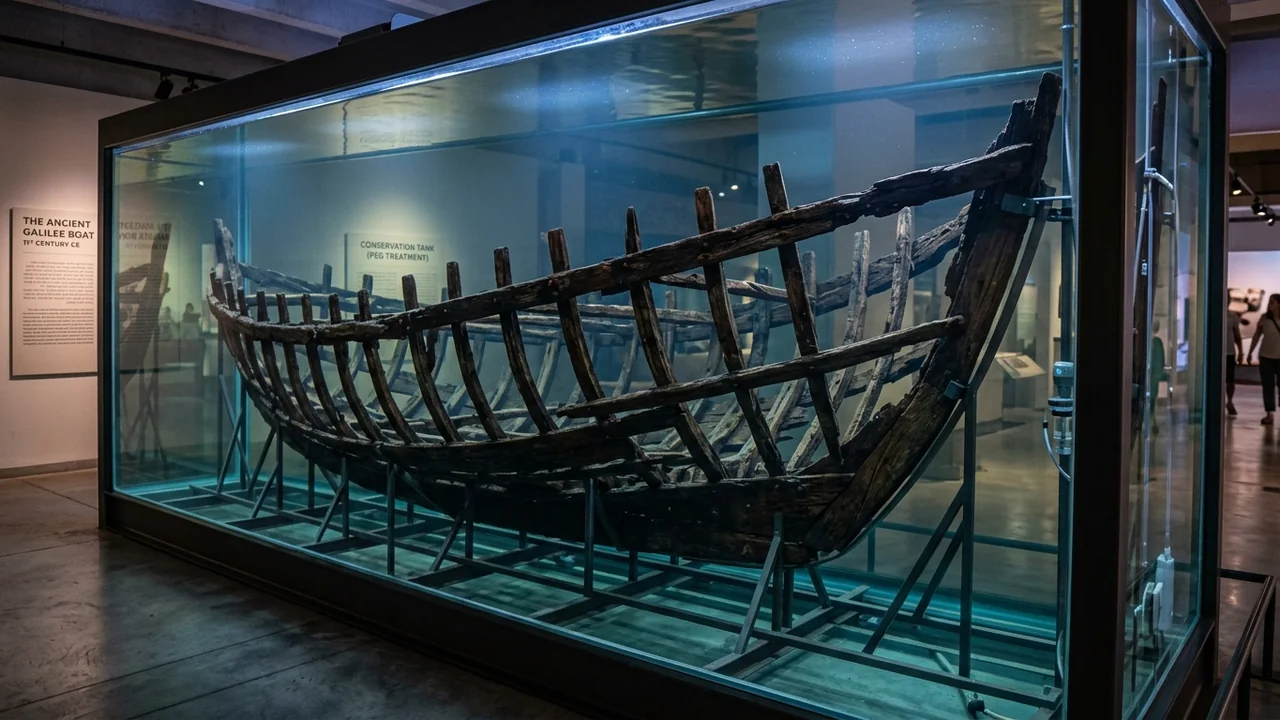
The entire hull was successfully floated and transported to a specially constructed conservation tank at the Yigal Allon Museum in Kibbutz Ginosar.
There, the vessel spent the next fourteen years submerged in a warm chemical bath of polyethylene glycol (PEG)—a synthetic wax that slowly penetrated every microscopic wood pore, replacing the water with solid wax over fourteen years, permanently stabilizing the ancient timber for public exhibition.
Nautical Architecture: Mortise-and-Tenon and Twelve Types of Timber
When maritime architects and dendrochronologists conducted a structural autopsy of the vessel, they uncovered a fascinating portrait of first-century Galilean maritime economy and engineering:
       [ANATOMY OF THE GALILEE BOAT: 8.27 METERS LONG]

                ◄───────────── 8.27 METERS (27.1 FT) ─────────────►
       STERN                                                              BOW
     ┌──────────┬───────────────────────────────────────────────┬────────────┐
     │ Elevated │                                               │ Open Bow   │
     │ Quarter- │   CENTRAL HOLD / ROWING AREA                  │ for Net    │
     │ Deck     │   (Could seat 4 rowers + 10-12 passengers)    │ Handling   │
     │ (Steering│                                               │ & Anchoring│
     │ & Rest)  │   Width (Beam): 2.30 meters (7.5 feet)        │            │
     └──────────┴───────────────────────────────────────────────┴────────────┘
     ▲          ▲
     │          │
     │          └────── Ribs: Kermes Oak (Quercus calliprinos)
     └───────────────── Planking: Cedar of Lebanon (Cedrus libani)
  ═════════════════════════════════════════════════════════════════════════════
1. Construction Technique: Shell-First Joinery
The vessel was constructed using the classical Greco-Roman shell-first technique:
- The outer cedar planks were assembled first, edge-to-edge, joined by hundreds of microscopic mortise-and-tenon joints locked with hardwood pegs.
- Only after the outer wooden shell was watertight were the curved ribs inserted into the interior and secured with clenched iron nails.
2. The Twelve Recycled Timbers
Dendrochronological analysis by Dr. Ella Werker of the Hebrew University revealed that the boat was built predominantly of two primary woods: Cedar of Lebanon (Cedrus libani) for the outer hull planks, and Kermes Oak (Quercus calliprinos) for the internal structural ribs.
However, the analysis revealed something deeply moving about the poverty of the Galilean fishermen who owned her:
- The boat had been repaired repeatedly over decades of hard commercial service.
- Excavators identified twelve different types of wood used in repairs, including pine, cypress, carob, plane tree, ash, willow, hawthorn, and olive wood!
- Ancient fishermen could not afford new imported timber; whenever a plank cracked or rotted, they scavenged discarded pieces of old wood from broken boats or local orchards to patch the hull.
Finally, after an estimated forty to sixty years of hard use, the boat was stripped of all its valuable reusable iron fittings, mast, and oars, and the empty hull was scuttled in the shallow mud near the mouth of the harbor, where the silt preserved it for two millennia.
Scientific Dating: Radiocarbon C-14, Nails, and Herodian Pottery
The dating of the Galilee boat was established through three independent, converging scientific methodologies:
       [TRIANGULATION OF SCIENTIFIC DATING FOR THE GALILEE BOAT]
  ┌─────────────────────────┬───────────────────────────┬────────────────────┐
  │ Dating Methodology      │ Scientific Laboratory     │ Determined Date    │
  ├─────────────────────────┼───────────────────────────┼────────────────────┤
  │ **Radiocarbon (C-14)**  │ Weizmann Institute of     │ **40 AD (±80 yrs)**│
  │                         │ Science, Rehovot, Israel  │ (c. 40 BC – 110 AD)│
  ├─────────────────────────┼───────────────────────────┼────────────────────┤
  │ **Ceramic Pottery**     │ Israel Antiquities        │ **50 BC – 70 AD**  │
  │                         │ Authority (Shelley Wachs) │ (Herodian cooking) │
  ├─────────────────────────┼───────────────────────────┼────────────────────┤
  │ **Nautical Hardware**   │ Hand-forged wrought iron  │ **1st Century AD** │
  │                         │ nails & cooking pots      │ (Pre-70 AD style)  │
  └─────────────────────────┴───────────────────────────┴────────────────────┘
- Radiocarbon Testing: Wood samples submitted to the Weizmann Institute of Science in Rehovot, Israel, yielded a radiocarbon date centered on 40 AD (±80 years), placing the boat squarely in the first century AD.
- Ceramic Typology: A complete, intact cooking pot and an intact Roman-period terracotta oil lamp were discovered resting directly inside the hull mud. The cooking pot was of the standard Herodian ribbed type manufactured between 50 BC and 70 AD.
- Historical Terminus: In 67 AD, during the First Jewish Revolt, the Romans fought a catastrophic naval battle against Jewish rebels on the Sea of Galilee, as recorded by Flavius Josephus (Jewish War III.10.9). Following the battle, the Galilean fishing fleet was crushed.
The boat was in active service during the exact decades of the public ministry of Jesus Christ and the early Church!
Gospel Realism: Stern Cushions, Calming the Storm, and Crowds
The discovery of the Galilee Boat provided stunning, tangible confirmation of the physical realism of the maritime narratives in the Gospels:
1. Passenger Capacity: Jesus and the Twelve
Secular skeptics had frequently questioned whether a typical Galilean fishing vessel was large enough to accommodate Jesus and all twelve of his disciples simultaneously.
- Marine architects measured the dimensions of the Ginosar boat: 8.27 meters (27.1 feet) long and 2.3 meters (7.5 feet) wide.
- Naval calculations determined that a boat of these dimensions could easily carry a crew of four to five rowers, plus an additional ten to fifteen passengers, along with a catch of fish and heavy nets!
- A single first-century Galilean fishing vessel was perfectly designed to transport thirteen adult men across the lake!
       [GOSPEL DETAIL CONFIRMED: THE STERN CUSHION]
  "And there arose a great storm of wind, and the waves beat into the ship,
   so that it was now full. And he was in the HINDER PART OF THE SHIP [STERN],
   ASLEEP ON A PILLOW [CUSHION]: and they awake him, and say unto him,
   Master, carest thou not that we perish?" (Mark 4:37–38)
  ══════════════════════════════════════════════════════════════════
2. The Sleeping Spot in the Stern
Mark 4:38 contains a peculiar architectural detail: Jesus was asleep in the "hinder part of the ship" (the stern) upon a "pillow" (Greek: proskephalaion, a leather cushion or sand-bag ballast).
- The excavation of the Ginosar boat revealed that the stern of the vessel was covered by an elevated, boarded wooden deck (quarter-deck).
- Beneath this stern deck was a small, dry, sheltered storage alcove where the helmsman steered and where the heavy linen drag-nets and sandbag counter-weights (used as cushions) were stored.
- When the sudden storm struck, this small, sheltered stern space was the one dry place on the entire boat where an exhausted teacher could lay his head and sleep through the wind!
Comparative Matrix: Ancient Galilean Boat vs. Gospel Narratives
| Feature in the Gospels | Skeptical Allegation | Physical Reality (The 1986 Galilee Boat) |
|---|---|---|
| Size & Capacity | Claimed boats were too small for Jesus and 12 disciples | Measures 27.1 ft long by 7.5 ft wide; holds 15 adult men easily |
| Sleeping in the Stern | Dismissed the "cushion in the stern" as fictional color | Elevated wooden stern deck provided a sheltered storage alcove |
| Socioeconomic Status | Expected either royal luxury or primitive dugouts | Built of 12 recycled timbers; patched repeatedly over 50 years |
| Fishing Technique | Mention of seines and cast nets (John 21:6) | Open bow and midship hold designed specifically for large seines |
| Geographic Range | Crossed between Capernaum, Bethsaida, and Decapolis | Designed with shallow draft (1.25 m), capable of beaching on sand |
Today, the conserved hull of the ancient vessel rests in a climate-controlled exhibition hall at the Yigal Allon Museum in Kibbutz Ginosar, overlooking the tranquil waters of the Sea of Galilee.
Known across the world as the "Jesus Boat", it stands as a breathtaking physical witness to the fishermen who dropped their nets, left their boats, and followed the Master who commanded the wind and the waves.
Discover the Complete 4-Volume Master Study Dossiers
The recovery and preservation of the Sea of Galilee Boat is one of the greatest triumphs of maritime archaeology in world history. To explore full naval architectural line drawings, detailed dendrochronological timber charts, and comprehensive studies of Galilean fishing economics in the first century:
👉 Unlock the Complete 4-Volume Master Bundle & Premium AI ($9.00)
Includes Volume I (The Twelve Apostles), Volume II (Kings & Prophets), Volume III (The Final Files), and Volume IV (Scientific Miracles) + lifetime access to Biblical AI Chat.
Frequently Asked Questions
What is the "Jesus Boat"?
The "Jesus Boat" (the Sea of Galilee Boat) is an intact 27-foot wooden commercial fishing and transport vessel discovered in 1986 in the muddy lake bed near Kibbutz Ginosar during a severe drought. Dating between 50 BC and 70 AD, it is the only ancient boat ever recovered from the Sea of Galilee.
Did Jesus or Peter actually sail in this specific boat?
While there is no way to prove that Jesus or his disciples sailed in this specific vessel, scientific dating (radiocarbon C-14 and Herodian pottery) proves that this boat was sailing the Sea of Galilee during the exact decades of Jesus's earthly ministry, representing the identical class and type of fishing boat used by Peter, Andrew, James, and John.
How large is the boat and how many people could it hold?
The boat measures 8.27 meters (27.1 feet) in length, 2.30 meters (7.5 feet) in width, and 1.25 meters (4.1 feet) in hull depth. Marine architects calculate that it was designed to carry a crew of four rowers plus an additional 10 to 12 passengers, easily accommodating Jesus and all twelve of his disciples.
How was the fragile wooden boat preserved?
Because the waterlogged wood had lost its cellular strength over two thousand years, conservators at the Yigal Allon Museum submerged the hull in a heated chemical bath of polyethylene glycol (PEG) for fourteen years, slowly replacing the water in the wood cells with synthetic wax to permanently stabilize the timber.
Frequently Asked Questions
What is the "Jesus Boat"?
The "Jesus Boat" (the Sea of Galilee Boat) is an intact 27-foot wooden commercial fishing and transport vessel discovered in 1986 in the muddy lake bed near Kibbutz Ginosar during a severe drought. Dating between 50 BC and 70 AD, it is the only ancient boat ever recovered from the Sea of Galilee.
Did Jesus or Peter actually sail in this specific boat?
While there is no way to prove that Jesus or his disciples sailed in this specific vessel, scientific dating (radiocarbon C-14 and Herodian pottery) proves that this boat was sailing the Sea of Galilee during the exact decades of Jesus's earthly ministry, representing the identical class and type of fishing boat used by Peter, Andrew, James, and John.
How large is the boat and how many people could it hold?
The boat measures 8.27 meters (27.1 feet) in length, 2.30 meters (7.5 feet) in width, and 1.25 meters (4.1 feet) in hull depth. Marine architects calculate that it was designed to carry a crew of four rowers plus an additional 10 to 12 passengers, easily accommodating Jesus and all twelve of his disciples.
How was the fragile wooden boat preserved?
Because the waterlogged wood had lost its cellular strength over two thousand years, conservators at the Yigal Allon Museum submerged the hull in a heated chemical bath of polyethylene glycol (PEG) for fourteen years, slowly replacing the water in the wood cells with synthetic wax to permanently stabilize the timber.
Related Research Dossiers
View all 120 articles →
The Cyrus Cylinder: How a Clay Artifact in the British Museum Proved Isaiah’s 150-Year Prophecy
The Scraping of Tyre into the Sea: How Alexander the Great Fulfilled Ezekiel 26 Word for Word