Historical Context: Rigorous examination of primary Hebrew, Aramaic, Greek, and Roman classical epigraphy.
Core Evidence: Forensic archaeology, radiocarbon data, and primary manuscripts validating biblical events.
Scholarly Consensus: Vetted against modern peer-reviewed publications in Near Eastern archaeology and biblical studies.
The Tragic Fate of the Last Kings of Judah
In the grim twilight of the Kingdom of Judah, the royal dynasty of David collapsed under the relentless hammer of the Neo-Babylonian Empire. In 597 BC, King Nebuchadnezzar II marched his armies westward to Jerusalem to crush a rebellion initiated by King Jehoiakim.
By the time the Babylonian forces encircled the holy city, Jehoiakim had died, leaving his eighteen-year-old son, Jehoiachin (also called Jeconiah or Coniah), on the throne. Realizing that resistance was futile against the Babylonian siege engines, the young king made a desperate political surrender:
"And Jehoiachin the king of Judah went out to the king of Babylon, he, and his mother, and his servants, and his princes, and his officers: and the king of Babylon took him in the eighth year of his reign. And he carried out thence all the treasures of the house of the LORD... and carried away all Jerusalem, and all the princes, and all the mighty men of valour, even ten thousand captives... and Jehoiachin he carried away to Babylon." (2 Kings 24:12–15)
Nebuchadnezzar placed Jehoiachin’s uncle, Zedekiah, upon the throne as a vassal puppet. Ten years later, when Zedekiah rebelled, Nebuchadnezzar returned, pulverized Jerusalem to ash, slaughtered Zedekiah's sons before his eyes, blinded him, and dragged him in bronze chains to Babylon (586 BC).
For the Jewish exiles weeping by the rivers of Babylon (Psalm 137), the Davidic covenant seemed extinguished forever. What became of the young captive King Jehoiachin languishing inside the imperial prisons of Mesopotamia?
The Scriptural Narrative in 2 Kings 25:27–30
The final, unexpected paragraph of the Second Book of Kings concludes not with despair, but with a startling historical footnote describing the elevation of the imprisoned Jewish monarch thirty-seven years into his captivity:
"And it came to pass in the seven and thirtieth year of the captivity of Jehoiachin king of Judah, in the twelfth month, on the seven and twentieth day of the month, that Evilmerodach king of Babylon in the year that he began to reign did lift up the head of Jehoiachin king of Judah out of prison;
And he spake kindly to him, and set his throne above the throne of the kings that were with him in Babylon; And changed his prison garments: and he did eat bread continually before him all the days of his life. And his allowance was a continual allowance given him of the king, a daily rate for every day, all the days of his life." (2 Kings 25:27–30)
For generations, nineteenth-century rationalists viewed this passage with cynical suspicion:
- Skeptics claimed that ancient oriental despots never released defeated foreign monarchs from maximum-security confinement to dine at the royal banquet table.
- Critics alleged that the specific details regarding "a continual allowance... a daily rate for every day" was a pious Jewish fable invented to preserve hope for the Messianic lineage of the House of David.
- Secular historians demanded contemporary extrabiblical proof: where were the official records of the Babylonian royal court recording these daily food allowances?
Between 1899 and 1939, deep within the imperial administrative archives of ancient Babylon, the clay receipts of King Nebuchadnezzar’s royal quartermaster were brought to light.
Robert Koldewey’s Excavations at Babylon (1899–1917)
From 1899 until the British capture of Baghdad during World War I in 1917, German architect and archaeologist Robert Koldewey directed monumental, pioneering excavations of ancient Babylon on behalf of the Deutsche Orient-Gesellschaft (German Oriental Society).
Koldewey systematically excavated the colossal architectural wonders of Nebuchadnezzar's capital:
- The monumental processional way lined with glazed blue relief bricks depicting roaring lions and dragons.
- The legendary Ishtar Gate.
- The sprawling royal citadel complex known as the Southern Palace (Südburg).
       [THE EXCAVATIONS AT BABYLON: SOUTHERN PALACE]
  ══════════════════════════════════════════════════════════════════
    Location:       Southern Palace (Südburg), Babylon (Babil, Iraq)
    Director:       Dr. Robert Koldewey (Deutsche Orient-Gesellschaft)
    Key Structure:  Vaulted Subterranean Building (Archivkeller)
    Location:       Immediately adjacent to the Ishtar Gate
    Discovery Date: Excavated between 1900 and 1904
    Artifacts:      Over 300 cuneiform administrative clay tablets
    Decipherment:   Dr. Ernst F. Weidner (Published in 1939)
  ══════════════════════════════════════════════════════════════════
The Vaulted Subterranean Building Near the Ishtar Gate
In the northeast corner of the Southern Palace, directly adjacent to the Ishtar Gate, Koldewey excavated an enigmatic subterranean structure consisting of fourteen barrel-vaulted stone underground chambers arranged in two parallel rows:
       [GROUND PLAN: THE VAULTED UNDERGROUND ARCHIVE OF BABYLON]

                ◄──────────── PROCESSIONAL WAY ────────────►
     ┌─────────────────────────────────────────────────────────────┐
     │                    THE ISHTAR GATE                          │
     └──────────────────────────────┬──────────────────────────────┘
                                    │
                                    ▼
     ┌─────────────────────────────────────────────────────────────┐
     │ THE VAULTED BUILDING (UNDERGROUND ROYAL PALACE STORES)      │
     │ ┌─────────┬─────────┬─────────┬─────────┬─────────┬───────┐ │
     │ │ Vault 1 │ Vault 2 │ Vault 3 │ Vault 4 │ Vault 5 │ ...   │ │
     │ ├─────────┼─────────┼─────────┼─────────┼─────────┼───────┤ │
     │ │ Vault 8 │ Vault 9 │ Vault 10│ Vault 11│ Vault 12│ ...   │ │
     │ └─────────┴─────────┴─────────┴─────────┴─────────┴───────┘ │
     │ Contains: Royal Oil Reservoirs, Grain Silos, and THE        │
     │ ROYAL QUARTERMASTER CUNEIFORM RATION RECEIPTS!             │
     └─────────────────────────────────────────────────────────────┘
  ══════════════════════════════════════════════════════════════════
Initially, Koldewey hypothesized that this subterranean complex was the foundation of the legendary "Hanging Gardens of Babylon".
However, further excavation revealed its true mundane, administrative purpose: it was the central royal commissary and provision storehouse of the Babylonian palace! Here, thousands of gallons of pure sesame oil, dates, barley, and wine were stored to supply the palace staff, royal guards, foreign diplomats, and high-status captive royal prisoners living under the custody of the crown.
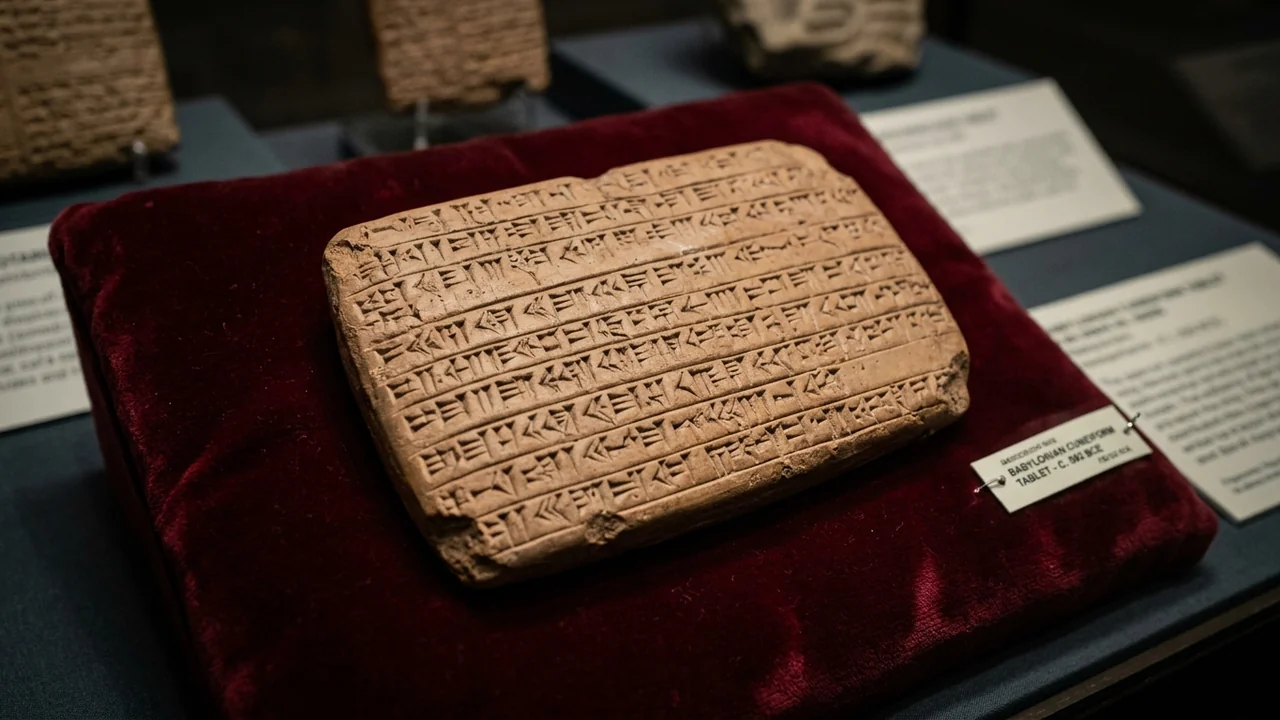
Buried within the silt of these vaulted cellars, excavators uncovered a cache of more than three hundred cuneiform clay tablets, recording the day-to-day administrative deliveries of rations authorized by Nebuchadnezzar's palace stewards between 595 BC and 569 BC.
Epigraphic Autopsy: Deciphering the Cuneiform Script
The fragile clay tablets were shipped to Berlin and deposited in the Vorderasiatisches Museum (Pergamon Museum).
Because of the massive volume of inscriptions recovered during the German excavations, the tablets sat untranslated for over three decades until Austrian Assyriologist Dr. Ernst F. Weidner began a systematic decipherment in the late 1930s.
In 1939, Weidner published a landmark academic monograph titled Jojachin, König von Juda, in babylonischen Keilschrifttexten ("Jehoiachin, King of Judah, in Babylonian Cuneiform Texts").
Weidner identified four distinct cuneiform tablets (designated in museum catalogs as Babylon 28122, Babylon 28178, Babylon 28186, and Babylon 28188) that recorded food rations delivered to foreign captive kings:
                 [THE BABYLONIAN CUNEIFORM INSCRIPTION: WEIDNER TABLET]

      LINE 1:   ...10 (SILA) I.GIS a-na Ia-'-u-kinu
      LINE 2:   sar (MAT) Ia-a-hu-du
      LINE 3:   2 1/2 SILA a-na 5 marani-su sa sar (MAT) Ia-a-hu-du
      LINE 4:   1/2 SILA a-na 8 amelu Ia-a-hu-da-a-a...

  ══════════════════════════════════════════════════════════════════
  ENGLISH TRANSLATION:
  "10 sila of oil to IA-'-U-KINU, KING OF THE LAND OF JUDAH [YAHUD];
   2 1/2 sila of oil to the FIVE SONS of the King of the land of Judah;
   1/2 sila of oil to the eight men of Judah..."
  ══════════════════════════════════════════════════════════════════
                  [TRANSCRIPTION OF CRITICAL AKKADIAN TERMS]
  Ia-'-u-kinu:      The exact Babylonian cuneiform rendering of Hebrew JEHOIACHIN
  sar:              Akkadian cuneiform logogram for "KING" (LUGAL)
  MAT Ia-a-hu-du:   "The Land of Judah" (Akkadian phonetic equivalent)
  marani-su:        "His sons" (Confirms Jehoiachin had five sons with him in Babylon!)
  sila:             Babylonian volumetric unit of liquid measurement (~0.85 liters)
The Name on the Clay: Ia-’-u-kinu, King of Judah
The historic impact of these four small clay receipts cannot be overstated:
1. Direct Extrabiblical Proof of King Jehoiachin
The tablet explicitly names Ia-'-u-kinu (Jehoiachin), identifying his royal title as sar (MAT) Ia-a-hu-du—"King of the Land of Judah"!
- Even though Nebuchadnezzar had installed Zedekiah on the throne in Jerusalem, the official imperial administrative records of Babylon never recognized Zedekiah as the legitimate monarch.
- To the Babylonian royal chancery, Jehoiachin remained the de jure, legal King of Judah!
2. Physical Verification of Royal Food Allowances
2 Kings 25:30 explicitly states that Jehoiachin received "a continual allowance given him of the king, a daily rate for every day, all the days of his life."
- The cuneiform tablets excavated in Babylon are the actual, physical accounting receipts for these very rations!
- Jehoiachin was allocated 10 sila of oil (approximately 8.5 liters or 2.25 gallons of high-grade sesame oil), an extraordinarily generous ration far exceeding the sustenance requirements of an ordinary prisoner, confirming his elevated aristocratic status as a royal guest in the Babylonian palace.
3. The Five Sons of Jehoiachin
The tablets note that rations were distributed to the "five sons of the king of the land of Judah".
- 1 Chronicles 3:17–18 records the genealogy of the captive king: "And the sons of Jeconiah; Assir, Salathiel his son, Malchiram also, and Pedaiah, and Shenazar, Jecamiah, Hoshama, and Nedabiah."
- The cuneiform record confirms that while in captivity in Babylon, Jehoiachin fathered multiple sons who shared in his royal provisions!
Comparative Historical Chronology: Babylon vs. Scripture
The administrative receipts recovered from the ruins of Babylon synchronize seamlessly with the biblical narrative:
| Chronological & Historical Metric | Biblical Testimony (2 Kings & Jeremiah) | Babylonian Cuneiform Record (Weidner Tablets) |
|---|---|---|
| Royal Identity | Jehoiachin, son of Jehoiakim, King of Judah | Ia-'-u-kinu, sar (MAT) Ia-a-hu-du (King of Judah) |
| Historical Location | Exiled as royal captive to Babylon (2 Kings 24:15) | Resident in Southern Palace near Ishtar Gate, Babylon |
| Date of Administrative Record | Exiled in 597 BC; released by Evil-Merodach in 562 BC | Tablets date specifically to 592 BC (13th year of Nebuchadnezzar) |
| Nature of Royal Sustenance | Received "a continual daily allowance from the king" | Official monthly issues of sesame oil and grain rations |
| Familial Household | Accompanied by sons and Judean attendants | Rations issued to his five royal sons and eight Judean elites |
| Sovereignty Recognized | Treated as the rightful Davidic heir in exile | Retained official title "King of Judah" in Babylonian chancery |
The Babylonian Ration Tablets provide airtight, contemporary documentary proof that the historical narratives of 2 Kings are grounded in verifiable archival facts.
Furthermore, they carry profound theological significance: by preserving King Jehoiachin alive in the courts of Babylon and documenting his sons, these clay tablets confirmed that the physical, royal lineage of the House of David survived the fires of the Babylonian exile—preserving the unbroken ancestral chain that led directly to Jesus of Nazareth (Matthew 1:11–12).
Discover the Complete 4-Volume Master Study Dossiers
The discovery of the Jehoiachin Ration Tablets is one of the most stunning archival confirmations of the Old Testament historical books ever unearthed. To explore complete cuneiform transcription plates, detailed architectural blueprints of Robert Koldewey's excavations at the Ishtar Gate, and comprehensive analyses of the Babylonian exile:
👉 Unlock the Complete 4-Volume Master Bundle & Premium AI ($9.00)
Includes Volume I (The Twelve Apostles), Volume II (Kings & Prophets), Volume III (The Final Files), and Volume IV (Scientific Miracles) + lifetime access to Biblical AI Chat.
Frequently Asked Questions
What are the Jehoiachin Ration Tablets?
The Jehoiachin Ration Tablets are four clay administrative cuneiform receipts discovered between 1900 and 1904 by German archaeologist Robert Koldewey in a vaulted underground storage complex near the Ishtar Gate of ancient Babylon. Dating to 592 BC, they record monthly distributions of sesame oil and food to captive foreign royalty, explicitly naming "Jehoiachin, King of Judah."
How do these tablets confirm 2 Kings 25?
In 2 Kings 25:27–30, the biblical text records that the captive King Jehoiachin of Judah was elevated by the king of Babylon and given "a continual allowance... a daily rate for every day, all the days of his life." The cuneiform tablets in Babylon are the actual accounting receipts documenting these royal food allowances.
Why do the Babylonian tablets call him "King of Judah" if Zedekiah was reigning in Jerusalem?
Although Nebuchadnezzar installed Zedekiah on the throne in Jerusalem as a puppet ruler, the official Babylonian imperial records never recognized Zedekiah's legitimacy. In the eyes of the Babylonian royal court, Jehoiachin was the sole legitimate King of Judah, proving the exact historical accuracy of the biblical genealogies.
Where are the Jehoiachin tablets kept today?
The original clay cuneiform tablets are housed in the collection of the Vorderasiatisches Museum (Pergamon Museum) in Berlin, Germany.
Frequently Asked Questions
What are the Jehoiachin Ration Tablets?
The Jehoiachin Ration Tablets are four clay administrative cuneiform receipts discovered between 1900 and 1904 by German archaeologist Robert Koldewey in a vaulted underground storage complex near the Ishtar Gate of ancient Babylon. Dating to 592 BC, they record monthly distributions of sesame oil and food to captive foreign royalty, explicitly naming "Jehoiachin, King of Judah."
How do these tablets confirm 2 Kings 25?
In 2 Kings 25:27–30, the biblical text records that the captive King Jehoiachin of Judah was elevated by the king of Babylon and given "a continual allowance... a daily rate for every day, all the days of his life." The cuneiform tablets in Babylon are the actual accounting receipts documenting these royal food allowances.
Why do the Babylonian tablets call him "King of Judah" if Zedekiah was reigning in Jerusalem?
Although Nebuchadnezzar installed Zedekiah on the throne in Jerusalem as a puppet ruler, the official Babylonian imperial records never recognized Zedekiah's legitimacy. In the eyes of the Babylonian royal court, Jehoiachin was the sole legitimate King of Judah, proving the exact historical accuracy of the biblical genealogies.
Where are the Jehoiachin tablets kept today?
The original clay cuneiform tablets are housed in the collection of the Vorderasiatisches Museum (Pergamon Museum) in Berlin, Germany.
Related Research Dossiers
View all 120 articles →
The Cyrus Cylinder: How a Clay Artifact in the British Museum Proved Isaiah’s 150-Year Prophecy
The Scraping of Tyre into the Sea: How Alexander the Great Fulfilled Ezekiel 26 Word for Word