Historical Context: Rigorous examination of primary Hebrew, Aramaic, Greek, and Roman classical epigraphy.
Core Evidence: Forensic archaeology, radiocarbon data, and primary manuscripts validating biblical events.
Scholarly Consensus: Vetted against modern peer-reviewed publications in Near Eastern archaeology and biblical studies.
The Interregnum of 62 AD: A Fatal Roman Power Vacuum
In the scorching summer of 62 AD, an unexpected political crisis paralyzed the Roman province of Judea. The Roman procurator Porcius Festus—the magistrate before whom the Apostle Paul had famously appealed to Caesar (Acts 25:11–12)—died suddenly in office.
In ancient Roman imperial administration, when a provincial governor died, a perilous administrative vacuum (interregnum) ensued. The replacement governor designated by Emperor Nero, Lucceius Albinus, was forced to undertake a perilous weeks-long voyage across the Mediterranean from Rome and Alexandria before arriving in Caesarea Maritima.
Into this temporary legal void stepped the newly appointed Sadducean High Priest: Ananus ben Ananus (Ananus II), the ambitious son of the biblical Annas (Luke 3:2; John 18:13) and brother-in-law of Caiaphas.
[Summer 62 AD: Roman Procurator Porcius Festus Dies in Office]
       │
       ▼ (Administrative Interregnum / Power Vacuum)
[Sadducean High Priest Ananus II Seizes the Moment]
       │
       ├──► Illegal Sanhedrin Concurrence (Without Roman Authorization)
       │         └── Roman law strictly forbade capital executions without governor's assent
       │
       └──► Target: James the Just (Leader of the Jerusalem Church & Brother of Jesus)
                 │
                 ▼
            Hurled from Temple Pinnacle ──► Stoned ──► Skull Crushed by Fuller's Club
The Sadducean aristocracy had long observed with mounting dread the astronomical growth of the early Christian community in Jerusalem. Unlike Paul’s Gentile-heavy mission across the Mediterranean, the church in Jerusalem was composed of tens of thousands of deeply devout Jewish believers who strictly observed the Torah, frequented the Second Temple daily, and revered their chief elder: James, the brother of the Lord (Galatians 1:19), known throughout Jerusalem as Ya'akov HaTzaddik—James the Just.
Ananus recognized that as long as a Roman governor resided in the praetorium, capital executions could not be legally conducted without imperial consent (as the priests had admitted during the trial of Jesus: "It is not lawful for us to put anyone to death," John 18:31).
With Festus dead and Albinus still at sea, Ananus saw his golden window to eliminate the shepherd and scatter the flock.
Flavius Josephus: The Secular Roman-Jewish Record of James's Murder
The most famous and indisputable secular historical documentation of the execution of James does not come from a Christian evangelist, but from the renowned 1st-century Jewish military commander and Roman imperial historian Flavius Josephus.
Writing in his monumental historical work Antiquitates Judaicae (Antiquities of the Jews, Book XX, Chapter 9, Section 1) around 93 AD, Josephus describes the ruthless maneuver of Ananus:
"And now Caesar, upon hearing the death of Festus, sent Albinus into Judea; so the king [Agrippa II] took the high priesthood from Joseph, and bestowed it upon the son of Ananus, who was also himself called Ananus... He was a bold man in his temper, and very insolent; he was also of the sect of the Sadducees, who are very rigid in judging offenders, above all the rest of the Jews... Thinking that he now had a proper opportunity, as Festus was now dead, and Albinus was but upon the road, Ananus assembled the Sanhedrin of judges, and brought before them the brother of Jesus, who was called Christ, whose name was James, and some others; and when he had formed an accusation against them as breakers of the law, he delivered them to be stoned."
This passage represents one of the most critical pieces of extra-biblical evidence in ancient historiography:
- Unquestioned Textual Authenticity: Unlike the controversial Testimonium Flavianum in Book XVIII (which was subjected to certain late Christian interpolations), this reference in Book XX is acknowledged by nearly all critical, secular, and Jewish historians as completely authentic and uncorrupted.
- Explicit Verification of Jesus: Josephus identifies James by his direct familial and messianic connection: "the brother of Jesus, who was called Christ" (ton adelphon Iesou tou legomenou Christou).
- Legal Indictment: Ananus fabricated a false charge of Torah transgression (nomoparabanonton) to secure a religious death sentence under Jewish law.
Hegesippus and the Camel-Kneed Nazarite of the Temple
While Josephus summarizes the legal trial from a secular civic perspective, the 2nd-century Jewish-Christian chronicler Hegesippus (c. 110–180 AD) preserves the vivid liturgical and human reality of James’s life and death in his five-volume Memoirs (Hypomnemata), preserved in Eusebius (Historia Ecclesiastica II.23).
Hegesippus describes James not as a Hellenized outsider, but as an ascetic Nazarite of holy standing:
"James, the brother of the Lord, succeeded to the government of the Church in conjunction with the apostles. He has been called the Just by all from the time of our Lord to our own days... He drank no wine nor strong drink, nor did he eat animal food. No razor came upon his head; he did not anoint himself with oil, and he used no public baths. He alone was permitted to enter into the holy place; for he wore not woolen but linen garments. And he was in the habit of entering alone into the temple, and was frequently found upon his knees begging forgiveness for the people, so that his knees became hard like camels’ knees, in consequence of his constantly bending them in his worship of God."
Because of his staggering moral integrity and continuous intercession for the nation, the Jewish populace affectionately called him Oblias—meaning in Hebrew "Rampart of the People" and "Justice."
Even the Pharisees and high-ranking scribes respected James, seeking his public opinion to calm the escalating messianic fervor sweeping the city.
The Triple Torment: Pinnacle Fall, Stoning, and the Fuller's Club
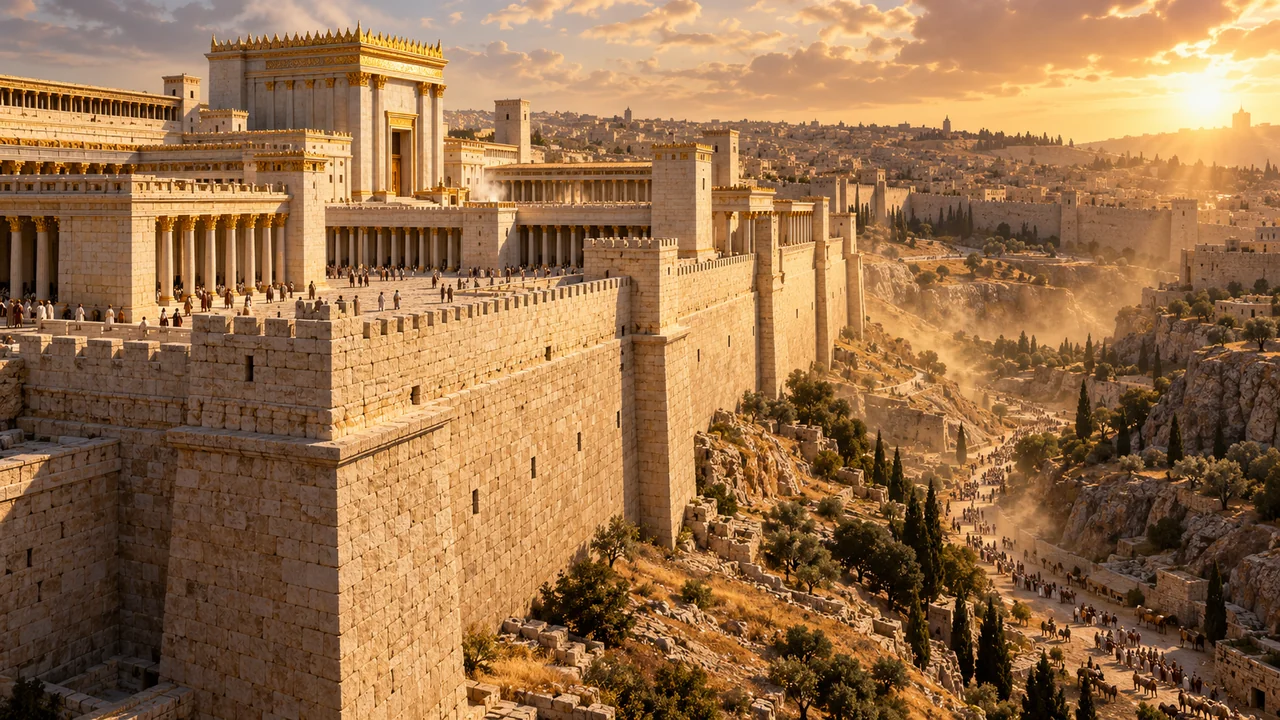
During the crowded Passover festival of 62 AD, the scribes and Sadducees brought James up to the Pinnacle of the Temple (Pterygion tou Hierou)—the dizzying southeastern corner of the Temple Mount retaining wall that dropped over 100 feet straight down into the rocky bed of the Kidron Valley.
Standing before the vast crowds gathered below in the courtyards, the priests shouted up to him:
"O Just one, whom we are all bound to believe, seeing that the people are going astray after Jesus who was crucified, declare unto us what is the door of Jesus!"
James, his voice ringing across the limestone courtyards of the Temple, answered with fearless apocalyptic conviction:
"Why do you ask me concerning the Son of Man? He himself sits in heaven at the right hand of the Great Power, and is coming upon the clouds of heaven!"
The multitude erupted in joyful praise, shouting: "Hosanna to the Son of David!"
Realizing their public trap had catastrophically backfired, the Sadducean leaders rushed James atop the parapet, shouting: "Oh, even the Just one has gone astray!"
[Stage 1: Pushed from 100-Foot Temple Pinnacle]
       │
       ▼ (Free fall onto jagged Kidron limestone rocks)
[Stage 2: Massive Polytrauma, Multiple Fractures, Yet Alive]
       │ James struggles to his knees: "Lord God, Father, forgive them..."
       ▼
[Stage 3: Mob Lapidatio (Stoning with Heavy Masonry Blocks)]
       │
       ▼
[Stage 4: Fatal Strike with Fuller's Wooden Club (Fustis)]
       │ Depressed cranial vault fracture, instantaneous cerebral destruction
- Stage 1: The Fall from the Pinnacle: The priests violently shoved James off the pinnacle. A free-fall plunge of approximately 80 to 100 feet onto the jagged limestone terracing of the Kidron Valley causes severe polytrauma: bilateral femur fractures, pelvic shattering, and multiple rib fractures. Remarkably, Hegesippus records that the fall did not kill him immediately.
- Stage 2: The Intercessory Prayer: James rolled onto his knees, lifted his bloody hands to heaven, and began praying the very words Christ had uttered on Golgotha: "I entreat thee, Lord God our Father, forgive them; for they know not what they do."
- Stage 3: Stoning (Lapidatio): The crowd rushed down into the valley and began hurling heavy limestone rocks at the kneeling apostle. While the stones battered his body, a priest of the sons of Rechab cried out: "Stop! What are you doing? The Just one is praying for you!"
- Stage 4: The Fuller’s Club (Gnapheus): Before the crowd could be restrained, a fuller (a cloth cleaner who used heavy wooden bats to beat wet fabrics in the Kidron wash-pools) grabbed his wooden fuller's club (fustis) and struck James with full force directly against the temple of his skull. The blunt-force impact caused a catastrophic depressed skull fracture, massive intracranial hemorrhage, and instant death.
James was buried on the exact spot where he fell, beside the Temple wall, where his memorial stele remained visible until the Roman siege of 70 AD.
Comparative Table: Ancient Historical Accounts of James's Death
| Feature / Detail | Flavius Josephus (Antiquities XX.9.1, c. 93 AD) | Hegesippus (Memoirs, c. 170 AD) | Clement of Alexandria (Hypotyposeis, c. 190 AD) |
|---|---|---|---|
| Primary Perpetrator | High Priest Ananus II and illegal Sanhedrin | Scribes, Pharisees & Sadducees | Priestly leadership |
| Political Timing | Interregnum between Festus & Albinus (62 AD) | Pre-Passover festival | Reign of Nero |
| Method of Execution | Stoning (Lapidatio) | Pushed from Pinnacle, Stoning, Fuller's Club | Thrown from Pinnacle and beaten to death |
| James's Identity | "Brother of Jesus, who was called Christ" | "Ya'akov HaTzaddik" (James the Just) | Bishop of Jerusalem, Apostle |
| Civic Consequence | Citizens complain; Ananus stripped of office | Believed to be direct cause of Jerusalem's fall | Exemplar of early Christian endurance |
The Political Backlash: Ananus II Stripped of the High Priesthood
The extrajudicial murder of James did not achieve Ananus’s political aims; it ignited a civic firestorm across Jerusalem.
Josephus records that the most respected, law-abiding citizens of the city—including the moderate Pharisees—were so outraged by this flagrant abuse of power that they dispatched a secret delegation to meet the incoming Roman Procurator Lucceius Albinus as he traveled from Alexandria:
"Those who were of the city that seemed the most fair-minded, and were strict in observing the law, were offended at what was done. They sent secretly to King Agrippa, desiring him to write to Ananus that he should act so no more, for what he had done already was not to be justified: nay, some of them went also to meet Albinus, as he was upon his journey from Alexandria, and informed him that it was not lawful for Ananus to assemble a Sanhedrin without his consent."
Furious that the young high priest had usurped imperial Roman sovereignty, Albinus sent a blistering letter to Ananus threatening immediate military punishment. King Herod Agrippa II, fearing Roman intervention, acted decisively: he stripped Ananus of the high priesthood after only three months of rule.
The Jewish populace viewed the murder of James as a cosmic turning point. Both Josephus and early Christian writers note that the common people believed the catastrophic Roman destruction of Jerusalem and the burning of the Second Temple in 70 AD—barely eight years later—was direct divine judgment for the shedding of the blood of James the Just.
Archaeological Echoes: The James Ossuary and the Kidron Valley Tombs
Today, the eastern slope of the Temple Mount descending into the Kidron Valley remains one of the densest archaeological necropolises on earth. Monumental 1st-century rock-hewn tombs—such as the Tomb of Benei Hezir and the Monolith of Zechariah—stand within walking distance of the traditional site where James was martyred.
In 2002, a private archaeological artifact came to international prominence: the James Ossuary—a 1st-century limestone bone box bearing an ancient Aramaic cursive inscription:
$$\text{"Ya'akov bar Yosef akhui diYeshua"} \quad (\text{יעקוב בר יוסף אחוה דישוע}) \implies \text{"James, son of Joseph, brother of Jesus"}$$
[The 1st-Century James Ossuary Discovery]
       │
       ├──► Geological Forensics: Chalk limestone matching Mount Scopus quarries
       │
       ├──► Patina Analysis: Natural biogenic micro-varnish inside inscription grooves
       │
       └──► Statistical Probability: Extraordinary convergence of three biblical names
Following a decade-long legal trial and extensive scientific testing by the Israel Geological Survey:
- The ossuary itself was confirmed to be an authentic 1st-century Jewish ossuary from Jerusalem.
- Scanning electron microscopy (SEM) identified natural biogenic patina inside the letter incisions, refuting modern forgery claims.
- Statistical demographic models demonstrate that the combination of "James," "son of Joseph," and "brother of Jesus" in 1st-century Jerusalem represents an extraordinary statistical convergence pointing to the historical family of Nazareth.
Whether the ossuary once contained the bones of James or not, the physical stones of Jerusalem cry out the reality of the man who stood on the parapet of the Temple, looked into the eyes of his killers, and died with a prayer of mercy on his lips.
Uncover the Untold Historical Dossiers
The murder of James the Just is one of the most meticulously documented martyrdoms in the ancient world. Discover the complete unabridged texts of Josephus, Greek transcripts of Hegesippus, and high-resolution forensic analyses:
👉 Download Volume I: The Twelve Apostles – Historical Dossier ($2.99)
Features the complete texts of early patristic and Jewish sources, detailed archaeological blueprints of the Second Temple pinnacle, and comprehensive investigations into 1st-century Judean politics.
Frequently Asked Questions
Who was James the Just?
James the Just (Ya'akov HaTzaddik) was the brother of Jesus Christ (Galatians 1:19) and the leader of the early Christian church in Jerusalem. He is the author of the canonical Epistle of James and was renowned throughout 1st-century Judea for his strict Torah observance and prayer life.
How did James the Just die?
According to Flavius Josephus, Hegesippus, and Eusebius, James was executed in 62 AD in Jerusalem. High Priest Ananus II had him hurled from the pinnacle of the Temple into the Kidron Valley. When he survived the fall and began praying for his executioners on his knees, he was stoned and his skull was crushed with a wooden fuller's club (fustis).
Does Flavius Josephus mention the death of James the Just?
Yes. In Antiquities of the Jews (Book XX, Chapter 9.1), Flavius Josephus explicitly records that High Priest Ananus assembled the Sanhedrin during a Roman power vacuum in 62 AD and condemned "the brother of Jesus, who was called Christ, whose name was James" to be stoned. This passage is widely regarded by modern historians as an authentic 1st-century secular reference to Jesus and James.
What happened to the High Priest who killed James?
High Priest Ananus ben Ananus (Ananus II) faced severe political backlash. Outraged Jewish citizens complained to King Agrippa II and the incoming Roman Procurator Lucceius Albinus about the illegal execution. Consequently, King Agrippa II stripped Ananus of the high priesthood after only three months of rule.
Frequently Asked Questions
Who was James the Just?
James the Just (Ya'akov HaTzaddik) was the brother of Jesus Christ (Galatians 1:19) and the leader of the early Christian church in Jerusalem. He is the author of the canonical Epistle of James and was renowned throughout 1st-century Judea for his strict Torah observance and prayer life.
How did James the Just die?
According to Flavius Josephus, Hegesippus, and Eusebius, James was executed in 62 AD in Jerusalem. High Priest Ananus II had him hurled from the pinnacle of the Temple into the Kidron Valley. When he survived the fall and began praying for his executioners on his knees, he was stoned and his skull was crushed with a wooden fuller's club (fustis).
Does Flavius Josephus mention the death of James the Just?
Yes. In Antiquities of the Jews (Book XX, Chapter 9.1), Flavius Josephus explicitly records that High Priest Ananus assembled the Sanhedrin during a Roman power vacuum in 62 AD and condemned "the brother of Jesus, who was called Christ, whose name was James" to be stoned. This passage is widely regarded by modern historians as an authentic 1st-century secular reference to Jesus and James.
What happened to the High Priest who killed James?
High Priest Ananus ben Ananus (Ananus II) faced severe political backlash. Outraged Jewish citizens complained to King Agrippa II and the incoming Roman Procurator Lucceius Albinus about the illegal execution. Consequently, King Agrippa II stripped Ananus of the high priesthood after only three months of rule.
Related Research Dossiers
View all 120 articles →
Flayed Alive in Armenia: The Royal Execution That Silenced St. Bartholomew
The First Apostle to Fall: How Herod Agrippa’s Sword Shocked the Early Jerusalem Church