Historical Context: Rigorous examination of primary Hebrew, Aramaic, Greek, and Roman classical epigraphy.
Core Evidence: Forensic archaeology, radiocarbon data, and primary manuscripts validating biblical events.
Scholarly Consensus: Vetted against modern peer-reviewed publications in Near Eastern archaeology and biblical studies.
The Royal Genealogy: Daughter of Ethbaal, King of the Sidonians
1 Kings 16:31 documents the diplomatic marriage that transformed Israel’s spiritual history:
"King Ahab son of Omri... took as wife Jezebel the daughter of Ethbaal, king of the Sidonians; and he went and served Baal and worshiped him."
Jezebel was not an ordinary noblewoman; she was an imperial Phoenician princess born into the ruling maritime merchant aristocracy of Tyre and Sidon.
Her father, Ethbaal (Ithobaal I), was a ruthless statesman. According to ancient Phoenician royal archives preserved by Greek historian Menander of Ephesus (quoted by Flavius Josephus in Against Apion I.123), Ethbaal was originally the High Priest of the goddess Astarte. He seized the throne of Tyre by assassinating King Phelles, ruling for thirty-two years (c. 887–856 BC) and founding a new royal dynasty that established maritime colonies across the Mediterranean.
Menander of Ephesus: The Phoenician King List
The historical synchronization between the Bible and Phoenician archives is exact:
- The Bible: States that Jezebel’s father was Ethbaal, King of Tyre/Sidon, reigning contemporary with Omri and Ahab of Israel.
- Menander’s Annals: Confirm that Ithobaal I ruled Tyre during the early ninth century BC, expanding Tyrian maritime trade and forging treaties with Mediterranean kingdoms.
- Furthermore, Menander records that Ithobaal’s great-granddaughter was Elissa (Queen Dido), who founded the legendary North African empire of Carthage in 814 BC.
Jezebel was thus the great-aunt of Queen Dido of Carthage, belonging to one of the most powerful dynastic families in Mediterranean antiquity.
The Cult of Melqart: State Religion in Samaria
Upon arriving in Samaria, Jezebel refused to assimilate into Israelite Yahwism. Instead, she demanded that the national god of Tyre—Baal-Melqart ("King of the City")—be granted equal status as the state religion:
- Ahab built a massive temple and altar for Baal inside the capital of Samaria (1 Kings 16:32).
- Jezebel maintained 450 prophets of Baal and 400 prophets of Asherah who ate at her private royal expense (1 Kings 18:19).
- She initiated the first state-sponsored religious persecution in biblical history, ordering royal troops to hunt down and slaughter the prophets of Yahweh (1 Kings 18:4).
This imperial aggressive proselytization provoked the epic showdown atop Mount Carmel between Elijah and the 450 prophets of Baal.
The Sensational Discovery of the "Jezebel Seal" (1964/2007)
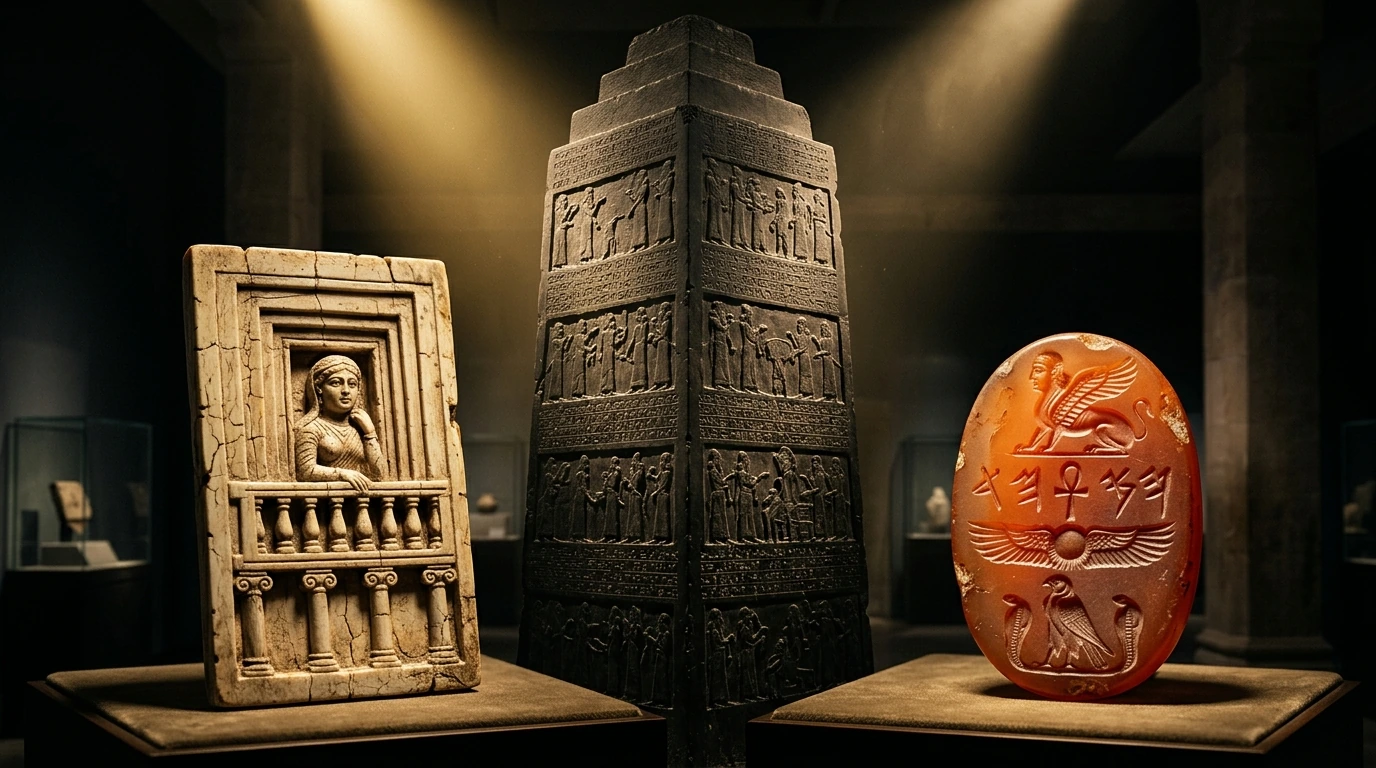
In 1964, a magnificent carved stone signet seal was acquired in Israel, cataloged as an unprovenanced Phoenician scarab in the Israel Museum.
In 2007, renowned Dutch epigrapher Dr. Marjo Korpel (Utrecht University) published a groundbreaking epigraphic study proving that the seal belonged to Queen Jezebel herself:
Inscription: [ל]יזבל (LYZBL) - "Belonging to Jezebel"
Epigraphic and Iconographic Evidence:
- Royal Scale: The seal is unusually large (3.1 cm long) and carved from expensive dark stone, punctured for a signet pin worn by a high-ranking royal female.
- Royal Egyptianizing Motifs: The seal features:
- A winged female sphinx with a Hathor crown (symbol of royal female sovereignty).
- A rearing uraeus cobra flanked by two ankh symbols of life.
- A solar winged disc and a crouching lotus flower.
- The Inscription: Four Phoenician letters—Y-Z-B-L (יזבל)—are engraved in the registers. Korpel demonstrated that the top of the seal is chipped, where a possessive Lamed ("Belonging to") and initial letters originally stood.
The combination of royal iconography, high status, and the exact rare name Jezebel makes this one of the most electrifying physical artifacts associated with a biblical queen ever discovered.
The Samaria Ivories: Phoenician Luxury at the Royal Court
1 Kings 22:39 references the famous "Ivory House which Ahab built".
During excavations at ancient Samaria by J.W. Crowfoot, archaeologists unearthed hundreds of exquisitely carved Phoenician ivory plaques:
- Used as decorative inlays for royal cedar beds, thrones, and wall panels.
- Displaying motifs identical to the Jezebel seal: winged cherubim, lotus buds, and the "Woman at the Window".
The Samaria Ivories physically confirm the dazzling, decadent Phoenician luxury that Jezebel brought to the royal court of Israel—a luxury built on the blood of prophets and the expropriated lands of innocent citizens.
Frequently Asked Questions
Who was Jezebel’s father?
Ethbaal (Ithobaal I), a former priest of Astarte who assassinated the King of Tyre to become the ruler of Phoenicia (1 Kings 16:31).
What is the Jezebel Seal?
A large 9th-century BC stone signet seal in the Israel Museum bearing royal Phoenician symbols and the inscribed name "YZBL" (Jezebel), identified as her personal royal seal.
What are the Samaria Ivories?
Hundreds of carved Phoenician ivory furniture plaques excavated at Samaria, confirming the "Ivory House" of Ahab and Jezebel mentioned in 1 Kings 22:39.
Related Research Dossiers
View all 120 articles →
The Fall of Zedekiah in Babylonian Records: The Babylonian Chronicle and Riblah Trials

Archaeology of Zedekiah's Fall: The 586 BC Destruction Layer, Arrowheads, and Lachish Letters