Historical Context: Rigorous examination of primary Hebrew, Aramaic, Greek, and Roman classical epigraphy.
Core Evidence: Forensic archaeology, radiocarbon data, and primary manuscripts validating biblical events.
Scholarly Consensus: Vetted against modern peer-reviewed publications in Near Eastern archaeology and biblical studies.
The Catastrophe on Mount Gilboa (1 Samuel 31)
The tragic reign of Saul son of Kish, Israel’s first anointed king, reached its apocalyptic conclusion on the rugged northern crest of Mount Gilboa around 1010 BC.
Having alienated the Prophet Samuel and driving his faithful champion David into exile, Saul stood spiritually abandoned. On the eve of battle, terrified by the massed Philistine armies gathered in the Jezreel Valley, Saul committed the capital sin of consulting a medium at En-dor (1 Samuel 28), where the spirit of Samuel announced his doom: "Tomorrow you and your sons will be with me. The Lord will also deliver the army of Israel into the hand of the Philistines."
The following morning, the Philistine battle lines broke the Israelite infantry:
- Saul’s valiant sons—Jonathan, Abinadab, and Malchishua—were slain on the battlefield.
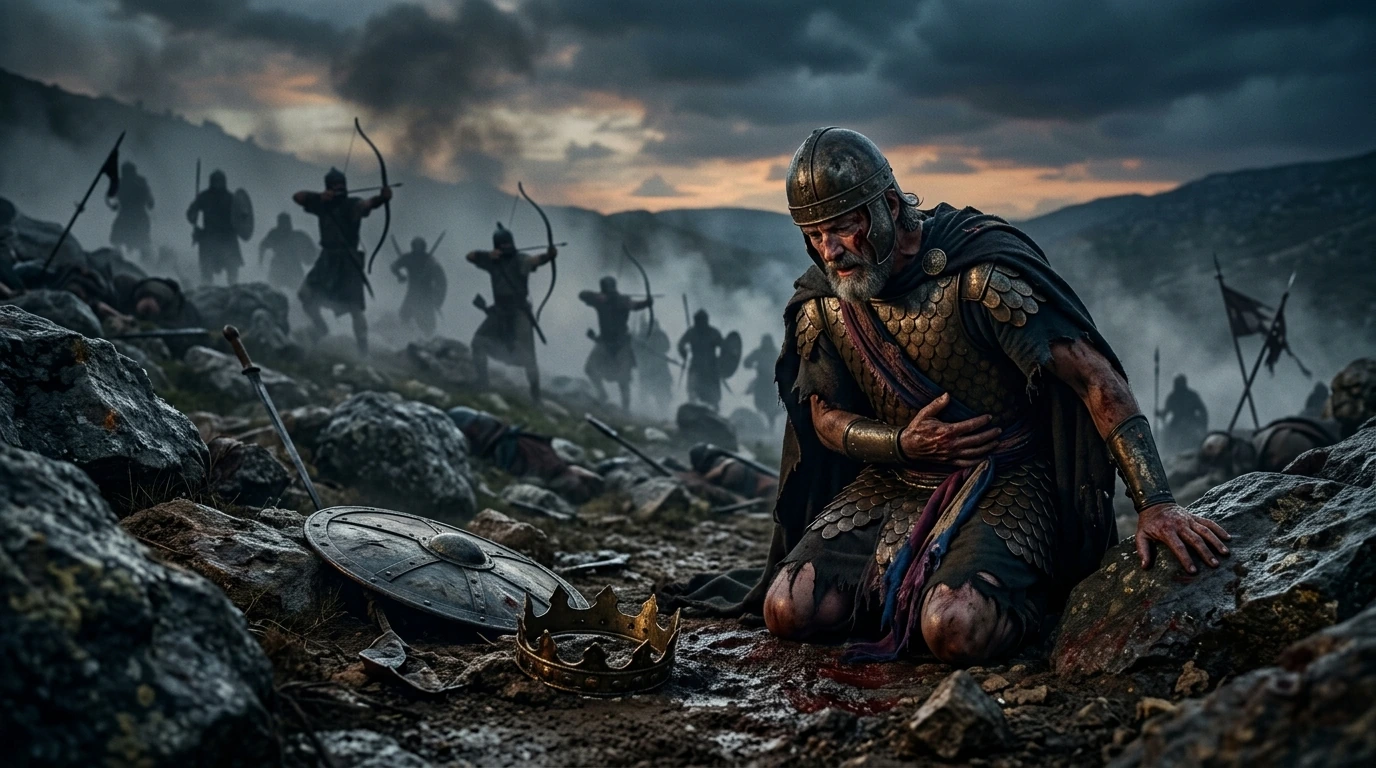
- The elite Philistine archers pressed hard around King Saul, severely wounding him with arrows (1 Samuel 31:3).
The Battlefield Suicide: Falling on His Own Sword
Bleeding heavily and unable to retreat, Saul faced a terrifying fate: capture by the Philistines, who would torture, blind, and publicly humiliate him before their pagan gods:
*"Then Saul said to his armor-bearer, 'Draw your sword, and thrust me through with it, lest these uncircumcised men come and thrust me through and abuse me.'
But his armor-bearer would not, for he was greatly afraid. Therefore Saul took a sword and fell on it. And when his armor-bearer saw that Saul was dead, he also fell on his sword, and died with him."* (1 Samuel 31:4–5)
The narrator of 1 Samuel 31—writing as an omniscient, inspired historical recorder—explicitly states that Saul committed suicide on the battlefield.
The Conflicting Testimony: The Amalekite’s Claim (2 Samuel 1)
However, in 2 Samuel 1, an Amalekite runner arrived at David’s military camp at Ziklag with torn clothes and dust on his head, presenting Saul’s royal golden crown (nezer) and armlet (etz‘adah):
*"I happened by chance to be on Mount Gilboa, and there was Saul, leaning on his spear; and indeed the chariots and horsemen followed hard after him...
He said to me, 'Please stand over me and kill me, for anguish has come upon me, but my life still lingers in me.'
So I stood over him and killed him, because I was sure that he could not live after he had fallen. And I took the crown that was on his head and the bracelet that was on his arm, and have brought them here to my lord."* (2 Samuel 1:6–10)
For generations, biblical critics claimed this represents an irreconcilable contradiction between two competing literary traditions.
Forensic Textual Exegesis: Harmonizing the Two Accounts
A rigorous literary and forensic analysis reveals that there is zero contradiction:
- The Narrator vs. A Character’s Testimony:
- 1 Samuel 31 is the objective, infallible historical narrative of what actually transpired: Saul fell upon his sword and died, confirmed by his armor-bearer who verified his death before taking his own life.
- 2 Samuel 1 is the subjective, self-serving testimony of an opportunistic Amalekite looter.
- The Amalekite’s Motive:
- The Amalekite was a scavenger trailing the battle lines to strip corpses of gold and weapons.
- Stumbling upon the already-dead (or dying) body of King Saul, he stripped the royal golden crown and bracelet.
- Knowing that David had been hunted by Saul as an outlaw for a decade, the Amalekite fabricated a heroic story: he claimed that he personally delivered the coup de grâce to Saul, expecting David to reward him with wealth, military rank, and royal favor!
David’s Royal Justice: The Execution of the Regicide
The Amalekite’s deadly gamble backfired catastrophically:
- Instead of celebrating, David tore his clothes, wept, and fasted until evening for Saul, Jonathan, and the fallen soldiers of Israel.
- David interrogated the young man: "How was it you were not afraid to put forth your hand to destroy the Lord’s anointed?" (2 Samuel 1:14).
- In ancient Near Eastern law, confessing to regicide (the murder of a king) was a capital crime. On the basis of his own self-condemning testimony, David ordered one of his bodyguards to strike the Amalekite down: "Your blood is on your own head, for your own mouth has testified against you, saying, 'I have killed the Lord’s anointed.'" (2 Samuel 1:16).
David then composed the immortal poetic lament The Song of the Bow (Lament of David): "How the mighty have fallen in the midst of battle! Jonathan was slain on your high places... Tell it not in Gath, publish it not in the streets of Ashkelon!" (2 Samuel 1:19–27).
Frequently Asked Questions
How did King Saul really die?
According to the historical narrator of 1 Samuel 31, King Saul was mortally wounded by Philistine archers and committed suicide by falling on his own sword.
Why did the Amalekite claim he killed Saul?
The Amalekite found Saul’s dead body, looted his crown and armlet, and invented the story thinking David would reward him handsomely for killing his former enemy.
What did David do to the Amalekite?
David ordered the Amalekite executed on the spot, ruling that his own confession of killing God’s anointed king condemned him to death.
Related Research Dossiers
View all 120 articles →
The Fall of Zedekiah in Babylonian Records: The Babylonian Chronicle and Riblah Trials
Archaeology of Zedekiah's Fall: The 586 BC Destruction Layer, Arrowheads, and Lachish Letters