Historical Context: Rigorous examination of primary Hebrew, Aramaic, Greek, and Roman classical epigraphy.
Core Evidence: Forensic archaeology, radiocarbon data, and primary manuscripts validating biblical events.
Scholarly Consensus: Vetted against modern peer-reviewed publications in Near Eastern archaeology and biblical studies.
The Palace of Susa: The Imperial Stage of the Achaemenid Empire
In the 5th century BC, the Achaemenid Persian Empire stood as the largest imperial domain the ancient world had ever seen. Stretching from the Indus River valley in modern Pakistan to the cataracts of the Nile in Nubia, the empire encompassed 127 royal provinces (satrapies) governed by King Ahasuerus (historically identified as Xerxes I, who reigned from 486 to 465 BC).
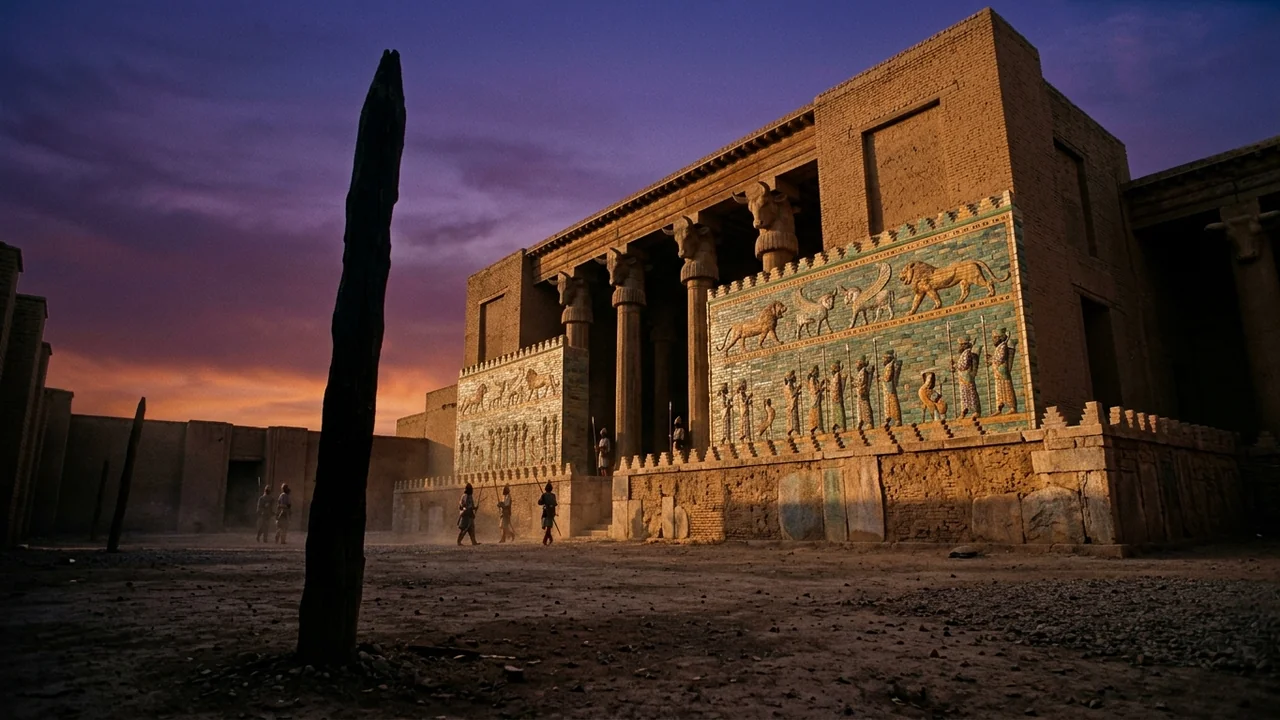
While Persepolis served as the ceremonial dynastic capital, the administrative winter residence of the Persian court was Shushan (Susa), located in southwestern Iran. Built atop an elevated royal acropolis, the palace was an architectural marvel constructed of cedar timber imported from Mount Lebanon, Babylonian mud-bricks, lapis lazuli from Sogdiana, and shimmering glazed-tile walls depicting imperial lion reliefs and Persian Immortals.
It was within this citadel of immense power and opulence that the dramatic events of the Book of Esther unfolded. Behind the cedar-paneled corridors and heavy embroidered draperies, an existential struggle between two ancient bloodlines threatened to exterminate the entire Jewish diaspora across the Persian Empire.
Haman the Agagite: Ancient Bloodline Feuds in the Persian Court
At the center of the conspiracy was Haman, son of Hammedatha, promoted by King Ahasuerus to the supreme post of Grand Vizier:
"After these things did king Ahasuerus promote Haman the son of Hammedatha the Agagite, and advanced him, and set his seat above all the princes that were with him. And all the king's servants, that were in the king's gate, bowed, and reverenced Haman... But Mordecai bowed not, nor did him reverence." (Esther 3:1–2)
The biblical text pointedly identifies Haman as an Agagite—a direct royal descendant of Agag, the Amalekite king spared by King Saul in 1 Samuel 15. The Amalekites were the primordial adversaries of Israel, who had ambushed the exhausted Hebrew stragglers in the wilderness of Rephidim (Exodus 17:8–16; Deuteronomy 25:17–19).
Mordecai, identified as a Benjamite from the family of Kish (the father of King Saul), refused to bow before the hereditary enemy of his people. Viewing Mordecai’s refusal as a mortal insult, Haman sought an atrocity far greater than the execution of a single court official: he cast the sacred lot (Pur) to determine an auspicious date for the simultaneous, empire-wide genocide of every Jewish man, woman, and child across the 127 provinces of Persia (Esther 3:8–13).
The Fifty-Cubit Gallows: Translation and Physical Dimensions
Infuriated by Mordecai's continued refusal to prostrate himself at the King’s Gate, Haman returned to his palace compound. His wife Zeresh and his counselors advised him to construct a lethal monument:
"Then said Zeresh his wife and all his friends unto him, 'Let a gallows be made of fifty cubits high, and tomorrow speak thou unto the king that Mordecai may be hanged thereon: then go thou in merrily with the king unto the banquet.' And the thing pleased Haman; and he caused the gallows to be made." (Esther 5:14)
Popular Western illustration traditionally envisions Haman’s structure as a medieval wooden gallows fitted with a hemp rope and trapdoor. However, ancient Near Eastern linguistic and archaeological evidence reveals a vastly different reality.
The Hebrew word translated as "gallows" is simply 'ets (literally, "tree", "wood", or "wooden pole/timber").
Furthermore, consider the staggering physical dimensions: fifty cubits (chamishim ammah). In ancient Persian and Mesopotamian metrology:
- A standard Royal Cubit measured approximately 52 centimeters (20.5 inches).
- Fifty royal cubits equals a towering structure of 26 meters (approximately 75 to 80 feet high)!
Why did Haman construct a wooden stake eighty feet tall?
- Visibility Across the Acropolis: The palace of Susa sat on a high, fortified mound elevated 15 to 20 meters above the lower city. An 80-foot pole erected in Haman’s private palace garden would rise above the royal perimeter walls, visible to the tens of thousands of citizens living in the plains below, as well as to King Ahasuerus from his palace windows!
- Psychological Terror: It served as a colossal, public proclamation of absolute power—warning all subjects that defying the Grand Vizier carried catastrophic, inescapable consequences.
[Haman's 50-Cubit 'Ets (Timber Stake)]
                  Height: 50 Cubits (75–80 Feet / 26 Meters)
                         ▲
                         │  [Sharpened Wooden Point (Top)]
                         │   └── High-exposure public display
                         │
                         │
                         │  [Long Cedar/Cypress Trunk]
                         │   └── Sourced from palace building supplies
                         │
                         │
                         ▼
                  [Deep Rock/Earth Foundation in Haman's Courtyard]
Persian Capital Punishment: The Forensic Reality of Impalement
In ancient Achaemenid Persia, the standard form of execution for treason and high crimes against the king was not hanging by the neck with a rope. The Greek historian Herodotus (The Histories III.159, IV.43) explicitly records that Persian kings executed rebels through impalement on a sharpened wooden stake (Greek: anastauroō or kremannymi):
"Darius impaled about three thousand of the chief men of Babylon... and gave the city to the rest to inhabit." (Herodotus III.159)
The famous Behistun Inscription in western Iran, carved into a high cliff face by Darius the Great (Xerxes' father), shows multiple relief panels of captured rebel kings awaiting impalement, accompanied by the royal cuneiform text: "I commanded: Let them be impaled upon stakes!" (uzmayāpatiy karīyai).
Forensic analysis of ancient Persian impalement reveals its horrific physical reality:
- A long, debarked cedar or cypress trunk was sharpened to a point at the top and planted vertically in the earth.
- The condemned victim was stripped naked and hoisted aloft. The sharpened wooden point was driven either through the lower abdomen (penetrating the epigastric viscera) or longitudinally along the perineum, avoiding immediate damage to the heart to deliberately prolong the execution.
- Suspended eighty feet in the desert air under the blazing Persian sun, the victim lingered in unspeakable agony for hours or even days, succumbing slowly to severe dehydration, diaphragmatic exhaustion, and progressive hemorrhagic shock.
- The corpse was left to rot as a feast for vultures and crows, denied burial—the ultimate dishonor in ancient Persian society.
Archaeological Excavations at Susa: Jacques de Morgan’s Discoveries
Between 1897 and 1913, the French archaeological mission led by Jacques de Morgan and Marcel-Auguste Dieulafoy conducted monumental excavations at the mound of Susa (Shushan).
Their discoveries verified the exact architectural details recorded in the Book of Esther:
- The Royal Gatehouse (Sha'ar ha-Melekh): Archaeologists excavated the monumental Gate of Xerxes at Susa—a massive square building measuring 40 meters on each side with four colossal interior columns. This was the precise gatehouse where Mordecai sat, conducted legal business, and overheard the palace assassination plot of Bigthan and Teresh (Esther 2:21).
- The King's Inner and Outer Courtyards: The palace layout uncovered at Susa matched the biblical text down to the meter. The excavators found the exact transition between the Outer Court (where Haman waited to request Mordecai’s execution) and the Inner Court (where Esther risked her life by approaching the royal throne unsummoned).
- Glazed Brick Archer Reliefs: The walls were lined with thousands of brilliant turquoise and gold glazed tiles depicting Persian palace guards, confirming the staggering wealth described in Esther 1:6 ("white, green, and blue hangings, fastened with cords of fine linen and purple to silver rings and pillars of marble").
The Irony of Retribution: Esther 7 Decoded
The climax of the Book of Esther represents one of the most stunning reversals of fortune in human literature—an ancient Near Eastern manifestation of poetic divine justice:
At her private wine banquet, Queen Esther unmasked Haman before the king: "The adversary and enemy is this wicked Haman" (Esther 7:6). Terrified, Ahasuerus stormed into the palace garden in fury. Returning, the king found Haman fallen in desperation upon the couch where Esther reclined. Misinterpreting the posture as an attempted assault on the queen, the king roared: "Will he force the queen also before me in the house?"
Instantly, royal chamberlains covered Haman's face—the formal Persian legal gesture signifying that a condemned man was no longer worthy to gaze upon the light of the king's presence.
Then Harbonah, one of the royal eunuchs, spoke:
"And Harbonah, one of the chamberlains, said before the king, 'Behold also, the gallows fifty cubits high, which Haman had made for Mordecai, who had spoken good for the king, standeth in the house of Haman.' Then the king said, 'Hang him thereon.' So they hanged Haman on the gallows that he had prepared for Mordecai. Then was the king's wrath pacified." (Esther 7:9–10)
The 75-foot sharpened wooden stake, designed in arrogant hatred to break the neck or impale the righteous Mordecai, became the instrument of Haman’s own public execution before all of Susa.
Mordecai was promoted to Grand Vizier, wearing the royal signet ring of Xerxes, and the feast of Purim was instituted across generations as a permanent celebration of deliverance from ethnic annihilation.
Investigate the Unsolved Mysteries of Ancient Persia
The historical world of the Book of Esther is brought to life through the archaeological excavations of Susa, Persepolis, and the royal archives of the Achaemenid Empire. If you want to explore the complete historical files, cuneiform decrees, and architectural blueprints of biblical Persia:
👉 Discover Volume II: Kings & Prophets – Tragic Ends & Medical Mysteries ($2.99)
Includes excavation maps of the Palace of Susa, translations of the Behistun Inscription, and forensic analyses of ancient Near Eastern capital punishments.
Frequently Asked Questions
Was Haman hanged by a rope on a wooden gallows?
No. In ancient Persia, capital execution for treason was carried out by impalement on a sharpened wooden stake, not hanging by a rope with a trapdoor. The Hebrew word in Esther is 'ets ("tree" or "timber"). Ancient historical sources, including Herodotus and the Persian Behistun Inscription, confirm that Persian kings executed rebels by impaling them on tall wooden poles.
Why was Haman’s gallows fifty cubits high?
Fifty cubits equals approximately 75 to 80 feet (26 meters) in height. Haman erected this towering timber stake in his private courtyard so that Mordecai's body would be visible above the high fortress walls of Susa, serving as a terrifying public spectacle of imperial power across the entire city.
Did archaeologists find the palace described in the Book of Esther?
Yes. In the late 19th and early 20th centuries, French archaeologists led by Marcel-Auguste Dieulafoy and Jacques de Morgan excavated the monumental palace of King Xerxes I at Susa (modern Shush, Iran). They uncovered the King's Gate, the Inner and Outer Courtyards, and the throne room, with dimensions and architectural layouts matching the biblical Book of Esther with remarkable precision.
Who was King Ahasuerus historically?
King Ahasuerus is the Hebrew transliteration of the Persian name Khshayarsha, known in Western Greek history as Xerxes I (Xerxes the Great), who ruled the Achaemenid Persian Empire from 486 to 465 BC. Xerxes is famous for his massive military invasion of Greece in 480 BC, including the Battle of Thermopylae.
Frequently Asked Questions
Was Haman hanged by a rope on a wooden gallows?
No. In ancient Persia, capital execution for treason was carried out by impalement on a sharpened wooden stake, not hanging by a rope with a trapdoor. The Hebrew word in Esther is 'ets ("tree" or "timber"). Ancient historical sources, including Herodotus and the Persian Behistun Inscription, confirm that Persian kings executed rebels by impaling them on tall wooden poles.
Why was Haman’s gallows fifty cubits high?
Fifty cubits equals approximately 75 to 80 feet (26 meters) in height. Haman erected this towering timber stake in his private courtyard so that Mordecai's body would be visible above the high fortress walls of Susa, serving as a terrifying public spectacle of imperial power across the entire city.
Did archaeologists find the palace described in the Book of Esther?
Yes. In the late 19th and early 20th centuries, French archaeologists led by Marcel-Auguste Dieulafoy and Jacques de Morgan excavated the monumental palace of King Xerxes I at Susa (modern Shush, Iran). They uncovered the King's Gate, the Inner and Outer Courtyards, and the throne room, with dimensions and architectural layouts matching the biblical Book of Esther with remarkable precision.
Who was King Ahasuerus historically?
King Ahasuerus is the Hebrew transliteration of the Persian name Khshayarsha, known in Western Greek history as Xerxes I (Xerxes the Great), who ruled the Achaemenid Persian Empire from 486 to 465 BC. Xerxes is famous for his massive military invasion of Greece in 480 BC, including the Battle of Thermopylae.
Related Research Dossiers
View all 120 articles →
Fallen on His Own Sword: The Witch of Endor and the Psychological Collapse of King Saul
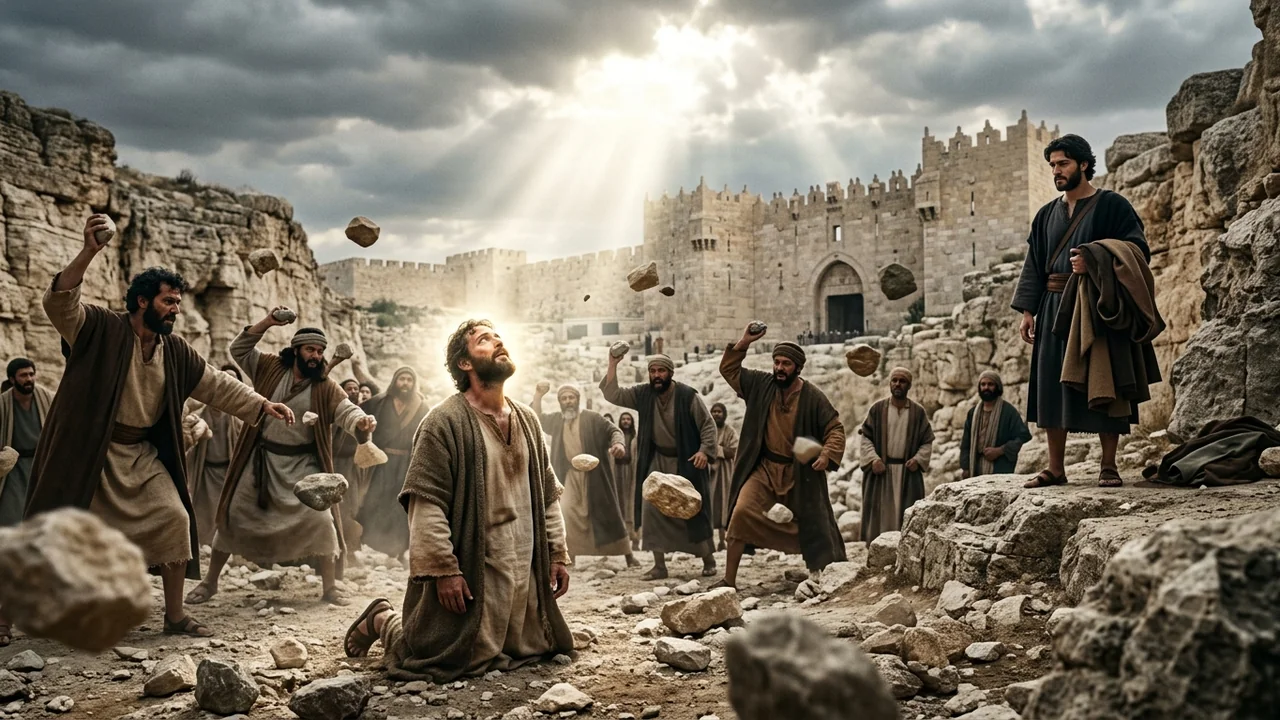
The Stoning of the First Christian Martyr: The Judicial Murder of Stephen Under Roman Law