Historical Context: Rigorous examination of primary Hebrew, Aramaic, Greek, and Roman classical epigraphy.
Core Evidence: Forensic archaeology, radiocarbon data, and primary manuscripts validating biblical events.
Scholarly Consensus: Vetted against modern peer-reviewed publications in Near Eastern archaeology and biblical studies.
The Skeptical Challenge to Roman Nails
In the four New Testament Gospels, the execution of Jesus of Nazareth is recorded as having been carried out by Roman imperial legionaries utilizing large iron nails driven through his hands and feet:
"The other disciples therefore said unto him, We have seen the Lord. But he said unto them, Except I shall see in his hands the print of the nails, and put my finger into the print of the nails, and thrust my hand into his side, I will not believe... Then saith he to Thomas, Reach hither thy finger, and behold my hands..." (John 20:25, 27)
Peter, preaching in Jerusalem on the Day of Pentecost, declared: "him... ye have taken, and by wicked hands have crucified [fastened with nails]" (Acts 2:23).
Despite these explicit biblical references, for decades during the twentieth century, several prominent secular historians and medical researchers questioned whether the Romans routinely nailed victims to the cross.
Skeptics raised formidable physical arguments:
- Ropes vs. Nails: Ancient literary sources (such as Pliny the Elder and Seneca) frequently described crucifixion victims being bound to the wooden crossbeam (patibulum) purely with ropes, leaving them to die slowly of exposure and asphyxiation over days.
- Anatomical Impossibility: Early medical experiments suggested that driving a nail through the center of the palm would tear through the soft tissues under the weight of the human body, leading skeptics to claim that biblical descriptions of pierced palms were mythological.
- Zero Physical Evidence: Tens of thousands of human beings were crucified across the Roman Empire—including the 6,000 slaves crucified along the Appian Way after the revolt of Spartacus (71 BC) and the hundreds crucified daily by Titus during the siege of Jerusalem in 70 AD. Yet, in all the annals of global archaeology, not a single physical human skeleton showing direct physical evidence of crucifixion nails had ever been unearthed.
Skeptics maintained that nails were never left in human bones, and that the Gospel descriptions were theological embellishments designed to fulfill the prophecy of Psalm 22:16 ("they pierced my hands and my feet").
Then, in the summer of 1968, in a residential suburb of northern Jerusalem, the earth yielded the first and only physical, direct skeletal proof of Roman crucifixion nails in world history.
The 1968 Discovery at Givat HaMivtar: Vassilios Tzaferis
In June 1968, the Ministry of Housing of the State of Israel was cutting roads and leveling ground for a new Jewish residential neighborhood at Givat HaMivtar (Ras el-Masaref), a rocky ridge located in northeast Jerusalem, halfway between Mount Scopus and the Sanhedria tombs.
While bulldozing an embankment, heavy equipment clipped the entrance to an underground, rock-cut burial cave. Work was immediately suspended, and the Israel Department of Antiquities and Museums (now the IAA) launched an urgent salvage excavation led by Greek-Israeli archaeologist Dr. Vassilios Tzaferis.
       [THE DISCOVERY AT GIVAT HAMIVTAR: JUNE 1968]
  ══════════════════════════════════════════════════════════════════
    Location:       Givat HaMivtar, Northeast Jerusalem
    Excavator:      Dr. Vassilios Tzaferis (Department of Antiquities)
    Context:        First-century Jewish tomb complex (Tomb 1)
    Artifacts:      Eight limestone ossuaries dating to pre-70 AD
    Key Discovery:  Tomb 1, Ossuary No. 4 (Limestone bone box)
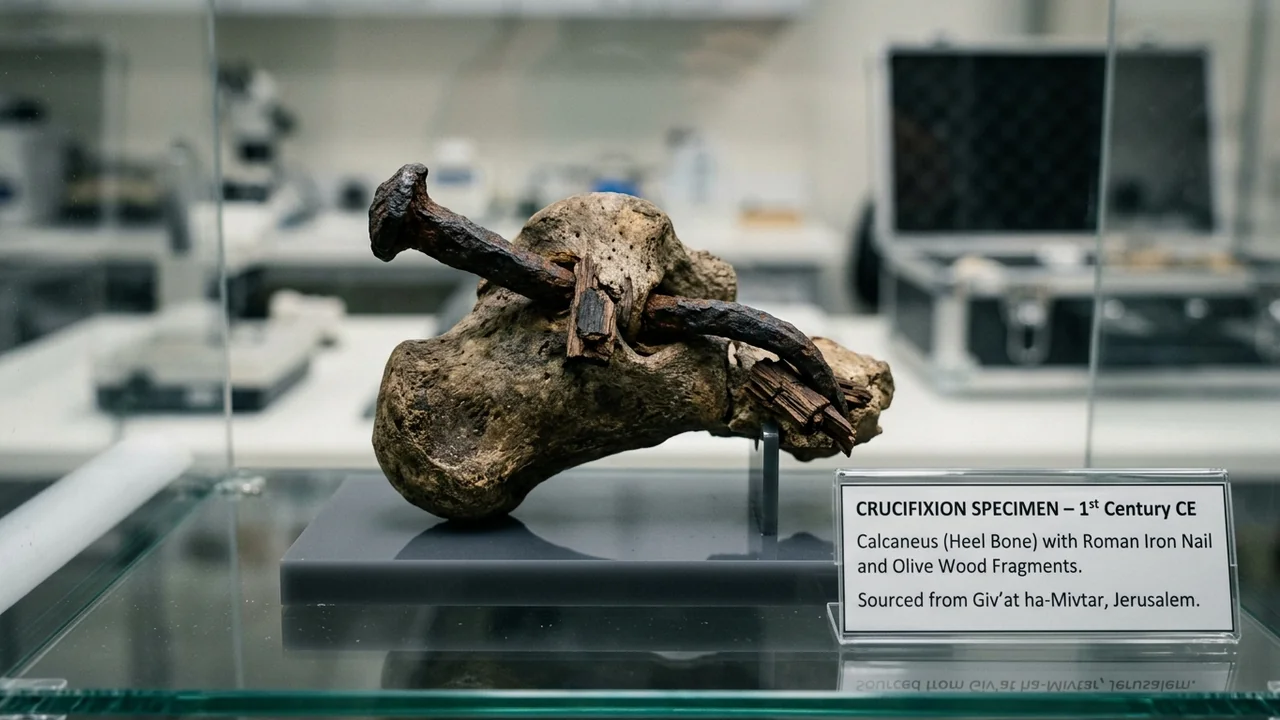
    Forensic Find:  Human heel bone (calcaneus) pierced by an
                    intact 11.5 cm rusted Roman iron nail!
    Subject ID:     Yehohanan ben Hagkol (Age: 24–28 years)
  ══════════════════════════════════════════════════════════════════
Tomb 1 was a classic, pristine first-century Jewish rock-cut cave consisting of two chambers with eight loculi (kokhim). The tomb contained eight limestone ossuaries.
Numismatic analysis of bronze coins found on the cave floor, along with the distinct Herodian wheel-made pottery, dated the tomb securely between 7 AD and 66 AD—the exact historical generation during which Jesus and the apostles lived.
Ossuary No. 4 and the Inscription: Yehohanan ben Hagkol
Among the stone chests in the chamber was Ossuary No. 4, a plain, finely crafted limestone box. On its long exterior side, the deceased’s name was deeply incised in ancient cursive Aramaic script:
                     [THE ARAMAIC INSCRIPTION]

                      יהוחנן בן חגקול
                     Yehohanan ben Hagkol
                   ("John, son of Hagkol")
  ══════════════════════════════════════════════════════════════════
Inside Ossuary No. 4, the excavators found the skeletal remains of two individuals: an infant around three to four years of age, and a young adult male between 24 and 28 years of age, with a height of approximately 5 feet 5 inches (167 cm).
When physical anthropologists lifted the skeletal leg bones of the young man out of the limestone chest, they made a horrifying discovery that sent shockwaves through the scientific world:
Embedded firmly through the right calcaneus (heel bone) was a massive, rusted, bent Roman iron nail, still fused to fragments of ancient wood!
Forensic Osteology of the Calcaneus: The 11.5 cm Iron Nail
The skeletal remains were immediately transported to the Department of Anatomy at the Hadassah Medical School of the Hebrew University of Jerusalem, where a comprehensive medical and osteological autopsy was conducted by chief pathologist Dr. Nicu Haas.
       [FORENSIC MEASUREMENTS OF THE ROMAN CRUCIFIXION NAIL]
  ══════════════════════════════════════════════════════════════════
    Material:          Wrought Roman iron (Square cross-section)
    Original Length:   11.5 centimeters (4.53 inches)
    Cross-Section:     0.9 cm thick tapering to a sharp point
    Head of Nail:      Broad, flattened circular iron head
    Point of Nail:     Bent backward into an acute 90-degree hook
    Preserved Organic: Acacia / Pistacia wood washer under head;
                       Olive wood (Olea europaea) fibers at tip!
  ══════════════════════════════════════════════════════════════════
       [ANATOMY OF THE PENETRATED HEEL BONE (CALCANEUS)]

         [HEAD OF NAIL]
              │
              ▼
           ════════   ◄── Acacia / Pistacia Wood Washer (Planted against skin)
           ┌──────┐
           │ SKIN │
           ├──────┤
           │      │   ◄── Right Calcaneus Bone (Pierced from lateral
           │ BONE │       to medial direction)
           │      │
           ├──────┤
           │ SKIN │
           └──────┘
              │
              │       ◄── Olive Wood Upright Cross Timber (*Stipes*)
              ▼
           ════════
              │
              └──────► 90-DEGREE BENT HOOK (Bent against hardwood knot!)
  ══════════════════════════════════════════════════════════════════
The nail had been driven horizontally through the lateral (outer) side of the right heel bone, exiting through the medial (inner) side.
The physical bone was heavily stained with green and brown iron oxide salts, proving that the nail had been driven into the living tissue and had remained embedded in the bone throughout the entire decomposition process.
Biomechanical Analysis: Wood Washers and Why the Nail Was Trapped
Why was this the only crucifixion skeleton ever discovered in human history?
In the ancient Roman world, iron was a precious, recyclable commodity. Furthermore, Roman execution nails were considered potent magical talismans (amulets) by pagans, believed to cure fevers and epilepsy (as documented by Pliny the Elder in Natural History XXVIII.11).
Consequently, when a victim died, the executioners almost invariably pulled the nails out with pliers to reuse the metal:
The Accidental Hardwood Knot
In the case of Yehohanan, the Roman executioner drove the 11.5 cm nail through the heel bone and into the upright vertical wooden post (stipes), which was made of olive wood (Olea europaea).
However, deep inside the olive timber, the tip of the iron nail struck a dense, rock-hard natural knot in the wood. Under the heavy blows of the executioner's mallet, the sharp point of the nail curled and bent backward into an acute, permanent 90-degree hook:
       [THE TRAPPED NAIL MECHANISM: WHY IT COULD NOT BE REMOVED]

  1. MALLET BLOWS drive the nail through the heel into olive timber.
  2. TIP STRIKES A HARD KNOT -> The iron tip bends into a 90° hook!
  3. AFTER DEATH, the family or soldiers attempt to pull the nail out.
  4. THE BENT HOOK ANCHORS INTO THE WOOD -> The nail cannot be extracted
     without completely shattering the heel bone into powder!
  5. EXECUTIONERS CUT THE BONE FREE: They chopped off the section of the
     upright olive wood with a saw or axe, leaving the nail, washer,
     and wood fused permanently to Yehohanan's heel bone!
  ══════════════════════════════════════════════════════════════════
When Yehohanan's family prepared him for secondary burial a year later, the nail could still not be dislodged without destroying the skeleton. Out of deep reverence for their dead son, they placed his heel bone into the limestone ossuary with the Roman iron nail still embedded in it, preserving it for modern science.
Reconstructing Roman Crucifixion Mechanics: Haas vs. Zias
In 1985, forensic anthropologist Joseph Zias (Rockefeller Museum) and anatomical expert Dr. Eliezer Sekeles (Hadassah Medical School) re-examined the calcaneus and Haas’s original anatomical notes, publishing a refined reconstruction of Roman crucifixion postures:
       [THE TWO RIVAL FORENSIC CRUCIFIXION RECONSTRUCTIONS]

  DR. NICU HAAS (1970 MODEL):
  - Claimed both feet were pinned together with a SINGLE long nail
    driven through both calcanei simultaneously in a straddled posture.

  JOSEPH ZIAS & DR. SEKELES (1985 REFINED MODEL):
  - Demonstrated that the length of the nail (11.5 cm) was anatomically
    TOO SHORT to penetrate two human heels, two wood washers, and the
    wooden upright beam!
  - PROVED: The victim straddled the upright post (*stipes*), with
    ONE NAIL DRIVEN INTO THE RIGHT HEEL on one side, and A SEPARATE
    NAIL DRIVEN INTO THE LEFT HEEL on the opposite side!
  ══════════════════════════════════════════════════════════════════
The Upper Body: Wrists vs. Palms
Forensic osteologists also examined Yehohanan’s radius and ulna (forearm bones):
- A distinctive scratch mark and micro-wear indentation were identified on the inner surface of the distal radius, just above the wrist joint.
- In ancient Hebrew, Aramaic, and Greek (cheir), the anatomical term "hand" included the wrist and forearm.
- Driving a nail through the Space of Destot (between the carpal bones of the wrist) or between the radius and ulna causes no bone fractures, but the heavy iron shank presses directly against the median nerve, sending excruciating, lightning-like pain through both arms while bearing the entire suspended weight of the human body.
Comparative Matrix: The Mechanics of Roman Crucifixion
The skeletal discovery of Yehohanan ben Hagkol verified every critical physiological and procedural detail recorded in the Gospels:
| Crucifixion Anatomical Feature | Historical Skeptical Allegation | Forensic Evidence (Yehohanan at Givat HaMivtar) |
|---|---|---|
| Use of Metal Nails | Alleged Romans used ropes only; nails were a myth | Confirmed: 11.5 cm square iron nail driven through bone |
| Piercing of the Feet | Claimed feet were never nailed; rejected John 20:25 | Confirmed: Calcaneus pierced through with iron nail |
| Use of Wood Washers | Alleged nails would pull through soft tissue | Confirmed: Acacia/olive wood washers placed under nail head |
| Permitted Decent Burial | Claimed crucified victims were thrown to wild dogs | Confirmed: Permitted full Jewish burial in family rock tomb |
| Breaking of the Legs | Dismissed crurifragium (John 19:31–32) as fiction | Confirmed: Both tibia bones were shattered by blunt force |
| Dating of Practice | Alleged late Christian embellishment | Confirmed: Firmly dated between 7 AD and 66 AD |
The presence of Yehohanan inside an expensive, inscribed private family ossuary demonstrated another crucial point against skeptics: Roman authorities regularly released the corpses of crucified victims to their families for honorable burial, precisely as the Gospels record regarding Joseph of Arimathea requesting the body of Jesus from Pontius Pilate (Mark 15:43–46).
Discover the Complete 4-Volume Master Study Dossiers
The crucified man of Givat HaMivtar is one of the most sobering and monumental discoveries in world archaeology, providing tangible physical proof of the horror, mechanics, and reality of the Roman cross. To explore full radiological scans of the pierced calcaneus, detailed anatomical diagrams of crucifixion biomechanics, and comprehensive studies of Second Temple martyrology:
👉 Unlock the Complete 4-Volume Master Bundle & Premium AI ($9.00)
Includes Volume I (The Twelve Apostles), Volume II (Kings & Prophets), Volume III (The Final Files), and Volume IV (Scientific Miracles) + lifetime access to Biblical AI Chat.
Frequently Asked Questions
What was discovered at Givat HaMivtar?
In June 1968, in the Jerusalem suburb of Givat HaMivtar, archaeologist Dr. Vassilios Tzaferis excavated an intact first-century Jewish tomb containing eight ossuaries. Inside Ossuary No. 4, inscribed "Yehohanan ben Hagkol," anthropologists discovered the skeletal remains of a young man whose right heel bone (calcaneus) was pierced by an 11.5 cm rusted Roman iron nail.
Why is this find unique in world archaeology?
It is the only physical human skeletal evidence of an authentic Roman crucifixion nail ever discovered in history. Although tens of thousands were crucified by Rome, executioners almost always removed the valuable iron nails after death; Yehohanan's nail survived because the tip bent into a hook inside a tree knot, making it impossible to pull out.
Does this discovery support the Gospel accounts?
Yes, in multiple ways. It proved that: (1) The Romans genuinely used iron nails through the feet and wrists; (2) Roman executioners used wood washers to anchor the limbs; (3) Roman authorities routinely allowed the families of crucified individuals to claim the body for honorable burial, directly supporting the account of Joseph of Arimathea burying Jesus.
Where is the pierced heel bone kept today?
The original pierced calcaneus and Roman nail are preserved in the collections of the Israel Antiquities Authority and the Israel Museum in Jerusalem, where they have undergone repeated radiographic and forensic analyses.
Frequently Asked Questions
What was discovered at Givat HaMivtar?
In June 1968, in the Jerusalem suburb of Givat HaMivtar, archaeologist Dr. Vassilios Tzaferis excavated an intact first-century Jewish tomb containing eight ossuaries. Inside Ossuary No. 4, inscribed "Yehohanan ben Hagkol," anthropologists discovered the skeletal remains of a young man whose right heel bone (calcaneus) was pierced by an 11.5 cm rusted Roman iron nail.
Why is this find unique in world archaeology?
It is the only physical human skeletal evidence of an authentic Roman crucifixion nail ever discovered in history. Although tens of thousands were crucified by Rome, executioners almost always removed the valuable iron nails after death; Yehohanan's nail survived because the tip bent into a hook inside a tree knot, making it impossible to pull out.
Does this discovery support the Gospel accounts?
Yes, in multiple ways. It proved that: (1) The Romans genuinely used iron nails through the feet and wrists; (2) Roman executioners used wood washers to anchor the limbs; (3) Roman authorities routinely allowed the families of crucified individuals to claim the body for honorable burial, directly supporting the account of Joseph of Arimathea burying Jesus.
Where is the pierced heel bone kept today?
The original pierced calcaneus and Roman nail are preserved in the collections of the Israel Antiquities Authority and the Israel Museum in Jerusalem, where they have undergone repeated radiographic and forensic analyses.
Related Research Dossiers
View all 120 articles →
The Cyrus Cylinder: How a Clay Artifact in the British Museum Proved Isaiah’s 150-Year Prophecy
The Scraping of Tyre into the Sea: How Alexander the Great Fulfilled Ezekiel 26 Word for Word