Historical Context: Rigorous examination of primary Hebrew, Aramaic, Greek, and Roman classical epigraphy.
Core Evidence: Forensic archaeology, radiocarbon data, and primary manuscripts validating biblical events.
Scholarly Consensus: Vetted against modern peer-reviewed publications in Near Eastern archaeology and biblical studies.
The Ashes of 586 BC: The Surviving Remnant in Judah
In the burning summer of 586 BC, the Holy City of Jerusalem ceased to exist. Nebuchadnezzar's Babylonian siege engines had battered the monumental walls into rubble, the palace of the Davidic kings was reduced to ash, and the magnificent Temple of Solomon was completely stripped of its gold, burned, and dismantled stone by stone (2 Kings 25:8–10).
King Zedekiah had his eyes gouged out after witnessing the slaughter of his sons at Riblah, and the political, military, and intellectual elites of Judah were marched eastward in iron collars across the Syrian desert into the Babylonian exile.
Yet, amid the smoldering devastation, the land was not entirely abandoned. Nebuzaradan, the captain of the Babylonian imperial bodyguard, left behind the poorest citizens of the land to be vinedressers and husbandmen (2 Kings 25:12).
To govern this fragile, traumatized agrarian remnant, Nebuchadnezzar appointed a noble, cultured Hebrew statesman: Gedaliah son of Ahikam, the grandson of Shaphan the royal scribe who had helped lead King Josiah’s great biblical reformation (2 Kings 22:12).
Because Jerusalem was an uninhabitable wasteland of charred stone, Gedaliah established his provincial capital eight miles north of Jerusalem at the fortified highland citadel of Mizpah of Benjamin (Tell en-Nasbeh).
Gedaliah Son of Ahikam: A Wise Administrator in Mizpah
Gedaliah was a pragmatic, compassionate diplomat who enjoyed the deep trust of the prophet Jeremiah. Recognizing that resistance against the Babylonian superpower was suicidal, Gedaliah urged the scattered refugees, fugitive soldiers, and guerilla captains hiding in the hills of Moab, Ammon, and Edom to lay down their swords and return to their ancestral fields:
"And Gedaliah the son of Ahikam the son of Shaphan sware unto them and to their men, saying, 'Fear not to serve the Chaldeans: dwell in the land, and serve the king of Babylon, and it shall be well with you. As for me, behold, I will dwell at Mizpah, to serve the Chaldeans, which will come unto us: but ye, gather ye wine, and summer fruits, and oil, and put them in your vessels, and dwell in your cities that ye have taken.'" (Jeremiah 40:9–10)
Gedaliah’s wise agricultural policies sparked an immediate economic miracle. Thousands of displaced Judeans returned from foreign exile. They gathered massive harvests of summer figs, vintage grapes, and olive oil. Hope began to bloom again among the surviving remnant of Israel.
However, in the shadows of the royal court of the neighboring Kingdom of Ammon, a lethal conspiracy was taking shape.
The Warning of Johanan: An Ignored Assassination Plot
Among the returning military captains was Johanan son of Kareah. Operating a sophisticated intelligence network, Johanan uncovered a terrifying plot: Baalis, the King of Ammon, had hired an extremist royal zealot named Ishmael son of Nethaniah to assassinate Governor Gedaliah!
Ishmael was of the royal seed of David (mizzera ha-melukhah) and a former high-ranking military commander under King Zedekiah. Arrogant, bitter, and ideologically fanatical, Ishmael viewed Gedaliah not as a savior of the poor, but as a traitor and collaborator with pagan Babylon who had usurped the royal prerogatives of the House of David.
Johanan approached Gedaliah in private at Mizpah, pleading for permission to eliminate the assassin:
"Then Johanan the son of Kareah spake to Gedaliah in Mizpah secretly, saying, 'Let me go, I pray thee, and I will slay Ishmael the son of Nethaniah, and no man shall know it: wherefore should he slay thee, that all the Jews which are gathered unto thee should be scattered, and the remnant in Judah perish?'" (Jeremiah 40:15)
Gedaliah’s noble magnanimity became his fatal flaw. Refusing to believe that a fellow Hebrew aristocrat could commit such treachery, Gedaliah rebuked Johanan: "Thou shalt not do this thing: for thou speakest falsely of Ishmael" (Jeremiah 40:16).
Gedaliah’s refusal to heed intelligence warnings sealed the doom of the Jewish remnant.
[Babylonian Destruction of Jerusalem (586 BC)]
                     │
                     ├──► Gedaliah Appointed Governor at Mizpah
                     │         └── Remnant gathers: Harvests of wine, figs, and oil
                     │
                     ├──► Ammonite Conspiracy: King Baalis Enlists Prince Ishmael
                     │         └── Royal zealot plots assassination
                     │
                     ├──► Ignored Intelligence Warning (Johanan son of Kareah)
                     │
                     └──► The Bloody Banquet & Cistern Massacre (Jeremiah 41)
                               └── Total extinction of native Jewish autonomy in Judah
The Banquet of Blood: Ishmael Son of Nethaniah Strikes
In the seventh month (Tishrei), approximately two months after the destruction of the Temple, Ishmael arrived at Mizpah accompanied by ten elite royal guards.
Gedaliah welcomed them with lavish oriental hospitality, hosting a formal diplomatic banquet:
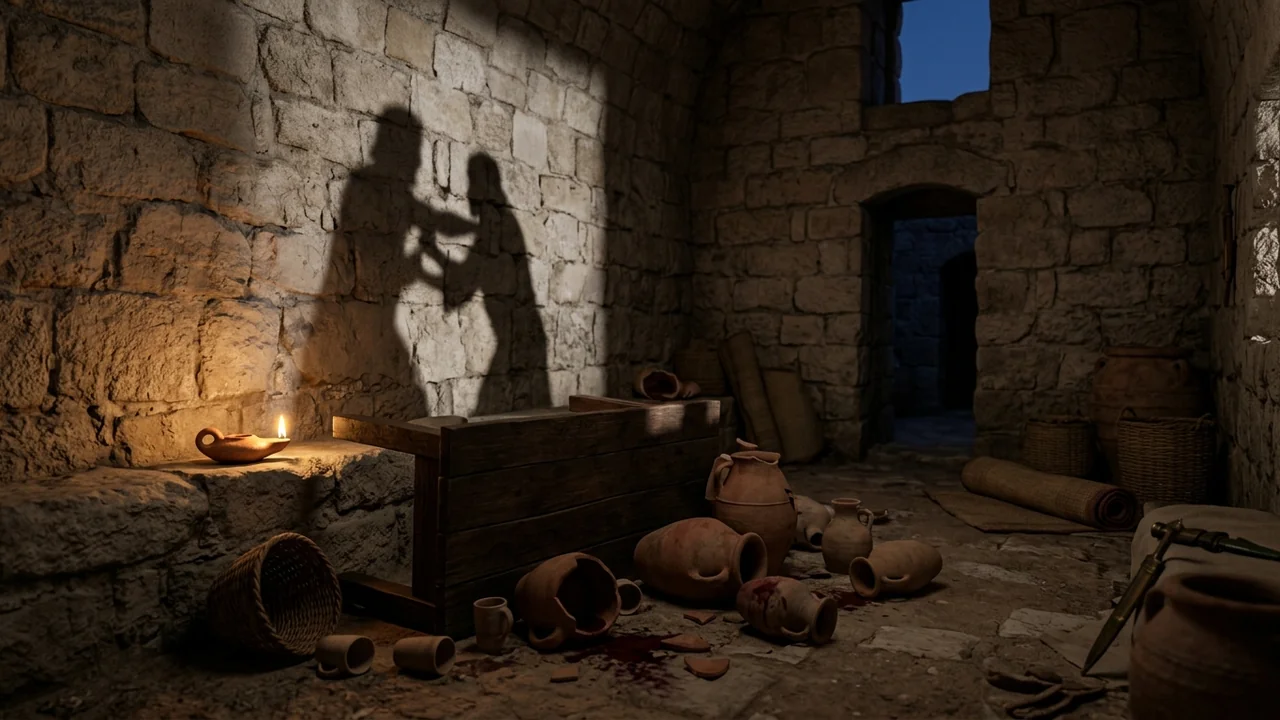
"Now it came to pass in the seventh month, that Ishmael the son of Nethaniah the son of Elishama, of the seed royal, and the princes of the king, even ten men with him, came unto Gedaliah the son of Ahikam to Mizpah; and there they did eat bread together in Mizpah. Then arose Ishmael the son of Nethaniah, and the ten men that were with him, and smote Gedaliah the son of Ahikam the son of Shaphan with the sword, and slew him, whom the king of Babylon had made governor over the land." (Jeremiah 41:1–2)
In ancient Near Eastern culture, sharing "bread and salt" at a banquet was a sacred covenant of peace and mutual protection. To draw a concealed dagger at the host's dinner table was an act of supreme moral perfidy.
Ishmael’s assassins butchered Gedaliah on his dining couch. They then launched a lightning purge through the citadel, slaughtering Gedaliah’s Jewish administrative staff and the small garrison of Babylonian soldiers stationed in Mizpah to keep order.
The Slaughter of the 70 Pilgrims and King Asa’s Cistern
The following day, unaware of the bloodbath inside the citadel, a religious delegation of eighty men arrived from the northern towns of Shechem, Shiloh, and Samaria. Devastated by the news of the Temple’s destruction, the men had shaved their beards, torn their clothes, cut themselves with mourning gashes, and were carrying meal offerings and frankincense to worship at the ruins of the house of the Lord in Jerusalem.
Ishmael walked out of the city gates to meet them, feigning grief and weeping crocodile tears: "Come to Gedaliah the son of Ahikam!" (Jeremiah 41:6).
Once the unsuspecting pilgrims walked inside the city courtyards, Ishmael and his men locked the gates and fell upon them with swords:
"And it was so, when they came into the midst of the city, that Ishmael the son of Nethaniah slew them, and cast them into the midst of the pit, he, and the men that were with him." (Jeremiah 41:7)
Ten men spared their lives by revealing hidden underground agricultural caches of wheat, barley, oil, and honey. The other seventy pilgrims were butchered and their corpses hurled into an ancient subterranean water reservoir:
"Now the pit wherein Ishmael had cast all the dead bodies of the men, whom he had slain because of Gedaliah, was it which Asa the king had made for fear of Baasha king of Israel: and Ishmael the son of Nethaniah filled it with them that were slain." (Jeremiah 41:9)
Three centuries earlier, King Asa of Judah (c. 910–870 BC) had fortified Mizpah during his border war against King Baasha of Israel (1 Kings 15:22), cutting massive stone cisterns deep into the bedrock to ensure a secure water supply during sieges. That ancient monument of national defense was converted by Ishmael into a gruesome mass grave filled to the brim with murdered worshippers!
Archaeological Excavations at Tell en-Nasbeh: The Jaazaniah Seal
Between 1926 and 1935, archaeological excavations conducted at Tell en-Nasbeh (widely identified by historical geographers as biblical Mizpah), directed by Prof. William Frederic Badè of the Pacific School of Religion, provided stunning material confirmation of the events of Jeremiah 40–41:
- Massive Iron Age Cisterns: Badè excavated dozens of colossal rock-cut cisterns dating to the 9th–6th centuries BC. Cistern No. 166 and surrounding pits matched the exact physical profile of King Asa’s subterranean water reservoir, large enough to contain dozens of human corpses.
- The Seal of Jaazaniah: In an unlooted Iron Age tomb outside the city wall, Badè uncovered one of the most famous glyptic artifacts in biblical archaeology: an exquisite banded agate signet seal bearing the carving of a fighting cock and a clear paleo-Hebrew inscription:
[The Jaazaniah Agate Signet Seal (Tell en-Nasbeh / Mizpah)]
                    ליאזניהו עבד המלך
               L' Y ' Z N Y H U   ' B D   H M L K
            "Belonging to Jaazaniah, Servant of the King"
This matches precisely Jaazaniah the son of a Maachathite (also called Jezaniah), one of the military captains who met with Gedaliah at Mizpah in 2 Kings 25:23 and Jeremiah 40:8! The seal belonged to an authentic historical officer who stood in the courtyard of Mizpah on that fateful day!
The Fast of Gedaliah (Tzom Gedaliah): A Day of Mourning
The assassination of Gedaliah was the final nail in the coffin of ancient Judah.
Terrified that Nebuchadnezzar would return with an iron broom to avenge the murder of his appointed governor and imperial soldiers, the surviving remnant—led by Johanan son of Kareah—panicked. Despite Jeremiah’s prophetic warnings that they would be safe if they remained in Judah (Jeremiah 42), the frightened survivors fled across the border into Egypt, dragging the aged prophet Jeremiah with them as a hostage, where the final remnant perished in apostasy.
Judah was left completely desolate, empty of human habitation, allowing the land to enjoy its Sabbath rests for seventy years until the decree of Cyrus the Great (2 Chronicles 36:21).
To this day, the third day of the Hebrew month of Tishrei (the day immediately following Rosh Hashanah) is observed throughout global Judaism as Tzom Gedaliah (the Fast of Gedaliah). The sages instituted a dawn-to-dusk national fast to commemorate not merely the death of a righteous man, but the catastrophic extinction of the last ember of Jewish sovereignty in the Promised Land.
Uncover the Lost Archaeological Seals of the Babylonian Era
The tragic murder of Gedaliah at Mizpah and the discovery of the Jaazaniah seal demonstrate the extraordinary tangible accuracy of the Jeremiah narratives. If you want to explore the complete epigraphic catalog of 6th-century BC bullae, Babylonian military chronicles, and excavation maps of Tell en-Nasbeh:
👉 Discover Volume II: Kings & Prophets – Tragic Ends & Medical Mysteries ($2.99)
Features the complete archaeological dossier of the Fall of Jerusalem, site plans of Mizpah cisterns, high-resolution photography of the Jaazaniah Seal, and historical commentaries on the Fast of Gedaliah.
Frequently Asked Questions
Who was Gedaliah in the Bible?
Gedaliah was a righteous Jewish nobleman appointed by Babylonian King Nebuchadnezzar II as governor over the surviving remnant of Judah following the destruction of Jerusalem in 586 BC. He established his provincial capital at Mizpah of Benjamin and successfully revived agriculture and gathered scattered refugees.
Why was Gedaliah assassinated?
Gedaliah was assassinated by Ishmael son of Nethaniah, an extremist royal prince of the House of David hired by King Baalis of Ammon. Ishmael viewed Gedaliah as a traitor for collaborating with Babylon and sought to wipe out Babylonian control and seize power.
What is the Fast of Gedaliah (Tzom Gedaliah)?
The Fast of Gedaliah is a minor public fast day observed in the Jewish calendar on the 3rd of Tishrei (the day after Rosh Hashanah). It mourns the assassination of Gedaliah and the catastrophic consequences that followed: the total dispersion of the surviving Jewish remnant into Egypt and the complete end of Jewish autonomy in the land until the return from exile.
What did archaeologists find at Tell en-Nasbeh (Mizpah)?
Excavations led by Prof. William F. Badè uncovered the fortified Iron Age city of Mizpah, including massive rock-cut cisterns matching King Asa’s reservoir (Jeremiah 41:9), and an authentic banded agate signet seal inscribed in paleo-Hebrew: "Belonging to Jaazaniah, servant of the king", directly confirming the officer named in 2 Kings 25:23 and Jeremiah 40:8.
Frequently Asked Questions
Who was Gedaliah in the Bible?
Gedaliah was a righteous Jewish nobleman appointed by Babylonian King Nebuchadnezzar II as governor over the surviving remnant of Judah following the destruction of Jerusalem in 586 BC. He established his provincial capital at Mizpah of Benjamin and successfully revived agriculture and gathered scattered refugees.
Why was Gedaliah assassinated?
Gedaliah was assassinated by Ishmael son of Nethaniah, an extremist royal prince of the House of David hired by King Baalis of Ammon. Ishmael viewed Gedaliah as a traitor for collaborating with Babylon and sought to wipe out Babylonian control and seize power.
What is the Fast of Gedaliah (Tzom Gedaliah)?
The Fast of Gedaliah is a minor public fast day observed in the Jewish calendar on the 3rd of Tishrei (the day after Rosh Hashanah). It mourns the assassination of Gedaliah and the catastrophic consequences that followed: the total dispersion of the surviving Jewish remnant into Egypt and the complete end of Jewish autonomy in the land until the return from exile.
What did archaeologists find at Tell en-Nasbeh (Mizpah)?
Excavations led by Prof. William F. Badè uncovered the fortified Iron Age city of Mizpah, including massive rock-cut cisterns matching King Asa’s reservoir (Jeremiah 41:9), and an authentic banded agate signet seal inscribed in paleo-Hebrew: "Belonging to Jaazaniah, servant of the king", directly confirming the officer named in 2 Kings 25:23 and Jeremiah 40:8.
Related Research Dossiers
View all 120 articles →
The Poisonous Snake That Didn’t Kill Paul: The Viper of Malta and Ancient Neurotoxins

The Three Piercing Darts: The Defeat and Death of Prince Absalom in the Forest of Ephraim