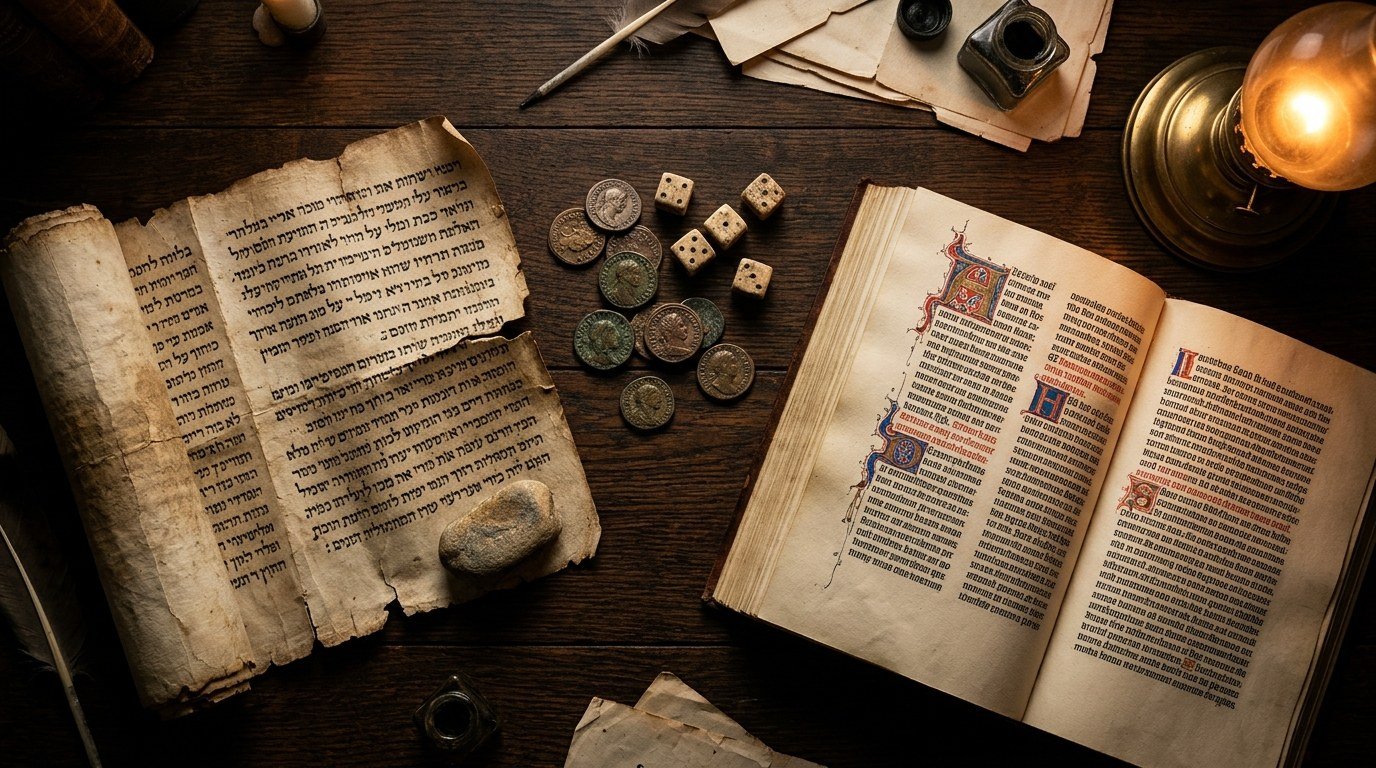
What everyday ancient artifacts are displayed alongside the Dead Sea Scrolls?
Exhibitions of the Dead Sea Scrolls pair biblical manuscripts with everyday Near Eastern objects dating back to 2000 B.C., including clay oil lamps, pottery vessels, carved six-sided bone dice, and first-century Jewish and Roman coins.
Ancient patristic witnesses, Second Temple manuscripts, and classical annals.
Stratigraphic digs, monumental epigraphy, and artifact forensics in the Levant.
Distinguishing canonical Scripture text from historical patristic traditions.
Subject Scope: From Qumran Caves to the Gutenberg Press: 5 Ancient Artifacts That Connect the Biblical World to Yours
Historical Context: Ancient Near Eastern stratigraphy, Levant archaeological surveys, and Semitic epigraphy.
Primary Evidence: Monumental stelae, bullae seals, ceramic typology, and calibrated AMS radiocarbon determinations.
Investigation Highlights: 1. Everyday Pottery, Tools, and Ancient Dice (Dating Back to 2000 B.C.) • 2. Jewish and Roman Coins from the First Century • 3. Hand-Written Torah Scrolls
Scholarly Consensus: Aligned with published excavation reports from leading Near Eastern archaeological institutes.
It is easy to think of the Bible as belonging to a distant, almost mythical era—a world completely disconnected from our own daily routines. Yet when you stand face-to-face with the physical objects left behind by the people of Scripture, that distance disappears in an instant.
In a recent report on Biola University's "Dead Sea Scrolls and the Bible" exhibit (The Chimes), fourth-year student Madison Hakala noted that the artifact that surprised her most wasn't just the towering scrolls—it was a humble set of ancient dice tucked in the corner of the gallery. "They're very much the same dice that we have today," she observed, "and it kind of just really reminded me that like the past and like the present aren't really that different from one another."
Here are 5 remarkable historical artifacts—all showcased along the timeline of biblical preservation—that trace how God's Word traveled from ancient desert caves to your nightstand.
1. Everyday Pottery, Tools, and Ancient Dice (Dating Back to 2000 B.C.)
Long before printing presses existed, real families cooked in clay vessels, traded with stamped bronze coins, and played tabletop games with carved six-sided dice (The Chimes). Seeing those ordinary objects reminds us that the men and women of the Bible felt the exact same human hopes, griefs, and financial pressures we experience today—and relied on the exact same faithful God.
2. Jewish and Roman Coins from the First Century
When Jesus asked to see a denarius and declared, "Render to Caesar the things that are Caesar's, and to God the things that are God's," He was holding real minted currency. Surviving Jewish and Roman coins displayed alongside the Dead Sea Scrolls anchor the Gospels in verifiable first-century economics and politics.
3. Hand-Written Torah Scrolls
Before books had bindings or page numbers, sacred communities gathered around hand-sewn parchment Torah scrolls. Every column was inspected for accuracy, preserving the five books of Moses with reverent precision across generations of synagogue worship.
4. A Leaf from the 15th-Century Gutenberg Bible
For over a thousand years, owning a personal copy of the Bible was nearly impossible for an ordinary family. Everything changed in the 1450s when Johannes Gutenberg's movable-type printing press produced the Gutenberg Bible—sparking a revolution that began placing Scripture into the hands of everyday believers.
5. William Tyndale's Legacy & the First Printing of the King James Bible
Exhibits pairing Matthew's Bible, Luther's Bible (drawing from William Tyndale's courageous English translation), and pages from the first printing of the King James Bible tell the story of men who risked—and gave—their lives so ordinary people could read the Gospel in their own native language (The Chimes).
Honoring the Gift We Hold in Our Hands
Today, we carry the entire Bible on our phones and keep leather study Bibles on our desks—a privilege generations of believers could only dream of. Knowing the extraordinary chain of scrolls, scribes, and printers that delivered Scripture to us turns daily reading from a chore into a sacred privilege.
Make Your Daily Bible Reading Unforgettable:
- Mark your place with an heirloom keepsake built to last a lifetime: explore our $10.00 Joshua 1:9 Laser-Engraved Stainless Steel Bible Bookmark (Free Worldwide Shipping + Free Instant E-Book).
- Unlock timeless biblical wisdom for daily decisions with The Solomon Code.
Dead Sea Scrolls & Second Temple Manuscripts
Examining Qumran cave discoveries, Septuagint variants, biblical textual transmission, and ancient Jewish non-canonical documents. Each investigation in this pillar is corroborated by primary classical manuscripts, epigraphy, and peer-reviewed historical forensics.
Pillar Dossiers in this Corpus
The Great Isaiah Scroll (1QIsa-a, c. 125 BC): The 7.34-Meter Masterpiece and Isaiah 53
13 min read · Verified Primary DossierThe Dead Sea Scrolls in Cave 4: The 1,000-Year Proof of Scripture's Textual Integrity
17 min read · Verified Primary DossierThe Community Rule (1QS / Serekh ha-Yahad): The Essene Discipline, Dual Messianism, and Primary Sources
13 min read · Verified Primary DossierHas the Bible Been Altered? What the Great Isaiah Scroll (1QIsa-a, c. 125 BC) Proves About the Divine Transmission of Scripture
26 min read · Verified Primary DossierThe Unwritten Gospel: Volume III — The Final Files
Complete unedited English translations of Qumran cave fragments, messianic hymns, and ancient temple treasures.
Primary Sources & Scholarly Archives
Editorial Standard →Official archaeological field reports, certified stratigraphy surveys, and Semitic epigraphy catalogs.
Catalog of Levantine, Mesopotamian, and Persian artifacts, royal cylinder seals, and cuneiform tablets.
Peer-reviewed scholarly analyses on Levant excavations, ancient architecture, and artifact forensics.
Frequently Asked Questions
What everyday ancient artifacts are displayed alongside the Dead Sea Scrolls?
Exhibitions of the Dead Sea Scrolls pair biblical manuscripts with everyday Near Eastern objects dating back to 2000 B.C., including clay oil lamps, pottery vessels, carved six-sided bone dice, and first-century Jewish and Roman coins.
How did the Gutenberg Press and William Tyndale change Bible history?
Johannes Gutenberg introduced movable-type printing in the 1450s, allowing Bibles to be printed rather than hand-copied, while William Tyndale gave his life translating the New Testament and Hebrew Scriptures directly into accessible English.
Why do biblical archaeology exhibits include both Qumran scrolls and 16th-century printed Bibles?
Pairing Qumran manuscripts with Torah scrolls, a Gutenberg Bible leaf, Matthew’s Bible, and a first-printing King James Bible traces the continuous 2,000-year chain of preservation from ancient desert caves to modern printed Scripture.
Related Research Dossiers
View all 572 research dossiers →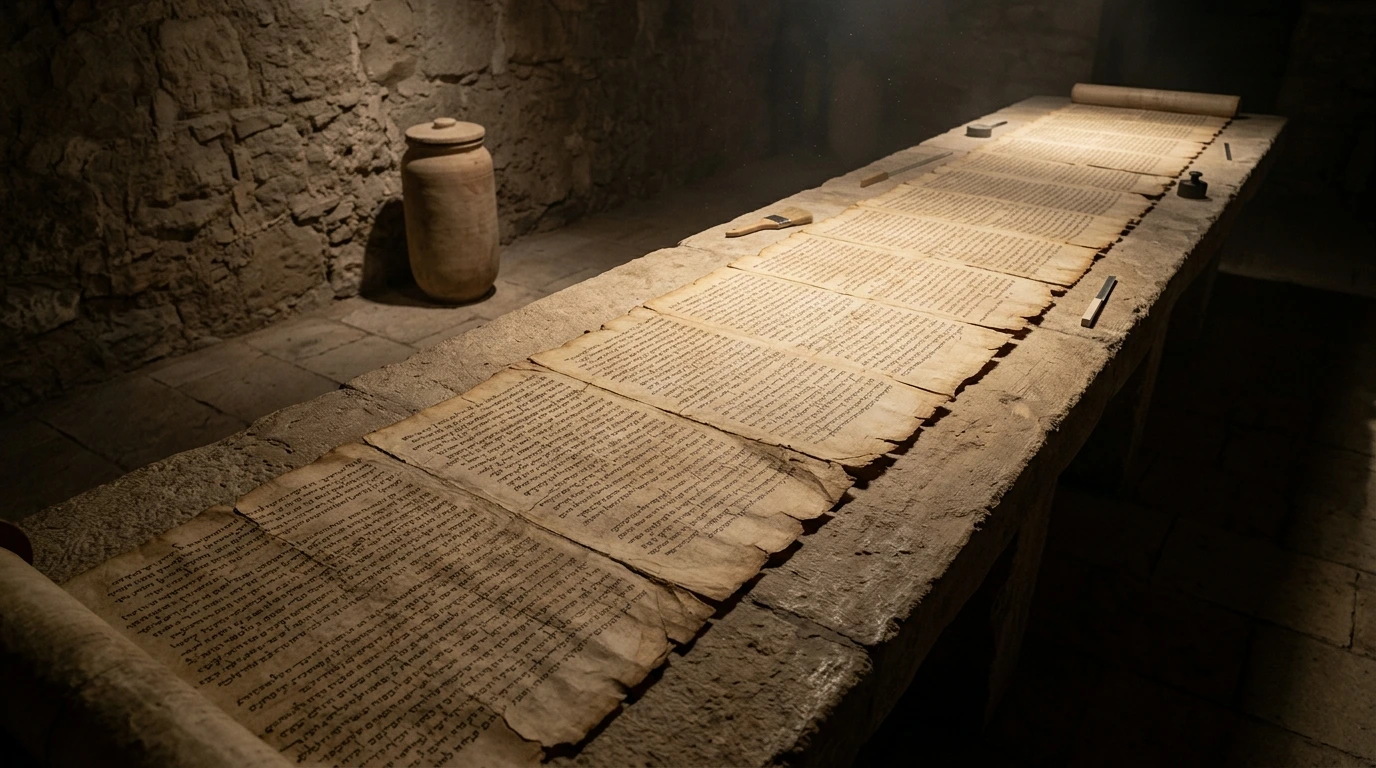
The Great Isaiah Scroll (1QIsa-a, c. 125 BC): The 7.34-Meter Masterpiece and Isaiah 53
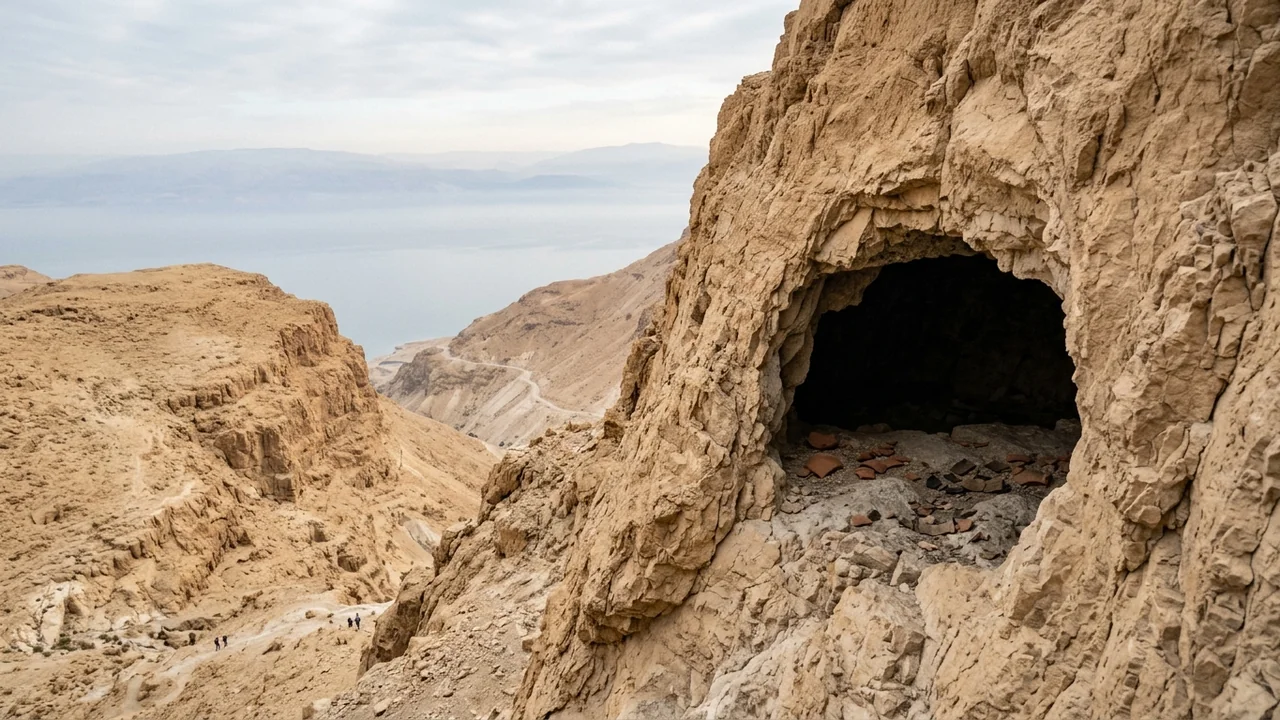
The Dead Sea Scrolls in Cave 4: The 1,000-Year Proof of Scripture's Textual Integrity
