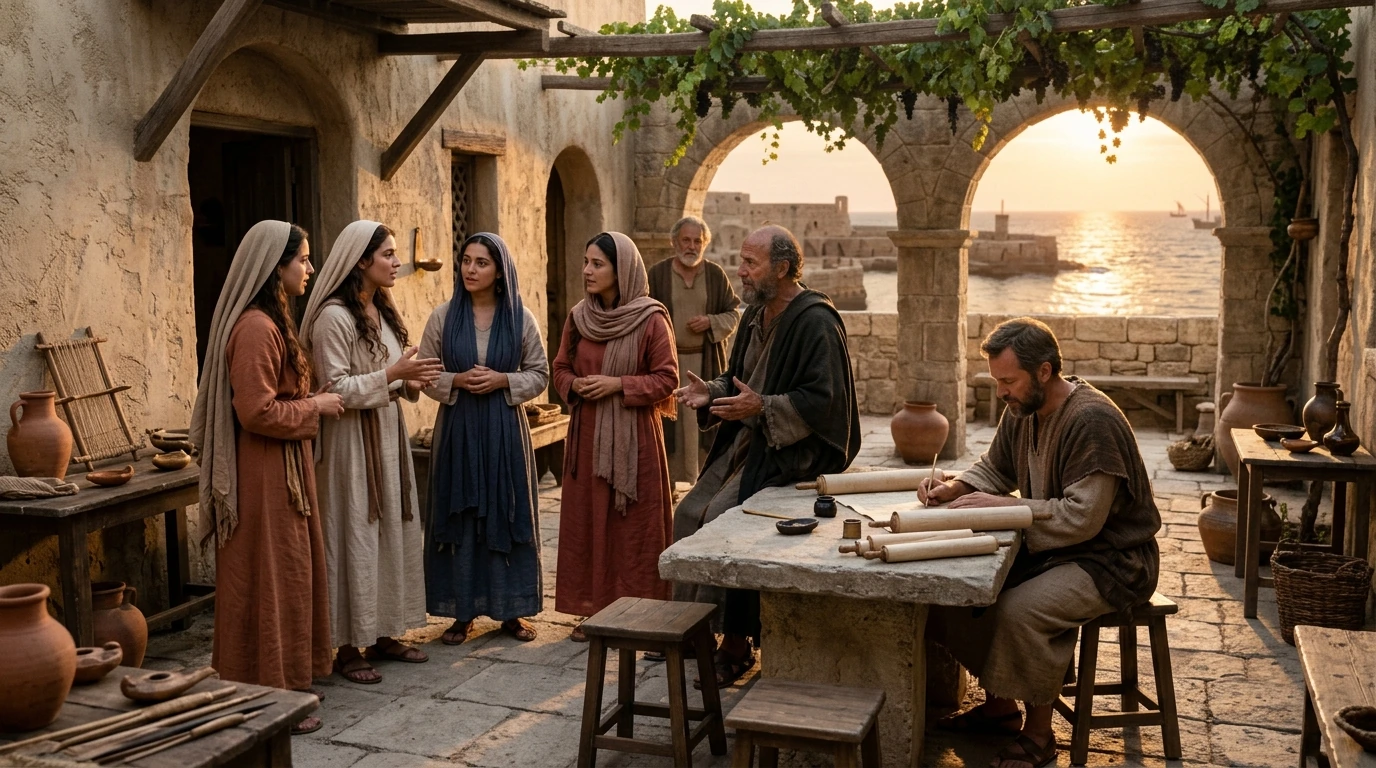
Subject Scope: The Four Daughters of Philip in Acts 21: Archaeology, Facts, and Verse-by-Verse Guide to Apostolic Caesarea
Historical Context: Rigorous historical and theological examination within the field of Women of the Bible & Ancient Near Eastern Law.
Primary Evidence: Forensic archaeology, textual preservation, and primary ancient manuscripts corroborating scriptural events.
Investigation Highlights: Acts 21:8: Philip the Evangelist and the "Seven" • Acts 21:9: The Four Virgin Prophetesses • Acts 21:10–11: Agabus and the Enacted Prophecy of the Belt
Scholarly Consensus: Vetted against peer-reviewed academic literature in biblical history, linguistics, and archaeology.
Acts 21:8: Philip the Evangelist and the "Seven"
In Acts 21:8, Luke records the arrival of Paul’s missionary delegation at Caesarea Maritima:
"On the next day we departed and came to Caesarea, and we entered the house of Philip the evangelist, who was one of the seven, and stayed with him." — Acts 21:8
This passage highlights an extraordinary historical reunion between two former theological adversaries:
- Philip the Hellenist: Appointed in Acts 6:5 as one of the Seven Hellenistic leaders in the Jerusalem church, alongside Stephen.
- Paul (Saul of Tarsus): The former Pharisaic inquisitor who actively consented to the execution of Stephen (Acts 8:1) and whose violent persecution dispersed Philip and the Hellenists from Jerusalem into Samaria.
Two decades later, the former persecutor and the displaced evangelist embrace as brothers in Christ. Philip welcomes Paul and Luke into his home for an extended stay of several days.
+----------------------------------------------------------------------------------------------------+
|               THE HISTORICAL RECONCILIATION: PHILIP AND PAUL (CAESAREA, AD 57)                    |
+--------------------------+-----------------------+-------------------+-----------------------------+
| HISTORICAL FIGURE        | AD 34 STATUS          | AD 57 STATUS      | THEOLOGICAL RESOLUTION      |
+--------------------------+-----------------------+-------------------+-----------------------------+
| 1. Philip the Evangelist | Persecuted Deacon     | Senior Pioneer    | Gracious hospitality        |
| 2. Paul (Saul of Tarsus) | Violent Persecutor    | Apostle to Nations| Honored brother & guest     |
| 3. Luke the Physician    | Hellenistic Convert   | Traveling Historian| Direct interview of Philip  |
+--------------------------+-----------------------+-------------------+-----------------------------+
Acts 21:9: The Four Virgin Prophetesses
In Acts 21:9, Luke provides a biographical snapshot of Philip’s immediate family:
"He had four unmarried daughters, who prophesied." — touto de esan thygateres tessares parthenoi propheteuousai.
This single verse presents several key theological and cultural insights:
- The Four Daughters: Having four daughters in an ancient household all consecrated to lifelong virginity (parthenoi) was exceedingly rare in Jewish and Greco-Roman society, where cultural pressure demanded early marriage to secure family lineage.
- Lifelong Consecration: Their celibacy was voluntary, anticipating the formal order of consecrated virgins (ordo virginum) that developed across the early church.
- Recognized Prophetic Function: The verb propheteuousai denotes continuous charismatic activity. They were widely known throughout the churches of Judea and Syria as women through whom the Holy Spirit spoke divine truth, wisdom, and pastoral direction.
Acts 21:10–11: Agabus and the Enacted Prophecy of the Belt
While Paul’s team lingered at Philip’s home, a prophet named Agabus arrived from Jerusalem:
"While we were staying for many days, a prophet named Agabus came down from Judea. And coming to us, he took Paul’s belt and bound his own feet and hands and said, 'Thus says the Holy Spirit, This is how the Jews at Jerusalem will bind the man who owns this belt and deliver him into the hands of the Gentiles.'" — Acts 21:10–11
+----------------------------------------------------------------------------------------------------+
|               THE TRADITION OF ENACTED DRAMATIC PROPHECY IN SCRIPTURE                             |
+--------------------------+-----------------------+-------------------+-----------------------------+
| PROPHET                  | SCRIPTURAL TEXT       | DRAMATIC ACTION   | SYMBOLIC MEANING            |
+--------------------------+-----------------------+-------------------+-----------------------------+
| 1. Isaiah                | Isaiah 20:2–4         | Walks barefoot    | Captivity of Egypt & Cush   |
| 2. Jeremiah              | Jeremiah 13:1–11      | Hides linen belt  | Ruin and pride of Judah     |
| 3. Ezekiel               | Ezekiel 4:1–12        | Lies on his side  | Siege and bearing iniquity  |
| 4. Agabus                | Acts 21:11            | Binds own hands   | Arrest and transfer of Paul |
+--------------------------+-----------------------+-------------------+-----------------------------+
Agabus’s action stood squarely within the classical Old Testament tradition of enacted prophetic sign-actions (otot). The Greek term for belt (zone) described a sturdy leather or textile sash worn around the tunic to carry money and documents. By physically tying his own hands and feet, Agabus visually arrested the attention of everyone in Philip’s home.
Acts 21:12–14: The Sovereign Will of the Lord
Agabus’s dramatic revelation provoked an intense emotional crisis among Paul’s traveling companions:
"When we heard this, we and the people there urged him not to go up to Jerusalem. Then Paul answered, 'What are you doing, weeping and breaking my heart? For I am ready not only to be imprisoned but even to die in Jerusalem for the name of the Lord Jesus.' And since he would not be persuaded, we ceased and said, 'Let the will of the Lord be done.'" — Acts 21:12–14
Notice that Luke includes himself in the pleading ("we... urged him"). Even seasoned missionaries misinterpreted the purpose of the prophecy:
- The Misinterpretation: Luke and the Caesarean believers assumed that because the prophecy warned of chains and suffering, God was commanding Paul to avoid Jerusalem.
- Paul's Theological Clarity: Paul understood that the Holy Spirit was not forbidding the journey, but forewarning and equipping him to endure the suffering ordained for the gospel (Acts 20:22–24).
The company submitted to divine sovereignty: "The will of the Lord be done" (to thelema tou Kyriou ginestho), echoing Jesus’ prayer in Gethsemane (Luke 22:42).
Archaeological Comparison Matrix: Caesarea Discoveries
+----------------------------------------------------------------------------------------------------+
|               ARCHAEOLOGICAL MATRIX: CAESAREA MARITIMA & ACTS 21                                   |
+--------------------------+-----------------------+-------------------+-----------------------------+
| BIBLICAL ELEMENT         | MATERIAL ARTIFACT     | EXCAVATION SITE   | EVIDENTIARY VALUE           |
+--------------------------+-----------------------+-------------------+-----------------------------+
| 1. Caesarea Harbor       | Pozzolana Breakwaters | Sebastos Port     | Authenticates maritime route|
| 2. Governor's Palace     | Promontory Praetorium | Southern Point    | Roman venue of Paul's trial |
| 3. Domestic Quarters     | Peristyle Townhouses  | Urban Insulae     | Material reality of villas  |
| 4. Christian Epigraphy   | Early Cross Inscriptions| Byzantine Walls | Continuous local tradition  |
+--------------------------+-----------------------+-------------------+-----------------------------+
Primary Sources & Scholarly Archives
Editorial Standard →Original Hebrew, Aramaic, and Greek interlinear analysis, morphological tags, and ancient variant readings.
Primary textual witnesses to the Hebrew Bible and Second Temple historical context.
Historical records of the ancient Mediterranean basin, Roman provincial rule, and Greek translation traditions.
Frequently Asked Questions
Why didn’t Philip’s four daughters prophesy about Paul’s arrest instead of Agabus?
God used Agabus as an independent prophetic sign from Judea to confirm prior warnings (Acts 21:4), while Philip’s daughters provided continuous household ministry.
What happened to Philip’s house in Caesarea after the Jewish War?
With the outbreak of the war in AD 66, Jewish Christians evacuated Caesarea, with Philip’s household establishing their final home in Hierapolis, Asia Minor.
Is voluntary celibacy promoted in the New Testament?
Yes. Jesus (Matt 19:12) and Paul (1 Cor 7:32–34) honor voluntary celibacy as a divine charisma for total focus on the Kingdom of God.
How did the Caesarea stay impact Luke’s Gospel?
Residing in Caesarea during Paul’s two-year imprisonment gave Luke direct access to foundational eyewitnesses like Philip to write his Gospel and Acts.
Related Research Dossiers
View all 515 research dossiers →
Herodian Oil Lamps of the First Century: Archaeology, Purity Laws, and the Parable of the Ten Virgins (Matthew 25)
Joanna Wife of Chuza in Luke 8: Archaeology, Facts, and Verse-by-Verse Guide to Herodian Court Disciples