Subject Scope: How Caesarea Maritima Confirms the Historical and Legal Accuracy of the Book of Acts
Historical Context: Ancient Near Eastern stratigraphy, Levant archaeological surveys, and Semitic epigraphy.
Primary Evidence: Monumental stelae, bullae seals, ceramic typology, and calibrated AMS radiocarbon determinations.
Investigation Highlights: Luke the Historian: Forensic Precision in Maritime Judea • The Italian Cohort: Epigraphic Confirmation of Cornelius (Acts 10) • The Death of Herod Agrippa I: Acts 12 vs. Flavius Josephus
Scholarly Consensus: Aligned with published excavation reports from leading Near Eastern archaeological institutes.
Luke the Historian: Forensic Precision in Maritime Judea
In the nineteenth and early twentieth centuries, historical-critical theologians of the German Tübingen School asserted that the Book of Acts was a second-century historical romance—a theological fiction written long after the apostolic generation to harmonize competing Peter and Paul factions. Critics claimed that the author (Luke) displayed an amateurish, inaccurate grasp of Roman provincial law, judicial magistrates, military titles, and geography.
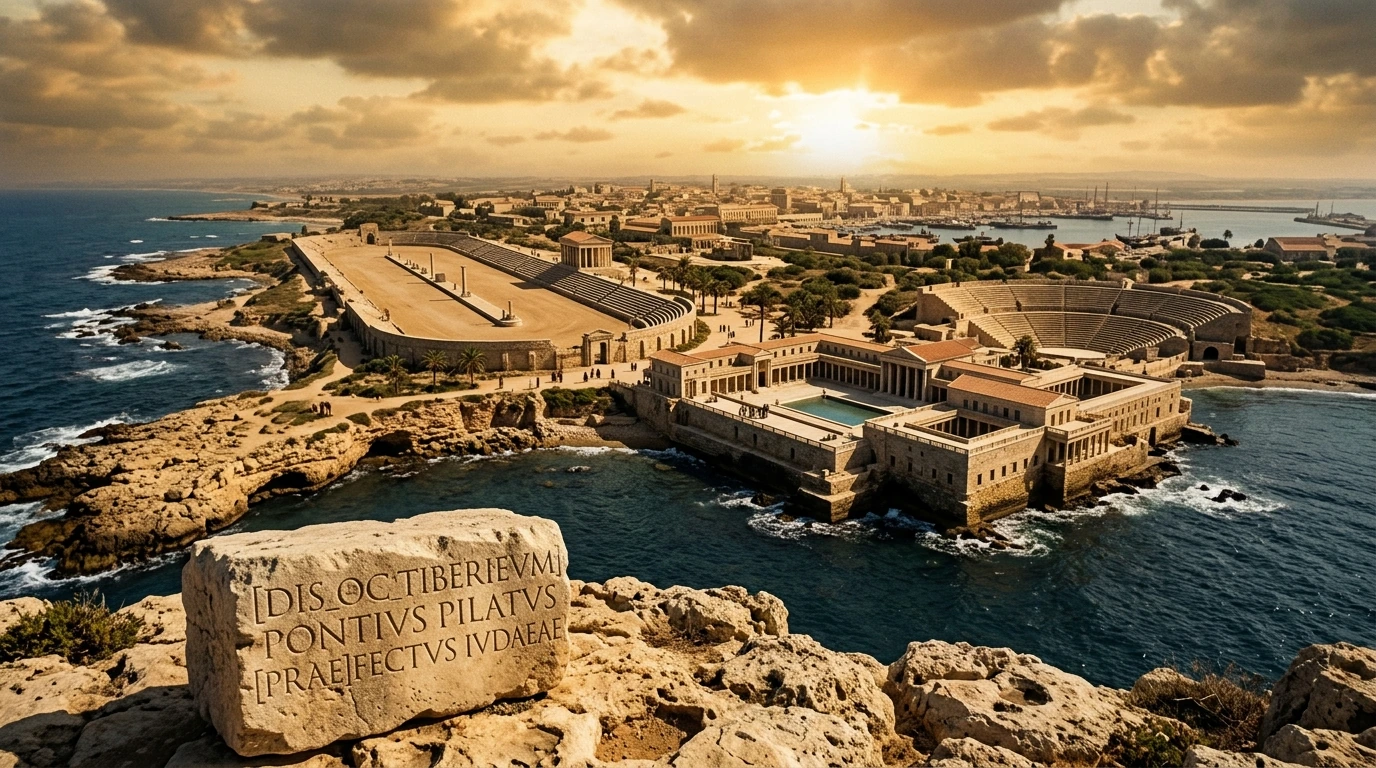
No archaeological site on earth has done more to dismantle this skeptical narrative than Caesarea Maritima. In his groundbreaking epigraphic research, Sir William Ramsay observed that whenever Luke’s accounts in Acts touch upon Roman administrative nomenclature, provincial boundaries, and legal procedures in Caesarea, Luke demonstrates the meticulous, firsthand accuracy of an eyewitness investigative historian.
From the specific regiment of the Roman military to the exact Latin jurisdictional legal mechanisms invoked by the Apostle Paul, the material and textual evidence uncovered at Caesarea vindicates the historical authenticity of Holy Scripture.
+----------------------------------------------------------------------------------------------------+
|               LUKE'S ACCURACY IN ROMAN LEGAL & CIVIC TERMINOLOGY IN CAESAREA                       |
+--------------------------+-----------------------+-------------------+-----------------------------+
| BIBLICAL PASSAGE         | SPECIFIC TERM / EVENT | ROMAN LEGAL REALITY| ARCHAEOLOGICAL STATUS       |
+--------------------------+-----------------------+-------------------+-----------------------------+
| Acts 10:1                | "Italian Cohort"      | Cohors II Italica | Epigraphically confirmed in |
|                          | (*speira Italike*)    | Civium Romanorum  | Syrian & Judean inscriptions|
| Acts 12:21–23            | Silver Robe & Death   | Royal festival in | Exactly matches Josephus    |
|                          | of Herod Agrippa I    | Caesarea theater  | Antiquities 19.8.2          |
| Acts 23:35               | "Herod's Praetorium"  | Promontory Palace | Official residence of Roman |
|                          | (*praitorion*)        | of Roman Governor | governors in excavations    |
| Acts 25:11–12            | "I appeal to Caesar!" | *Provocatio ad    | Sacred legal right of all   |
|                          | (*Kaisara epikaloumai*)| Caesarem*        | verified Roman citizens     |
+--------------------------+-----------------------+-------------------+-----------------------------+
The Italian Cohort: Epigraphic Confirmation of Cornelius (Acts 10)
In Acts 10:1, Luke introduces the pivotal figure through whom the Gospel was first extended to the uncircumcised Gentile world:
"At Caesarea there was a man named Cornelius, a centurion in what was known as the Italian Regiment (Cohort, σπείρης τῆς καλουμένης Ἰταλικῆς)."
Skeptics long alleged that Luke made a chronological blunder, arguing that auxiliary Italian units were not stationed in Judea until after the Jewish War of 70 AD.
Epigraphic discoveries have utterly refuted this objection. Inscriptions discovered in Syria, Austria, and Rome document the historical existence of the Cohors II Italica Voluntariorum civium Romanorum ("Second Italian Cohort of Roman Citizen Volunteers"), an auxiliary infantry unit composed of freeborn Roman citizens recruited from the Italian peninsula. An inscription found at Carnuntum confirms that this exact Italian cohort was stationed in Syria and Judea during the mid-first century AD, precisely during the timeframe of Peter's visit to Caesarea.
As a centurion (hekatonarches) of an elite citizen cohort, Cornelius commanded 80 to 100 soldiers, possessed substantial social prestige, and enjoyed Roman citizen status—making his humble submission to the message of a crucified Galilean Messiah an earth-shattering cultural and theological watershed.
The Death of Herod Agrippa I: Acts 12 vs. Flavius Josephus
In Acts 12:21–23, Luke describes the sudden, terrifying demise of King Herod Agrippa I (grandson of Herod the Great), who had recently executed the Apostle James and imprisoned Peter:
"On the appointed day Herod, wearing his royal robes, sat on his throne and delivered a public address to the people. They shouted, 'This is the voice of a god, not of a man.' Immediately, because Herod did not give praise to God, an angel of the Lord struck him down, and he was eaten by worms and died."
Remarkably, the non-Christian Jewish historian Flavius Josephus, writing in Rome decades later, records this exact event in his Antiquities of the Jews (19.8.2) with astonishing circumstantial agreement:
- The Location: Josephus specifies that the festival took place in the theater of Caesarea Maritima, held in honor of Emperor Claudius.
- The Robes: Josephus records that Agrippa entered the theater wearing a garment "woven entirely of silver, of truly wonderful texture," which glittered so blindingly in the morning sun that it struck dread into his onlookers.
- The Flattery: Josephus notes that his sycophantic flatterers cried out that he was a god, shouting: "Be merciful to us; for although we have hitherto reverenced thee only as a man, yet shall we henceforth own thee as superior to mortal nature!"
- The Sudden Judgment: Josephus states that the king did not rebuke them. Immediately, looking up, he saw an owl perched on a rope above him (an omen of death), was seized with violent intestinal agony, was carried into his palace, and died after five days of severe abdominal agony.
+----------------------------------------------------------------------------------------------------+
|               SYNOPTIC COMPARISON: THE DEATH OF HEROD AGRIPPA I (44 AD)                            |
+------------------------------------+---------------------------------------------------------------+
| ACTS 12:21–23 (LUKE)               | ANTIQUITIES 19.8.2 (FLAVIUS JOSEPHUS)                         |
+------------------------------------+---------------------------------------------------------------+
| Appointed day in Caesarea          | Festival in the Caesarea Theater in honor of Claudius         |
| Dressed in royal robes             | Garment woven entirely of silver glittering in the morning sun|
| Public speech from royal seat      | Addressed the assembly from the theater's elevated podium     |
| Crowd cries: "Voice of a god!"     | Flatterers shout: "Be merciful to us... thou art a god!"      |
| King did not give praise to God    | King did not rebuke them for their impious flattery           |
| Struck down; eaten by worms & died | Seized with violent intestinal pains; died after 5 days agony |
+------------------------------------+---------------------------------------------------------------+
The precision with which two independent first-century authors—one a Christian physician, the other a Jewish aristocrat—describe the identical location, garment, royal hubris, crowd blasphemy, and fatal medical pathology provides unassailable proof of the historical veracity of Acts.
Paul’s Roman Legal Defense: Provocatio ad Caesarem (Acts 25)
Following his arrest in Jerusalem to save him from a Jewish mob, Paul was transferred to Caesarea to prevent his assassination by forty conspirators (Acts 23). For two years, Paul languished in custody inside Herod's Praetorium under the corrupt procurator Antonius Felix, who delayed justice hoping Paul would offer him a bribe (Acts 24:26).
When Porcius Festus replaced Felix in 60 AD, the Jerusalem religious authorities pressured the new governor to transfer Paul to Jerusalem for trial, intending to ambush and murder him along the mountain road.
In Acts 25:9–12, inside the Caesarean judgment hall, Paul enacted the ultimate constitutional right granted to Roman citizens: Provocatio ad Caesarem (The Right of Appeal to the Emperor):
"Paul answered: 'I am now standing before Caesar’s court, where I ought to be tried. I have not done any wrong to the Jews, as you yourself know very well... I appeal to Caesar! (Καίσαρα ἐπικαλοῦμαι).' Then Festus, when he had conferred with the council, answered: 'You have appealed to Caesar. To Caesar you will go!'"
The Roman Legal Jurisprudence
Under the Lex Valeria and the Lex Julia de vi publica, every Roman citizen possessed an inviolable constitutional safeguard against arbitrary provincial magistrate tyranny. Once a citizen uttered the formal legal formula Appello Caesarem, the provincial magistrate lost all legal jurisdiction over the case. To execute, scourge, or unlawfully detain an appealing citizen was a capital crime against imperial majesty (crimen laesae maiestatis).
Festus had no legal authority to overrule Paul’s appeal; he was legally compelled to dispatch Paul under military guard on an imperial transport grain ship to Rome, initiating the fateful voyage recorded in Acts 27.
The Audience Hall of Agrippa II and Bernice: Royal Protocols
Prior to sending Paul to Rome, Festus hosted King Herod Agrippa II and his sister Queen Bernice, who came to Caesarea to pay official imperial respects to the new Roman governor. Festus sought Agrippa’s expertise in Jewish religious law to compose the formal legal charges (elogium) required by the imperial chancery in Rome (Acts 25:26–27).
In Acts 25:23, Luke describes their grand entrance with vivid cultural color:
"The next day Agrippa and Bernice came with great pomp (μετὰ πολλῆς φαντασίας, meta polles phantasias) and entered the audience room with the high-ranking military officers and the prominent men of the city."
The Greek phrase meta polles phantasias literally denotes a theatrical, extravagant royal procession—purple robes, golden diadems, Roman lictors bearing axes (fasces), and heralds blowing bronze trumpets.
Standing in chains before this dazzling array of imperial power, Paul delivered the masterwork defense speech of Acts 26: recounting his Damascus road theophany, explaining the resurrection of the dead, and boldly challenging the Jewish monarch: "King Agrippa, do you believe the prophets? I know you believe!" (Acts 26:27).
Three-Tier Evidentiary Evaluation: Material Artifacts
+----------------------------------------------------------------------------------------------------+
|               THREE-TIER EVIDENTIARY EVALUATION: ACTS AT CAESAREA                                  |
+----+----------------------+-----------------------------+-------------------+----------------------+
| #  | HISTORICAL SKEPTICISM| SKEPTICAL CLAIM             | MATERIAL EVIDENCE | EVIDENTIARY VERDICT  |
+----+----------------------+-----------------------------+-------------------+----------------------+
| 1  | "The Italian Cohort  | Italian cohorts did not     | Carnuntum & Syrian| CONFIRMED: Epigraphy |
|    | in Acts 10 Was a Late| exist in Judea prior to the | Latin inscriptions| proves Cohors II     |
|    | Fictional Invention" | destruction of 70 AD        | of Italian Cohort | Italica active in era|
+----+----------------------+-----------------------------+-------------------+----------------------+
| 2  | "Agrippa's Worm-Eaten| The miraculous death of     | Flavius Josephus  | CONFIRMED: Extrabi-  |
|    | Death in Acts 12 Was | Agrippa I was a Christian   | Antiquities 19.8.2| blical confirmation  |
|    | Made-Up Propaganda"  | fairy tale                  | theater festival  | of exact details     |
+----+----------------------+-----------------------------+-------------------+----------------------+
| 3  | "Paul's Legal Trial  | Luke fabricated Roman legal | Lex Julia de vi   | CONFIRMED: Exact     |
|    | & Appeal Were Late   | procedures and magistrate   | publica; Caesarea | first-century legal  |
|    | Inventions"          | terminology                 | Praetorium hall   | mechanics documented |
+----+----------------------+-----------------------------+-------------------+----------------------+
Frequently Asked Questions
Did Flavius Josephus confirm the death of Herod Agrippa I in the Caesarea theater?
Yes. In Antiquities of the Jews (19.8.2), Josephus independently confirms that Herod Agrippa I died after attending a festival in the Caesarea theater wearing a silver robe, where flatterers hailed him as a god, suffering immediate abdominal agony, perfectly confirming Acts 12:21–23.
What was the 'Italian Cohort' mentioned in Acts 10:1?
The Italian Cohort (Cohors II Italica Voluntariorum civium Romanorum) was an elite Roman auxiliary unit composed of Roman citizens from Italy. Ancient military inscriptions found in Syria and Europe confirm that this exact unit was stationed in Judea during the mid-first century AD.
Why did the Roman governor Festus have to send Paul to Rome after his appeal?
Under Roman constitutional law (Provocatio ad Caesarem), any verified Roman citizen accused of a crime had the legal right to appeal their case directly to the Emperor in Rome. Once Paul invoked this right, Festus had no legal authority to try or release him, but was mandated to send him to Nero.
Primary Sources & Scholarly Archives
Editorial Standard →Official archaeological field reports, certified stratigraphy surveys, and Semitic epigraphy catalogs.
Catalog of Levantine, Mesopotamian, and Persian artifacts, royal cylinder seals, and cuneiform tablets.
Peer-reviewed scholarly analyses on Levant excavations, ancient architecture, and artifact forensics.
Frequently Asked Questions
Did Flavius Josephus confirm the death of Herod Agrippa I in the Caesarea theater?
Yes. Josephus recorded that Agrippa I was stricken with fatal intestinal agony in the Caesarea theater after accepting blasphemous praise from a crowd while wearing a garment of pure silver, matching Acts 12:21–23.
What was the 'Italian Cohort' mentioned in Acts 10:1?
Ancient Roman military inscriptions confirm that the 'Cohors II Italica Voluntariorum' was an authentic Roman citizen infantry unit deployed in Judea during the mid-first century AD, verifying Cornelius' military background.
Why did the Roman governor Festus have to send Paul to Rome after his appeal?
Under the Roman legal statutes of Provocatio, any Roman citizen who formally appealed to Caesar was immune from provincial execution and was legally required to be transported to Rome for trial before the imperial court.
Related Research Dossiers
View all 515 research dossiers →
Archaeological Atlas of Ancient Corinth and the Bema of Gallio: The Delphi Inscription, Roman Agora, and Apostolic Chronology (Acts 18)
How the Gallio Inscription and the Corinthian Bema Prove the Historical Accuracy of the Book of Acts