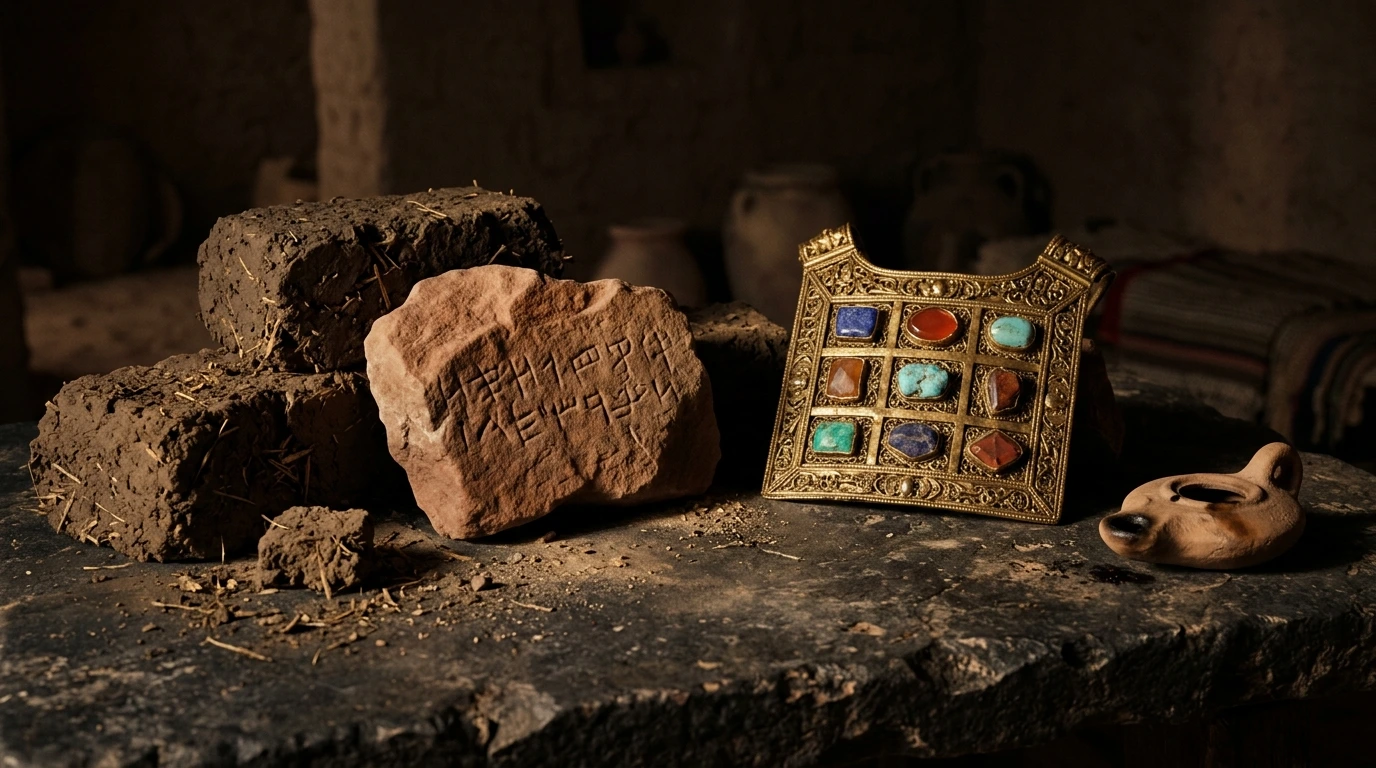
Subject Scope: Printable & Digital Bible Study Kit: The Book of Exodus, Plagues, and Tabernacle Archaeology and Biblical Facts
Historical Context: Ancient Near Eastern stratigraphy, Levant archaeological surveys, and Semitic epigraphy.
Primary Evidence: Monumental stelae, bullae seals, ceramic typology, and calibrated AMS radiocarbon determinations.
Investigation Highlights: The Historical Framework of the Semitic Presence in Egypt • The Pithom and Raamses Synchronism (Exodus 1:11) • The Soleb Inscription: Earliest Historical Attestation of Yahweh
Scholarly Consensus: Aligned with published excavation reports from leading Near Eastern archaeological institutes.
The Historical Framework of the Semitic Presence in Egypt
For over two centuries, modern archaeological excavations in the eastern Nile Delta (the biblical Land of Goshen) have unearthed compelling evidence of massive Asiatic (Western Semitic) settlements dating between the Middle Kingdom and New Kingdom periods. At the site of Tell el-Dab'a (ancient Avaris, later incorporated into the Ramesside royal complex of Pi-Ramesse), Austrian archaeologist Manfred Bietak conducted decades of stratigraphic excavations revealing a bustling Semitic metropolis.
The material culture discovered at Tell el-Dab'a reflects distinctly Canaanite architecture:
- Four-room houses identical to those later built by Israelites in the hill country of Canaan.
- Levantine-style ceramic vessels and Middle Bronze Age Canaanite bronze duckbill daggers.
- Distinctive burials showing male individuals buried with weapons, donkey burials at tomb entrances (a distinctly Amorite and Semitic sacrificial practice), and Egyptianized Canaanite tombs.
+----------------------------------------------------------------------------------------------------+
|               STRATIGRAPHY OF SEMITIC OCCUPATION AT TELL EL-DAB'A (AVARIS)                        |
+--------------------------+-----------------------+-------------------+-----------------------------+
| STRATUM                  | APPROXIMATE DATE      | MATERIAL EVIDENCE | CORRELATION WITH EXODUS     |
+--------------------------+-----------------------+-------------------+-----------------------------+
| Stratum d/2 (Early MB)   | c. 1750–1700 BC       | Syro-Palestinian  | Early Patriarchal migration |
|                          |                       | domestic quarters | and settlement in Goshen    |
| Stratum d/1 (Late MB)    | c. 1700–1650 BC       | Palatial complex, | Semitic administrative power|
|                          |                       | large Asiatic tomb| and prosperity (Joseph)     |
| Stratum c (Hyksos Age)   | c. 1650–1550 BC       | Fortified capital | Semitic demographic peak    |
| Stratum b/3 (Early 18th) | c. 1540–1450 BC       | Military garrisons| Expulsion of Hyksos; new    |
|                          |                       | and labor camps   | dynasty "who knew not Joseph"|
+--------------------------+-----------------------+-------------------+-----------------------------+
The Pithom and Raamses Synchronism (Exodus 1:11)
Exodus 1:11 records: "Therefore they set taskmasters over them to afflict them with their burdens. And they built for Pharaoh supply cities, Pithom and Raamses."
- Pithom: Identified with Tell el-Retaba or Tell el-Maskhuta in the Wadi Tumilat. The Egyptian name Pi-Atum ("House of the God Atum") was a strategic fortress city on the eastern border controlling trade routes into the Sinai.
- Raamses: The royal residence city Pi-Ramesse A-nakhtu ("The House of Ramesses, Great of Victories"), constructed in the eastern Delta near modern Qantir, directly adjacent to ancient Avaris.
Crucially, Egyptian records document that the construction of state architecture in the Delta relied heavily on mudbrick masonry mixed with chopped straw (teben) to bind the alluvial silt—the exact industrial process detailed in Exodus 5:6–18. Ancient Egyptian wall paintings from the tomb of the vizier Rekhmire at Thebes (15th century BC) depict dark-skinned Nubian and light-skinned Semitic slaves molding bricks under Egyptian taskmasters armed with batons, bearing the famous caption: "The taskmaster says to the builders: 'The rod is in my hand; be not idle!'"
The Soleb Inscription: Earliest Historical Attestation of Yahweh
One of the most consequential discoveries in biblical epigraphy was made at the Temple of Amun in Soleb (modern Sudan), constructed during the reign of Pharaoh Amenhotep III (c. 1390–1353 BC). On the temple's hypostyle hall columns, Amenhotep inscribed lists of hostile foreign nations represented as bound prisoners.
Column IV, relief #4 contains a clear hieroglyphic inscription reading:
"tꜣ šꜣsw j-h-wꜣ-w" — Ta Shasu Yahwa ("The Land of the Nomads of Yahweh").
This inscription, later re-copied in the 13th century BC under Ramesses II at West Amara, provides undeniable archaeological proof that:
- A nomadic pastoralist group called the Shasu worshipped a God named Yahweh (YHW) in the Sinai and southern Transjordan long before the Iron Age monarchy.
- The specific divine name revealed to Moses in Exodus 3:14 (YHWH) was recognized by the highest levels of the Egyptian state chancellery as a distinct geographic and religious reality in the 14th century BC.
The Ipuwer Papyrus and the Ecological Catastrophes
Preserved in the Dutch National Museum of Antiquities in Leiden (Papyrus Leiden 344), the Admonitions of Ipuwer is an ancient Egyptian literary text composed by an Egyptian scribe describing an unprecedented breakdown of the cosmic and social order in the Nile Valley.
The striking textual parallels with the Book of Exodus include:
- "Plague stalks through the land and blood is everywhere... Nay, but the river is blood, yet men drink of it" (Compare Exodus 7:20–21).
- "The gates, the columns and the walls are consumed by fire... The trees are felled and the branches stripped" (Compare Exodus 9:23–25).
- "Nay, but the son of the high-born man is no longer recognized... Groaning is throughout the land, mingled with lamentations" (Compare Exodus 12:29–30).
- "Gold and lapis lazuli, silver and malachite are fastened on the necks of female slaves" (Compare Exodus 12:35–36 on the spoiling of the Egyptians).
While scholars debate whether Ipuwer reflects the chaotic First Intermediate Period or echoes of Late Bronze Age trauma, the imagery proves that catastrophic collapses matching the plague cycle were recognized within authentic Egyptian scribal memory.
Tabernacle Metallurgy and Midianite Tent Sanctuaries
The architectural descriptions of the Tabernacle in Exodus 25–40 have often been dismissed by 19th-century critics as an anachronistic projection of the Second Temple period. However, modern archaeological discoveries in the Sinai Peninsula have demonstrated the authentic Late Bronze Age character of mobile wilderness shrines.
At Timna in the southern Arabah (the copper-mining region associated with ancient Midian and Kenites), archaeologist Beno Rothenberg excavated a 14th–12th century BC Midianite tent sanctuary:
- A rectangular enclosure oriented east-to-west, exactly like the Tabernacle.
- Fragments of heavy woven wool textiles dyed in yellow and red, used as tent coverings over wooden framework.
- Evidence of bronze casting, gold foil wrapping, and a cast copper serpent discovered inside the shrine, directly illuminating the Bronze Serpent made by Moses in Numbers 21:8–9 and the metallurgical expertise attributed to Bezalel in Exodus 31:1–5.
Master 20-Question Archaeological Fact Quiz
Round 1: Egyptian Records & Inscriptions
- Q: What is the name of the Egyptian Pharaoh whose victory monument (c. 1208 BC) contains the earliest extra-biblical mention of Israel as a distinct people group in Canaan?
- Answer: Pharaoh Merneptah (The Merneptah Stele) (Exodus 1–15 context).
- Q: In which ancient Egyptian temple column was the hieroglyphic phrase "Land of the Shasu of Yahweh" first discovered?
- Answer: The Temple of Soleb in ancient Nubia (Sudan), built by Amenhotep III.
- Q: What vizier's 15th-century BC tomb at Thebes features vivid wall paintings of Semitic and Nubian slaves making mud bricks under Egyptian taskmasters?
- Answer: The Tomb of Rekhmire (TT100).
- Q: What ancient papyrus preserved in the Leiden Museum describes the Nile turning to blood and servants wearing the jewels of nobles?
- Answer: The Ipuwer Papyrus (Papyrus Leiden 344).
- Q: What was the ancient Egyptian name of the Ramesside Delta capital that corresponds to the biblical city of Raamses?
- Answer: Pi-Ramesse A-nakhtu ("The House of Ramesses, Great of Victories").
Round 2: Geography, Desert Life & Metallurgy
- Q: What archaeological site in the eastern Nile Delta revealed a massive Asiatic Semitic city dating to the Middle Bronze Age?
- Answer: Tell el-Dab'a (ancient Avaris).
- Q: What type of desert sanctuary discovered at Timna proved that portable tent shrines with dyed textile curtains existed in Moses' era?
- Answer: The Midianite Tent Sanctuary excavated by Beno Rothenberg.
- Q: What ancient metallurgical artifact discovered at the Timna shrine mirrors the healing serpent made by Moses in the wilderness?
- Answer: A gilded copper snake with an incised head.
- Q: What Egyptian loanword used in Exodus for the "bulrush basket" (tevah) also serves as the Hebrew word for Noah’s Ark?
- Answer: Tevah (תֵּבָה), derived from Egyptian db't (chest, casket, coffin).
- Q: What specific mineral did Egyptian miners harvest in the Sinai at Serabit el-Khadim, where early Proto-Sinaitic alphabetic inscriptions were discovered?
- Answer: Turquoise (Egyptian mefkat).
Round 3: Sinai Epigraphy & Linguistic Facts
- Q: What script discovered in the Sinai mines represents the earliest ancestor of the Hebrew and Phoenician alphabets?
- Answer: The Proto-Sinaitic script (c. 18th–15th century BC).
- Q: What is the linguistic origin of the name Moses (Moshe in Hebrew)?
- Answer: It reflects the Egyptian verbal root ms or msy ("is born" or "child of", as in Thutmose/Ramses) combined with Hebrew mashah ("drawn out of water").
- Q: What Hebrew unit of weight (shekel) was calibrated during the Tabernacle census at 20 gerahs per half-shekel?
- Answer: The Sanctuary Shekel (Shekel HaKodesh) (Exodus 30:13).
- Q: What marine animal skin is traditionally thought to correspond to the elusive desert covering tahash (תַּחַשׁ) used for the Tabernacle roof?
- Answer: Dugong (sea cow) skin from the Red Sea, or fine marine leather.
- Q: What was the golden lid of the Ark of the Covenant called, which featured two cherubim forged from a single piece of gold?
- Answer: The Kapporet (Mercy Seat / Propitiatory) (Exodus 25:17–22).
Round 4: Biblical Facts & Historical Realities
- Q: In what season did the seventh plague of hail strike, leaving the wheat and spelt undamaged because they were late-season crops?
- Answer: Early spring (Adar/Nisan), when barley was in the ear and flax in bud (Exodus 9:31–32).
- Q: How many total chariots did Pharaoh assemble from his elite select forces to pursue Israel to the sea?
- Answer: 600 chosen chariots, along with all the regular chariots of Egypt (Exodus 14:7).
- Q: What physical sign of supernatural glory did Moses exhibit on his facial skin after descending from forty days on Sinai?
- Answer: His facial skin shone (sent forth rays of light, qaran), requiring him to wear a veil (Exodus 34:29–35).
- Q: What two precious stones bearing the names of the twelve tribes were set into golden filigree settings on the shoulders of the High Priest's ephod?
- Answer: Two onyx stones, six names engraved on each (Exodus 28:9–12).
- Q: How many solid talents of pure gold were used to craft the seven-branched golden Lampstand (Menorah)?
- Answer: One full talent of pure gold (approx. 75 pounds / 34 kg) (Exodus 25:39).
Evidentiary Synthesis: Egyptian Epigraphy vs. Biblical Text
+----------------------------------------------------------------------------------------------------+
|                SYNTHESIS OF ARCHAEOLOGICAL EVIDENCE FOR THE EXODUS ERA                             |
+--------------------------+-----------------------+-------------------+-----------------------------+
| EVIDENCE CATEGORY        | ARCHAEOLOGICAL PROOF  | BIBLICAL VERSE    | HISTORICAL SIGNIFICANCE     |
+--------------------------+-----------------------+-------------------+-----------------------------+
| 1. Semitic Enclaves      | Tell el-Dab'a ruins   | Exodus 1:7–11     | Proves Canaanite city in Nile|
| 2. Mudbrick Labor        | Rekhmire Tomb Fresco  | Exodus 5:6–19     | Exact slave work matches    |
| 3. Divine Name "YHWH"    | Soleb Inscription     | Exodus 3:14–15    | YHWH worshipped by Sinai Shasu|
| 4. Ecological Disruption | Ipuwer Papyrus        | Exodus 7–10       | Nile blood & fire matches   |
| 5. National Identity     | Merneptah Stele       | Exodus 1–15       | Israel in Canaan by 1208 BC |
| 6. Desert Shrine Craft   | Timna Tent Sanctuary  | Exodus 25–40      | Mobile textile shrine verified|
+--------------------------+-----------------------+-------------------+-----------------------------+
Frequently Asked Questions
Did archaeologists find evidence of Semitic slaves in Egypt?
Yes. Excavations at Tell el-Dab'a (ancient Avaris) uncovered a massive Asiatic/Semitic population, while the Tomb of Rekhmire (15th century BC) explicitly depicts Semitic slaves making mud bricks under Egyptian taskmasters, matching Exodus 5.
What is the significance of the Soleb Inscription for the Exodus?
Carved around 1390 BC by Pharaoh Amenhotep III, the Soleb inscription contains the earliest known mention of "The Land of the Nomads of Yahweh," proving that the biblical name of God was known in the Sinai region in Moses' historical era.
What does the Merneptah Stele prove about Israel?
Discovered in Thebes and dated to c. 1208 BC, the Merneptah Stele contains the earliest extra-biblical hieroglyphic reference to "Israel" as a distinct people already established in the hill country of Canaan.
Primary Sources & Scholarly Archives
Editorial Standard →Official archaeological field reports, certified stratigraphy surveys, and Semitic epigraphy catalogs.
Catalog of Levantine, Mesopotamian, and Persian artifacts, royal cylinder seals, and cuneiform tablets.
Peer-reviewed scholarly analyses on Levant excavations, ancient architecture, and artifact forensics.
Frequently Asked Questions
Did archaeologists find evidence of Semitic slaves in Egypt?
Yes. Excavations at Tell el-Dab'a (ancient Avaris) uncovered a massive Asiatic/Semitic population, while the Tomb of Rekhmire (15th century BC) explicitly depicts Semitic slaves making mud bricks under Egyptian taskmasters, matching Exodus 5.
What is the significance of the Soleb Inscription for the Exodus?
Carved around 1390 BC by Pharaoh Amenhotep III, the Soleb inscription contains the earliest known mention of 'The Land of the Nomads of Yahweh', proving that the biblical name of God was known in the Sinai region in Moses' historical era.
What does the Merneptah Stele prove about Israel?
Discovered in Thebes and dated to c. 1208 BC, the Merneptah Stele contains the earliest extra-biblical hieroglyphic reference to 'Israel' as a distinct people already established in the hill country of Canaan.
Related Research Dossiers
View all 515 research dossiers →
Visual Pilgrimage and Study Guide to Capernaum (The City of Jesus): Daily Life, Peter’s Insula, and 1st-Century Synagogue Realities
Scriptures Illuminated by Archaeology: Key Biblical Passages That Come Alive in Capernaum (Kfar Nahum)