Subject Scope: A Visual & Historical Field Guide to Bethlehem of Judea and the Cave of the Nativity: Daily Life, Archaeology, and Sacred Topography
Historical Context: Ancient Near Eastern stratigraphy, Levant archaeological surveys, and Semitic epigraphy.
Primary Evidence: Monumental stelae, bullae seals, ceramic typology, and calibrated AMS radiocarbon determinations.
Investigation Highlights: The Sacred Topography of Bethlehem of Judah • The 2012 Bethlehem Fiscal Bulla (First Temple Period) • Cave Dwellings, Guest Rooms, and the Manger (Phatne)
Scholarly Consensus: Aligned with published excavation reports from leading Near Eastern archaeological institutes.
The Sacred Topography of Bethlehem of Judah
Perched upon a jagged limestone ridge approximately 2,550 feet above sea level, five miles south of Jerusalem, ancient Bethlehem of Judah (Hebrew: Beit Lechem, בֵּית לֶחֶם, meaning "House of Bread"; Arabic: Beit Lahm, بيت لحم) occupies a hallowed position in biblical redemptive history. Bordered on the west by the fertile terraced valleys of the Judean hill country and falling away sharply to the east into the desolate, chalky canyons of the Judean Desert (Yeshimon), Bethlehem commanded the southern ridge road leading toward Hebron and Beersheba.
Throughout Scripture, Bethlehem emerges not as an imperial fortress like Megiddo or Hazor, but as an intimate, pastoral settlement inextricably woven into the covenantal lineage of the House of David:
- The Burial of Rachel: Genesis 35:19 records the death and burial of Jacob’s beloved wife Rachel along the road to Ephrath (that is, Bethlehem), marked by an ancient pillar (massebah).
- The Setting of Ruth and Boaz: The Book of Ruth portrays the golden barley and wheat harvests of Bethlehem’s eastern terraced fields, where the Gentile Moabitess Ruth gleans in the fields of Boaz, culminating in the birth of Obed, the grandfather of King David (Ruth 4:18–22).
- The Anointing of David: In 1 Samuel 16:1–13, the prophet Samuel is dispatched by God to the rustic stone homestead of Jesse the Bethlehemite, where the youngest shepherd boy David is summoned from the sheepfolds and anointed king over Israel.
- The Prophetic Oracle of Micah: In the eighth century BC, amid the thunderous threat of the Neo-Assyrian empire, the prophet Micah pronounced the definitive messianic oracle: "But you, Bethlehem Ephrathah, though you are small among the clans of Judah, out of you will come for me one who will be ruler over Israel, whose origins are from of old, from ancient times" (Micah 5:2).
+----------------------------------------------------------------------------------------------------+
|               THE REDEMPTIVE CHRONOLOGY OF BETHLEHEM IN SCRIPTURE                                  |
+--------------------------+-----------------------+-------------------+-----------------------------+
| ERA / CENTURY            | BIBLICAL EVENT        | SCRIPTURE PASSAGE | SPIRITUAL RELEVANCE         |
+--------------------------+-----------------------+-------------------+-----------------------------+
| c. 1900 BC (Patriarchs)  | Burial of Rachel      | Genesis 35:19     | Maternal Sorrow & Hope      |
| c. 1150 BC (Judges)      | Ruth & Boaz Harvest   | Ruth 1:22–4:22    | Kinsman-Redeemer Typology   |
| c. 1025 BC (Monarchy)    | Anointing of David    | 1 Samuel 16:13    | Davidic Covenant Lineage    |
| c. 700 BC (Prophets)     | Messianic Oracle      | Micah 5:2         | Divine Ruler of Eternity    |
| c. 5–4 BC (New Testament)| Birth of Jesus Christ | Luke 2:1–20       | Incarnation of God in Flesh |
+--------------------------+-----------------------+-------------------+-----------------------------+
The 2012 Bethlehem Fiscal Bulla (First Temple Period)
For decades, radical minimalist historians challenged the historical veracity of early biblical references to Bethlehem, arguing that the town was an unpopulated, fictional backwater created by late Hellenistic authors to fabricate a venerable pedigree for the Davidic dynasty.
In May 2012, this minimalist skepticism suffered a decisive archaeological defeat. During wet-sifting of excavation spoil from the City of David archaeological park in Jerusalem, directed by archaeologist Eli Shukron on behalf of the Israel Antiquities Authority, excavators discovered a minuscule, baked clay seal impression known as a bulla (measuring just 1.5 centimeters in diameter).
Epigraphic Anatomy of the Bulla
The bulla, dated stratigraphically and paleographically to the First Temple Period (seventh to eighth century BC, the reign of King Hezekiah or King Josiah), was stamped with three lines of ancient Paleo-Hebrew script:
- Line 1: בשבעת (Bishv'at – "In the 7th [year of the reign]")
- Line 2: בת לחם (Bat Lechem – "Bethlehem")
- Line 3: [למל]ך ([l'Mele]kh – "To the King")
+----------------------------------------------------------------------------------------------------+
|               THE BETHLEHEM FIRST TEMPLE FISCAL BULLA (8TH–7TH CENTURY BC)                         |
+----------------------------------------------------------------------------------------------------+
| PALEO-HEBREW TRANSCRIPTION:                                                                        |
|                                                                                                    |
|    Line 1:  ב  ש  ב  ע  ת        (B-Y-Sh-V-A-T  -> In the 7th year)                                 |
|    Line 2:  ב  ת     ל  ח  ם     (B-T  L-Ch-M   -> Bethlehem)                                       |
|    Line 3:  [ל  מ  ל]  ך         ([L-M-L]-Kh    -> To the King)                                     |
|                                                                                                    |
| FUNCTIONAL PURPOSE:                                                                                |
| A fiscal taxation seal affixed to a shipment of grain, wine, or olive oil dispatched               |
| from Bethlehem to the royal treasury in Jerusalem in compliance with Judah's administrative tax law.|
+----------------------------------------------------------------------------------------------------+
This extraordinary discovery represents the first and only extra-biblical archaeological inscription ever found from the First Temple Period that explicitly names the city of Bethlehem (Beit Lechem). It confirms beyond dispute that over seven centuries before the birth of Jesus, Bethlehem was an active, organized administrative and agricultural taxation district supplying the royal court of the Davidic kings in Jerusalem.
Cave Dwellings, Guest Rooms, and the Manger (Phatne)
Popular modern Western Christmas traditions routinely depict the nativity of Jesus through a Victorian lens: a callous 19th-century innkeeper slamming the door of a commercial hotel on Joseph and Mary, forcing them into a standalone wooden stable in the snow. Rigorous Middle Eastern archaeology and biblical Greek lexicography reveal a vastly different, deeply authentic historical reality.
1. The Anatomy of Ancient Judean Hillside Homes
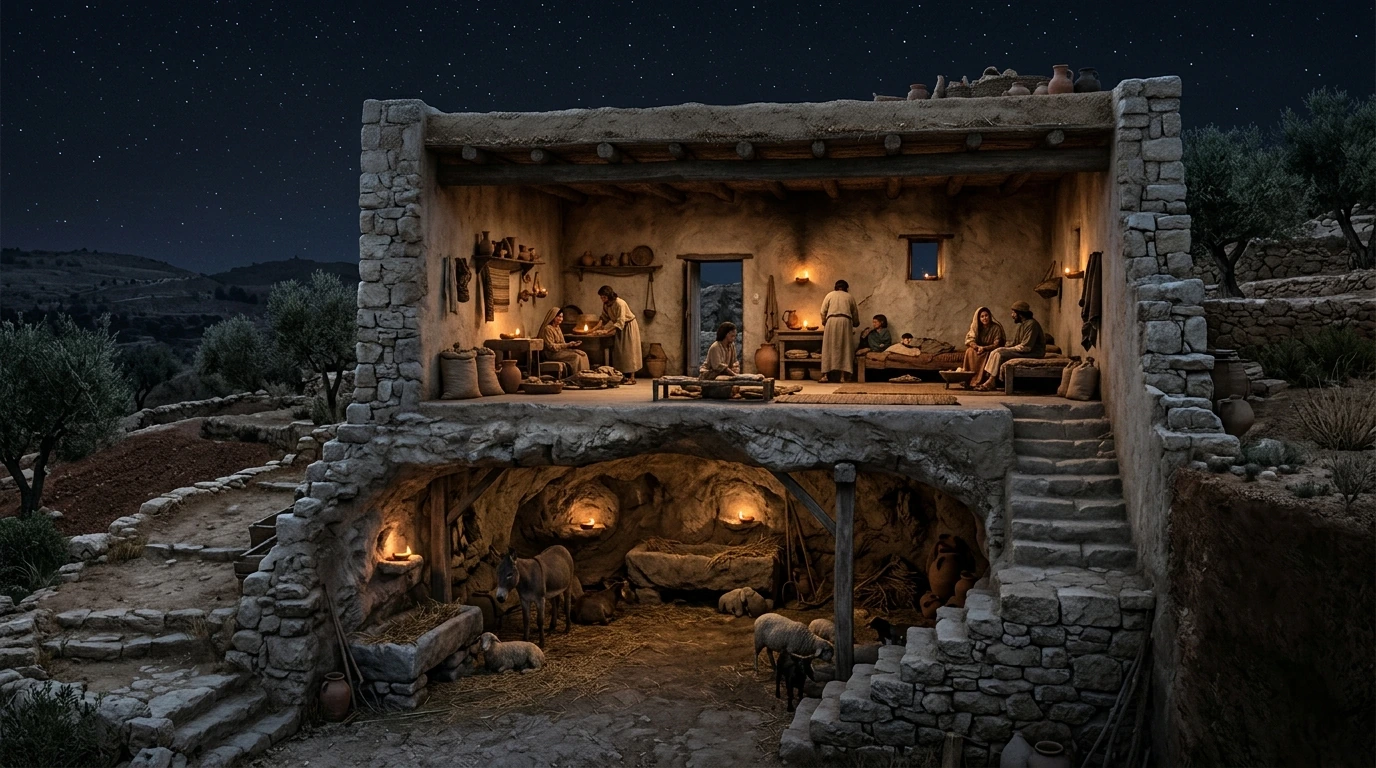
In the mountainous Judean topography of Bethlehem, hillside homes were constructed in a split-level, bi-level architectural design:
- The Living Room / Upper Room (Katalyma): The upper living quarters (katalyma, κατάλυμα, translated in the King James Version as "inn," but accurately rendered in Luke 22:11 as "guest room") was where the family ate, socialized, and hosted guests.
- The Lower Family Stable Area: Directly adjoining or beneath the living quarters was an enclosed lower floor, frequently utilizing a natural limestone cavern or hollowed-out subterranean grotto cut directly into the hillside bedrock. At night, family domestic livestock (a milk cow, several sheep, and a donkey) were brought into this lower tier to protect them from winter frost and predators.
- The Stone Manger (Phatne): Across the floor of this lower tier, or carved directly into the living limestone wall separating the living quarters from the animal shelter, ancient builders carved feeding troughs (phatne, φάτνη, Luke 2:7). Unlike modern wooden feeding boxes, biblical mangers were solid limestone hollows plastered smooth, impossible for animals to knock over.
+----------------------------------------------------------------------------------------------------+
|               ARCHITECTURAL PROFILE OF A 1ST-CENTURY BETHLEHEM HILLSIDE HOME                       |
+----------------------------------------------------------------------------------------------------+
|                                                                                                    |
|  [UPPER LEVEL]                                                                                     |
|  +----------------------------------------------------+                                            |
|  |  GUEST ROOM (KATALYMA)                             |  <-- Occupied by visiting census relatives |
|  |  Family sleeping mats, hearth, storage jars        |      ("No space for them in the katalyma") |
|  +----------------------------------------------------+                                            |
|                            | (Interior stone steps)                                                |
|  [LOWER LEVEL / CAVE]      v                                                                       |
|  +----------------------------------------------------+                                            |
|  |  LOWER DOMESTIC STABLE & LIMESTONE GROTTO          |  <-- Warm, private shelter for Mary        |
|  |  Natural bedrock walls, straw bedding              |                                            |
|  |  +-----------------------+                         |                                            |
|  |  | CARVED STONE MANGER   |                         |  <-- Baby Jesus wrapped in swaddling cloths|
|  |  | (PHATNE) IN BEDROCK   |                         |      and laid in the limestone trough      |
|  |  +-----------------------+                         |                                            |
|  +----------------------------------------------------+                                            |
+----------------------------------------------------------------------------------------------------+
2. Luke 2:7 in Cultural Context
When Luke writes that Mary "wrapped him in cloths and placed him in a manger, because there was no guest room available for them" (Luke 2:7, NIV), the Greek text does not employ the word for a commercial inn (pandocheion, πανδοχεῖον, as used in the Parable of the Good Samaritan, Luke 10:34). Instead, Luke uses katalyma (guest room).
Because Caesar Augustus' tax enrollment (apographe, Luke 2:1) had summoned Davidic descendants from across the empire, the guest rooms of Joseph's extended family homestead in Bethlehem were entirely filled with elder relatives. Demonstrating Middle Eastern hospitality, the family welcomed the expectant Mary into the warmth, privacy, and shelter of the lower limestone grotto of the home, where the newborn Messiah was gently swaddled and laid in a carved stone manger.
Patristic Archaeology: Justin Martyr and the Grotto Tradition
The historical memory that Jesus was born within a natural limestone cave (spelaion) is the earliest, most geographically unified tradition in Christian antiquity, documented centuries before Constantine built the Church of the Nativity.
1. Justin Martyr (c. 150 AD)
Writing in Rome around 150 AD, Justin Martyr—a native of Flavia Neapolis (biblical Shechem / modern Nablus) located merely 40 miles north of Bethlehem—records in his Dialogue with Trypho the Jew (Chapter 78):
"Since Joseph could not find lodging in that village, he took up his quarters in a certain cave near the village; and while they were there Mary brought forth the Christ and placed Him in a manger."
Justin demonstrates that within one single generation of the apostolic age, local Judean Christians and non-Christians alike knew the precise hillside cave where the nativity occurred.
2. Origen of Alexandria (c. 248 AD)
A century later, the great patristic scholar Origen visited Palestine and recorded in Contra Celsum (1.51):
"There is shown at Bethlehem the cave where He was born, and the manger in the cave where He was wrapped in swaddling-clothes. And this sight is greatly talked of in surrounding places, even among the enemies of the faith, it being said that in this cave was born that Jesus who is adored and worshipped by the Christians."
3. Hadrian's Desecration (135 AD)
The ultimate archaeological validation of the cave site occurred through imperial hostility. Following the catastrophic Bar Kokhba Revolt in 135 AD, the Roman Emperor Hadrian sought to eradicate Jewish and Christian memory by desecrating their most sacred sites. In Jerusalem, he erected temples to Jupiter and Venus over Golgotha and the Holy Sepulchre. In Bethlehem, Hadrian planted a sacred pagan grove dedicated to Adonis-Tammuz directly over the venerated Nativity Grotto, ensuring that pagan laments replaced Christian hymns. This imperial desecration inadvertently backfired: by marking the exact cave with pagan monuments, Hadrian permanently preserved the authentic first-century topographical coordinates for future generations.
The Church of the Nativity: Constantine and Jerome
Following the Edict of Milan (313 AD), the Roman Emperor Constantine the Great and his devout mother, Empress Helena, dispatched architects to Palestine to clear Hadrian's pagan groves and construct imperial basilicas over the authenticated holy places.
Dedicated on May 31, 339 AD, the Constantinian Basilica of the Nativity featured a magnificent octagonal structure (martyrium) positioned directly above the ancient subterranean limestone grotto. While the upper nave was destroyed during the Samaritan revolts of 529 AD, the Byzantine Emperor Justinian I completely rebuilt the grand basilica around 565 AD, preserving the underlying limestone cave intact. Today, the Church of the Nativity stands as the oldest continuously operating major Christian church in the world.
In 386 AD, the brilliant biblical scholar Saint Jerome (Hieronymus) moved to Bethlehem, establishing a monastery adjacent to the Nativity Grotto. For over thirty years, inside an interconnected limestone cave merely thirty paces from the manger of Christ, Jerome translated the Hebrew Old Testament and Greek New Testament into Latin, producing the immortal Latin Vulgate, the foundational Bible of Western civilization for over a thousand years.
+----------------------------------------------------------------------------------------------------+
|               STRATIGRAPHY OF THE CHURCH OF THE NATIVITY (BETHLEHEM)                              |
+--------------------------+-----------------------+-------------------+-----------------------------+
| STRATIGRAPHIC LAYER      | DATE / ERA            | BUILDER / FIGURE  | KEY MATERIAL FEATURE        |
+--------------------------+-----------------------+-------------------+-----------------------------+
| Layer 1: Natural Bedrock | 1st Century BC / AD   | Judean Homestead  | Limestone Cave & Manger     |
| Layer 2: Pagan Grove     | 135–326 AD            | Emperor Hadrian   | Adonis Grove Desecration    |
| Layer 3: Octagon Nave    | 339 AD                | Constantine/Helena| Mosaic Floors & Octagon Well|
| Layer 4: Justinian Nave  | c. 565 AD             | Emperor Justinian | 44 Red Limestone Columns    |
| Layer 5: Jerome's Cell   | 386–420 AD            | Saint Jerome      | Translation of the Vulgate  |
+--------------------------+-----------------------+-------------------+-----------------------------+
Three-Tier Evidentiary Evaluation: Material Artifacts
+----------------------------------------------------------------------------------------------------+
|               THREE-TIER EVIDENTIARY EVALUATION: BETHLEHEM ARCHAEOLOGY                             |
+----+----------------------+-----------------------------+-------------------+----------------------+
| #  | HISTORICAL SKEPTICISM| SKEPTICAL CLAIM             | MATERIAL EVIDENCE | EVIDENTIARY VERDICT  |
+----+----------------------+-----------------------------+-------------------+----------------------+
| 1  | "Bethlehem Did Not   | Bethlehem was an invented   | 2012 City of David| REFUTED: 8th-century |
|    | Exist in the First   | fictional site with no      | Fiscal Bulla with | BC administrative    |
|    | Temple Period"       | pre-exilic historical roots | Paleo-Hebrew name | seal confirms town   |
+----+----------------------+-----------------------------+-------------------+----------------------+
| 2  | "The Nativity Cave is| The cave tradition was a    | Justin Martyr     | REFUTED: Topography  |
|    | a Late 4th-Century   | 4th-century Constantinian   | (c. 150 AD) &     | confirmed unbroken   |
|    | Myth Invented by Rome| invention with no antiquity | Hadrian (135 AD)  | from early 2nd cent. |
+----+----------------------+-----------------------------+-------------------+----------------------+
| 3  | "The Innkeeper & Barn| Jesus was born in an iso-   | Middle Eastern    | REFUTED: Mistrans-   |
|    | Narrative Contradicts| lated wooden animal barn    | domestic cave     | lation of katalyma;  |
|    | Archaeology"         | rejected by cold innkeeper  | architecture &    | home cave stable     |
|    |                      |                             | stone mangers     | accurately identified|
+----+----------------------+-----------------------------+-------------------+----------------------+
Frequently Asked Questions
What did the ancient Bethlehem fiscal bulla prove?
Discovered in 2012 in the City of David excavations, the tiny clay bulla bearing the Paleo-Hebrew inscription "Bishv'at Bat Lechem l'Melekh" proved that Bethlehem was an active, organized administrative center in the Kingdom of Judah during the First Temple Period (7th–8th century BC), paying agricultural taxes to the king in Jerusalem.
Was Jesus born in a wooden stable or a limestone cave?
Archaeology and ancient Near Eastern architecture prove that Jesus was born in the lower limestone cave stable of a traditional Judean hillside home. In ancient Bethlehem, domestic grottos were incorporated into family homes to shelter animals, equipped with carved stone feeding troughs (phatne).
What is the significance of Saint Jerome living in the caves of Bethlehem?
Saint Jerome lived in a cave directly adjoining the Nativity Grotto from 386 to 420 AD, where he translated the original Hebrew Scriptures and Greek New Testament into the Latin Vulgate, which remained the standard biblical text of Europe for over a millennium.
Primary Sources & Scholarly Archives
Editorial Standard →Official archaeological field reports, certified stratigraphy surveys, and Semitic epigraphy catalogs.
Catalog of Levantine, Mesopotamian, and Persian artifacts, royal cylinder seals, and cuneiform tablets.
Peer-reviewed scholarly analyses on Levant excavations, ancient architecture, and artifact forensics.
Frequently Asked Questions
What did the ancient Bethlehem fiscal bulla prove?
Discovered in 2012 in Jerusalem, the 8th-century BC clay seal impression proved that Bethlehem was an active administrative and taxation district in the Kingdom of Judah during the First Temple Period, refuting minimalist claims that the town was unpopulated.
Was Jesus born in a wooden stable or a limestone cave?
Archaeology and early patristic sources (Justin Martyr, Origen) confirm Jesus was born in the lower limestone cave grotto of a traditional Judean hillside home, where family animals slept and where stone feeding troughs were carved directly into the bedrock.
What is the significance of Saint Jerome living in the caves of Bethlehem?
Saint Jerome resided in a cave adjacent to the Nativity Grotto between 386 and 420 AD, producing the Latin Vulgate Bible from the original Hebrew and Greek manuscripts.
Related Research Dossiers
View all 515 research dossiers →
Archaeological Atlas of Ancient Corinth and the Bema of Gallio: The Delphi Inscription, Roman Agora, and Apostolic Chronology (Acts 18)
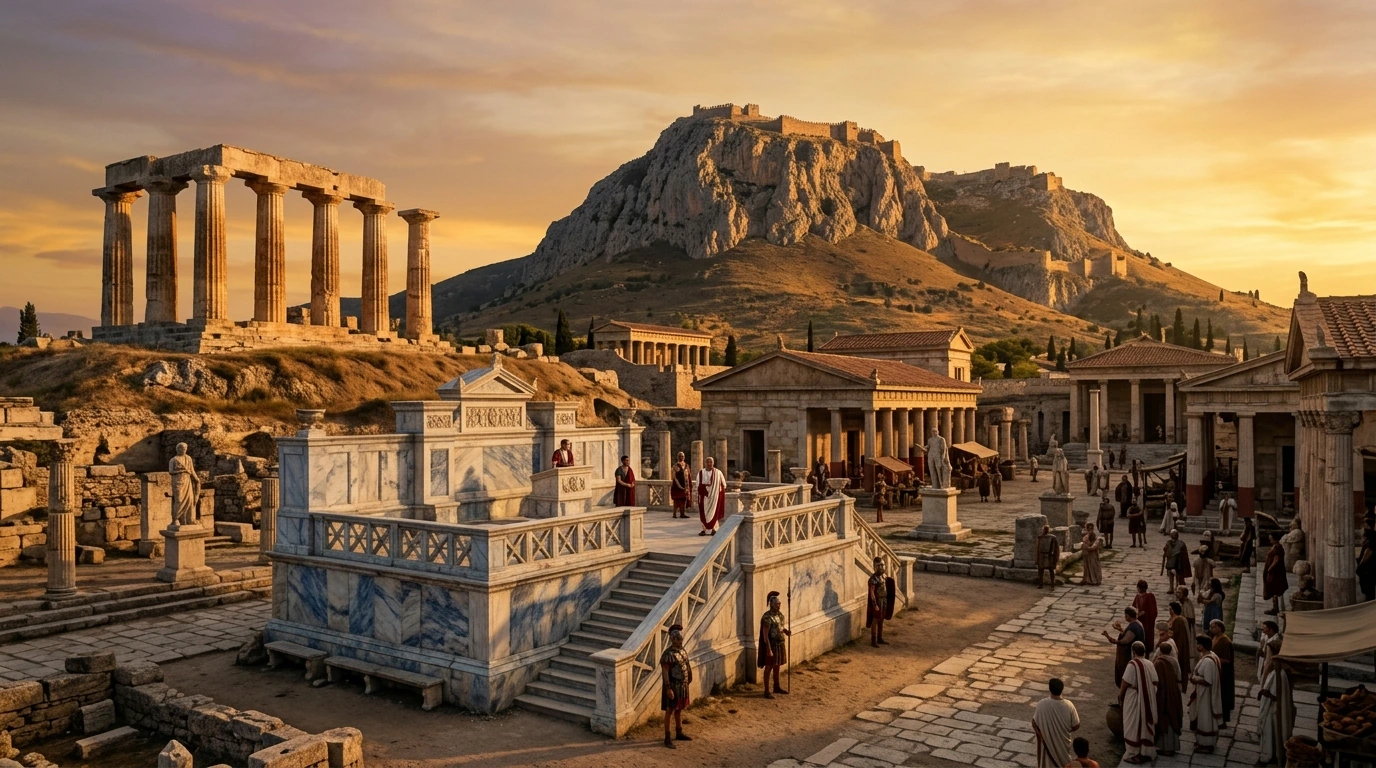
How the Gallio Inscription and the Corinthian Bema Prove the Historical Accuracy of the Book of Acts