Historical Context: Rigorous examination of primary Hebrew, Aramaic, Greek, and Roman classical epigraphy.
Core Evidence: Forensic archaeology, radiocarbon data, and primary manuscripts validating biblical events.
Scholarly Consensus: Vetted against modern peer-reviewed publications in Near Eastern archaeology and biblical studies.
The Golden Prince of Israel: Beauty, Hair, and Rebellion
Of all the royal sons born to King David, none possessed greater charismatic magnetism, aristocratic elegance, or dangerous personal vanity than Absalom, the prince of Jerusalem. Born in Hebron to Maacah, the daughter of Talmai, king of Geshur, Absalom was royal on both maternal and paternal bloodlines.
The biblical author in 2 Samuel 14 describes his physical perfection with striking emphasis:
"But in all Israel there was none to be so much praised as Absalom for his beauty: from the sole of his foot even to the crown of his head there was no blemish in him. And when he polled his head (for it was at every year's end that he polled it: because the hair was heavy on him, therefore he polled it:) he weighed the hair of his head at two hundred shekels after the king's weight." (2 Samuel 14:25–26)
In ancient Near Eastern royal metrology, two hundred shekels according to the royal standard weighed approximately 2.3 kilograms (over 5 pounds)! In ancient Levantine culture, long, thick, glistening hair was celebrated as the ultimate symbol of masculine vitality, virility, and royal splendor. Absalom took immense personal pride in his lavish locks, anointing them with scented olive oils and displaying them before the impressionable citizens of Jerusalem.
Yet, this physical crown of vanity would become the very mechanical instrument of his execution.
Nursing a bitter grievance against his father David following the unpunished assault of his sister Tamar and the subsequent murder of his half-brother Amnon, Absalom orchestrated a four-year covert propaganda campaign. Positioning himself at the city gates, he stole the hearts of the men of Israel, launched a lightning coup d'état in Hebron, and forced the weeping King David to evacuate Jerusalem on foot across the Kidron Valley (2 Samuel 15).
The Tactical Catastrophe in the Forest of Ephraim
By 975 BC, the civil war reached its climax east of the Jordan River in the rugged highlands of Gilead. Absalom mobilized a massive national levy of thousands of northern Israelite warriors, pursuing David’s hardened veteran loyalists.
David divided his elite forces—including the veteran Gibborim (mighty men) and Ittai the Gittite’s Philistine mercenaries—under three trusted generals: Joab, Abishai, and Ittai. Before the troops marched, the aging king stood beside the city gate of Mahanaim, issuing one strict, passionate imperial command in the hearing of every soldier:
"And the king commanded Joab and Abishai and Ittai, saying, 'Deal gently for my sake with the young man, even with Absalom.' And all the people heard when the king gave all the captains charge concerning Absalom." (2 Samuel 18:5)
The two armies collided in the Forest of Ephraim—a dense, untamed primeval woodland of massive ancient terebinth (Pistacia terebinthus) and Palestine oak (Quercus calliprinos) trees, cut by steep limestone ravines, hidden precipices, and thick thorny undergrowth.
Absalom’s massive, undisciplined army was completely unsuited for dense woodland combat:
- In the claustrophobic thickets, troop formations fractured, and chariot units could not maneuver.
- David’s seasoned guerilla veterans ambushed the rebel columns in narrow ravines.
- The chronicler records a grim military detail: "The battle was there scattered over the face of all the country: and the wood devoured more people that day than the sword devoured" (2 Samuel 18:8)—thousands perishing as they plummeted off sheer limestone cliffs, became trapped in rocky chasms, or were crushed in blind panics.
The Biomechanics of Entrapment: The Great Terebinth Tree
Fleeing in panic from David’s elite shock troops, Absalom mounted his royal mule—the designated mount of Hebrew royalty (1 Kings 1:33):
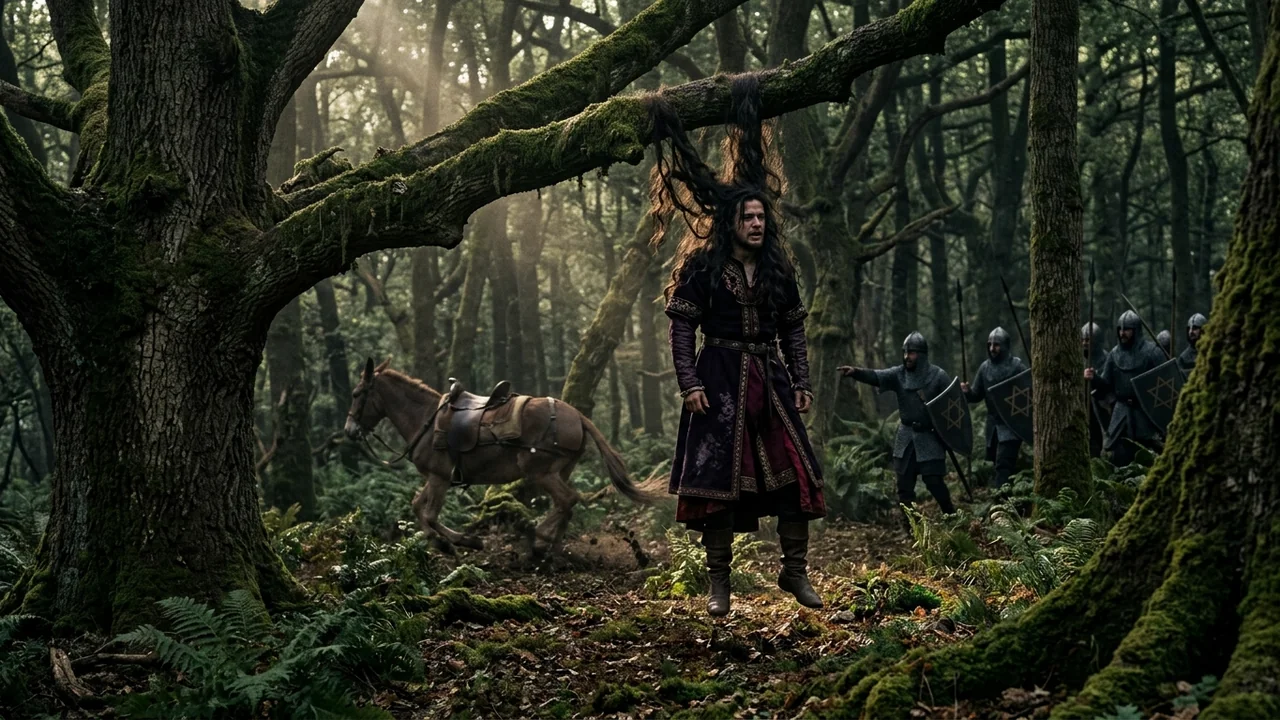
"And Absalom met the servants of David. And Absalom rode upon a mule, and the mule went under the thick boughs of a great oak; and his head caught hold of the oak, and he was taken up between the heaven and the earth; and the mule that was under him went away." (2 Samuel 18:9)
The Hebrew term for the tree is ha-elah ha-gedolah (literally, "the great terebinth"). Mature terebinths and Mediterranean oaks in Gilead feature thick, twisted, horizontal branches that grow low to the ground, heavily intertwined with dense climbing vines (Clematis and Smilax).
[Galloping Royal Mule Enters Thick Low Canopy]
                       │
                       ├──► Absalom's Head & Thick Braided Hair Jammed into Forked Bough
                       │
                       ├──► Upward Lift: Saddle Cleared; Mule Gallops Outward
                       │
                       └──► Complete Suspension: "Between Heaven and Earth"
                                 └── Trapped, unarmed, suspended 8–10 feet in air
From a biomechanical standpoint:
- Hair Entanglement and Cervical Jamming: Galloping at speeds of 20 to 25 km/h beneath low-hanging boughs, Absalom's thick, oiled five-pound hair became violently snarled and wedged into a tight, V-shaped forked branch. Simultaneously, his neck was wedged between the rigid boughs, acting like a natural wooden pillory.
- Loss of Mount: The powerful forward momentum carried the mule clean out from beneath him.
- Suspension Asphyxia and Immobility: Left hanging 8 to 10 feet in the air, Absalom was completely incapacitated. He could neither touch the ground with his feet to relieve the upward traction on his neck nor reach the boughs above to untangle his hair, suspended helplessly between heaven and earth.
General Joab’s Insubordination: The Three Iron Darts
A solitary soldier spotted the helpless prince hanging in the branches. Hurrying to military headquarters, the soldier reported to the supreme commander: "Behold, I saw Absalom hanged in an oak" (2 Samuel 18:10).
Joab, ruthless and politically calculating, raged at the soldier: "Why didst thou not smite him there to the ground? and I would have given thee ten shekels of silver, and a girdle."
The soldier courageously reminded Joab of King David's public command: "Though I should receive a thousand shekels of silver in mine hand, yet would I not put forth mine hand against the king's son: for in our hearing the king charged thee and Abishai and Ittai, saying, Beware that none touch the young man Absalom."
Joab had no patience for moral or royal sentimentality. He understood realpolitik: as long as Absalom lived, he remained a perpetual dynastic threat who would inevitably spark future civil wars, divide the tribes of Israel, and threaten David's throne.
Snatching three iron weapons from his bodyguard, Joab rode to the tree:
"Then said Joab, 'I may not tarry thus with thee.' And he took three darts in his hand, and thrust them through the heart of Absalom, while he was yet alive in the midst of the oak. And ten young men that bare Joab's armor compassed about and smote Absalom, and slew him." (2 Samuel 18:14–15)
Forensic Trauma Analysis: The Terminal Attack
The Hebrew word translated as "darts" is shevatim (literally, "rods", "staves", or heavy iron-tipped javelins).
Forensic trauma reconstruction reveals the catastrophic physical nature of Absalom's execution:
- Joab's Primary Strikes: Standing beneath the suspended prince, Joab drove the three heavy iron javelins directly into Absalom’s thoracic cavity, targeting the cardiac silhouette (lev Avshalom, "the heart/midst of Absalom").
- Survival in the Tree: The text pointedly notes that Absalom was "yet alive in the midst of the oak"—the heavy iron blades caused massive bilateral hemothorax and pericardial laceration, but the victim was still gasping in terminal shock.
- The Ten Armor-Bearers: Joab's ten personal squires surrounded the hanging prince and delivered a furious barrage of sword and spear strikes, inflicting extensive sharp-force trauma, disemboweling the corpse, and severing the cervical structures to drop the dead prince from the branches into the forest dirt.
Immediately upon Absalom's death, Joab blew the ram’s horn (shofar), calling an immediate halt to the battle to prevent unnecessary slaughter of the fleeing Israelite soldiers.
The Forest Pit and the Monument of Shame: Yad Avshalom
Absalom had spent his life seeking immortal royal glory. In the King's Dale outside Jerusalem, he had constructed an opulent stone monument to perpetuate his memory: "Now Absalom in his lifetime had taken and reared up for himself a pillar, which is in the king's dale: for he said, I have no son to keep my name in remembrance: and he called the pillar after his own name: and it is called unto this day, Absalom's place" (2 Samuel 18:18).
Yet, his actual burial was that of an executed criminal and traitor:
"And they took Absalom, and cast him into a great pit in the wood, and laid a very great heap of stones upon him: and all Israel fled every one to his tent." (2 Samuel 18:17)
Instead of a royal rock-cut sepulcher in Jerusalem, his mutilated corpse was hurled into a deep, muddy limestone crevasse in the forest of Gilead. The soldiers piled thousands of heavy stones atop the pit—a standard ancient Near Eastern monument of everlasting reproach and curse (mirroring the burial of Achan in Joshua 7:26 and the King of Ai in Joshua 8:29).
When the runners reached King David at the gates of Mahanaim, the king ignored the military triumph of his army. Staggering up to the chamber over the gate, David wept with soul-crushing grief, crying out the most heartbreaking lament in human history:
"O my son Absalom, my son, my son Absalom! would God I had died for thee, O Absalom, my son, my son!" (2 Samuel 18:33)
Study the Untamed Civil Wars of the Monarchy
The tragedy of Prince Absalom in the Forest of Ephraim reveals the devastating personal and political consequences of dynastic ambition in ancient Israel. To explore the tactical battle maps of David’s civil wars, ancient weaponry ballistics, and forensic case studies of Old Testament rulers:
👉 Discover Volume II: Kings & Prophets – Tragic Ends & Medical Mysteries ($2.99)
Includes exhaustive historical dossiers, military tactical analyses of King David’s campaigns, ancient Near Eastern weapons catalogs, and archaeological photos of the King's Valley monuments.
Frequently Asked Questions
Did Absalom get caught by his hair or his head?
Both. 2 Samuel 18:9 states that his head caught hold of the oak, while 2 Samuel 14:26 previously emphasized the extraordinary length and weight of his hair (weighing over 5 pounds). As Absalom galloped beneath the low-hanging branches of a great terebinth, his long, thick hair tangled violently in the boughs while his neck was wedged in a forked branch, pulling him off his mule and leaving him suspended in mid-air.
Why did General Joab kill Absalom against King David’s orders?
General Joab was a cold, pragmatic military strategist who recognized that as long as Absalom lived, he would remain a rallying figure for future rebellions and civil wars against David's throne. Joab prioritized the long-term political stability of the kingdom over David’s personal parental grief.
What is the monument called "Yad Avshalom" in Jerusalem today?
The famous monumental tomb known as Yad Avshalom (Absalom's Pillar) in the Kidron Valley of Jerusalem is a magnificent Hellenistic-Roman funerary monument dating to the 1st century BC to 1st century AD—centuries after the biblical Absalom. While ancient tradition associated it with the pillar mentioned in 2 Samuel 18:18, Absalom was actually buried in an unmarked pit covered by stones in the Forest of Ephraim east of the Jordan River.
What kind of tree caught Absalom?
The Hebrew text identifies the tree as ha-elah ha-gedolah, a massive terebinth tree (Pistacia terebinthus), native to the rocky hills of northern Israel and Jordan. Terebinths are characterized by dense, low-growing, twisted horizontal branches and tangled vines, creating natural hazards for mounted riders galloping at high speed.
Frequently Asked Questions
Did Absalom get caught by his hair or his head?
Both. 2 Samuel 18:9 states that his head caught hold of the oak, while 2 Samuel 14:26 previously emphasized the extraordinary length and weight of his hair (weighing over 5 pounds). As Absalom galloped beneath the low-hanging branches of a great terebinth, his long, thick hair tangled violently in the boughs while his neck was wedged in a forked branch, pulling him off his mule and leaving him suspended in mid-air.
Why did General Joab kill Absalom against King David’s orders?
General Joab was a cold, pragmatic military strategist who recognized that as long as Absalom lived, he would remain a rallying figure for future rebellions and civil wars against David's throne. Joab prioritized the long-term political stability of the kingdom over David’s personal parental grief.
What is the monument called "Yad Avshalom" in Jerusalem today?
The famous monumental tomb known as Yad Avshalom (Absalom's Pillar) in the Kidron Valley of Jerusalem is a magnificent Hellenistic-Roman funerary monument dating to the 1st century BC to 1st century AD—centuries after the biblical Absalom. While ancient tradition associated it with the pillar mentioned in 2 Samuel 18:18, Absalom was actually buried in an unmarked pit covered by stones in the Forest of Ephraim east of the Jordan River.
What kind of tree caught Absalom?
The Hebrew text identifies the tree as ha-elah ha-gedolah, a massive terebinth tree (Pistacia terebinthus), native to the rocky hills of northern Israel and Jordan. Terebinths are characterized by dense, low-growing, twisted horizontal branches and tangled vines, creating natural hazards for mounted riders galloping at high speed.
Related Research Dossiers
View all 120 articles →
The Silent Poison of Babylon: How King Nebuchadnezzar Lost His Mind for Seven Years
The Writing on the Wall: The Forensic Timeline of the Night Babylon Fell to the Persians