Historical Context: Rigorous examination of primary Hebrew, Aramaic, Greek, and Roman classical epigraphy.
Core Evidence: Forensic archaeology, radiocarbon data, and primary manuscripts validating biblical events.
Scholarly Consensus: Vetted against modern peer-reviewed publications in Near Eastern archaeology and biblical studies.
The Catastrophe in the City of David
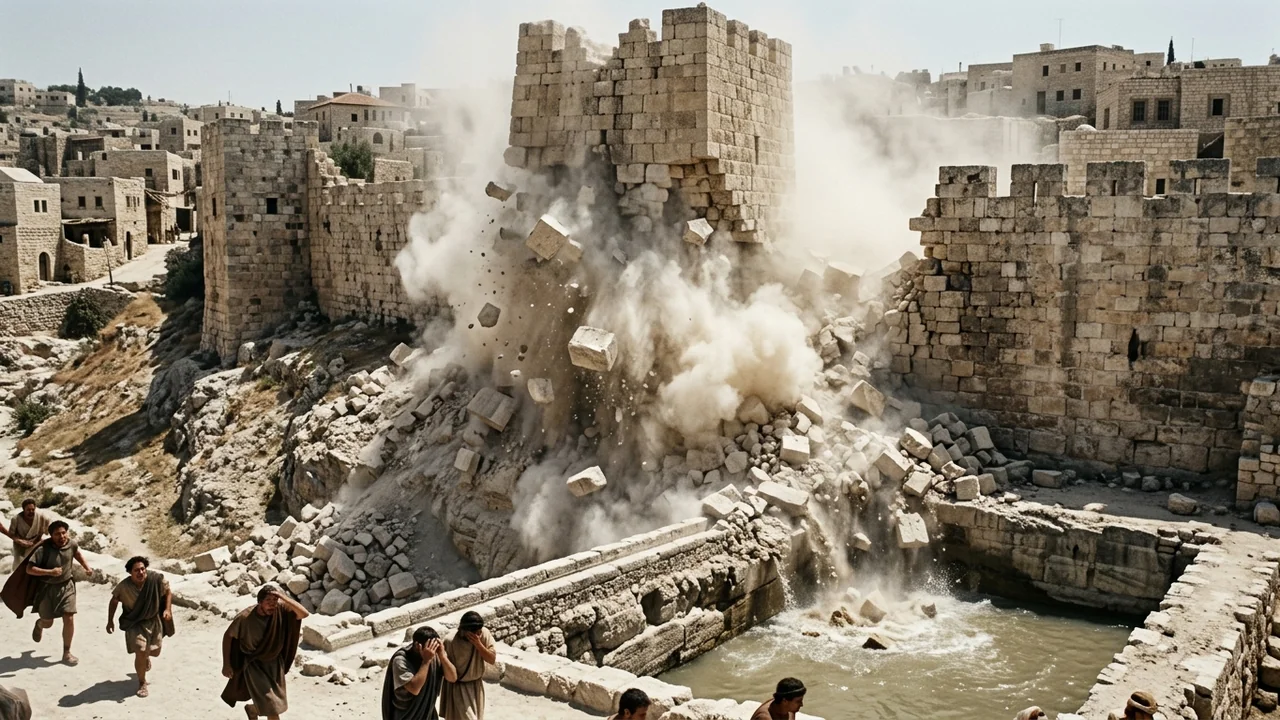
In the late 20s AD, during the volatile Roman prefecture of Pontius Pilate (26–36 AD) and the public ministry of Jesus of Nazareth, a catastrophic urban disaster shocked the residents of Jerusalem. Without warning, a massive stone defensive tower guarding the southern fortifications of the city abruptly failed, collapsing in an avalanche of multi-ton limestone ashlars.
Eighteen men—civilians, municipal laborers, or guards standing beneath the structure—were instantly crushed to death beneath the falling masonry.
The incident is preserved in a remarkable historical discourse in the Gospel of Luke:
"There were present at that season some that told him of the Galilaeans, whose blood Pilate had mingled with their sacrifices. And Jesus answering said unto them, 'Suppose ye that these Galilaeans were sinners above all the Galilaeans, because they suffered such things? I tell you, Nay: but, except ye repent, ye shall all likewise perish. Or those eighteen, upon whom the tower in Siloam fell, and slew them, think ye that they were sinners above all men that dwelt in Jerusalem? I tell you, Nay: but, except ye repent, ye shall all likewise perish.'" (Luke 13:1–5)
To the 1st-century Jewish mind steeped in traditional retribution theology ("the righteous prosper, the wicked are struck down"), an unforeseen structural catastrophe of this magnitude could only mean one thing: those eighteen victims had committed clandestine, monstrous sins that provoked the immediate, targeted wrath of God.
Yet Jesus did something revolutionary: He rejected the ancient dogma of karmic retribution. By examining 1st-century Herodian civil engineering, recent archaeological excavations at the Pool of Siloam, and Roman historical records from Flavius Josephus, we can uncover the physical reality of the tower's collapse and the profound theological revolution ignited in its aftermath.
Archaeological Discovery: The Reich-Shukron Excavations at Siloam
For nearly two millennia, the precise location of the "Tower in Siloam" (Pyrgos en tō Silōam) remained an academic enigma. However, monumental excavations conducted between 2004 and 2018 at the southern tip of the City of David by Israeli archaeologists Prof. Ronny Reich and Eli Shukron revolutionized our understanding of the site:
[City of David / Ophel Ridge]
             │
             ▼  Steep 35-degree natural bedrock slope
[Tyropoeon (Central) Valley Junction with Kidron Valley]
             │
             ▼
[Monumental 1st-Century Pool of Siloam]
   ├── Grand stone-paved steps (tri-level terrace flights)
   ├── Monumental Roman/Herodian Stepped Street leading to Temple Mount
   └── First Wall defensive fortifications, retaining walls, and aqueduct sluices
Key Excavation Findings
- The Authentic 1st-Century Pool of Siloam: In autumn 2004, municipal repair of a broken sewer pipe accidentally struck ancient stone steps. Reich and Shukron unearthed the genuine trapezoidal monumental pool used by Jewish pilgrims in the era of Jesus (measuring over 225 feet wide), fed by water flowing through Hezekiah's subterranean bedrock tunnel.
- Massive Herodian Retaining Walls and Towers: Guarding the pool and the lower sluice gates, archaeologists uncovered the foundational remains of massive ashlar watchtowers integrated into Jerusalem's ancient First Wall (Teichos Protos).
- Collapsed Herodian Ashlars: In the drainage channels and paved plazas surrounding the southern pool complex, excavators discovered colossal drafted limestone blocks bearing the distinctive marginal dressing of Herodian stonemasons, showing clear evidence of structural collapse and violent seismic dislocation dating to the 1st century AD.
Herodian Civil Engineering and Pontius Pilate’s Corban Aqueduct
Why was a major tower being constructed, repaired, or modified at the Pool of Siloam during the governorship of Pontius Pilate?
The Jewish historian Flavius Josephus provides a vital historical clue in two separate works (The Jewish War 2.175–177 and Antiquities of the Jews 18.60–62):
"On a later occasion, Pilate provoked a fresh uproar by expending the sacred treasure known as Corban on an aqueduct which brought water to the city from a distance of two hundred furlongs [roughly 25 miles / 40 km]... Indignant at this proceeding, the populace formed a ring round the tribunal of Pilate... and besieged him with clamorous shouts." — Flavius Josephus, The Jewish War (2.175)
The Corruption of Sacred Funds
- The Corban Outrage: Pilate seized sacred funds consecrated exclusively for Temple sacrifices (Corban, see Mark 7:11) to finance a colossal Roman civil engineering project: the Arrub/Solomon’s Pools Aqueduct, which channeled immense volumes of spring water from south of Bethlehem into Jerusalem.
- The Siloam Terminal: The aqueduct system discharged its waters into the lower reservoirs of the city—specifically the Pool of Siloam and the adjacent public baths at the base of the Tyropoeon Valley.
- The Eighteen Victims: Many historical scholars (such as Dr. Kenneth Bailey and Dr. Paul Barnett) suggest that the eighteen men who died in the collapse were Jewish municipal laborers or stonemasons employed on Pilate’s controversial Corban-funded aqueduct and defensive watchtower project!
- Under traditional nationalist logic, pious Jews viewed anyone who took Roman money from the stolen Temple treasury as traitorous sinners under divine judgment. When the tower collapsed directly on top of them, the populace nodded in self-righteous satisfaction: "God struck them down for working on Pilate's corrupted project!"
Structural Forensic Autopsy: Why Did the Tower Collapse?
From a geotechnical and structural engineering perspective, the southern spur of the City of David is one of the most mechanically precarious building sites in ancient Palestine:
[Deep Winter Rainstorms / Hydrostatic Saturation]
                        │
                        ▼
[Subterranean Seepage into Fractured Bedrock along Tyropoeon Valley Fault]
                        │
                        ▼
[Differential Settlement of Unreinforced Lime-Mortar Bedding Planes]
                        │
                        ▼
[Overweight Herodian Ashlar Watchtower (30+ Meters Tall / 800+ Tons)]
                        │
                        ▼
[Sudden Shear Failure of Bedrock / Retaining Footing -> Catastrophic Structural Collapse]
The Three Geotechnical Triggers of Structural Failure
- Extreme Topographical Gradient: The Pool of Siloam sits at the lowest elevation in Jerusalem (~620 meters above sea level), wedged into a narrow bedrock funnel where the Tyropoeon Valley, the Kidron Valley, and the Hinnom Valley converge. Bedrock slopes plunge at angles of 30 to 40 degrees.
- Subterranean Water Infiltration and Saturated Fills: Water constantly flowed through Hezekiah’s Tunnel and the Roman aqueducts into the Siloam basin. In wet winter seasons, uncontained subterranean seepage saturates ancient agricultural terrace fills, reducing soil shear strength and creating differential foundation settlement.
- Herodian Ashlar Mass vs. Weak Mortar: Herodian defensive towers were colossal stone edifices constructed with exterior ashlar stones weighing between 2 and 10 tons each, filled with a rubble-and-mortar core. If the foundation footing on the downslope terrace slipped by even a few centimeters, the center of gravity shifted outside the base, resulting in sudden, explosive shear collapse without prior warning!
The men beneath the tower were not struck down by a targeted bolt of divine lightning; they were crushed by the unforgiving, predictable laws of gravitational mechanics and geotechnical failure.
Comparative Architecture: Defensive Towers of 1st-Century Jerusalem
| Tower Structure | Location in Jerusalem | Commissioning Authority | Structural Engineering Specifications | Primary Historical / Archaeological Reference |
|---|---|---|---|---|
| Tower in Siloam | Southern tip of City of David / Pool of Siloam | Herodian / Roman Prefectural (Pilate) | Heavy ashlar masonry guarding southern aqueduct sluices and First Wall gate. | Luke 13:4; Reich-Shukron excavations (2004–2018). |
| Phasael Tower | Western palace of Herod (modern Citadel / Jaffa Gate) | Herod the Great (named for his brother) | Massive 40-cubit (60 ft) solid stone base of drafted Meleke limestone ashlars. | Josephus, War 5.166–175; surviving base at Tower of David Citadel. |
| Hippicus Tower | Northwest corner of First Wall | Herod the Great (named for his friend) | Square watchtower (25 cubits square); housed colossal interior rainwater reservoir. | Josephus, War 5.163–165; foundations identified in Jerusalem Citadel. |
| Mariamne Tower | Adjacent to Herod's Royal Palace | Herod the Great (named for his Hasmonean queen) | Luxurious upper residential quarters over reinforced stone defensive core. | Josephus, War 5.170–171; destroyed by Titus in 70 AD. |
| Antonia Fortress Towers | Northwest corner of Temple Mount precinct | Herod the Great (named for Mark Antony) | Four corner bastions (50 to 70 cubits high) overlooking Temple courts for riot suppression. | Josephus, War 5.238–246; Acts 21:31–37 (Paul's rescue). |
The Deconstruction of Retribution Theology: Jesus vs. Ancient Karma
The intellectual and spiritual climate of the 1st century was dominated by rigid retribution theology:
- If a man was born blind, the disciples instinctively asked: "Master, who did sin, this man, or his parents, that he was born blind?" (John 9:2).
- If a ship was caught in a storm, ancient sailors cast lots to determine which passenger had offended the gods (Jonah 1:7).
- If Roman soldiers butchered Galilean worshipers in the Temple court (Luke 13:1), popular opinion concluded that those Galileans were harboring secret, hideous wickedness.
Jesus attacked this assumption at its philosophical foundation:
[Traditional Retribution Theology / Karmic Dogma]
   ├── Good Health & Wealth = Direct proof of personal moral superiority.
   └── Sudden Disaster / Disease = Direct proof of secret, unrepented wickedness.
                                  │
                                  ▼  Jesus's Absolute Refutation:
[Jesus's Gospel of Common Grace and Universal Frailty]
   ├── "Think ye that they were sinners above all men? I tell you, NAY!"
   ├── Natural disasters occur within a fallen, broken physical cosmos.
   └── Physical catastrophe is not a measurement of personal guilt,
       but a universal, urgent wake-up call to all mortal humans!
The Three Fallacies Jesus Demolished
- The Fallacy of Comparative Self-Righteousness: When disaster strikes our neighbor, human pride instinctively seeks comfort in self-exoneration: "That happened to them because they were bad; it didn't happen to me because I am good." Jesus completely stripped away this psychological defense mechanism: "Think ye that they were sinners above all men that dwelt in Jerusalem? I tell you, Nay!"
- The Sovereign Independence of Tragedy: Physical calamity is not distributed in this life as an exact, real-time mathematical scorecard of moral demerit. The sun rises on the evil and the good, and the rain falls on the just and the unjust (Matthew 5:45). The world operates under physical laws where unstable stone towers succumb to gravity regardless of whether the people beneath are saints or scoundrels.
- The Mirror of Impending Judgment: Instead of treating the Siloam collapse as an entertaining piece of neighborhood gossip or a theological curiosity, Jesus turned the collapsing tower into an existential mirror held up to every listener:
"Except ye repent, ye shall all likewise perish." (Luke 13:5)
The Universal Mortality Warning: Luke 13:4–5
Jesus’s phrase—"ye shall all likewise perish" (pantōs hōmoīōs apoleisthe)—held both an urgent spiritual reality and a terrifying literal historical prophecy:
The Literal Historical Prophecy (70 AD)
Within forty years of Jesus speaking these words, Jerusalem refused the path of divine repentance and plunged headlong into violent nationalist zealotry against Rome. In the fateful summer of 70 AD, the Roman legions of Titus encircled the city:
- The Roman siege engines (ballistae and battering rams) pulverized the walls and defensive towers of Jerusalem.
- Literally tens of thousands of Jerusalem’s inhabitants were crushed to death under the collapsing stone ashlars of their own walls and burning Temple colonnades—dying in the exact physical manner of the eighteen victims of Siloam!
The Spiritual Imperative
The collapse of the Tower of Siloam proves that human life is fragile, unpredictable, and suspended by a single thread over eternity. The eighteen men who woke up that morning, kissed their wives, ate their bread, and walked down to the Pool of Siloam had no premonition that their lives would end before sunset under eight hundred tons of falling limestone.
Disaster does not ask for our schedule, and death does not wait for a convenient hour. For Jesus, every collapsing building, every fatal earthquake, every sudden medical diagnosis, and every tragic accident in human history is a megaphone of divine mercy sounding across a broken world: Turn to the Living God today, for tomorrow is promised to no man.
Discover the Full Archaeological and Engineering Dossiers
The collapse of the Tower of Siloam is one of dozens of ancient urban catastrophes where Roman civil engineering, New Testament archaeology, and biblical texts intersect. To examine complete structural diagrams of Herodian masonry, excavation site maps of the Pool of Siloam, and historical translations of Pontius Pilate's aqueduct disputes:
👉 Discover Volume III: The Final Files – Biblical Disasters & Ancient Wonders ($2.99)
Features detailed architectural blueprints of the First Wall towers, geological fault maps of the Tyropoeon Valley, and forensic reconstructions of 1st-century Jerusalem disasters.
Frequently Asked Questions
Where was the Tower of Siloam located in ancient Jerusalem?
The Tower of Siloam stood at the southern tip of the City of David, guarding the Pool of Siloam, the southern water gates, and the First Wall of Jerusalem where the Central (Tyropoeon) Valley meets the Kidron Valley. Recent excavations by Ronny Reich and Eli Shukron uncovered Herodian watchtower foundations and collapsed ashlars at this exact site.
Who were the eighteen men who died in the collapse?
While Scripture does not record their names, historical context from Flavius Josephus suggests they may have been Jewish laborers or municipal stonemasons working on Pontius Pilate's controversial aqueduct and defensive wall projects, which were funded by stolen Temple treasury funds (Corban).
What theological dogma was Jesus refuting in Luke 13:4?
Jesus was refuting traditional "retribution theology" (the belief that individuals who suffer sudden calamity or horrific accidents are being directly punished by God for exceptional, secret wickedness). Jesus asserted that physical disasters occur in a fallen world and that the victims were no worse than anyone else in Jerusalem.
What did Jesus mean by "except ye repent, ye shall all likewise perish"?
Jesus used the sudden collapse of the tower as an existential warning of mortality: human life is fragile, and death arrives without warning. Historically, this also proved to be a literal prophecy: forty years later, in 70 AD, the Roman army pulverized Jerusalem's walls, and tens of thousands of unrepentant citizens were crushed beneath the collapsing stone towers of the city.
Frequently Asked Questions
Where was the Tower of Siloam located in ancient Jerusalem?
The Tower of Siloam stood at the southern tip of the City of David, guarding the Pool of Siloam, the southern water gates, and the First Wall of Jerusalem where the Central (Tyropoeon) Valley meets the Kidron Valley. Recent excavations by Ronny Reich and Eli Shukron uncovered Herodian watchtower foundations and collapsed ashlars at this exact site.
Who were the eighteen men who died in the collapse?
While Scripture does not record their names, historical context from Flavius Josephus suggests they may have been Jewish laborers or municipal stonemasons working on Pontius Pilate's controversial aqueduct and defensive wall projects, which were funded by stolen Temple treasury funds (Corban).
What theological dogma was Jesus refuting in Luke 13:4?
Jesus was refuting traditional "retribution theology" (the belief that individuals who suffer sudden calamity or horrific accidents are being directly punished by God for exceptional, secret wickedness). Jesus asserted that physical disasters occur in a fallen world and that the victims were no worse than anyone else in Jerusalem.
What did Jesus mean by "except ye repent, ye shall all likewise perish"?
Jesus used the sudden collapse of the tower as an existential warning of mortality: human life is fragile, and death arrives without warning. Historically, this also proved to be a literal prophecy: forty years later, in 70 AD, the Roman army pulverized Jerusalem's walls, and tens of thousands of unrepentant citizens were crushed beneath the collapsing stone towers of the city.
Related Research Dossiers
View all 120 articles →
150 mph Ballistics: Why Goliath’s Bronze Helmet Was Useless Against David’s Sling
185,000 Assyrian Soldiers Wiped Out in One Night: The Pathology of Sennacherib's Siege Failure