Historical Context: Rigorous examination of primary Hebrew, Aramaic, Greek, and Roman classical epigraphy.
Core Evidence: Forensic archaeology, radiocarbon data, and primary manuscripts validating biblical events.
Scholarly Consensus: Vetted against modern peer-reviewed publications in Near Eastern archaeology and biblical studies.
The 1898 Egyptian Discovery: Walter L. Nash’s Purchase
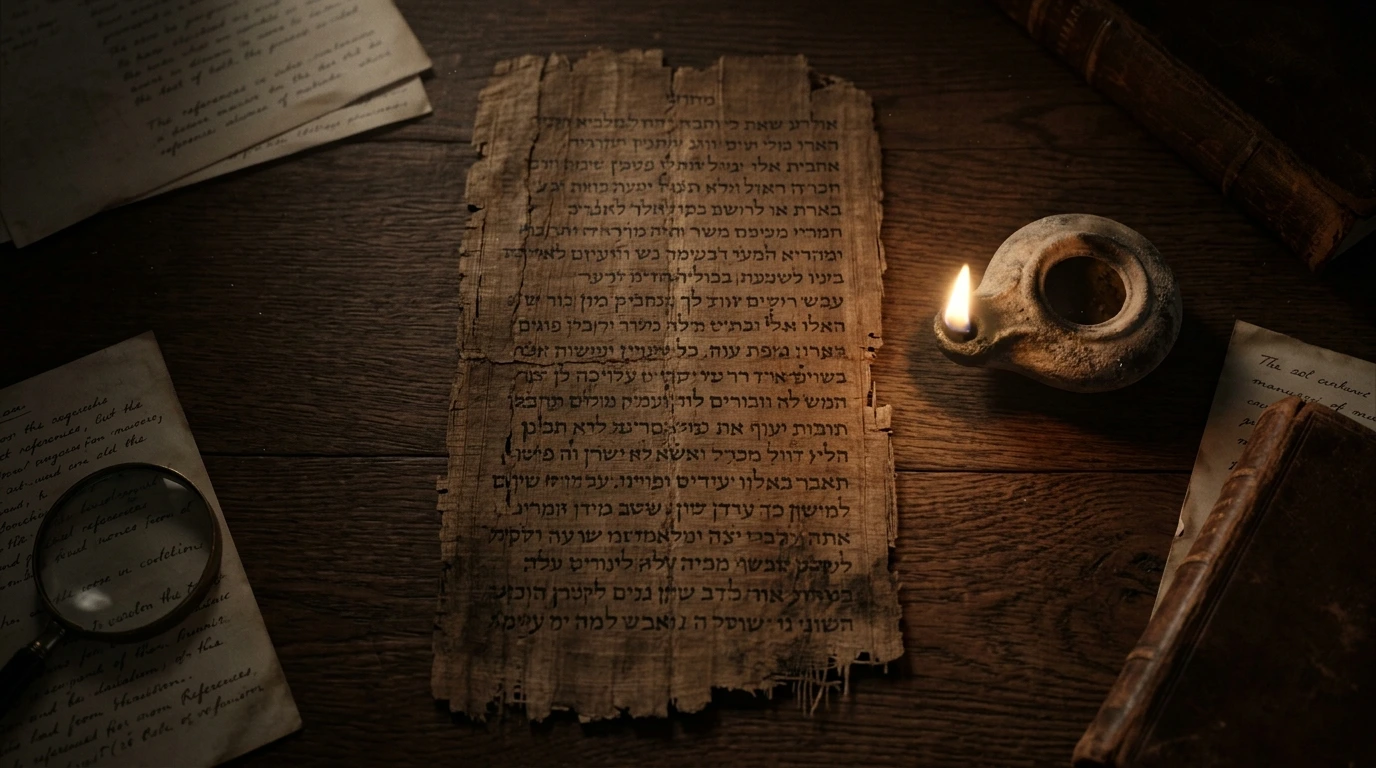
For half a century prior to the accidental 1947 Bedouin discovery at Qumran, the single oldest Hebrew biblical manuscript fragment known to human civilization was The Nash Papyrus (cataloged as Cambridge University Library MS Add. 4445).
Acquired in Egypt in 1898 by Walter Llewellyn Nash, an antiquarian and secretary of the Society of Biblical Archaeology, the fragment was purchased from an antiquities dealer who stated it was found in the Fayum oasis.
In 1903, Nash presented the precious relic to the Cambridge University Library.
Physical Artifact Specifications
- Dimensions: Approximately 13.5 cm high by 6.0 cm wide.
- Material: Fine Egyptian papyrus leaf.
- Preservation: A single, continuous column containing 24 lines of clear Hebrew square script, with the right-hand margin intact and minor damage along the left edge.
- Date: Dated by leading 20th-century paleographers (Stanley A. Cook, F.C. Burkitt, and William Foxwell Albright) to the Maccabean / Late Hasmonean era (c. 150–100 BC).
[ARTIFACT METADATA: THE NASH PAPYRUS]
Repository: Cambridge University Library (MS Add. 4445)
Origin: Fayum Oasis, Egypt
Date of Inscription: c. 150–100 BC (2nd century BC)
Language: Classical Biblical Hebrew
Text: Exodus 20:2–17 / Deuteronomy 5:6–21 (Decalogue) +
      Deuteronomy 6:4–5 (Shema Yisrael)
Significance: Oldest Hebrew manuscript known prior to Dead Sea Scrolls
The Textual Contents: Decalogue and Shema Yisrael in One Sheet
The Nash Papyrus does not present an ordinary continuous biblical chapter. Instead, it presents a composite liturgical compilation uniting the two supreme creeds of ancient Israel:
1. The Ten Commandments (Lines 1–21)
The Decalogue text is a fascinating harmonization combining readings from both Exodus 20 and Deuteronomy 5:
- Fourth Commandment (Sabbath): Uses the Exodus reading "Remember the Sabbath day" (Zakhor - זָכוֹר) alongside Deuteronomy’s social motivation ("that your manservant and maidservant may rest as well as you").
- Commandment Order: Strikingly, the Nash Papyrus places the Sixth, Seventh, and Eighth Commandments in the order: Adultery, Murder, Theft:
- "You shall not commit adultery" (Line 13)
- "You shall not murder" (Line 14)
- "You shall not steal" (Line 15)
This specific sequence (Adultery before Murder) is identical to the order preserved in the Greek Septuagint (LXX) of Exodus 20 and is quoted by Jesus in the Gospel of Luke (Luke 18:20: "Do not commit adultery, Do not murder, Do not steal").
2. The Shema Yisrael (Lines 22–24)
Following the Decalogue, Line 22 features an introductory rubric found in the Septuagint: "And these are the statutes and the judgments which Moses commanded..." followed immediately by the immortal confession of monotheism:
[THE IMMORTAL SHEMA: LINES 23–24]
שְׁמַע יִשְׂרָאֵל יְהוָה אֱלֹהֵינוּ יְהוָה אֶחָד׃
וְאָהַבְתָּ אֵת יְהוָה אֱלֹהֶיךָ בְּכָל־לְבָבְךָ וּבְכָל־נַפְשְׁךָ...
"Hear, O Israel: YHWH our God, YHWH is One!
And you shall love YHWH your God with all your heart and with all your soul..."
Scribal Characteristics: An Ancient Liturgical Phylactery Sheet
Why would an ancient scribe copy the Ten Commandments and the Shema on a single small papyrus sheet?
Biblical scholars, supported by Talmudic evidence, have concluded that the Nash Papyrus was:
- A Personal Liturgical Prayer Leaf: Carried by a pious Jewish emigrant living in Egypt for daily morning prayers (Shacharit).
- An Early Tefillin (Phylactery) or Mezuzah Prototype: The Mishnah (Tamid 5:1) explicitly records that in the Second Temple, priests recited the Ten Commandments immediately before the Shema every morning!
Later rabbinic authorities removed the Decalogue from daily public recitation to refute sectarian claims that only the Ten Commandments were directly given by God at Sinai. The Nash Papyrus physically preserves this pre-rabbinic Second Temple daily liturgy.
The Pre-Qumran Paleographical Milestone (Albright’s Masterpiece)
In 1937, American biblical archaeologist William Foxwell Albright published a landmark paleographical re-examination of the Nash Papyrus in the Journal of Biblical Literature.
Albright traced the evolution of the Hebrew script:
- Comparing the Nash characters with the 3rd-century BC Edfu papyri and 1st-century AD ossuary graffiti.
- Establishing precise morphological markers for medial mem, final pe, and hooked lamed.
The Ultimate Validation in 1947
When John Trever first photographed the Great Isaiah Scroll (1QIsa-a) in Jerusalem in February 1948, he had no precedent for dating biblical scrolls. Trever immediately referenced Albright’s 1937 chart of the Nash Papyrus!
Because the script of 1QIsa-a matched the morphological traits established by the Nash Papyrus, scholars were able to instantly confirm that the Dead Sea Scrolls were authentic antiquity relics dating to the 2nd–1st centuries BC, rather than medieval forgeries.
Three-Tier Evidentiary Evaluation: Textual Stability
| Evidentiary Tier | Scientific Data | Textual Conclusion |
|---|---|---|
| Tier 1: Physical Manuscript | Papyrus leaf MS Add. 4445 at Cambridge; 24 lines, 2nd century BC (c. 150–100 BC). | Proves biblical Hebrew texts were preserved in private Egyptian Jewish archives before the Roman conquest. |
| Tier 2: Textual Harmony | Agreement with the Septuagint and New Testament order of the commandments (Adultery, Murder, Theft). | Demonstrates the authentic antiquity of the manuscript tradition cited by Christ in the Gospels. |
| Tier 3: Liturgical Consistency | Matches the Mishnaic description of the Second Temple priestly morning liturgy (Tamid 5:1). | Provides tangible material proof of historical Jewish liturgical worship in the Hellenistic era. |
Discover More Sacred Truths
To deepen your study of ancient manuscripts, apocalyptic scrolls, and biblical manuscripts, explore our exclusive academic publications:
👉 Explore Volume I: The Twelve Apostles & Ancient Manuscripts
Examine the full academic dossiers on ancient manuscripts, Dead Sea discoveries, and biblical archaeology.
🎁 Or Unlock The Sacred Keys Trilogy Master Collection ($7.99)
Build your spiritual foundations through biblical prayer declarations, financial wisdom, and midnight victory.
Frequently Asked Questions
Why does the Nash Papyrus omit "the house of bondage" in the First Commandment?
Line 1 preserves "I am the Lord your God who brought you out of the land of Egypt..." but omits the phrase "out of the house of bondage", likely due to scribal abbreviation for liturgical brevity or reflecting an ancient textual variant preserved in Egyptian Jewish circles.
Did the Nash Papyrus influence the dating of the Dead Sea Scrolls?
Directly. In 1948, the Nash Papyrus was the primary benchmark used by William F. Albright and John Trever to determine that the newly discovered Dead Sea Scrolls were authentic pre-Christian manuscripts.
Where can one view the Nash Papyrus today?
The original papyrus is preserved in the Special Collections of the Cambridge University Library in England. High-resolution digital facsimiles are accessible through the Cambridge Digital Library.
Frequently Asked Questions
Why does the Nash Papyrus omit "the house of bondage" in the First Commandment?
It represents either an intentional abbreviation for liturgical prayer usage or an ancient textual variant circulating in Egyptian Jewish communities.
Did the Nash Papyrus influence the dating of the Dead Sea Scrolls?
Yes. It was the sole paleographical reference point enabling Albright and Trever in 1948 to securely anchor the Dead Sea Scrolls to the 2nd and 1st centuries BC.
Where can one view the Nash Papyrus today?
It is housed at the Cambridge University Library in the UK and is fully digitized in their online repository.
Related Research Dossiers
View all 120 articles →
The Great Isaiah Scroll (1QIsa-a) Research Guide: Shrine of the Book, Google Digital Project, and Codicology
The War Scroll (1QM): Cosmic Eschatology, Roman Legion Tactics, and Apocalyptic Scriptural Fidelity