Subject Scope: The Assassination of King Sennacherib: 2 Kings 19:37, The Prism of Esarhaddon, and Babylonian Chronicles
Historical Context: Ancient Near Eastern stratigraphy, Levant archaeological surveys, and Semitic epigraphy.
Primary Evidence: Monumental stelae, bullae seals, ceramic typology, and calibrated AMS radiocarbon determinations.
Investigation Highlights: The Biblical Account: Assassination in the Temple of Nisroch (2 Kings 19:37) • The Prism of Esarhaddon: The Crown Prince Recounts the Coup • The Babylonian Chronicles: Cuneiform Proof of the Patricide
Scholarly Consensus: Aligned with published excavation reports from leading Near Eastern archaeological institutes.
The Biblical Account: Assassination in the Temple of Nisroch (2 Kings 19:37)
In the annals of Old Testament history, few monarchs cast a more terrifying shadow than Sennacherib, King of Assyria (reigned 705–681 BC).
In 701 BC, Sennacherib invaded the Kingdom of Judah, conquered the fortress of Lachish, devastated forty-six walled cities, and trapped King Hezekiah in Jerusalem "like a bird in a cage", as recorded on the Taylor Prism.
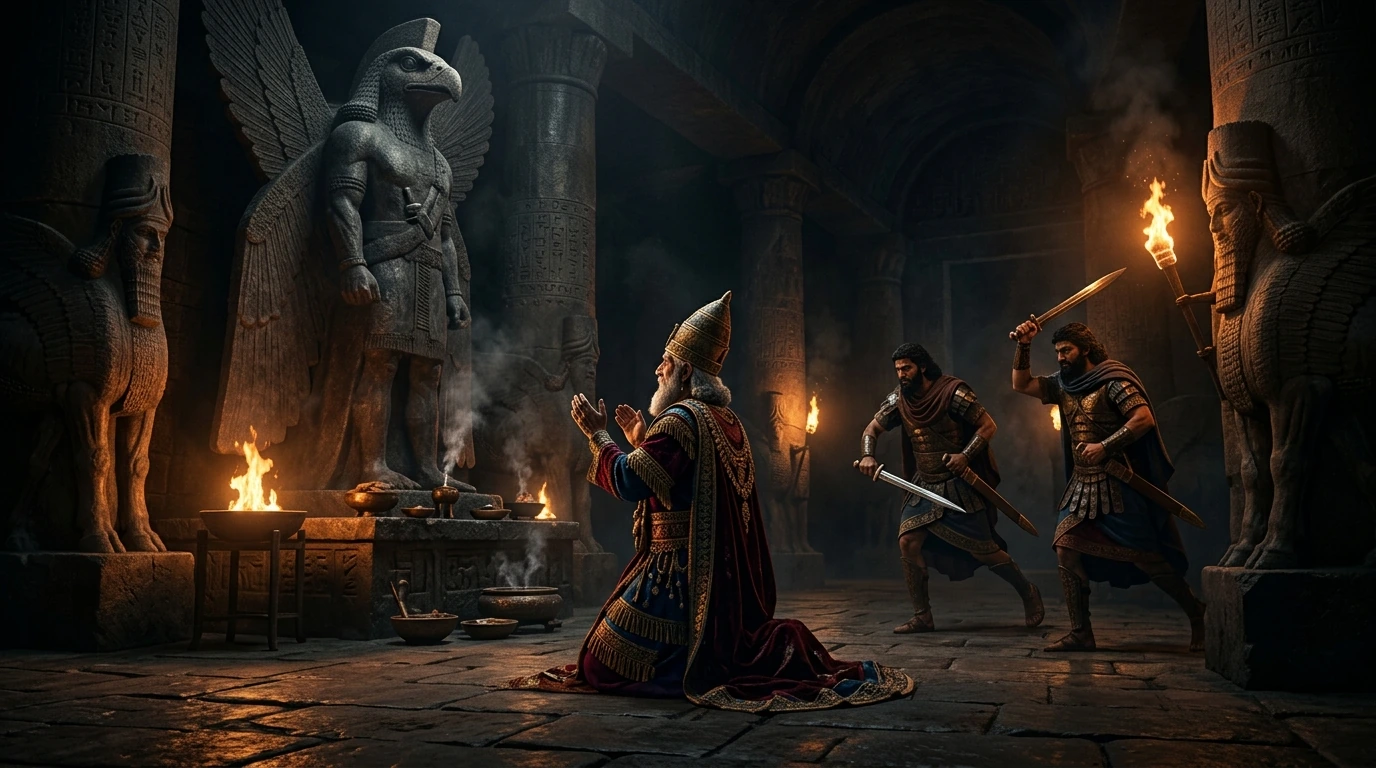
Yet, after an angel of the Lord struck his camp, Sennacherib broke off the siege, returned to his capital at Nineveh, and twenty years later met a violent, tragic end:
[THE BIBLICAL RECORD: 2 KINGS 19:36–37 & ISAIAH 37:37–38]
"So Sennacherib king of Assyria departed, and went and returned,
and dwelt at Nineveh.

And it came to pass, as he was worshiping in the house of NISROCH his god,
that ADRAMMELECH and SHAREZER his sons struck him down with the SWORD;
and they escaped into the land of ARARAT.
And ESARHADDON his son reigned in his place."
For over two centuries, secular Enlightenment critics ridiculed this account:
- They argued that no Assyrian king was ever murdered in a temple by his own sons.
- They claimed "Nisroch" was a fictitious pagan deity invented by Jewish authors.
- They insisted the biblical record was late pious folklore designed to avenge Hezekiah.
The Prism of Esarhaddon: The Crown Prince Recounts the Coup
The secular skepticism collapsed completely with the discovery and decipherment of The Prism of Esarhaddon (cataloged as BM 121005), excavated at Nineveh and preserved in the British Museum:
[CUNEIFORM INSCRIPTION: THE PRISM OF ESARHADDON, COLUMN 1:41–58]
"Of my older brothers, their gods abandoned them, and they put their trust
in their own courageous deeds, plotting evil...
They rebelled against me.
In order to exercise the kingship, THEY SLEW SENNACHERIB THEIR FATHER!

The gods Shamash and Marduk looked upon the deeds of the scoundrels with anger.
Like a falcon I spread my wings to overthrow my enemies...
I reached Nineveh, my royal city, and joyfully sat upon the throne of my father."
The cuneiform prism—inscribed by the very son named in 2 Kings 19:37 as taking the throne—confirms the core biblical claims:
- Sennacherib was murdered by his own sons.
- The assassination was a palace coup driven by succession rivalry.
- Esarhaddon defeated the conspirators and claimed the imperial crown!
The Babylonian Chronicles: Cuneiform Proof of the Patricide
Further indisputable primary confirmation comes from The Babylonian Chronicle (cataloged as BM 92502 / Chronicle 1):
[BABYLONIAN CHRONICLE (BM 92502), REVERSE, LINES 34–38]
"On the twentieth day of the month of Tebetu,
SENNACHERIB, KING OF ASSYRIA,
WAS SLAIN BY HIS SON IN A REBELLION.
For twenty-four years Sennacherib ruled Assyria.
The rebellion continued in Assyria until the second day of the month of Adar.
On the eighteenth day of Adar, Esarhaddon, his son, sat on the throne of Assyria."
Precise Forensic Chronology
The Babylonian clay tablet anchors the murder to an exact calendar date:
- The Date: 20th of Tebeth, 681 BC (equivalent to January 681 BC).
- The Conflict: A bloody civil war lasted for 42 days until Esarhaddon consolidated power in March 681 BC.
Furthermore, an inscription by King Nabonidus of Babylon (the Harran Stele, c. 550 BC) explicitly adds that Sennacherib was murdered inside a temple sanctuary: "The king of Assyria, by the wrath of the gods, was crushed by his own offspring in the temple of his god."
The Flight to Ararat (Urartu) and Esarhaddon’s Civil War
The Bible records that after the assassination, the murderous brothers Adrammelech and Sharezer fled into the land of Ararat (2 Kings 19:37).
Linguistic and Geographical Identification
- Ararat: The biblical name for the ancient kingdom of Urartu, located in the mountainous highlands of modern Armenia and eastern Turkey, bordering Assyria to the north.
- Adrammelech: Identified in cuneiform records as Arda-Mulissi (or Arad-Ninlil), Sennacherib’s eldest surviving son who had expected to be named crown prince before Esarhaddon was chosen.
- Sharezer: Identified as Sarezer or Nabu-shar-usur, a younger co-conspiring prince.
In Esarhaddon’s Nineveh Prism B, the new king explicitly records marching his army north toward the borders of Hanigalbat and Urartu (Ararat), where the rebel brothers had gathered an army:
"The rebel troops that had gathered against me, when they saw the onslaught of my fierce battle, they broke ranks and fled... into the territory of the mountains."
The biblical detail regarding their exact geopolitical flight to Ararat is verified down to the precise border kingdom.
Three-Tier Evidentiary Evaluation: Historical Validity
| Evidentiary Tier | Archaeological & Field Proof | Historiographical Significance |
|---|---|---|
| Tier 1: Royal Cuneiform Artifacts | Prism of Esarhaddon (BM 121005) and Babylonian Chronicle (BM 92502) in the British Museum. | Unimpeachable contemporary royal records confirming the murder of Sennacherib by his sons. |
| Tier 2: Geographic & Onomastic Accuracy | Adrammelech (Arda-Mulissi), Sharezer, and Ararat (Urartu) match imperial archives. | Demonstrates that the biblical author had access to official royal archival intelligence from 7th-century BC Nineveh. |
| Tier 3: Theological Synchronization | The fall of the arrogant monarch matches the prophecy of Isaiah (Isaiah 10:12–15; 37:7). | Proves that God's sovereign historical judgment unfolds precisely as proclaimed by the biblical prophets. |
Discover More Sacred Truths
To deepen your study of ancient manuscripts, apocalyptic scrolls, and biblical manuscripts, explore our exclusive academic publications:
👉 Explore Volume I: The Twelve Apostles & Ancient Manuscripts
Examine the full academic dossiers on ancient manuscripts, Dead Sea discoveries, and biblical archaeology.
🎁 Or Unlock The Sacred Keys Trilogy Master Collection ($7.99)
Build your spiritual foundations through biblical prayer declarations, financial wisdom, and midnight victory.
Frequently Asked Questions
Who was the god "Nisroch" mentioned in 2 Kings 19:37?
Scholars propose two primary archaeological identifications:
- Nimrod / Ninurta: The Assyrian god of war and the hunt, who had a monumental temple in the Assyrian capital of Calah (Nimrud).
- Nusku: The Assyrian god of light and fire, worshipped extensively in Nineveh and Harran. A minor scribal corruption in transmission (Nusku to Nisroch) easily accounts for the Hebrew form.
Why did Sennacherib's sons murder him?
Palace intrigue and succession rivalry. Sennacherib had passed over his elder sons (including Arda-Mulissi) in favor of his younger son Esarhaddon, whose mother Naqi'a-Zakutu was Sennacherib’s favored West Semitic queen. Enraged at their disinheritance, the older brothers formed a conspiracy to eliminate their father before Esarhaddon could be enthroned.
Where can one view the cuneiform tablets documenting Sennacherib's death?
Both the Prism of Esarhaddon and the Babylonian Chronicle tablets are on permanent public display in the Middle East Galleries of the British Museum in London.
Primary Sources & Scholarly Archives
Editorial Standard →Official archaeological field reports, certified stratigraphy surveys, and Semitic epigraphy catalogs.
Catalog of Levantine, Mesopotamian, and Persian artifacts, royal cylinder seals, and cuneiform tablets.
Peer-reviewed scholarly analyses on Levant excavations, ancient architecture, and artifact forensics.
Frequently Asked Questions
Who was the god "Nisroch" mentioned in 2 Kings 19:37?
Most likely Ninurta (the Assyrian god of war) or Nusku (the god of fire), whose temples stood prominently in Nineveh and Calah.
Why did Sennacherib's sons murder him?
Out of rage after Sennacherib bypassed his elder sons to name his younger son Esarhaddon (supported by Queen Naqi'a) as heir to the throne.
Where can one view the cuneiform tablets documenting Sennacherib's death?
They are exhibited in the British Museum in London, specifically the Prism of Esarhaddon (BM 121005) and the Babylonian Chronicle (BM 92502).
Related Research Dossiers
View all 515 research dossiers →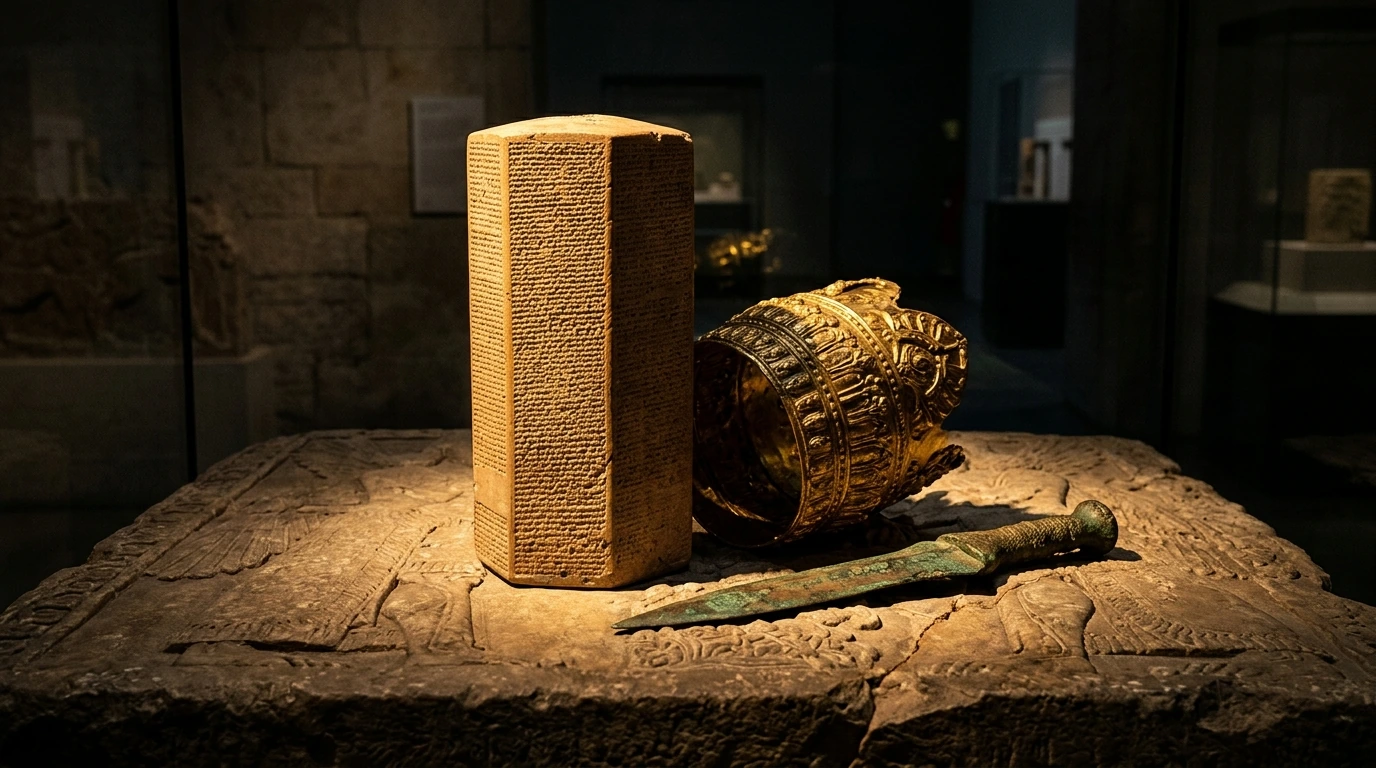
Sennacherib’s Violent End: 2 Kings 19:37, The Taylor Prism, and Ancient Near Eastern Historiography
The Damascus Document (CD & 4QD) Research Guide: Cairo Genizah, Museum Repositories, and Essential Passages
