Historical Context: Rigorous examination of primary Hebrew, Aramaic, Greek, and Roman classical epigraphy.
Core Evidence: Forensic archaeology, radiocarbon data, and primary manuscripts validating biblical events.
Scholarly Consensus: Vetted against modern peer-reviewed publications in Near Eastern archaeology and biblical studies.
The Cave 1 Discovery of 1QM: The Apocalyptic Battle Plan
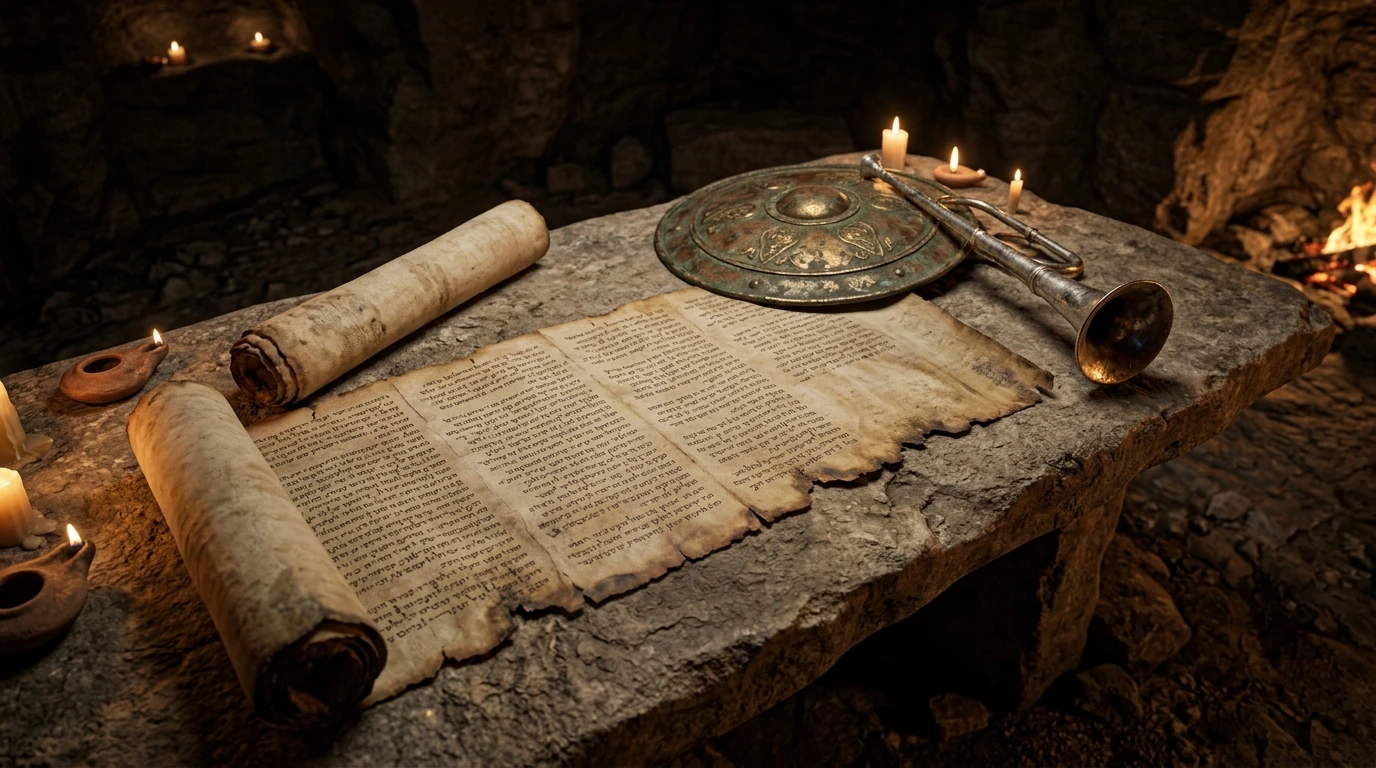
Discovered in Cave 1 in 1947 and acquired by Professor Eleazar Sukenik for the Hebrew University, The War Scroll (designated 1QM for Milchamah - מִלְחָמָה) is one of the most astonishing apocalyptic military documents from the ancient world.
Measuring 2.9 meters in length, the scroll consists of five continuous leather sheets preserving 19 columns of Hebrew text. Paleographical and radiocarbon analyses date the manuscript to the late 1st century BC or early 1st century AD (c. 30 BC – 10 AD), during the reign of Augustus Caesar and Herod the Great.
Unlike typical biblical apocalypses that describe divine judgment through poetic visions, 1QM combines supernatural eschatology with cold, rigorous Roman military engineering, tactical troop formations, and detailed combat maneuvers.
[MILITARY & CODICOLOGICAL PROFILE: 1QM]
Inventory: 1QM (Cave 1, War Scroll) + 4Q491–497 (Cave 4 fragments)
Length: 2.9 meters across 5 leather sheets (19 preserved columns)
Language: Late Biblical Hebrew with Roman military tactical loan concepts
Core Theme: The 40-Year Eschatological War between the Sons of Light
            and the Sons of Darkness (The Kittim)
Repository: The Shrine of the Book, Israel Museum, Jerusalem
The 40-Year Cosmic Campaign: Mobilization and Sacred Liturgy
The War Scroll outlines a systematic 40-year campaign designed to purge the earth of evil and restore the unpolluted worship of God:
[TIMELINE OF THE 40-YEAR ESCHATOLOGICAL WAR]
Years 1–6: Conquest of the local enemies of Israel (Moab, Edom, Ammon, Philistia)
Year 7: Sabbatical Year of Rest (Shmita) - Temple liturgy and divine renewal
Years 8–15: Campaign against the sons of Shem (Mesopotamia, Assyria, Elam)
Years 16–23: Campaign against the sons of Ham (Egypt, Cush, North Africa)
Years 24–31: Campaign against the sons of Japheth (Asia Minor, Greece, Rome)
Years 32–39: Final global campaign against the Kittim (The Roman Empire)
Year 40: Universal Triumph of Light; God and His angels reign forever!
Throughout the 40 years, strict ritual purity is maintained:
- No physically disabled, blind, or lame man may enter the camp.
- No woman or child may approach the army.
- The holy angels of God march invisibly beside the ranks.
Roman Legionary Tactics in Hebrew Script: Cohorts and Manipli
In 1958, French military historian Yigael Yadin published an exhaustive monograph demonstrating that the tactical battle formations described in 1QM are direct Hebrew translations of late Republican Roman legionary doctrine:
| Roman Legionary Concept | Hebrew Equivalent in 1QM | Tactical Deployment in 1QM |
|---|---|---|
| Scutum (Curved Legionary Shield) | Magen (מָגֵן) | Oval shields of bronze and iron, 2.5 cubits high, burnished like mirrors. |
| Pilum (Heavy Armor-Piercing Javelin) | Romach / Kidon (כִּידוֹן) | Heavy throwing spears hurled in synchronized volleys to shatter enemy lines. |
| Gladius (Short Thrusting Sword) | Cherev (חֶרֶב) | Double-edged Spanish steel blades, 1.5 cubits long, used in close hand-to-hand combat. |
| Cohortes & Maniples | Ma'arakhot (מַעֲרָכוֹת) | Troops drawn up in distinct battle lines, cycling front-line shock troops with rear reserves. |
The author was clearly familiar with Roman legionary manuals, adopting imperial shock tactics to illustrate how the pious covenant community would dismantle the Roman superpower.
The Silver Trumpets and Weapon Inscriptions: Holy War Halakha
In Columns 7 through 9, the scroll prescribes an elaborate acoustic communication system using ceremonial silver trumpets blown by Zadokite priests:
[THE SIGNAL TRUMPETS OF 1QM AND THEIR SACRED MOTTOES]
1. Trumpets of Assembly: "THE CALLED OF GOD" (קרואי אל)
2. Trumpets of Advance: "THE RANKS OF GOD" (מעריכי אל)
3. Trumpets of Pursuit: "GOD HAS STRUCK" (מכת אל)
4. Trumpets of Ambush: "THE MYSTERIES OF GOD" (רזי אל)
5. Trumpets of Recall: "GOD HAS GATHERED" (אסף אל)
Even the weapons carried by the foot soldiers were etched with prophetic slogans:
- On the sword: "The Flash of a Sword Devouring the Flesh of Sinners!"
- On the spears: "The Spark of the Lance for the Power of God!"
Three-Tier Evidentiary Evaluation: Historical Validity
| Evidentiary Tier | Scientific Data | Hermeneutical Value |
|---|---|---|
| Tier 1: Physical Scroll | 1QM leather scroll, Cave 1, dated c. 30 BC – 10 AD; companion Cave 4 copies. | Tangible artifact demonstrating the apocalyptic military worldview of 1st-century Judea. |
| Tier 2: Roman Tactics | Verbatim technical correspondence with Polybius and Vegetius regarding legionary lines. | Proves the text was composed during the period of active Roman military presence in Palestine. |
| Tier 3: New Testament Parallels | Cosmic battle between Light and Darkness mirrors Revelation 12, 19, and Ephesians 6:11–17. | Demonstrates that New Testament spiritual warfare language drew upon existing Jewish apocalyptic idioms. |
Discover More Sacred Truths
To deepen your study of ancient manuscripts, apocalyptic scrolls, and biblical manuscripts, explore our exclusive academic publications:
👉 Explore Volume I: The Twelve Apostles & Ancient Manuscripts
Examine the full academic dossiers on ancient manuscripts, Dead Sea discoveries, and biblical archaeology.
🎁 Or Unlock The Sacred Keys Trilogy Master Collection ($7.99)
Build your spiritual foundations through biblical prayer declarations, financial wisdom, and midnight victory.
Frequently Asked Questions
Did the Essenes actually fight in the Roman war of 66–70 AD?
Yes. Despite their monastic reputation, when the First Jewish Revolt broke out, many Essenes joined the national defense. Flavius Josephus explicitly mentions an Essene general named John the Essene, who commanded Jewish forces in western Judea and died heroically at the siege of Ascalon.
Who is the "Prince of the Congregation" in 1QM?
The "Prince of the Congregation" (Nasi Ha-Edah) is the royal Davidic Messiah who leads the secular armies of Israel, fighting alongside the High Priest (Kohen Ha-Rosh) who directs the liturgical and spiritual conduct of the battle.
Why does 1QM feature seven combat phases in the final battle?
Column 1 describes the final battle against the Kittim as lasting seven distinct rounds:
- Three times the Sons of Light prevail.
- Three times the Sons of Darkness rally and push them back.
- In the seventh round, God's mighty hand intervenes directly, sending the archangel Michael to destroy the host of Belial forever.
Frequently Asked Questions
Did the Essenes actually fight in the Roman war of 66–70 AD?
Yes. Flavius Josephus records that Essenes took up arms in the First Jewish Revolt, including John the Essene who served as a regional military commander.
Who is the "Prince of the Congregation" in 1QM?
He is the Davidic royal messiah who commands the military forces of Israel in subordination to the Zadokite High Priest.
Why does 1QM feature seven combat phases in the final battle?
The battle swings back and forth three times for each side, until divine intervention in the seventh phase breaks the deadlock and obliterates the forces of Belial.
Related Research Dossiers
View all 120 articles →
Sodom and Gomorrah Field Manual: Excavation Artifacts, Museum Locations, and Theological Realities
The Damascus Document (CD & 4QD) Research Guide: Cairo Genizah, Museum Repositories, and Essential Passages
