Historical Context: Rigorous examination of primary Hebrew, Aramaic, Greek, and Roman classical epigraphy.
Core Evidence: Forensic archaeology, radiocarbon data, and primary manuscripts validating biblical events.
Scholarly Consensus: Vetted against modern peer-reviewed publications in Near Eastern archaeology and biblical studies.
The Threshold of the Kidron Valley
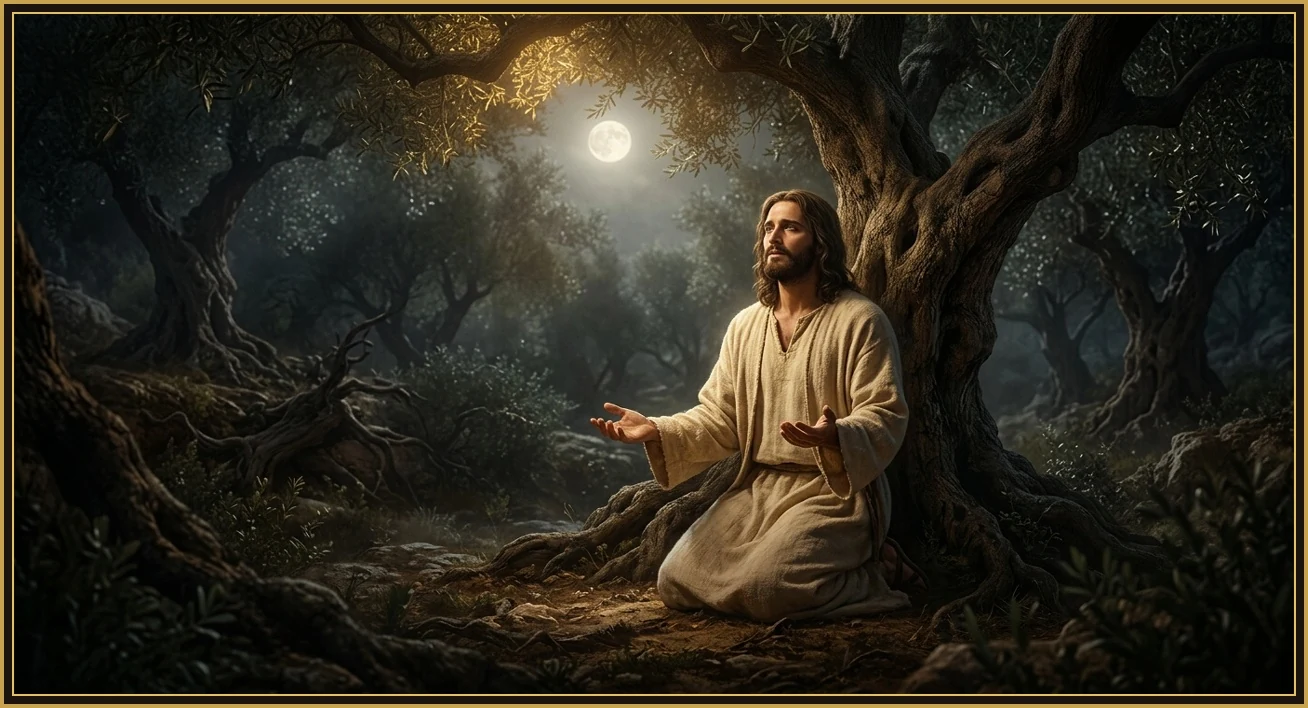
On the night before His execution, Jesus Christ did not seek refuge in the reinforced palaces of Jerusalem or escape over the mountains toward the safe haven of Bethany.
Instead, following the Last Supper, He deliberately crossed the dark, dry riverbed of the Kidron Valley and led His disciples into an ancient walled grove on the lower slopes of the Mount of Olives.
The name of that grove has echoed through human literature for two millennia: Gethsemane.
To read the Gospel accounts of that Thursday midnight is to witness the absolute epicenter of human and divine agony. Matthew records that Jesus began to be "sorrowful and deeply distressed" (lypeisthai kai adēmonein—Matthew 26:37). The Greek verb adēmonein describes a profound, isolating mental anguish—a state of utter, shuddering grief that borders on psychological shock.
Jesus turned to His inner circle—Peter, James, and John—and spoke words of raw, unvarnished vulnerability that should silence every superficial religious doctrine:
"My soul is exceedingly sorrowful, even to death. Stay here and watch with Me." (Matthew 26:38)
Here is the King of Glory, the Creator of the stars, confessing to Galilean fishermen that the weight pressing upon His heart was severe enough to literally stop His heart.
If the Son of God experienced inner anguish of this magnitude, why do we treat our own emotional crises as unspiritual embarrassments?
The Ancient Engineering of Gath-Shemanim (The Olive Press)
The location was not a picturesque, manicured garden. It was an industrial agricultural olive orchard.
The word Gethsemane is an anglicized transliteration of two Aramaic and Hebrew words: Gath (a press, vat, or trough) and Shemanim (oils, plur. of shemen). Literally, it means "The Valley of the Olive Press."
In ancient Judean olive production, extracting oil was a brutal, multi-tiered mechanical process:
- The Harvest and Bruising: Ripe, bitter olives were harvested from the gnarly trees and first rolled under a colossal circular millstone (rochem) turned by a donkey or oxen. This crushed the flesh and cracked the stones without destroying the oil cells.
- The Wicker Baskets: The crushed olive mash was shoveled into porous, woven wicker baskets called ‘aqalim.
- The Immense Limestone Beam: These woven baskets were stacked inside a stone press directly underneath a colossal wooden lever beam anchored into a bedrock alcove.
- The Crushing Stones: Massive limestone weights—each weighing between 500 and 1,000 pounds—were hung on the far end of the wooden beam one by one. The downward gravitational torque exerted tens of thousands of pounds of compressive force upon the baskets.
The very first oil that seeped through the wicker mesh under the initial crushing weight was pure, golden, and spotless: it was the Virgin Oil (shemen zayit zak), reserved exclusively for the sacred golden Menorah inside the Holy Place of the Temple.
Jesus did not arrive in Gethsemane by accident. He brought His trembling humanity into the exact physical facility designed for crushing, because He was about to undergo the ultimate spiritual pressing that would generate the oil of eternal redemption for all humanity.
Forensic Pathology of Hematidrosis (Sweating Blood)
Luke—the only physician among the four Gospel biographers—records a medical detail that secular critics questioned for centuries until modern clinical forensic science confirmed its reality:
"And being in agony, He prayed more earnestly. Then His sweat became like great drops of blood falling down to the ground." (Luke 22:44)
The Greek phrase is Thromboi Haimatos (θρόμβοι αἵματος). Thromboi refers to thick, clotted globules—not thin, watery sweat with a reddish tint, but heavy, viscous clots of blood oozing from the skin.
This clinical phenomenon is known in forensic medicine as Hematidrosis (or hematohidrosis).
Under conditions of overwhelming, acute psychological horror, terror, or existential dread, the sympathetic nervous system triggers an astronomical release of catecholamines (adrenaline and noradrenaline). This extreme vascular constriction is followed immediately by severe vascular dilation, causing the microscopic subcutaneous capillary networks surrounding the sweat glands to rupture under immense blood pressure.
Blood leaks directly into the lumens of the sweat ducts. As the sweat glands pump perspiration to the surface of the skin, the blood mixes with the sweat, producing a heavy, crimson exudate that coagulates into clots upon contact with cool night air.
Hematidrosis is extraordinarily rare in clinical literature; it occurs almost exclusively in individuals facing imminent, brutal execution or cataclysmic trauma.
Before a single Roman lash tore Christ’s back at the scourging pillar, before a single iron spike pierced His wrists at Golgotha, Jesus was already bleeding from every pore of His face solely from the internal wrestling of His soul.
The Geometry of Surrender: The Three Prayers
Notice how Jesus handled this crushing weight. He did not suppress His emotions. He did not recite detached religious formulas.
Scripture notes: "He went a little farther, and fell on His face, and prayed..." (Matthew 26:39). In Middle Eastern posture, falling prostrate (nophal ‘al-panav) means lying flat on the earth, hands outstretched, face pressed into the dust in complete submission.
He prayed three distinct times, each prayer following a precise, three-fold covenant cadence:
- The Petition of Natural Agony: "O My Father, if it is possible, let this cup pass from Me..." He gave voice to His human desire to avoid the torture of the cross and the cosmic horror of bearing divine wrath for human sin.
- The Relinquishment of Human Autonomy: "...nevertheless, not as I will, but as You will." The Greek phrase is stunning: plēn mē to thelēma mou alla to son ginesthō. “Not My will, but Yours be done.”
- The Angelic Strengthening: Luke 22:43 records that following this agonizing surrender, "an angel appeared to Him from heaven, strengthening Him" (enischyōn auton).
Notice the divine sequence: The angel did not take away the cup! The angel gave Him the supernatural physical and emotional endurance to drink it.
When Jesus finally rose from the dust after the third prayer, the trembling was gone. His disciples were fast asleep from sheer grief, but Christ stood erect, majestic, and completely in command of the cosmos.
When Judas arrived with hundreds of Roman legionaries bearing lanterns, swords, and spears, Jesus did not run. He stepped forward into the torchlight and demanded: "Whom do you seek?" (John 18:4). When He spoke His divine name—“I am He” (Egō Eimi)—the entire imperial detachment collapsed backward onto the ground.
The victory of the Cross was not won on the hill of Golgotha; the victory of the Cross was won on His knees in the dirt of Gethsemane.
The Gethsemane Protocol: How to Survive Your Own Crushing
When life places your marriage, your finances, your health, or your family under the heavy limestone beam of an unexpected olive press, enact the Gethsemane Blueprint:
1. Identify Your Three Inner-Circle Watchmen
Jesus had seventy disciples, but He only brought twelve to the garden, and He only took three (Peter, James, and John) to the edge of His pressing. Stop broadcasting your deepest pain on social media or to superficial acquaintances. Find the two or three covenant believers who know how to stay awake and intercede when your soul is bleeding.
2. Express Your Raw Human Petition Without Guilt
Tell God what you actually feel: “Father, I hate this divorce. I hate this cancer. I hate this debt. If there is any other way for this cup to pass, let it pass.” Honesty does not offend God; hypocrisy does.
3. Make the "Nevertheless" Pivot
You cannot stay in petition; you must cross into covenant alignment. Utter the words that break the power of hell:
“Nevertheless, Father, not my comfort, not my will, but Your sovereign purpose be done in my life. If this trial produces the oil of Your glory, I surrender.”
4. Expect Supernatural "Enischyō"
When you surrender your will, heaven dispatches angelic reinforcement. You may still have to walk through the valley of shadow, but you will not walk it alone. The very crushing that was designed to destroy your soul will yield the purest holy oil of your life.
Step Into the Full Sacred Keys Warfare Library
The Gethsemane Protocol is Key VII—the crowning revelation in The 7 Biblical Keys for Silent Battles. Learn how to take these ancient biblical blueprints and apply them night after night until your soul is cloaked in unshakable peace:
👉 Download The 7 Biblical Keys for Silent Battles ($3.99)
Instant access to the complete 16-page guide, 9 fine-art sacred plates, the full Gethsemane 7-night protocol, and spoken covenant decrees.
🎁 Or Unlock The Complete Sacred Keys Trilogy Bundle ($7.99 — 33% Off)
Own all 3 foundational volumes: Silent Battles, The Solomon Code, and Command Your Morning & Night with 19 museum-grade plates and priority digital delivery.
Frequently Asked Questions
What is the theological meaning of the "Cup" Jesus prayed about?
Throughout the Old Testament, the "Cup" (kos) is a consistent symbol of divine judgment and holy wrath against sin (Psalm 75:8, Isaiah 51:17, Jeremiah 25:15). In Gethsemane, Jesus was not merely dreading physical crucifixion; He was confronting the cosmic horror of bearing the full holy wrath of God against the sins of all mankind as our substitutionary sacrifice.
Did Jesus experience a lack of faith when He prayed to avoid the cross?
Absolutely not. His prayer demonstrated the utter perfection of His holy humanity. Death and separation from the Father are fundamentally contrary to life and holy communion; for Jesus to casually embrace death would have shown callous indifference. His agonizing prayer followed by absolute obedience (“Nevertheless, not My will...”) represents the pinnacle of holy faith.
Why does God allow us to go through our own "Gethsemane" seasons?
Just as the olive must be crushed under limestone to yield pure virgin oil for the sacred Menorah, human self-sufficiency must be broken so that the pure, supernatural life of Christ can shine through us. Gethsemane seasons burn away pride, entitlement, and superficiality, imparting deep spiritual authority and compassion for others.
Frequently Asked Questions
What is the theological meaning of the "Cup" Jesus prayed about?
Throughout the Old Testament, the "Cup" (kos) is a consistent symbol of divine judgment and holy wrath against sin (Psalm 75:8, Isaiah 51:17, Jeremiah 25:15). In Gethsemane, Jesus was not merely dreading physical crucifixion; He was confronting the cosmic horror of bearing the full holy wrath of God against the sins of all mankind as our substitutionary sacrifice.
Did Jesus experience a lack of faith when He prayed to avoid the cross?
Absolutely not. His prayer demonstrated the utter perfection of His holy humanity. Death and separation from the Father are fundamentally contrary to life and holy communion; for Jesus to casually embrace death would have shown callous indifference. His agonizing prayer followed by absolute obedience ("Nevertheless, not My will...") represents the pinnacle of holy faith.
Why does God allow us to go through our own "Gethsemane" seasons?
Just as the olive must be crushed under limestone to yield pure virgin oil for the sacred Menorah, human self-sufficiency must be broken so that the pure, supernatural life of Christ can shine through us. Gethsemane seasons burn away pride, entitlement, and superficiality, imparting deep spiritual authority and compassion for others.
Related Research Dossiers
View all 120 articles →
When God Is Silent at 3 AM: The Mystery of the Fourth Watch and the Unseen Battle
The Elijah Syndrome: Why God Whispers to Exhausted Believers Under the Broom Tree