Historical Context: Rigorous examination of primary Hebrew, Aramaic, Greek, and Roman classical epigraphy.
Core Evidence: Forensic archaeology, radiocarbon data, and primary manuscripts validating biblical events.
Scholarly Consensus: Vetted against modern peer-reviewed publications in Near Eastern archaeology and biblical studies.
The Necropolis of Ancient Jerusalem
In biblical law, death caused severe ritual uncleanness (tumat met, Numbers 19:11–16). Consequently, Jewish burial was strictly forbidden inside the city walls of Jerusalem.
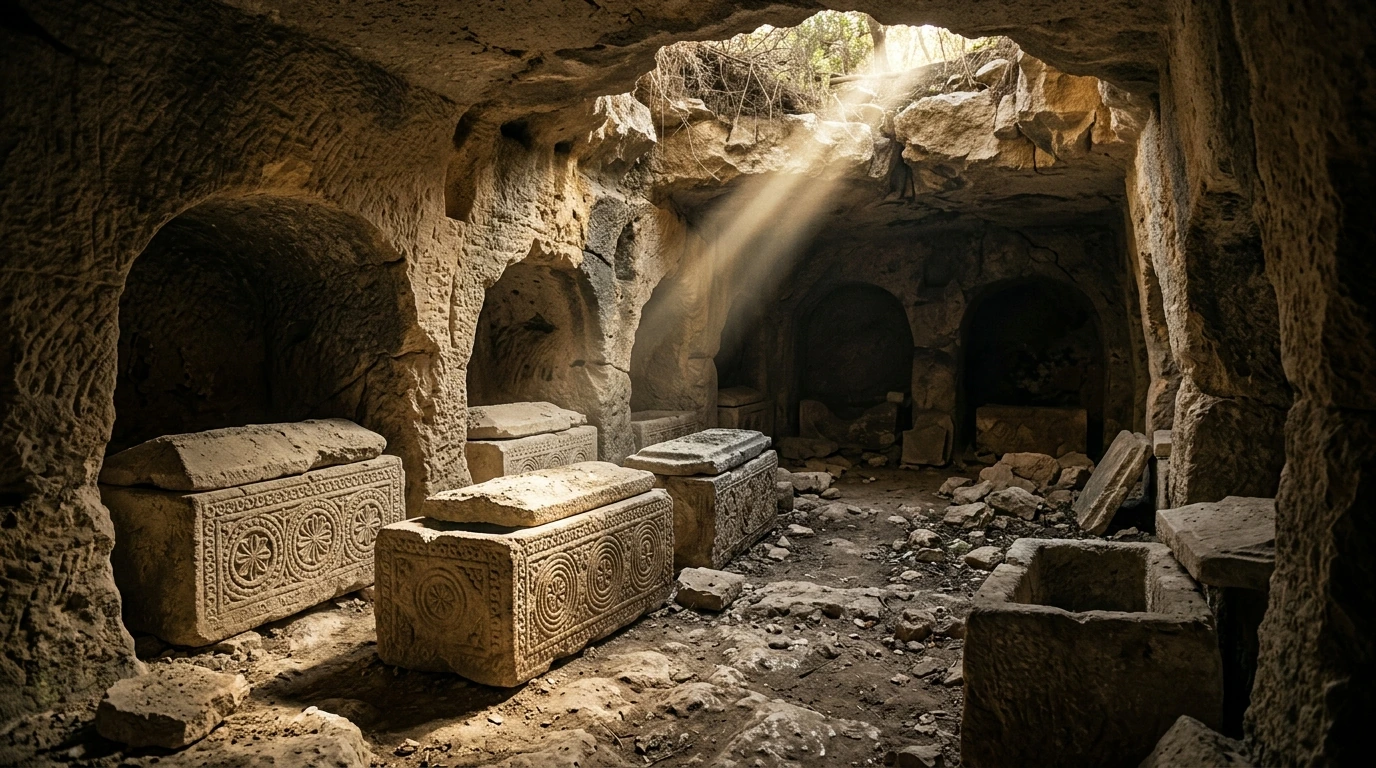
Surrounding the Holy City was a vast necropolis carved into the limestone hills:
- The Mount of Olives and Kidron Valley to the east.
- The Hinnom Valley (Gehenna) to the south.
- The North Talpiot ridge (Peace Forest), offering an elevated vista directly facing the Temple Mount across the valley.
The Caiaphas family selected this elevated southern ridge for their family mausoleum, ensuring that even in death, their tomb faced the golden facade of the sanctuary where they had presided over the Yom Kippur atonement sacrifices.
Visual Guide to the Twelve Ossuaries of the Tomb
The salvage excavation cataloged twelve ossuaries, providing a cross-section of First-Century aristocratic society:
| Ossuary # | Decoration Style | Inscription | Identification |
|---|---|---|---|
| No. 1 | Plain limestone | None (Coin of Agrippa I inside skull) | Adult female matriarch |
| No. 3 | Incised rosettes | Shalom (שלום) | Female family member |
| No. 5 | Geometric zigzag | Qafa (קפא) | Caiaphas family member |
| No. 6 | Ornate Masterpiece | יהוסף בר קיפא (Joseph son of Caiaphas) | The High Priest of the Passion |
| No. 7 | Simple incised lines | Miriam bat Shim‘on | Miriam, daughter of Simeon |
| No. 11 | Plain limestone | Eliezer bar Qafa | Brother or son of the High Priest |
The presence of multiple ossuaries bearing the surname Qafa proves beyond all statistical doubt that the cave was the private family vault of the Caiaphas dynasty.
The Jewish Custom of Ossilegium (Secondary Burial)
The practice of using stone ossuaries appeared abruptly in Jerusalem around 20 BC (during the reign of Herod the Great) and vanished completely with the Roman destruction of the city in 70 AD.
This brief 90-year window represents the exact lifespan of Jesus Christ and the Apostolic Church. The practice was driven by two core beliefs:
- The Expiation of Sins through Decomposition: Ancient rabbis taught: "The decay of the flesh is the expiation of the soul" (Babylonian Talmud, Sanhedrin 47b). As the flesh withered away, the deceased was purged of mortal transgressions.
- Resurrection of the Dry Bones: Inspired by Ezekiel 37, Jews believed that the resurrected body required its original skeletal framework. Storing bones in durable stone chests protected them from wild animals, grave-robbers, and grave contamination.
The High Priest’s Final Resting Place in Historical Perspective
For critics of the New Testament, Caiaphas had long been treated as a literary villain invented by Gospel authors.
The physical recovery of his burial cave, his personal bone box, and his mortal skeletal remains anchored the New Testament narrative into bedrock historical geography:
- The same man whose ears heard the confession of Jesus of Nazareth: "I am; and you will see the Son of Man sitting at the right hand of Power, and coming with the clouds of heaven" (Mark 14:62).
- The same hands that tore his high-priestly vestments in the middle of the night (Matthew 26:65).
- Preserved in a modest stone box, awaiting the final judgment before the very King of Kings he condemned.
Frequently Asked Questions
Why did the practice of using ossuaries last only 90 years?
The practice emerged around 20 BC during Herod’s reign and ended abruptly with the destruction of Jerusalem and the Temple by Roman legions in 70 AD.
How did the tomb face the Temple Mount?
Located in North Talpiot south of Jerusalem, the entrance to the Caiaphas family cave looked directly north toward Mount Moriah and the Second Temple.
Where can the Caiaphas Ossuary be seen today?
The original ornate ossuary is on permanent public display in the Israel Museum in Jerusalem.
Related Research Dossiers
View all 120 articles →
Solomon’s Archaeology: Six-Chambered City Gates at Hazor, Megiddo, and Gezer, and the Royal Copper Mines
Daniel's Four Empires Confirmed by History: Babylon, Medo-Persia, Greece, and Rome