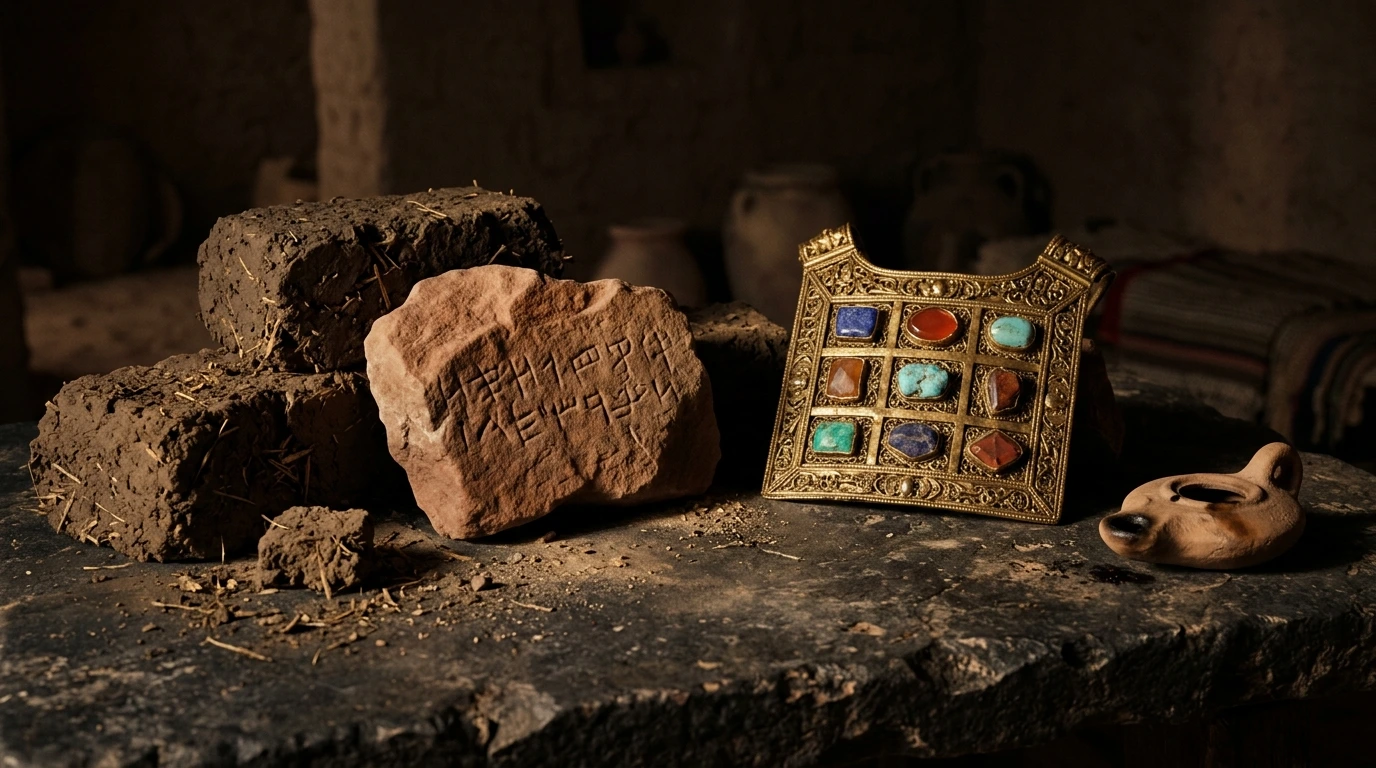
Historical Context: Rigorous examination of primary Hebrew, Aramaic, Greek, and Roman classical epigraphy.
Core Evidence: Forensic archaeology, radiocarbon data, and primary manuscripts validating biblical events.
Scholarly Consensus: Vetted against modern peer-reviewed publications in Near Eastern archaeology and biblical studies.
The Unvarnished Realism of the Patriarchal Family
When modern readers open the Book of Genesis, they often expect an idealized, pious portrait of saintly figures living in tranquil harmony. Instead, the patriarchal narrative delivers a shock of uncompromising, forensically raw realism.
The founding fathers of Israel were not stained-glass saints; they were deeply flawed men and women living in complex, fractured homes:
- Sibling Rivalry: Cain murders Abel in a fit of narcissistic jealousy (Gen 4); Jacob exploits Esau's starvation to buy his birthright (Gen 25); and ten brothers plot the murder of teenage Joseph, throwing him into an empty cistern and selling him into slavery (Gen 37).
- Deception and Betrayal: Abraham lies about Sarah being his sister out of cowardice (Gen 12, 20); Laban deceives Jacob on his wedding night by substituting Leah for Rachel (Gen 29); and Jacob's sons deceive their grieving father by dipping Joseph's ornate tunic in goat's blood (Gen 37:31–33).
- Parental Favoritism: Isaac loved Esau because he ate of his game, while Rebekah loved Jacob (Gen 25:28); and Jacob openly favored Joseph over his older brothers, sparking violent resentment.
Why did the Holy Spirit preserve these scandalous failures in sacred Scripture? Because the Bible is not an artificial myth designed to whitewash human pride. It is a forensic document of redemption proving that God does not build His kingdom with flawless human heroes; He works through broken families, transforming their moral failures into instruments of His sovereign, redeeming grace.
+----------------------------------------------------------------------------------------------------+
|               THE DYSFUNCTIONS AND REDEMPTIONS OF GENESIS HOMES                                    |
+--------------------------+---------------------------------+---------------------------------------+
| PATRIARCHAL HOUSEHOLD    | HUMAN DYSFUNCTION / SIN         | DIVINE REDEMPTIVE OUTCOME             |
+--------------------------+---------------------------------+---------------------------------------+
| Abraham & Sarah          | Impatience; taking Hagar to     | Covenant grace reaffirmed; Isaac born |
|                          | engineer their own promise      | by supernatural divine intervention   |
|                          |                                 |                                       |
| Isaac & Rebekah          | Destructive parental favoritism | Divine sovereign election overrides   |
|                          | dividing twin brothers          | human manipulation                    |
|                          |                                 |                                       |
| Jacob & His Wives        | Polygamous domestic rivalry;    | 12 sons preserved; transformed at     |
|                          | deceit of Laban and Jacob       | Peniel into the Tribes of Israel      |
|                          |                                 |                                       |
| Joseph & His Brothers    | Hatred, kidnapping, human       | Preservation of thousands from famine;|
|                          | trafficking into Egyptian chains| Genesis 50:20 reconciliation          |
+--------------------------+---------------------------------+---------------------------------------+
The Poison of Favoritism: From Isaac to Jacob
One of the most urgent warnings Genesis delivers to contemporary parents is the catastrophic consequence of parental favoritism.
In Genesis 25:28, the author summarizes the tragic division in Isaac's home in a single devastating sentence:
"Isaac loved Esau because he ate of his game, but Rebekah loved Jacob."
Instead of celebrating the unique spiritual gifts of their twin boys, each parent adopted a favorite. The devastating result was a home poisoned by manipulation:
- When Isaac sought to bless Esau secretly, Rebekah orchestrated an elaborate conspiracy, clothing Jacob in Esau's garments and covering his hands with goat skins to deceive her blind, dying husband.
- Jacob acquired the patriarchal blessing through deceit, but the emotional cost was catastrophic: he was forced to flee for his life, lived in exile for twenty years, and never saw his beloved mother alive again.
Tragically, Jacob failed to learn from his parents' error. When he had children, he repeated the identical sin, openly preferring Rachel's firstborn son Joseph above his ten older brothers and presenting him with a lavish royal tunic (k'tonet passim). The older brothers "hated him and could not speak peacefully to him" (Gen 37:4). Unaddressed generational dysfunction repeats itself until broken by intentional repentance and grace.
Wrestling with God at Peniel: Authentic Transformation
For anyone struggling with personal failure, guilt, or fear of the past, the story of Jacob at the Jabbok River (Genesis 32:22–32) is one of the most profound therapeutic and spiritual turning points in all literature.
Returning home after twenty years of exile in Paddan-Aram, Jacob learned that his estranged brother Esau was marching toward him with 400 armed men. Paralyzed with terror, Jacob sent his wives, children, and herds across the river, leaving him entirely alone in the pitch-black desert night.
There, an enigmatic Man—a divine Christophany—wrestled with Jacob until the break of dawn:
- The Crippling Touch: When the Man saw that Jacob held on stubbornly, He touched the socket of Jacob's hip, dislocating it. Jacob's self-reliant physical strength was broken; he could no longer fight or flee. All he could do was cling with desperate tears: "I will not let you go unless you bless me!" (Gen 32:26; Hosea 12:4).
- The Question of Identity: The Man asked: "What is your name?" Twenty years earlier, when Isaac had asked that exact question, Jacob had lied: "I am Esau your firstborn." Now, stripped of all masks, he confessed his true identity: "Jacob" (Ya'akov—the deceiver, the heel-catcher, the manipulator).
- The Bestowal of Grace: The Man declared: "Your name shall no longer be called Jacob, but Israel (Yisrael), for you have striven with God and with men, and have prevailed."
Jacob walked away limping into the sunrise. His limp was the permanent, physical badge of a transformed man who had learned that true blessing comes not from deceitful striving, but from broken, surrendered dependence upon God.
Joseph's Providence: "God Meant It for Good" (Gen 50:20)
The climax of the entire Book of Genesis occurs in chapter 50, following the death of Jacob in Egypt. Terrified that Joseph had only restrained his vengeance out of respect for their father, the ten brothers fell down before Joseph, weeping and pleading for mercy: "Behold, we are your servants!" (Gen 50:18).
Joseph's response is the summit of biblical ethics, anticipating the Sermon on the Mount by nearly two millennia:
"Do not fear, for am I in the place of God? As for you, you meant evil against me, but God meant it for good, to bring it about that many people should be kept alive, as they are today. So do not fear; I will provide for you and your little ones." (Genesis 50:19–21).
Joseph did not deny the reality of their sin: "You meant evil against me." He did not minimize the horror of their betrayal, the pit, the slavery, or the prison. But he looked through human malice to behold the sovereign hand of God: "God meant it for good."
This is the bedrock of Christian hope: God does not cause human sin, but His sovereign providence is so profound that He weaves even the malicious actions of wicked men into the tapestry of His redemptive victory (Romans 8:28).
4-Week Family & Small Group Curriculum: Healing Generational Wounds
Week 1: Breaking the Cycle of Favoritism (Isaac & Rebekah)
- Scripture: Genesis 25:19–34; 27:1–40.
- Core Question: How does subtle favoritism or comparison wound our children and create sibling rivalry?
- Discussion Prompts:
- Have you ever felt that a sibling, coworker, or classmate was favored over you? How did that affect your self-worth?
- How can parents celebrate the completely different personalities and giftings of each child without fostering jealousy?
- Action Step: Speak a specific, customized word of encouragement to each member of your family this week, praising character rather than achievement.
Week 2: Confronting Past Guilt and Fear (Jacob at the Jabbok)
- Scripture: Genesis 32:1–32.
- Core Question: What happens when we stop running from our past and allow God to confront our true character?
- Discussion Prompts:
- Jacob was terrified of facing Esau because of the guilt he had carried for twenty years. What unresolved conflict or past mistake causes you anxiety?
- God had to dislocate Jacob's hip to break his self-reliance. Has God ever used a painful trial or limitation in your life to teach you to depend on Him?
- Action Step: Spend 10 minutes in honest solitude confessing any hidden masks, compromises, or self-reliance to the Lord.
Week 3: Surviving Betrayal and Injustice (Joseph in Prison)
- Scripture: Genesis 37:12–36; 39:1–23.
- Guiding Thought: How do we maintain integrity and trust in God when we are treated unfairly?
- Discussion Prompts:
- Joseph was thrown into a pit by his own flesh and blood, then falsely accused by Potiphar's wife. Why did he not become bitter or renounce God?
- When Joseph was tempted by Potiphar's wife, he responded: "How then can I do this great wickedness and sin against God?" (Gen 39:9). How does loving God protect us from moral compromise?
- Action Step: Pray for someone who has treated you unjustly or betrayed your trust, releasing vengeance into God's hands.
Week 4: The Miracle of Radical Forgiveness (Joseph Reconciled)
- Scripture: Genesis 45:1–15; 50:15–21.
- Guiding Thought: How can we extend forgiveness when we hold the power to seek revenge?
- Discussion Prompts:
- Joseph held absolute power over his brothers' lives, yet he wept and kissed them. What made such supernatural forgiveness possible?
- How does believing Genesis 50:20 ("God meant it for good") help you view the painful chapters of your personal story?
- Action Step: Initiate a conversation of grace, an apology, or a letter of reconciliation with someone from whom you have been estranged.
Interactive Discussion Scenarios: Navigating Family Conflict
Scenario 1: The Will and the Inherited Resentment
- Case: An elderly father passes away. His will reveals that he left 75% of his substantial estate to the youngest son who stayed near home, while dividing the remaining 25% among three older siblings who moved away for careers. The older siblings are furious, accusing the younger brother of manipulation and threatening legal action.
- Biblical Parallel: Isaac's stolen blessing and Jacob's flight from Esau (Genesis 27).
- Discussion: How should the younger brother respond? What is the Christian duty when money threatens to destroy sibling bonds forever?
Scenario 2: The Slanderous False Accusation
- Case: A dedicated employee is falsely accused of misconduct by a jealous colleague whose advances were rejected. The employee is suspended without pay while an investigation occurs, enduring public shame and isolation.
- Biblical Parallel: Joseph and Potiphar's wife in Genesis 39.
- Discussion: How does a believer maintain faith and diligence when doing the right thing leads to immediate suffering rather than reward?
Three-Tier Evidentiary Evaluation: The Moral Reality of Genesis
+----------------------------------------------------------------------------------------------------+
|               THREE-TIER EVIDENTIARY EVALUATION OF MORAL NARRATIVES IN GENESIS                     |
+--------------------------+-----------------------+-------------------+-----------------------------+
| EVIDENTIARY PILLAR       | FORENSIC DATA POINT   | METHODOLOGICAL    | APOLOGETIC CONCLUSION       |
|                          |                       | ATTRIBUTION       |                             |
+--------------------------+-----------------------+-------------------+-----------------------------+
| 1. Criterion of          | Sins of patriarchs    | High Historical   | Proves the text was not     |
|    Embarrassment         | (deception, cowar-    | Authenticity      | invented to glorify royal   |
|                          | dice) exposed openly  |                   | or priestly bloodlines      |
|                          |                       |                   |                             |
| 2. Psychological &       | Complex family dyna-  | Human Behavioral  | Characters possess profound |
|    Sociological Depth    | mics, grief, jealousy | Reality           | literary and psychological  |
|                          | match human nature    |                   | depth impossible in myth    |
|                          |                       |                   |                             |
| 3. Theological Coherence | God works through     | Redemptive Logic  | Prepares the foundation for |
|    of Providence         | flawed individuals    | of Scripture      | grace and the gospel of the |
|                          | without endorsing sin |                   | cross across 66 books       |
+--------------------------+-----------------------+-------------------+-----------------------------+
Frequently Asked Questions
Did God approve of Jacob's deception of Isaac to get the blessing?
No. God had already sovereignly prophesied before the twins were born that "the older shall serve the younger" (Gen 25:23). God did not need Rebekah and Jacob's deceitful manipulation to fulfill His promise. Although God upheld His covenant through Jacob, Jacob suffered severe, lifelong consequences for his dishonesty: he was exiled from his home, suffered twenty years of deception under Laban, and was himself deceived by his own sons regarding Joseph.
Why did Judah offer himself as a substitute for Benjamin in Genesis 44?
Judah's impassioned plea in Genesis 44 is the ultimate evidence of moral transformation in Scripture. Twenty-two years earlier, Judah was the very brother who proposed selling Joseph into slavery for twenty shekels of silver (Gen 37:26–27). Now, seeing his aged father's life bound up in Benjamin's survival, Judah steps forward and offers to remain as a lifelong slave in Egypt in Benjamin's place so the boy can return to his father. This act of sacrificial substitution foreshadows the ultimate Lion of the Tribe of Judah—Jesus Christ—who substituted Himself for our sins.
How does Genesis 50:20 connect to Romans 8:28?
Genesis 50:20 ("You meant evil against me, but God meant it for good") is the Old Testament narrative equivalent of Romans 8:28 ("God works all things together for good to those who love Him"). Both passages teach that while God is never the author of evil, His sovereign wisdom is so boundless that He harnesses even the painful betrayals, tragedies, and injustices of human life to achieve ultimate redemptive good.
Frequently Asked Questions
Did God approve of Jacob's deception of Isaac to get the blessing?
No. God had already promised Jacob the blessing before birth; the deception was human sin that brought decades of exile, estrangement, and heartbreak upon Jacob.
Why did Judah offer himself as a substitute for Benjamin in Genesis 44?
Judah demonstrated radical repentance; having sold Joseph into slavery years earlier, he now offered his own life as a slave to spare Benjamin and his grieving father, foreshadowing Christ.
How does Genesis 50:20 connect to Romans 8:28?
Both verses teach that God’s sovereign providence orchestrates even the evil actions of men and personal tragedies into ultimate redemptive good for His people.
Related Research Dossiers
View all 120 articles →
Complete Interactive Study Guide: The Book of Exodus, Egyptian Plagues, and Tabernacle Bible Quiz (With Detailed Answers & Scripture References)

Small Group & Family Edition: The Book of Exodus and Tabernacle Bible Quiz (Deliverance, Law, and Wilderness Worship)